He Opened The Trunk And Found Three Children — They’d Been Traveling Like Cargo For A Month
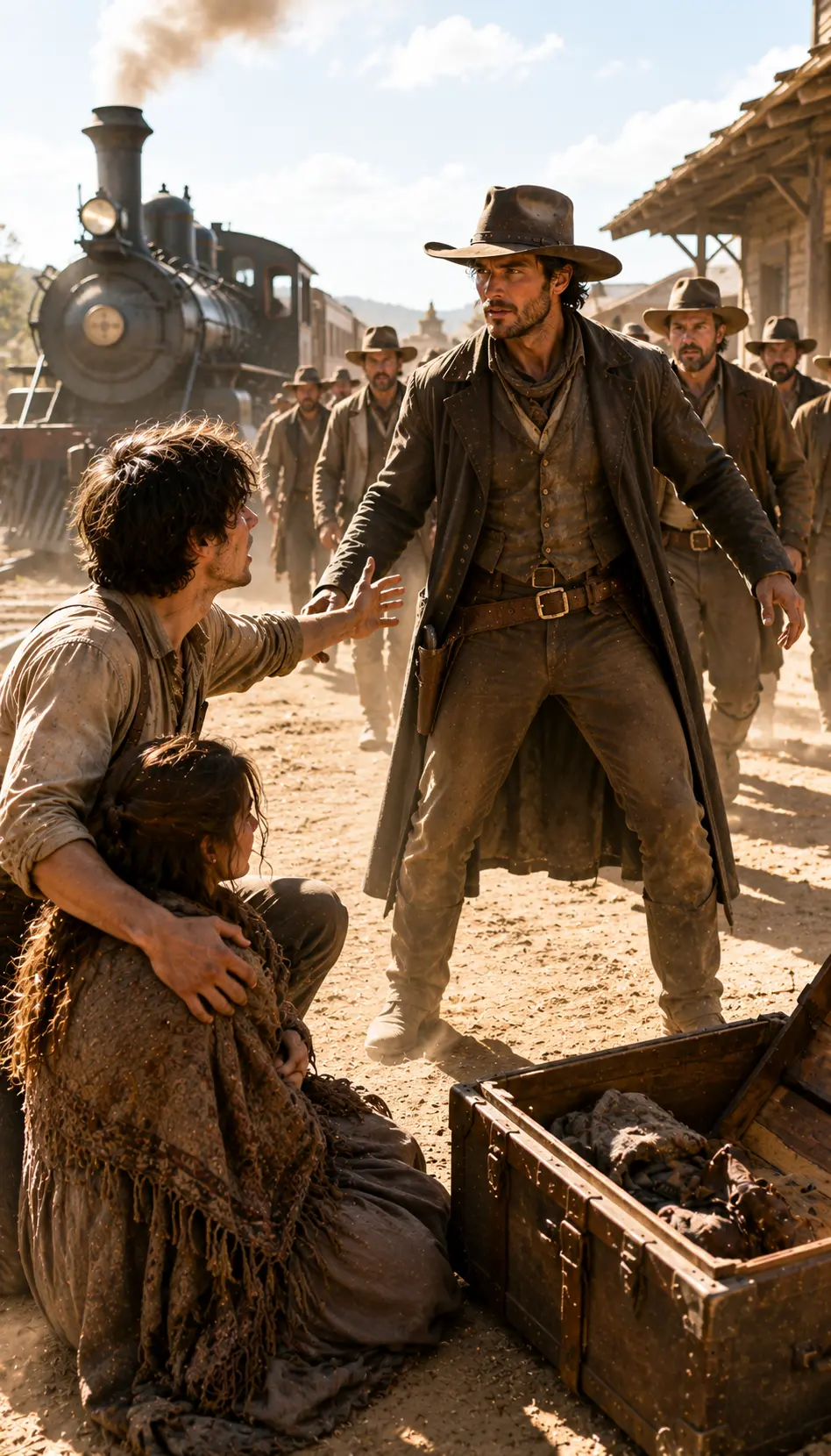
The trunk was not supposed to breathe.
Samuel Bridger knew freight better than most men knew their own families. For eleven years he had driven wagons across Wyoming Territory, through dust, snow, flooded crossings, empty plains, hostile weather, broken wheels, desperate towns, and roads that were only roads because enough unlucky men had passed that way before him.
He knew the sound of cargo.
Barrels rolled differently than crates. Iron shifted differently than sacks of flour. A load of tools had a hard, clattering weight. A load of books sat dead and quiet. Machinery groaned low. Furniture creaked high. Samuel could tell, just by the complaint of the axles and the pull on the team, whether a wagon was carrying grain, rifles, glass, whiskey, or something a man did not want talked about.
But this trunk was different.
It shifted.
Not with the harmless slide of goods over rough ground, but with a low, uneven movement that came and stopped, came and stopped, like something inside was trying not to be heard.
Like something alive had learned fear.
Samuel had picked up the load in Cheyenne three days earlier under a private contract paid in advance. The man who hired him wore a suit too clean for that part of the country and a smile too wide for the hour. He had a smooth way of speaking, the kind that made every word sound polished before it left his mouth.
“Deliver it to the rail depot in Laramie,” the man had said, sliding gold coins across the table. “Do not open it. Do not stop unless you have to. No questions.”
Samuel had spent enough years on the road to understand that “no questions” usually meant trouble.
But trouble paid well.
And freight drivers survived by minding their own business.
So he had taken the coins.
He had taken the trunk.
And for three days, he told himself that whatever was inside was not his concern.
Until the sound came again.
A soft thump.
Then a scrape.
Not the wind. Not rats. Not loose boards. Something deliberate. Something weak. Something trying to reach the world from the wrong side of a lid.
Now, twenty miles short of Laramie, Samuel stood in a canyon gulch under a dying sky and stared at the iron-banded trunk lashed to the bed of his wagon.
The canyon walls rose steep on either side, red stone darkening as evening drained the heat from the land. Shadows pooled between the rocks. His horses shifted in their harnesses, ears flicking back as if even they understood something was wrong. There was no town nearby, no ranch light, no rider on the ridge. Just Samuel, the wagon, the fading sun, and that sound.
He rested one hand on the revolver at his hip.
Then he took it away.
Whatever was inside that trunk had not chosen to be there.
Samuel climbed onto the wagon bed and pulled a crowbar from beneath a canvas tarp. The padlock was new, heavy, cold under his fingers. He wedged the iron tip beneath the latch, braced one boot against the wagon wheel, and leaned his weight into it.
Metal shrieked.
The lock held.
Samuel adjusted his grip and pulled harder.
The canyon seemed to hold its breath.
Then the lock snapped.
The trunk exhaled.
Not air.
A small, choked gasp.
Samuel froze.
For one long second he did not move. He stared at the lid while his heart slammed against his ribs. He had expected contraband. Stolen money. Weapons. Smuggled documents. Maybe liquor, maybe silver, maybe something that would get him arrested if he was caught with it.
He had not expected fear to make a sound.
Slowly, he lifted the lid.
The smell hit him first, sour and trapped, the smell of heat, sweat, panic, and too many hours without mercy. He turned his face away, breathing through his mouth, and forced himself to look.
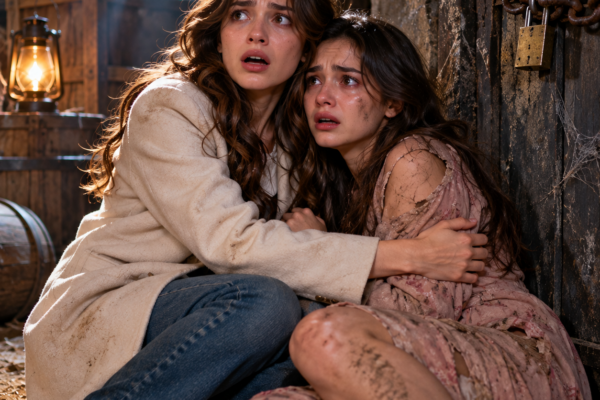
Three children stared back at him.
Two boys and a girl, huddled together in a space barely large enough for them to sit. The oldest boy could not have been more than ten. Dark hair. Dark eyes. A bruise shadowed one cheekbone. The girl was younger, maybe seven, holding the smallest boy against her side as if her arms were the only wall left between him and the world. The little one could not have been older than five. His lips were cracked. His eyes were too empty for a child.
None of them moved.
Samuel’s mouth opened.
No words came.
He had seen terrible things before. A man did not live through war and years of frontier roads without seeing things that stayed with him. But there was a special kind of wrong in children being packed into darkness and shipped across the country like cargo.
“Jesus,” he whispered.
The oldest boy flinched.
Not from anger.
From sound.
He pulled the other two closer, his stare locked on Samuel’s face with a kind of fierce, exhausted suspicion. Samuel recognized that look. He had seen it on soldiers younger than they should have been, boys who had learned too quickly that mercy was not something to count on.
He stepped back and held both hands where they could see them.
“I’m not going to hurt you.”
The children did not answer.
The girl tightened her arms around the little boy.
Samuel scanned the inside of the trunk. No water. No real food. A few hard crusts of bread. An empty tin cup. Burlap sacks lining the bottom. He did not let himself study the stains. There were some details a man could understand without staring.
“Can you stand?” he asked.
The oldest boy said nothing.
He just watched.
Samuel lowered the crowbar to the wagon bed and kept his voice slow.
“All right. I’ll help you out one at a time. We’ll go slow.”
He reached toward the girl, thinking she was smaller, weaker, easier to lift down.
The oldest boy blocked him with one thin arm.
Jaw set.
Eyes blazing with warning.
Samuel froze immediately.
“All right,” he said quietly. “You first, then.”
The boy hesitated. Then nodded once.
He climbed out with painful care. His legs shook when his feet touched the ground. He was barefoot. They all were. Around his ankles, the skin was rubbed raw in narrow rings.
Samuel’s stomach turned.
The girl came next, helping the smallest boy over the edge. The little one whimpered when his feet touched the earth and his knees buckled. Samuel caught him by instinct before he fell.
The child went rigid in his arms, eyes squeezed shut, breath trapped.
“Easy,” Samuel murmured. “Easy now.”
He set him down as gently as he could.
The girl immediately pulled the little boy close again, wrapping both arms around him.
The three of them stood in the dirt, staring at Samuel as if he were simply the next bad thing in a line that had not ended yet.
Samuel looked at the trunk.
Then at the road ahead.
Then back at the children.
His instructions had been clear.
Deliver the trunk to Laramie.
Do not open it.
Do not ask questions.
But he had opened it.
And now he knew.
The sun slipped behind the canyon rim. Darkness thickened in the gulch. Somewhere beyond the rocks, a coyote called. The horses shifted again, restless in the traces.
Samuel crouched to bring himself closer to their height, though not too close.
“I need to know who put you in there.”
The oldest boy’s jaw tightened.
He shook his head once.
Sharp. Final.
“All right,” Samuel said. “Then I need to know where you’re from.”
Again, nothing.
The girl whispered something to the little boy too softly for Samuel to hear. The boy pressed his face into her shoulder.
Samuel stood and rubbed both hands over his face.
His mind was already moving through the dangers.
If he delivered them to Laramie, whoever waited there would take them back.
If he failed to deliver them, the man in Cheyenne would come looking.
If he ran with them, he would be hunted by morning.
But if he did nothing, if he closed that lid again and kept driving, then whatever happened next would be on him forever.
He had spent too many years telling himself that survival meant not getting involved.
But there are moments when not getting involved is just another name for cowardice.
He looked at the children again, at the way they clung to each other like the whole world had ended and the only thing left was their little circle of fear.
“You’re not going back in that trunk,” he said.
The oldest boy’s expression barely changed.
But something flickered in his eyes.
Maybe hope.
Maybe the memory of it.
Samuel turned to the wagon, pulled a canteen from beneath the seat, and held it out to the girl.
She took it with both hands, but did not drink. She simply stared at him.
“Go ahead,” he said.
She lifted it first to the youngest boy’s lips. He drank in desperate gulps, water spilling down his chin. Then she handed it to the oldest boy. Only after both boys had drunk did she allow herself to drink.
Samuel watched, jaw clenched so tight it hurt.
He did not know their names. He did not know where they had come from, who they had been, or who was waiting to claim them at the end of the line. But he knew what happened to children moved in secret. He had heard the whispers at rail depots and freight yards. He had heard men joke in low voices about “extra hands” for mines, ranches, mills, and places where questions went to die.
The West was full of wide-open land.
It was also full of places where a child could vanish.
Samuel built a small fire against the shelter of the canyon wall, far enough from the road that the light would not carry. He wrapped the children in horse blankets. They sat close to the flames, silent and watchful. The youngest finally stopped shaking.
Samuel opened a tin of beans, warmed it over the fire, and handed it to them with a spoon.
They ate slowly.
Too slowly.
Like their stomachs had forgotten how to trust food.
He did not rush them.
He sat on the opposite side of the fire and waited.
When the tin was empty, the oldest boy set it down.
Then, for the first time, he spoke.
“You’re going to sell us.”
His voice was hoarse, worn thin, and flat in the way only a child’s voice becomes when childhood has been taken too far away.
It was not a question.
It was a fact as far as he knew.
Samuel met his eyes across the flames.
“No.”
“Everyone sells us.”
“I’m not everyone.”
The boy’s face did not change.
He did not believe it.
He could not afford to.
“What’s your name?” Samuel asked.
The boy hesitated.
“Thomas.”
“I’m Samuel.”
Samuel looked at the girl.
“And you?”
She glanced at Thomas first. He gave the smallest nod.
“Grace,” she whispered.
“And him?”
The smallest boy stared into the fire as if the flames were telling him something no one else could hear.
“Peter,” Grace said. “He doesn’t talk much anymore.”
Samuel’s throat tightened.
He did not ask why.
Some questions only make wounds bleed again.
“Where are you from?”
Thomas’s answer was immediate.
“Doesn’t matter.”
“It does if I’m going to help you.”
“You can’t help us.”
“I can try.”
Thomas gave a bitter little laugh that sounded too old for him.
“You don’t know what you’re getting into.”
“Then tell me.”
For a long moment, Thomas only stared at him.
Then he pulled down the collar of his shirt enough to show a small, deliberate mark burned near his collarbone.
The letter M.
Samuel’s blood went cold.
He had heard stories.
Most men had.
Whispers in saloons, freight depots, rail stations. Children taken from cities, sold under false papers, renamed, marked, moved from wagon to train to wagon again. Some sent to mines. Some to isolated ranches. Some to factories where nobody asked why the workers were so small. Some simply disappeared.
“Mercer,” Samuel said quietly.
Thomas’s eyes sharpened.
“You know him.”
“I know of him.”
Samuel’s voice hardened.
“Jacob Mercer runs a labor syndicate out of Cheyenne. Uses the rail lines to move…” He stopped and glanced at Grace and Peter. “To move people.”
Thomas’s face became stone.
“We were in a house in Kansas City,” he said. “Then a train. Then a wagon. Then another wagon. Then the trunk. We don’t know where they were taking us.”
He paused.
“But we know what happens when we get there.”
Grace lowered her eyes.
Peter pressed closer to her.
Samuel leaned back and stared into the fire.
Mercer was not just a man. He was a machine. Money. Contacts. False documents. Men paid to look away. Men paid to hurt anyone who did not. If Samuel failed to deliver the trunk, Mercer would send riders. If those riders found the trunk empty, they would track him. If they found the children, they would take them.
And if Samuel handed the children back, he would spend the rest of his life hearing that small gasp when the trunk opened.
Grace’s voice broke the silence.
“Are you going to take us back?”
Samuel looked at her.
At the fear in her eyes.
At the way her fingers held Peter’s hand like letting go would mean losing him forever.
“No.”
Thomas leaned forward.
“Then what are you going to do?”
Samuel did not answer right away.
He stood and walked to the edge of the firelight, staring into the dark canyon. The wind moved between the rocks. Somewhere beyond the gulch, the rails ran west. Somewhere beyond those rails, Jacob Mercer waited.
Samuel had spent eleven years moving freight. Eleven years keeping his head down. Eleven years telling himself that questions were bad for business and worse for a man’s health. Before that, he had survived the war by learning when to fight and when to walk away.
He had built a quiet life afterward.
No wife. No children. No home that could burn down with his heart inside it.
A wagon, a team, a contract, a road.
Simple.
Safe.
Empty.
But now three children were sitting by his fire after being locked in a box for a month, and the truth stood plain before him.
You cannot drive past suffering and call yourself decent.
You cannot close the lid and keep going.
He turned back.
“I’m taking you somewhere safe.”
Thomas shook his head.
“There’s nowhere safe from Mercer.”
“There’s a mission outside Laramie. A woman named Abigail Cross runs it. She takes in people who need help. No questions.”
Thomas narrowed his eyes.
“And Mercer won’t find out?”
“Not if we’re careful.”
“You’re risking your life for us. Why?”
Samuel crouched down in front of him.
“Because someone should have done it a long time ago.”
For the first time, Thomas’s mask cracked.
Only for a heartbeat.
Then it hardened again.
“They’ll kill you.”
“Maybe,” Samuel said. “But I’m not handing you back.”
Grace whispered, “Thank you.”
Samuel nodded once.
He did not trust himself to speak.
They sat in silence while the fire burned low. Peter fell asleep against Grace’s shoulder, his small chest rising and falling in shallow breaths. Thomas stayed awake, eyes fixed on some place inside himself that Samuel could not reach.
Samuel stood watch through the night.
Every sound made his hand drift toward his gun.
By dawn, his choice had become action.
He woke the children gently, gave them water and the last of his dried meat. Then he walked to the trunk, still open in the wagon bed, and stared at it.
That box had carried fear across half a territory.
It would carry nothing else.
Samuel dragged it to the edge of the canyon and shoved it over.
It tumbled down the rocks, cracking, splintering, breaking apart against the stones below.
When it came to rest in the dry creek bed, it lay open, empty, ruined.
Thomas watched from beside the ashes of the fire.
Samuel turned to him.
“We leave the wagon. Take the horses. Travel light.”
“They’ll track us.”
“Let them try.”
They rode out just after sunrise.
The canyon rocks glowed gold behind them, and the broken trunk lay in shadow like a grave for the life the children were not going back to.
Samuel kept away from the main road. He led them through dry washes, narrow deer trails, old freight cuts, and gullies where wagon wheels could not follow. The horses picked carefully over loose stone. The children held on without complaint.
Peter had stopped whimpering.
Grace watched the horizon like she expected it to swallow them.
Thomas rode with Samuel, rigid and silent, scanning every ridge like a soldier.
By midday they reached a stand of cottonwoods near a creek bed. Samuel called a halt, let the horses drink, and rationed what food remained.
The children ate without joy.
Food was not comfort yet.
Food was survival.
Samuel knelt by the creek, splashing water on his face, when Thomas spoke behind him.
“Someone’s following us.”
Samuel froze.
“You see them?”
“No.”
“Then how do you know?”
Thomas stared toward the scrubland behind them.
“I can feel it.”
Samuel stood slowly.
There was nothing visible. Only grass moving in the wind. A hawk circling high above. Empty land in every direction.
But Thomas had stayed alive this long for a reason.
Samuel did not ignore him.
“How long?”
“Since the canyon.”
Samuel cursed under his breath.
He had hoped for more time. Hoped Mercer’s men would not notice the missing trunk until they reached Laramie. But hope was a luxury best left to people who were not being hunted.
“We keep moving,” he said. “Stay close. Stay quiet.”
They mounted again and pushed deeper into rough country.
The land rose into red rock and sage, with mesas like broken teeth against the sky. Samuel’s mind worked through every possibility. If Mercer’s men were tracking them, they would have guns, horses, and no intention of leaving witnesses. A freight driver with three exhausted children would not survive open ground.
But Samuel knew this country.
There were places a man could disappear if he knew where to look.
By late afternoon, they reached an old line shack tucked into a hollow between two ridges. Samuel had used it once during a winter storm years earlier. The roof sagged but still held. The walls were rough, but solid enough to stop the wind. Not much of a shelter.
But enough.
He led the horses into the lean-to behind the shack and ushered the children inside. Grace carried Peter, who had gone limp with exhaustion. Thomas moved like a ghost, silent and watchful.
Samuel barred the door, checked the gaps between the boards, then pulled his rifle from the saddle.
“We wait here until dark,” he said. “Then we move again.”
Thomas crouched near the far wall.
“They’ll find us.”
“Not if we’re careful.”
“You don’t know these men.”
“I know enough.”
“No,” Thomas said, shaking his head. “You don’t. They don’t stop. They don’t care who gets hurt. We watched them hurt a man in Kansas City because he tried to help us.”
Grace’s arms tightened around Peter.
Samuel’s grip on the rifle hardened.
“That won’t happen here.”
“You can’t promise that.”
“I just did.”
For a moment, Thomas stared at him.
Then he looked away.
“You should leave us. Take your horse and go. They’re not after you.”
“I’m not leaving.”
“You’ll die for nothing.”
Samuel crouched in front of him.
“If I walk away, that’s dying for nothing.”
Thomas’s face twisted.
Something raw and desperate broke through.
“Why do you care?”
Samuel thought about the war. About boys younger than they should have been, bleeding in fields far from home. About the ones he had dragged to safety and the ones he had not. About all the times he had kept breathing by telling himself that one man could not save everyone.
“Because someone has to,” he said.
Before Thomas could answer, hoofbeats echoed through the hollow.
Samuel moved to the window.
Three riders came slowly through the brush, dusters hanging loose, rifles across their saddles. One dismounted and crouched to study the dirt.
Tracking.
Samuel motioned for silence.
The children pressed back against the wall. Peter buried his face in Grace’s shoulder. Thomas’s breathing went shallow, but he made no sound.
The riders circled the hollow.
One pointed toward the shack.
Samuel checked the rifle.
Six rounds.
Then his revolver.
Five.
Eleven bullets.
Three men.
It could work.
It had to.
The lead rider stopped twenty yards from the shack.
“We know you’re in there,” he called. His voice was flat, businesslike. “We’re here for the cargo. Hand them over and you walk away.”
Samuel did not answer.
“Don’t make this hard. You’re just the driver. This isn’t your fight.”
Thomas whispered, “Let us go out. Maybe they’ll—”
“No,” Samuel said.
The rider sighed and gestured to the others. They dismounted, spreading out, rifles raised.
Samuel aimed through a crack in the wall.
His finger settled near the trigger.
The lead rider took one step forward.
Then a woman’s voice cut through the hollow.
“That’s far enough.”
Everyone froze.
A tall, gray-haired woman stepped out from behind the ridge, a shotgun leveled at the riders. She wore range clothes, boots dusty, face weathered, eyes hard as flint.
Samuel breathed out.
“Abigail.”
The lead rider turned slowly.
“This isn’t your business, ma’am.”
Abigail Cross did not blink.
“Children are always my business. And you’re on my land.”
“We have a contract.”
“I don’t care what paper a cruel man paid for.”
She cocked the shotgun.
“Ride.”
The riders exchanged glances.
The odds had shifted.
The lead rider’s jaw tightened.
“Mercer won’t let this go.”
“Then Mercer can come speak to me himself.”
The hollow went silent.
Then the lead rider lowered his rifle, nodded to the others, and mounted. They rode out slowly, but before they disappeared over the ridge, the leader looked back once.
Samuel saw the promise in his eyes.
This was not over.
Abigail Cross’s mission sat three miles west of Laramie, tucked into a valley where the worst of the wind could not reach. It was a simple building, wood frame and stone foundation, with a bell tower that had not held a bell in years. But the windows glowed warm in the dusk, and smoke curled from the chimney.
When Samuel led the children inside, the smell of bread wrapped around them like a promise.
A dozen faces turned from the long table.
Children mostly. Some toddlers, some teenagers, some with the same haunted watchfulness as Thomas, Grace, and Peter. Others had begun to heal. There was laughter in a few eyes. Not much, but enough to prove it could return.
Abigail closed the door and set the shotgun by the wall.
“You three look like you could use a meal,” she said gently.
Grace and Peter froze in the doorway.
Thomas’s hand drifted to his sister’s shoulder, ready to pull her back if danger appeared.
“It’s all right,” Samuel said quietly. “You’re safe here.”
A girl about Grace’s age approached slowly, holding out a rag doll.
“You can sit by me.”
Grace looked up at Thomas.
He hesitated.
Then nodded.
She took Peter’s hand and followed the girl to the table.
Abigail ladled stew into bowls thick with vegetables and meat. Steam rose into the lamplight. The children ate slowly at first, then faster, as if they were afraid the bowls might vanish.
Peter’s eyes filled with tears as he chewed.
Grace stroked his hair and whispered to him.
Samuel stood near the door, watching, his chest painfully tight.
Abigail joined him, wiping her hands on her apron.
“You did a good thing, Samuel.”
“I opened a trunk.”
“You opened your eyes. Plenty of men don’t.”
He looked at her.
“The men who came after us won’t stop.”
“I know.”
“Mercer has money. Reach. Friends.”
“I know that too.”
“He’ll come for them.”
Abigail looked toward the table where the children were eating.
“Then he’ll have to come through me.”
Samuel lowered his voice.
“I can take them farther.”
“There is no farther,” Abigail said. “This fight was always coming. You only brought it to my door sooner.”
“I’m sorry.”
“Don’t be.”
She smiled faintly.
“I’ve been waiting for this fight a long time.”
Later that night, after the children had been bathed and given clean clothes, Samuel sat on the porch with Thomas. The boy refused to sleep. Too alert. Too used to staying awake while others rested.
Stars opened above the valley.
Inside, someone played a harmonica softly, a slow melody that sounded almost like a lullaby.
“Grace cried tonight,” Thomas said.
Samuel did not know what to say.
“First time in weeks,” Thomas continued. “I thought she forgot how.”
His voice was distant.
“We all did. You shut it off. Because if you feel it, it breaks you.”
“You’re not broken,” Samuel said.
Thomas laughed, hollow and bitter.
“You don’t know that.”
“I know you kept your brother and sister alive.”
Thomas looked down at his hands.
“I wanted to give up.”
“But you didn’t.”
“Because Peter needed me. Grace needed me.”
“That counts.”
Thomas wiped his eyes roughly, angry that tears had dared appear.
“Peter used to sing all the time. Drove me crazy.”
A ghost of a smile crossed his face.
“Now he barely talks. Grace used to laugh at everything. Now she just waits for the next bad thing.”
He looked at Samuel.
“How do you fix that?”
Samuel leaned back against the porch post.
“I don’t know,” he admitted. “But maybe you start by giving them enough safe days in a row that they begin to believe one might follow another.”
Thomas absorbed that.
Then, quietly, he said:
“My real name isn’t Thomas.”
Samuel turned.
“It’s Jonathan. Jonathan Clark. Grace is Elizabeth. Peter is just Peter.”
He swallowed.
“They made us change our names. Said it was easier.”
Samuel’s throat tightened.
“I’m glad you told me.”
“I haven’t said my real name out loud in eight months. Felt like if I did, something bad would happen. Or like I’d forget who I was before.”
“You didn’t forget.”
“Almost did.”
They sat in silence.
“What happens now?” Jonathan asked.
“Now you rest.”
“I don’t think I remember how.”
“Then you learn again.”
Jonathan looked at him, eyes shining in the starlight.
“You’re not going to leave, are you?”
“Not until I know you’re safe.”
“What if that takes a long time?”
Samuel smiled faintly.
“Then it takes a long time.”
Jonathan nodded.
Then, almost shyly, he said:
“Thank you for not driving past us.”
Samuel’s chest ached.
“You don’t have to thank me.”
“Yes,” Jonathan said quietly. “I do.”
Mercer came three days later.
He did not come with guns raised.
He came with papers.
A polished black carriage rolled into the mission yard just after dawn, drawn by a matched pair of horses. Jacob Mercer stepped out in a gray suit, silver-haired, clean-shaven, smiling like a politician at a church picnic. Two men flanked him, hands near their holsters.
Abigail met him at the gate with her shotgun resting in her arms.
“Mrs. Cross,” Mercer said pleasantly, tipping his hat. “I believe you have something that belongs to me.”
“I have children who were being transported in a locked trunk,” Abigail said. “Children do not belong to anyone.”
Mercer’s smile did not falter.
“A misunderstanding. These children were being relocated to families who agreed to take them in. Legal contracts. Proper signatures.”
He produced a leather folder.
“I have the paperwork.”
“I don’t care about your paperwork.”
“The law does.”
Samuel stepped out of the mission house with his rifle.
“Not when the paper is covering a crime.”
Mercer’s eyes flicked to him.
Recognition dawned.
“Ah. The driver. You broke our contract, Mr. Bridger.”
“You put children in a trunk.”
Mercer’s smile vanished.
“Careful. Accusations like that can ruin a man.”
“Truth isn’t an accusation.”
The gunmen shifted.
Abigail raised the shotgun slightly.
The air tightened.
“I do not want trouble,” Mercer said, though his eyes said otherwise. “But I will have those children one way or another.”
“No,” Abigail said. “You won’t.”
“You have no legal standing.”
“And you have no soul.”
Her voice cut clean through the morning.
“You can wave papers, threaten lawyers, and pay as many men as you want. But you are not taking those children from this place.”
For the first time, Mercer’s mask cracked.
Only a little.
But enough.
“You are making a mistake.”
“I’ve made plenty,” Abigail said. “This is not one of them.”
Mercer turned to Samuel.
“You cost me a significant investment.”
Samuel held his gaze.
“Send me a bill.”
Mercer’s smile returned, thin and cold.
“Oh, I will.”
He climbed back into his carriage. As it rolled away, he looked back once.
Samuel understood the look.
The fight had only changed shape.
Two weeks later, a U.S. marshal arrived from Denver. His name was Garrett, a stern-faced man with a careful eye and no patience for charm. He had come after an anonymous letter detailed Mercer’s operation: names, dates, routes, depots, contacts.
Samuel never found out who sent it.
He had suspicions.
Marshal Garrett interviewed the children gently, documented the marks, traced the routes, questioned freight men, depot clerks, and railroad agents. Within a month, Jacob Mercer was arrested in Cheyenne. His network began to collapse. Arrests followed in several states.
It was not enough.
It could never be enough.
Too many children had already vanished into places no one could find.
But it was something.
And something mattered.
Jonathan, Elizabeth, and Peter stayed at the mission through the winter.
Slowly, in uneven pieces, they began to heal.
Peter started speaking again. One word at first. Then two. Then a whole sentence whispered to Elizabeth at breakfast. The first time he laughed, everyone in the room went quiet, not because it was strange, but because it was beautiful.
Elizabeth laughed one morning at a joke another child told, and the sound was so bright it made Samuel turn away for a moment.
Jonathan stopped watching the door every time someone entered.
Not always.
But sometimes.
And sometimes was the beginning of enough.
In spring, a letter arrived.
Their mother’s sister had been searching for them for a year. She had traced them to Kansas City, then lost the trail. When news of Mercer’s arrest spread, she hired a lawyer, followed the evidence, and finally found them.
She came in April.
A small woman with kind eyes, calloused hands, and a face that looked as if grief had aged it ten years.
When she saw the children, she wept.
They stood frozen at first.
Cautious.
Unsure whether joy could be trusted.
Then Peter ran to her.
Elizabeth followed.
Jonathan held back the longest.
Then he broke too.
Samuel watched from the porch as the family folded back into itself, not perfectly, not easily, but truly.
Before they left, the aunt came to Samuel with tears in her eyes.
“I don’t know how to thank you.”
“You don’t have to.”
“They told me what you did. Opening that trunk. Risking everything.”
Samuel shook his head.
“They survived. I only gave them a chance.”
“That is more than most would have done.”
Jonathan approached, eyes clearer than the day Samuel found him.
“You staying here?” he asked.
“For a while,” Samuel said. “Abigail needs help. And I’m not in a hurry to go back to freight driving.”
Jonathan smiled.
Small.
Real.
“Good.”
He held out a hand.
Samuel shook it, then pulled the boy into a brief, tight hug.
“Take care of them,” Samuel said.
“I will.”
Samuel watched the wagon carry them toward a future they had almost been denied. He stood there long after they disappeared over the ridge.
Abigail joined him, wiping flour from her hands.
“You did good, Samuel.”
“We all did.”
“What now?”
Samuel looked at the mission, at the children playing in the yard, at the garden beginning to bloom, at the empty bell tower catching the late sun.
“I think I’ll stay a while longer.”
Abigail smiled.
“Good. I could use the help.”
Years later, when people asked Samuel Bridger about the story, he never told it all.
He would only say he opened a trunk once and found something worth saving.
But on quiet nights, when the wind moved through the valley and the mission windows glowed warm against the dark, he remembered everything.
The strange groan of the wagon axle.
The scrape inside the wood.
The snapped lock.
The first breath from the trunk.
Three children staring up at him as if mercy was a language they had forgotten.
He remembered the moment he chose not to look away.
A small act, some might say.
Opening a lock.
Lifting a lid.
Giving water.
Refusing to keep driving.
But sometimes the world changes exactly that way.
Not with armies.
Not with speeches.
Not with grand men making grand promises.
Sometimes it changes because one tired freight driver hears a sound he could have ignored and decides that silence is no longer enough.
The mission still stands.
Weathered now.
Repaired many times.
The bell tower has a bell again, and it rings every Sunday.
And those who know the story say that if you stand in the yard when the evening wind comes down from the hills, you can almost hear the echo of children laughing.
Not because the world was kind.
But because someone opened the trunk.
And refused to close it again.