Lone Rancher Wanted an Empty Marriage — But One Evening Changed Everything
Katherine Williams had exactly three dollars, one worn leather bag, and a stepfather who had already decided the shape of her future without asking whether she wanted to live inside it.
She stood in the narrow hallway of a San Antonio boarding house with a folded newspaper in her hand, gripping it so tightly the cheap paper cut little half-moons into her fingers. The ceiling fan turned slowly above her, pushing warm air from one side of the hall to the other without cooling anything. Downstairs, someone laughed too loudly. A door opened. A kettle whistled. The city outside kept moving like it had no idea a woman was standing upstairs with her whole life balanced on four printed lines.
The advertisement was small.
Almost easy to miss.
It sat between a notice for cattle feed and a reward for a lost horse, plain and unadorned, without a single romantic word.
Rancher in southwest Texas seeks capable woman for practical arrangement. No romance expected. Respond to B. Lawrence, Dusty Flats.
That was all.
No poetry.
No promise of affection.
No talk of moonlight, courtship, devotion, or a fine home with lace curtains.
Just a man somewhere beyond the life she knew, asking for someone capable.
For reasons Katherine could not explain, those four lines felt more honest than anything Garrett Howell had ever said to her.
Garrett smiled with his whole face, but never with his eyes. He had clean boots, a good coat, a father who knew important people, and the kind of charm that made older women say he would make a fine husband because they did not have to sit across from him at supper and feel weighed, measured, and silently priced.
Katherine had met him twice.
Both times, he looked at her the way a man looks at land he is deciding whether to buy.
Her stepfather called him a fine prospect.
Her mother, tired from years of trying to keep peace in a house that no longer belonged to her, said almost nothing.
Katherine knew what silence meant in that house. It meant the decision had already been made and everyone was waiting for her to stop resisting it.
She folded the newspaper again, slipped it into her bag, and sat on the edge of her cot. The room was barely larger than a pantry. A narrow bed, a washstand, a chair, one small window that looked over the alley behind the boarding house. She had lived there two years, long enough to know every crack in the plaster and every argument that traveled through the walls.
Outside, San Antonio breathed and rattled and sang. Wagons rolled over stone. Vendors called. Children shouted. Somewhere nearby, someone was frying peppers and onions, and the smell made her chest ache because it reminded her of ordinary mornings, back when ordinary still seemed possible.
She took out a sheet of paper.
Her hand trembled only once.
Then she wrote back.
Three weeks later, Katherine stepped off a train in a town so small it seemed surprised to have a station.
Dusty Flats, Texas.
One road.
A general store.
A trough with a cracked side.
A feed sign hanging crooked in front of a building that had lost most of its paint.
Wind.
Dust.
Silence.
And at the far end of the platform, a man leaning against a post with his arms crossed and his hat pulled low over his brow.
Billy Lawrence was not what she had imagined.
She had pictured someone older, perhaps heavy in the shoulders, with a kind face worn down by work and disappointment. A man who might speak little because his life had not given him much worth saying.
Billy was tall and angular, built like someone who had never wasted a movement in his life. His shirt was clean but sun-faded. His jaw was rough with a day’s stubble. His face was not unfriendly exactly, but it was closed, like a gate built for weather and never opened unless necessary.
He did not wave when he saw her.
He did not smile.
He watched her walk toward him with a stillness that made her slow down without meaning to.
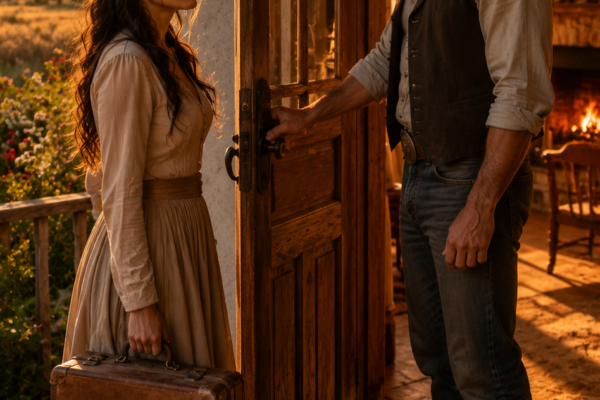
When she reached him, he looked at her face, then at the worn leather bag in her hand.
“You pack light,” he said.
She waited.
He added, “Good.”
That was his greeting.
Then he turned and walked toward a dusty wagon as if the conversation had ended.
Katherine stood there for one full second, looking at his back.
Then she picked up her bag and followed.
She had come too far to be discouraged by a man who did not know how to say hello.
The ride from the station to the Broken Spur Ranch took forty minutes, and Billy Lawrence said eleven words the entire time.
Katherine counted.
She had nothing else to do.
The land stretched around them in every direction, flat and dry and burnt gold beneath the afternoon sun. Mesquite trees appeared in scattered clusters like stubborn thoughts. Low hills sat on the horizon, blue with distance. The wind moved through the grass in long, slow waves, and the sky seemed too large, almost rude in its openness.
It was nothing like San Antonio.
San Antonio had noise. Neighbors. Church bells. Laundry lines. Children running in alleys. The smell of tamales in the morning from a cart near Calle Dorado. San Antonio could be lonely, yes, but it never let a person forget other people existed.
This place had wind.
This place had space.
This place had a man beside her who drove the wagon with the focused expression of someone completing a duty he intended to survive.
When they were about a mile from the ranch, Billy finally spoke without looking at her.
“I’ll say this once so we’re clear. You run the house. I run the land. What’s mine stays mine. What’s yours stays yours. We don’t get in each other’s way.”
Katherine kept her eyes on the road ahead.
“Understood.”
He nodded once, as if that settled everything.
Maybe for him it did.
The Broken Spur Ranch came into view slowly, first as a roofline, then as a house, then as a life she had agreed to enter before she understood its shape. It was modest but solid, with a covered porch running across the front, a barn to the left, a fenced pasture to the right, and dust gathered at the base of everything like the land was trying to reclaim it.
It was not beautiful.
But it was real.
And real, for Katherine, was enough.
They were married that same afternoon.
The town clerk’s office smelled of cedar, old paper, and heat trapped in closed drawers. Two men from the feed store served as witnesses. They shook Billy’s hand, nodded at Katherine, and returned to work within five minutes. The ceremony lasted less time than it had taken her to pin her hair that morning.
There were no flowers.
No music.
No tender moment where Billy looked at her like a man grateful for the woman beside him.
He signed the paper.
She signed the paper.
The clerk stamped it and wished them well in the flat tone of a man who had said the words too often to mean them.
On the ride back to the ranch, the sun sat lower in the sky, and the wind pushed dust across the road in slow, curling waves. Katherine held her bag in her lap and looked straight ahead.
She had known this would not be romantic.
She had told herself that a hundred times on the train.
But there was something about the finality of the stamped paper that sat heavy in her chest. It made everything real in a way the letter had not. She was no longer simply running away from Garrett Howell or her stepfather’s plans.
She was Billy Lawrence’s wife.
And Billy Lawrence had not yet looked at her long enough to learn the color of her eyes.
At the ranch, he showed her to her room without ceremony, pointed out where extra blankets were kept, and closed the door behind him. She stood alone in the small clean space and listened to his boots move down the hall, down the stairs, and out through the back door.
The house went quiet.
Katherine sat on the edge of the bed, put her face in her hands, and allowed herself exactly one minute to feel everything.
Fear.
Relief.
Humiliation.
Exhaustion.
A grief she did not yet know how to name.
Then she straightened, unpacked her bag, and went to find the kitchen.
The first two weeks at the Broken Spur were not hard.
They were just quiet in a way that had weight.
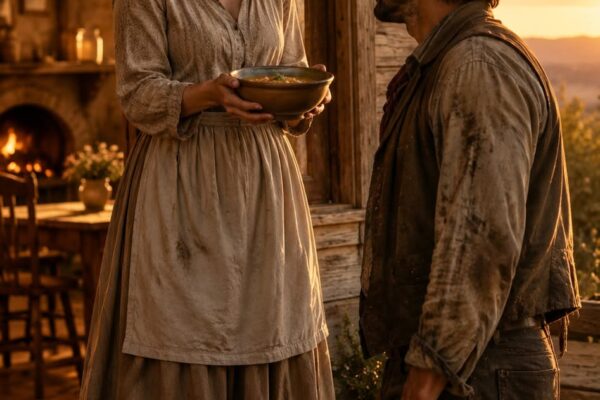
Katherine learned the rhythm of the ranch the way one learns a song through a wall, slowly, in pieces, without anyone teaching directly. Billy rose before dawn every morning. By the time she came downstairs, his coffee cup was already rinsed and turned upside down on the counter. The back door would be open, and he would be somewhere out on the land, doing whatever needed doing before the heat became cruel.
She cooked.
She cleaned.
She repaired two curtains that had been hanging torn for what looked like years.
She found a stack of unopened supply invoices on the kitchen shelf and organized them by date without being asked. The house was not dirty, but it had the feeling of a place maintained by a man alone: functional, orderly, and missing the small touches that make a room feel willing to hold a life.
Katherine added those things back quietly.
A cloth folded properly beneath the bread.
A jar of wildflowers on the table.
The curtains washed.
The lamps trimmed before dusk.
The pantry counted.
A cracked bowl moved from the best shelf to the work shelf.
She did not announce these changes.
She did not ask for praise.
Billy never commented.
But she noticed that he stopped eating supper standing at the counter and began sitting at the table.
That felt, in its own small way, like progress.
What Katherine noticed most about Billy Lawrence was what he never did.
He never raised his voice. Not once. Not even when a ranch hand made a mistake that cost him half a day’s work.
He never left a mess for her to deal with.
He never came inside with muddy boots if he could help it.
Every morning, without fail, she found a fresh basin of water outside her bedroom door. He set it there before she woke and never mentioned it. She never asked. It was simply there.
That was how Billy spoke.
Not in declarations.
In handled things.
In fixed things.
In water carried before dawn.
It was not warmth exactly.
But it was not coldness either.
It was something in between, something she did not yet have a name for.
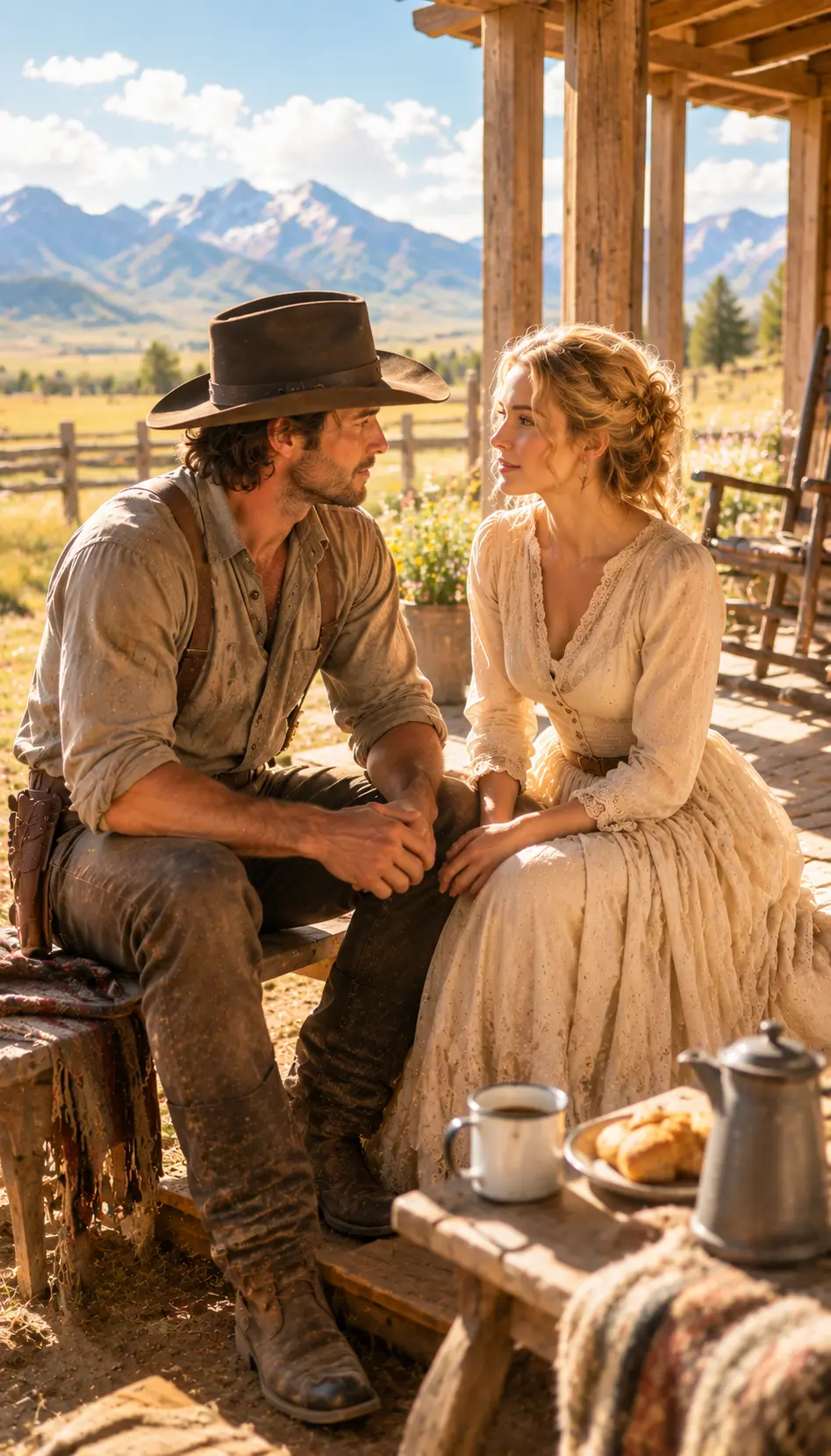
One evening, she came out to the porch to watch the sun go down and found him already there, sitting in the far chair with his hat in his hands, staring toward the horizon. He did not look at her. She did not speak.
She sat in the other chair.
They remained in separate silences that somehow shared the same air.
When the sky went dark, she went inside.
He stayed.
Neither of them explained themselves.
That was the night Katherine first admitted, quietly and without making too much of it, that Billy Lawrence was not the man she had expected him to be.
The first argument started over a shelf.
Katherine had reorganized the supply room off the kitchen. She moved flour and cornmeal to the lower shelves, where she could reach them easily, and shifted tools and hardware higher, where they were out of the way. It made sense. She had spent the better part of a morning cleaning mouse droppings, wiping dust, sorting tins, and making the space work.
She was still wiping the final shelf when Billy walked in.
He stopped in the doorway.
His eyes moved over the room.
Not angrily.
Not loudly.
But with the stillness of a man looking at something that had been changed without permission.
He walked to the upper shelf, picked up a wrench, looked at it, and set it back down.
“I knew where everything was,” he said.
His voice was even.
That made it worse.
Katherine set her cloth down.
“The flour was on the top shelf. I use it every day. It makes more sense where it is now.”
“I’ve had this ranch for eight years. Things were in a certain place for a reason.”
“What reason?”
He did not answer.
And that told her there was not one, not a practical one.
The real reason was that the room had been his, and she had moved something inside it. He could not say that aloud. She understood it.
She just did not agree with it.
Billy left without another word.
Katherine stood in the reorganized supply room and felt the particular frustration of being right and having that not matter. Then she finished wiping the shelves.
She did not move anything back.
That evening, she sat at the kitchen table mending a curtain when the back door opened. Billy came in, crossed the kitchen without looking at her, and opened the supply room door.
Katherine kept her eyes on her needle.
She heard him moving things.
Not putting them back.
Checking them.
Learning the new arrangement.
After a few minutes, he came out. He pulled the chair across from her, sat down, and picked up the loose end of the curtain she was trying to mend. He held the fabric flat so she could stitch without it bunching.
He did not apologize.
She did not ask him to.
They worked like that for twenty minutes.
When the curtain was done, she folded it and set it aside.
Billy stood, pushed the chair back into place, and headed for the stairs. At the doorway, he paused without turning around.
“The flour makes sense down low,” he said quietly.
Then he was gone.
Katherine stared at the folded curtain.
Then, despite herself, she smiled.
Nobody forced Billy Lawrence to change.
He just did it slowly.
The way a river changes course.
Not all at once.
So steadily that one day you look up and realize the water is going somewhere it was not going before.
Katherine noticed it in pieces.
The first thing was the door.
Her bedroom door had a hinge that sat wrong, making it drag against the frame every time she opened it. She mentioned it once, under her breath, while wrestling it open one morning.
Three days later, she came upstairs and found the hinge reset. The door swung clean and quiet.
No note.
No mention at supper.
Just a fixed door that had not been fixed in years.
The second thing was the timing.
Billy had always come in from the fields whenever work was done. Sometimes five. Sometimes seven. Sometimes later. But around the third week, Katherine realized he was coming in consistently close to supper. Close enough that food was still hot when he sat down. He never acknowledged the pattern. She never pointed it out.
But she started timing supper to match him.
He started washing up before he came inside.
And somehow, without either of them deciding to do it, they built a shared routine out of nothing.
The third thing was the saddle.
That one stopped her cold.
She had mentioned exactly once, weeks earlier, that the stitching on her saddle was coming apart and she would need to see about it in town. She had not thought about it since.
One morning, she walked onto the porch and found the saddle resting over the rail. Every seam had been restitched with fresh leather cord, neat and tight, done by someone who knew exactly what he was doing.
Katherine stood on the porch steps for a long time.
She ran her fingers over the new stitching.
Billy was already in the far pasture, a distant shape moving along the fence line.
She looked at the saddle.
Then at him.
Then back at the saddle.
She went inside and set two cups on the breakfast table instead of one.
When Billy came in later, she poured his coffee without being asked and slid the cup across to him.
He wrapped both hands around it and drank.
Neither of them said a word about the saddle.
Neither needed to.
Something was shifting between them.
Not fast.
Not dramatic.
But real.
The kind of real that does not announce itself. The kind one only recognizes later, when looking back and trying to find the exact moment everything changed, only to realize there was no single moment. It happened in all the moments.
In the fixed door.
In the lowered flour.
In the fresh water basin.
In the repaired saddle.
In two cups of coffee on a table that had once held only one.
The letter arrived on a Tuesday.
It was tucked between a hardware invoice and a notice from the county land office. Katherine almost missed it. The handwriting on the envelope was small and slanted, unmistakably Clara Briggs, her oldest friend from San Antonio, the only person from her old life who still wrote.
She took it to the porch.
The afternoon was hot and still, the kind of heat that presses down on everything until the world feels like it is holding its breath. Katherine opened the envelope carefully.
Clara’s letters were always long and full of news. Who had married whom. Which business had closed. Which family had moved away. Who was ill. Who had recovered. Who was pretending not to be in love with whom.
Katherine read the first page with a faint smile.
Then she reached the second page.
Her eyes stopped moving.
Daniel Hurst had married.
A schoolteacher named Adeline from Corpus Christi.
The wedding had been in April.
Clara had written it plainly, without drama, the way one writes news when one does not know whether it will land hard or soft.
Katherine read the paragraph twice.
Then she sat with the letter in her lap and looked out at the dry flat land stretching beyond the porch.
She waited to feel devastated.
She did not.
But she felt something.
Quieter than grief.
Heavier than nothing.
Daniel had been the closest thing she had once had to a real choice. He was not a great romance, not a tragic promise, not a man she had run away for. But he had been kind. He had looked at her as if she were a person, not a bargain. Before Garrett. Before her stepfather’s pressure. Before the boarding house began to feel like a hallway with no doors.
Now even that possibility was sealed into someone else’s April wedding.
She was quiet for three days.
Billy noticed on the first.
He did not ask.
That was the thing about him. He never pushed. But she felt his attention shift toward her in small ways. He came in from the fields earlier. He stayed at the table longer after supper instead of heading upstairs. He left the coffee warmer near the stove without comment.
On the second evening, Katherine sat on the porch after dark with the letter folded in her apron pocket.
The screen door opened.
Billy came out and sat in the far chair.
No words.
The sky was wide, black, and full of stars the way it only gets far from a city. They sat in silence for a long time. Katherine felt the weight of the letter against her hip, but did not take it out.
Somewhere around the fourth star she counted, she started talking.
Not about Daniel at first.
About San Antonio.
About the boarding house.
About how strange it was to be surrounded by people and still feel entirely unseen.
Billy listened without shifting, without filling the silences with easy comfort.
When she finally said Daniel’s name and told him what Clara had written, he did not react with pity. He did not tell her she was better off. He did not make himself the answer to a question she had not asked.
He just said quietly, “That is a hard thing to read.”
Four words.
But they were the right four.
Katherine felt something loosen in her chest that had been tight for three days.
They stayed on the porch until the wind picked up and the night turned cool. When she finally went inside, she felt lighter than she had since the letter arrived.
Billy did not talk about Ruth on purpose.
It came out the way old things come out when they have been kept too long.
Slowly.
Then all at once.
It was four nights after Katherine’s letter. They had fallen into a new habit without naming it: sitting on the porch after supper. Sometimes they talked. Sometimes they did not. But they were there.
That evening, the sky had gone a bruised orange near the horizon, and the air smelled like dry earth and coming rain.
Katherine asked him, simply and without pressure, how he had ended up alone at the Broken Spur.
She expected a short answer.
Billy was quiet for a long time. He turned his hat in his hands the way he always did when deciding whether a truth was safe to release. Then he set it on the porch rail, leaned forward with his elbows on his knees, and looked at the ground.
“Ruth Callaway,” he said.
He had met her in Abilene when he was twenty-four. She was sharp, funny, honest in a way most people were not. For the first and only time in his life, he had believed he had found someone worth building with.
They were engaged eight months.
Then the ranch hit a bad season.
A long drought.
Two sick horses.
A fence collapse that cost more than he had.
The money dried up quickly.
Ruth endured four months of hardship, then told him she was going back to Abilene. She was not cruel about it. She did not shout. She did not insult the ranch. She simply said she could not live that way.
Then she left.
Billy stood in the yard of the Broken Spur and watched the wagon take her away.
That day, he decided quietly and completely that he would never do that again.
Katherine listened the way he had listened to her.
Still.
Present.
Without trying to fix it.
When he finished, she did not say Ruth was wrong to leave. She did not say Billy was right to close himself off. She simply sat with the truth, because some things deserve to be taken seriously before they are answered.
After a while, she said, “So the advertisement was not only about needing help with the house.”
Billy looked at her sideways.
“No.”
“What was it about?”
He stared toward the darkening pasture.
“Needing something that would not leave when things got hard.”
The honesty landed between them like a stone dropped into still water.
Katherine looked down at her hands.
She thought of the three dollars. The worn leather bag. The folded newspaper. Garrett Howell. Her stepfather. The quiet desperation that made four plain lines feel like the only real door in a hallway full of walls.
“Well,” she said softly, “I was not running toward something either.”
Billy turned his head.
“I was running away from something worse.”
He nodded slowly.
As if that might be the truest thing either of them had said since she arrived.
The rain that had threatened all evening finally came. Soft at first. Then steady. It drummed on the porch roof in a low, even rhythm.
They stayed outside.
The rain fell around them.
Neither moved to go in.
For the first time, the space between their two chairs felt like it was closing.
The sky turned the wrong color at midday a week later, and Billy knew before the wind even rose that the storm would be bad.
He had seen storms like that before. A green-gray heaviness over the flatlands. A held breath before the sky broke loose. He spent the early afternoon securing the barn, moving the horses to the back stalls, and checking fence posts along the east pasture, where the ground softened fastest in heavy rain.
He told Katherine once, briefly, to stay inside and keep the shutters latched.
She nodded.
He went back out.
By three o’clock, the rain was coming sideways and the wind had teeth.
Billy was at the far fence line when the first post gave.
The ground had soaked faster than he expected. Two sections of fencing collapsed outward, leaving a gap wide enough for cattle to walk through. He started working in the rain, bracing the posts with his hands, trying to force wood, wire, and mud into obedience. But it was a two-person job, and he was doing it alone.
He did not hear Katherine coming over the storm.
He looked up and she was simply there.
Standing in the mud in work boots, hair plastered against her face, holding the post steady without being asked.
She said nothing.
He said nothing.
They worked.
For two hours, they fought wind, mud, frightened cattle, and stubborn fencing. Katherine’s dress grew heavy with rain. Billy’s shirt stuck to his back. Mud covered her boots and streaked one cheek. She did not complain once.
By the time the livestock were secure again and the storm began to pull back toward the horizon, both of them were soaked and exhausted.
They walked back to the house through thinning rain, silent.
The sky had shifted from green-gray to a pale washed gold, the way it does after hard weather, as if the land itself is relieved to still exist.
At the porch steps, Billy stopped.
He turned and looked at her.
Really looked.
Not quick assessing glances. Not polite avoidance. A long, steady look that took in the mud on her cheek, the soaked fabric, the tired set of her shoulders, and the fact that she had walked into a storm for no reason except that he needed help.
And she had seen it.
Katherine looked back.
The air between them was clean and still.
Billy opened his mouth.
For one moment, she thought he might say something that would change everything.
What came out was quiet and simple.
“You did not have to do that.”
Katherine held his gaze.
“I know.”
Then she went up the porch steps and inside to change.
Billy stood in the yard long after she disappeared, looking at the place where she had been standing.
Something moved through him.
Something he had not felt in a very long time.
This time, he did not push it away.
The days after the storm were different.
They both knew it.
Neither pretended otherwise.
It was not dramatic. There was no single conversation that remade their marriage. It was more like a door that had been stuck for months finally swinging open on its own.
Not forced.
Just ready.
Billy stopped disappearing into the far fields after supper.
Katherine stopped keeping herself busy with tasks that did not need doing.
They talked more, and the talking had a different quality now. Less careful. Less managed.
She told him about her mother, who had died when Katherine was eleven, and the particular way that loss made a girl grow up too quickly. He told her about his father, who had built the Broken Spur from nothing and died owing it everything. He told her about inheriting land that came with pride and debt wrapped around each other so tightly he could not always tell which was which.
They talked about things that had nothing to do with ranching and everything to do with who they were beneath the arrangement they had made.
One evening, Billy came in from the barn and set something small on the kitchen table.
No explanation.
Katherine looked down.
It was a carved wooden sparrow, small enough to fit in a closed fist, polished smooth, its wings detailed with careful patience.
Her breath caught.
Weeks earlier, she had mentioned her mother’s sparrow in passing, a tiny ceramic bird her mother had kept on a windowsill. It had been lost after her death, along with many other things Katherine had never stopped missing but had learned not to mention.
She picked up the wooden sparrow and turned it over in her hands.
Billy had already turned toward the stove, busying himself with pouring water as if the room had not shifted.
“Billy,” she said.
He turned.
She had no words for what she felt, so she only held up the sparrow.
He looked at it.
Then at her.
“Your mother should have something here,” he said simply.
Katherine placed the sparrow on the windowsill above the kitchen sink, where the evening light could catch it. She stood there for a moment with her hand resting on the sill.
And for the first time in years, she felt exactly where she was supposed to be.
She went looking for him the next morning.
That was new.
Katherine had spent most of her life waiting for things to come to her, waiting for situations to resolve, waiting for other people to make first moves because limited choices teach a person to be cautious with every step.
But that morning, she woke up done with waiting.
She found Billy at the east fence line, the same place where they had worked side by side in the storm. He was checking the posts they had braced. When he saw her coming through the dry morning grass, he straightened and waited.
She stopped a few feet away.
The sky above them was pale blue and enormous.
“I know what we agreed to,” she said. “And I know why we agreed to it. But I do not want that anymore.”
Billy looked at her steadily.
“I stopped wanting it a long time ago,” he said. “I just did not know how to say so.”
They stood there in the early light.
It was nothing like the stories Katherine had read as a girl.
No grand declaration.
No music.
No perfect moment arranged by fate.
Just two people who had arrived at the same place by different roads, finally brave enough to say so out loud.
“I do not want to be only a practical arrangement,” she said.
Billy stepped closer, slowly enough that she could decide the distance.
“I do not want a house you run and land I run. I want a life we build.”
Her eyes warmed.
“That sounds almost romantic for a man who said good because I packed light.”
A faint smile crossed his face.
“I was nervous.”
“You were rude.”
“I was nervous and rude.”
“That is more accurate.”
He looked down, then back at her.
“Katherine, I do not have fancy words. I do not know how to make promises sound pretty. But I know how to stay. I know how to work. I know how to fix what I break, if I am told plainly enough that I broke it. And I know I want you here not because a paper says so, but because this place is better with you in it.”
Her throat tightened.
“You are learning words just fine.”
They were married again three weeks later.
Not legally, because legally the town clerk had already handled that in less time than it took coffee to cool. But this time, they stood in the small Dusty Flats church before the reverend, the town clerk and his wife, two ranch hands, and the woman from the general store who had always been kind to Katherine.
Billy wore a clean shirt.
Katherine wore her mother’s brooch pinned to her collar.
When the reverend asked if they took each other, they both said yes like they meant it.
Because this time, they did.
Afterward, there was no grand feast. The general store woman brought a cake wrapped in cloth. One of the ranch hands played a rough tune on a fiddle. Someone tied ribbons to the wagon, and Billy looked so uncomfortable that Katherine laughed in front of everyone.
On the ride back to the Broken Spur, the late afternoon light spread across the land in warm sheets of gold.
Billy held the reins.
Katherine leaned slightly against his shoulder.
“Any regrets?” he asked.
She smiled.
“Only that you wasted so much time pretending not to care.”
He looked at the road ahead.
“I cared from the first morning I put water outside your door.”
“I know.”
“You knew?”
“Billy, no man carries water that quietly unless he is trying very hard not to be tender.”
He did not answer.
But his mouth softened.
That was enough.
A year passed the way good years do.
Not fast.
Not slow.
Full.
The Broken Spur changed in ways anyone could see.
The garden Katherine planted along the south side of the house came in strong: tomatoes, peppers, beans, herbs she used every day in the kitchen. The porch had two chairs that were used every evening without fail. The supply room stayed arranged the way Katherine had made it that first friction-filled morning, and Billy long ago stopped pretending he did not prefer it.
The ranch hands noticed the change in him too, though none of them said it directly.
Billy was still quiet. Still exacting. Still a man who communicated more through action than words. But the sharp edges had worn down. He laughed sometimes now, low and unhurried, usually at something Katherine said.
It startled people the first time they heard it.
Not because laughter was rare in Texas.
Because Billy Lawrence did not laugh carelessly.
When he did, it meant something.
The Broken Spur felt, for the first time in its history, like a home instead of a piece of land a man was trying to hold onto.
Katherine was four months along when the first real cold came in November.
Billy had already started on the extra room.
She had not asked him to.
She had only mentioned once that the back room off the kitchen caught the best morning light.
Two weeks later, she came downstairs and found him measuring the wall with a length of cord, a pencil tucked behind his ear, his face set in focused calm.
He was building the room to face the sunrise.
Katherine stood in the kitchen doorway watching him work.
The feeling that came over her was so complete and uncomplicated that it nearly startled her.
This was not the life she had planned.
She had planned survival.
Three dollars.
A worn leather bag.
Four lines in a newspaper.
A cold arrangement with a man she did not know.
She had planned to endure.
Instead, she had built something slowly without realizing it.
Out of fixed doors.
Repaired saddles.
A wooden sparrow on a windowsill.
Two chairs on a porch.
A storm where she held the fence and he finally saw her.
A man who said the right four words when the right four words were all she needed.
The sparrow still sat on the kitchen windowsill, catching the light every morning. The two cups were always on the table. The fresh water basin was no longer outside her door, because now he brought it inside and kissed the top of her head while doing it, as if tenderness had become a chore he had finally admitted he liked.
On the coldest evenings, when the wind came off the flatlands and moved through the dry grass in long slow waves, Billy and Katherine Lawrence sat together on the porch of the Broken Spur Ranch and watched the sky go dark.
Neither felt the need to be anywhere else in the world.
And that, more than any stamped paper or church ceremony, was the real story of Billy and Katherine Lawrence.
Two people who came together with nothing but practicality and fear.
Two people who did not plan to fall in love.
They planned to survive.
But somewhere between a lowered flour shelf and a repaired saddle, between a letter that hurt and a porch that listened, between a storm-bent fence and a carved wooden sparrow, survival became something neither of them had dared to call by its true name.
Belonging.
Sometimes the life you do not choose is the one that chooses you back.
Sometimes the door you open only to escape becomes the doorway home.
And sometimes love does not arrive with poetry, flowers, or promises.
Sometimes love arrives as fresh water outside your room.
A hinge fixed without a word.
A man sitting beside you under the stars because he knows something has hurt you, but he respects you enough to let you speak when ready.
A woman walking into the storm because the fence will not hold and neither should have to hold it alone.
Years later, people in Dusty Flats would tell the story differently.
Some said Billy Lawrence found himself a wife through a newspaper and got lucky.
Some said Katherine saved the Broken Spur by putting order into a house and sense into a stubborn man.
Some said she had run from a forced marriage and found a better one.
Some said he had been cold until she taught him warmth.
But the truth was quieter.
The truth lived in the everyday things.
In two cups.
In a windowsill sparrow.
In a supply room arranged for the person who used it most.
In a child’s room facing the morning sun.
In a porch where silence no longer felt like loneliness.
Katherine arrived at Dusty Flats with three dollars and a bag small enough for Billy to call practical.
But she carried more than he saw.
She carried grief.
Pride.
Fear.
A memory of being treated like a decision instead of a person.
And a courage so steady it did not need to announce itself.
Billy met her with rules because rules had once helped him survive.
She answered with patience because patience had once helped her endure.
Neither expected tenderness.
Neither trusted hope quickly.
But love, real love, rarely begins by asking permission.
It begins in small proofs.
It begins when someone notices what hurts and does not use it against you.
It begins when someone changes, not because they were forced, but because they finally understand.
It begins when two strangers stop guarding separate corners of the same house and start making room at the table.
So no, Katherine Williams did not find the life she imagined.
She found the life that waited behind a dusty road, a silent man, a broken shelf arrangement, and a ranch with a name that sounded like damage.
The Broken Spur.
A place that, like both of them, had been worn down, weathered, and nearly convinced that surviving was enough.
Until it became a home.
And in the end, that was the miracle.
Not that Billy learned to speak.
Not that Katherine learned to stay.
But that two people who had both been treated as if love was a risk discovered that love was the very thing that made risk bearable.
The wind still crossed the Texas flatlands.
The dust still rose.
The work never ended.
But inside the house at the Broken Spur, there was light in the window, bread on the table, a wooden sparrow watching over the sink, and two people who knew that the life they had built was not perfect.
It was better.
It was theirs.