Cowboy Found Her Waiting By The Wagon Yard, Offered His Blanket And A Life Beside Him Forever
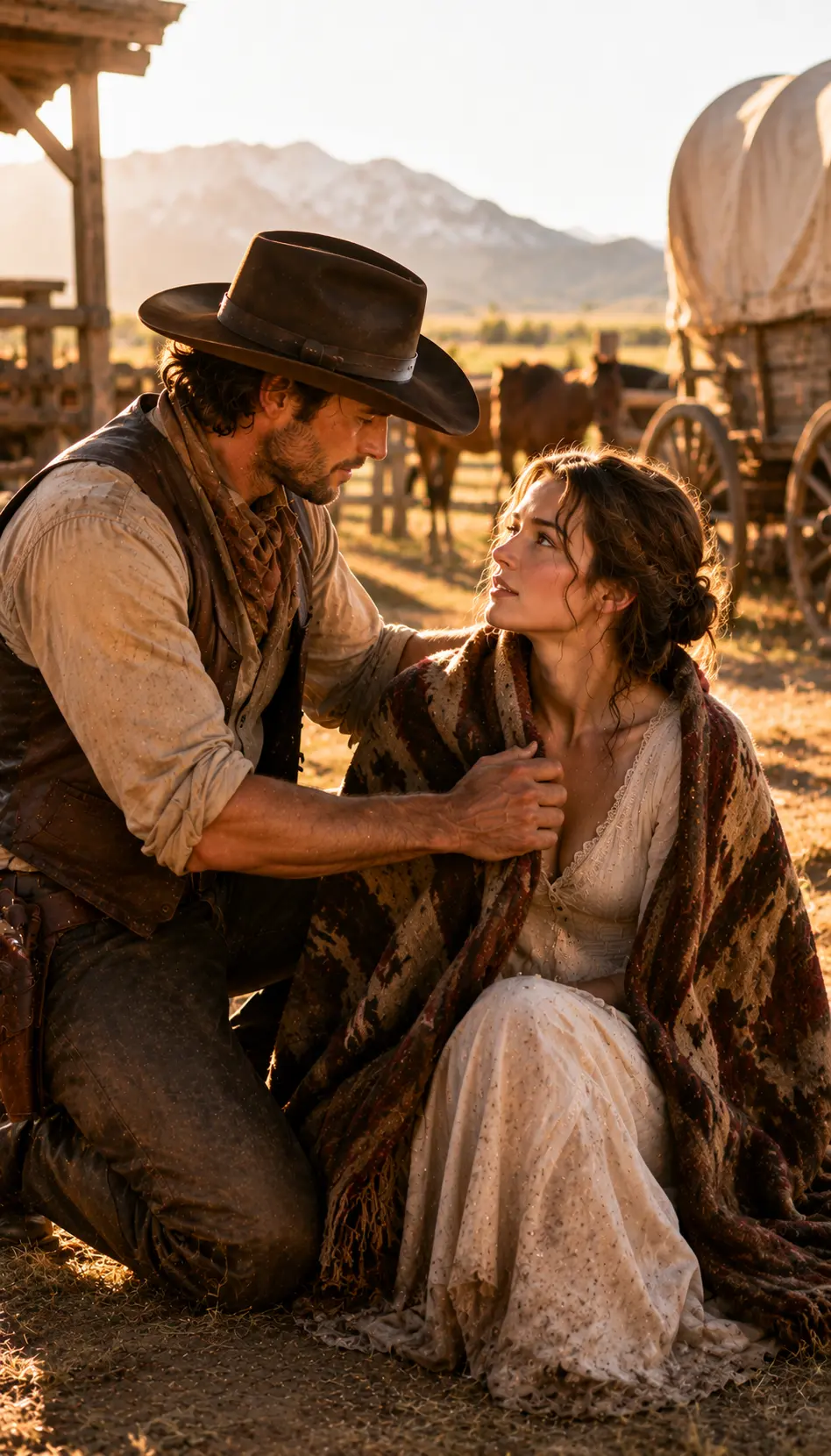
Wyoming Territory, late October of 1878, and the wind already carried the sharp promise of snow.
It came down from the northern ridges like a warning, slipping under collars, biting through worn gloves, and making the horses behind the Buffalo livery snort steam into the fading light. The sun hung low over the town, thin and orange, casting long shadows across the wagon yard where the last westbound party had pulled out that morning, leaving ruts in the dirt and silence in their place.
That was where Bram Hollis saw her.
She sat alone on the edge of a wagon tongue, hands tucked beneath her arms, shoulders tight against the cold. Her dress was dusty, the hem torn where it had dragged too long through mud and brush. Her boots were scuffed nearly white at the toes. A small bundle sat beside her, tied with a strip of faded cloth, too small to hold much more than a change of clothes and whatever pieces of a life a woman could not bear to leave behind.
She was not crying when Bram first noticed her.
That was what made him stop.
Crying would have been easier to understand. Tears asked for something. Help. Pity. A witness. But this woman sat with her eyes lowered toward the dirt as if she had already asked the world for help and the world had looked the other way.
Bram had only meant to water his mare and move on.
He had come into Buffalo for coffee, salt, nails, and a new rasp for the farrier kit he kept wrapped in old canvas. His place was north, more than a day’s ride if weather held and longer if the pass turned mean. He did not linger in town when cold was coming. A man who lived alone learned to count hours by daylight, not by comfort.
But now he stood still with the mare’s reins loose in his hand, looking at the woman on the wagon tongue.
Something about her pulled at him before he understood why.
The hollow in her cheeks.
The stubborn line of her mouth.
The way she held herself together as if she had been holding together for so long that falling apart would be an insult to the effort already spent.
He had seen that look before.
In soldiers after a battle.
In widows at train depots.
In his own reflection the winter after his mother died.
He walked over slowly, hat in hand so she would not think he meant trouble.
“You waiting on somebody?”
She looked up, startled.
For a moment, fear passed through her face, quick and practiced. Then she steadied herself. Her eyes were gray-blue, or maybe green beneath the dust and fading light. It was hard to tell. They had the bruised clarity of a prairie sky after a storm.
“No,” she said.
Her voice was low and rough, from cold or crying. Bram could not tell which.
“Not anymore.”
Those two words told him more than a whole story might have.
Bram crouched beside the wagon, leaving enough space between them for her to decide whether he was safe.
“My name’s Bram,” he said gently. “You got a name?”
She looked at him for a long moment.
Measuring.
Not trusting.
Not yet.
Then she nodded once.
“Willa Joyner.”
He repeated it in his mind, quietly, as if a name deserved care before being spoken again.
“You hungry, Willa?”
Her fingers tightened around her arms.
“I ain’t got coin.”
“Didn’t ask that.”
He reached into his coat pocket, pulled out a strip of jerky wrapped in cloth, and offered it to her.
She stared at it as if expecting a trick. Then she took it carefully, almost painfully, like she believed kindness could be snatched back if she moved too fast.
Bram sat on his heels and waited while she chewed.
He did not ask questions.
He had learned, through years of grief and the hard manners of the frontier, that not every hurt should be dragged into daylight before a person has food in their stomach.
The yard behind them had emptied. The last of the wagons had rolled out with the morning frost, heading west before winter sealed the pass. Now only a few chickens scratched near the stable wall, and an old mule stood sleeping under a broken awning.
Willa swallowed.
“They left me.”
Bram leaned his forearms on his knees.
“Who?”
“My brother and his wife.”
Her eyes stayed on the dirt.
“They said they could not carry three mouths through the mountains. Said I would do better in town. Said there might be work here.”
The words were plain.
That made them worse.
Bram’s jaw tightened, but he kept his voice calm.
“How long ago?”
“Two days.”
He looked toward the empty yard, the exposed sky, the cold setting in along the edges of everything.
“You slept out here?”
She nodded once.
Pride held her spine straight, but exhaustion had begun to wear through it.
Bram stood, shrugged off his coat, and unrolled the thick wool blanket tied behind his saddle. He laid it over her shoulders without making a performance of it, as naturally as if he were covering a campfire from the wind.
To him, it was a necessary thing.
To Willa, it landed like mercy.
Her fingers closed around the edges of the blanket.
“You don’t even know me,” she whispered.
“I know enough.”
She looked up.
“I know you shouldn’t be out here freezing,” Bram said. “And I know what it feels like to get left behind.”
That made her really look at him.
Not as a stranger now.
As a man who had just spoken from someplace deeper than politeness.
Bram gave a small half smile and held out his hand.
“Come on. I’ve got a fire going at my camp outside town. You can warm up. Eat something proper.”
She looked at his hand.
Then toward the darkening yard.
Every instinct in her had been trained by disappointment to hesitate. Kindness could carry a price. Men could say one thing and mean another. Safety could turn into a door locked from the outside.
Bram seemed to read the fear without being offended by it.
“You don’t have to stay,” he said. “But you shouldn’t be alone tonight.”
Willa drew in a slow breath.
Then she stood.
The blanket nearly slipped from her shoulders, and Bram caught one edge before it fell. He did not touch her arm. He did not hurry her. He just held the blanket steady until she had it again.
“All right,” she said.
They walked through the edge of Buffalo in silence.
Her steps were slow from cold and weariness. Bram matched them without comment, his mare trailing behind, his hand close enough to steady her if she stumbled but never taking hold unless she asked. The town windows glowed behind curtains. Somewhere, laughter spilled from a saloon. A church bell rang once in the distance, thin and lonely in the cold air.
No one stopped them.
No one asked why a woman had been sitting alone in the livery yard for two days.
That, more than anything, told Bram what he needed to know about towns.
They reached the cottonwoods by the creek just as darkness began settling properly over the land. Bram’s camp sat in a shallow curve of bank where the wind broke against the trees. A small tent leaned low near a bedroll. The fire burned steady in a ring of stones, and coffee warmed in a battered tin pot.
Willa stopped at the edge of the firelight.
Bram noticed.
“Sit where you like,” he said. “No one’s going to crowd you.”
She chose a fallen log across from him, close enough to feel warmth but far enough to keep space between them.
Bram pulled a tin from his saddlebag and set beans near the fire to heat. He gave her a biscuit, then another when she finished the first too slowly, as if trying to convince him she was not as hungry as she was.
“You got family?” she asked after a while.
Bram poked at the fire.
“Used to.”
She waited.
He could have left it there. Most people would have. The frontier was full of used-to stories, and nobody had to explain the dead unless they wanted to.
But her voice carried the same careful loneliness as his own.
So he answered.
“Lost my brother in the war. Mama passed not long after. Fever took her quick once grief had done the weakening. Been just me a long while now.”
Willa stared into the fire.
“Me too.”
The flames shifted orange across her face.
“My folks died in Texas. Sickness swept through in spring. Took them both within six days.”
Bram’s hands stilled around the coffee pot.
“My brother said we’d start over out west. Said there was land, work, chance. I believed him because he was the only family I had left.”
She gave a small laugh, but there was no humor in it.
“Turns out blood don’t always mean staying.”
Bram did not say what he thought.
That her brother had no right to call himself kin.
That leaving a woman alone in a wagon yard with winter coming was not survival, but cowardice dressed up as practicality.
Instead, he poured coffee into a tin cup and handed it to her.
She wrapped both hands around it, letting the heat seep into her fingers.
They sat that way a long time, with the creek moving black beyond the trees and the fire filling the silence.
Finally, Bram asked, “You planning to stay in Buffalo?”
Willa looked down at the cup.
“I don’t know where else to go.”
He watched the way her fingers gripped the tin like it was the only solid thing left in the world.
The words came to him before he could dress them up.
“You could come with me.”
She blinked.
“What?”
“I’ve got a stretch of land up north. Not much, but enough. Cabin’s rough, but it’s warm. Spring runs clean. Got a slope behind the house that catches morning sun. I could use someone who knows how to keep a fire going, plant a garden, and tell me when I’m being an idiot.”
She stared.
He looked into the fire because it was easier than looking directly at the life he was offering.
“I’m not offering charity,” he said. “I’m offering a life beside me. If you want it.”
Her mouth parted slightly, but no words came.
Bram continued, quieter now.
“I know it’s sudden. I know you don’t know me. I don’t expect trust just because I gave you a blanket. But I know you sat alone two days and didn’t give up. I know you’ve got more grit than most men I’ve met. And I know I’d like the chance to learn everything else.”
The fire cracked between them.
Willa looked at the dark trees, then at the stars beginning to show through bare branches.
“You offering marriage?”
Bram nodded.
“I am.”
No hesitation.
No flourish.
No poetry.
Just a steady answer in a cold world.
Willa pressed the cup between her palms.
“I haven’t had anything steady in a long time.”
“You could,” he said. “With me.”
Her eyes lifted to his.
“What if you wake up in a month and decide three mouths was too much for you too?”
The question hit him harder than she knew.
“I’m not your brother.”
“No. But men say things at night by a warm fire that morning light don’t always honor.”
Bram took that in.
Then he reached into his vest and pulled out a small leather cord. On it hung a plain silver ring, worn dull from years of touching skin. He held it in his palm.
“My mother’s,” he said. “I kept it because it was the only soft thing left from that life.”
Willa stared at the ring.
“I won’t put it on your hand tonight,” he said. “Not until you decide with a clear head and a full stomach. But I’ll make this promise now: if you come with me, you’ll have your own say. You’ll work beside me, not under me. I don’t take to barking orders. And I won’t leave you standing in a yard because life got harder than expected.”
Willa looked at him for a long time.
Then she reached across the space between them and laid her hand over his.
It was cold.
Thin.
Trembling.
But it was there.
“For the first time in weeks,” she said, almost surprised by the sound of her own voice, “I think I would like to see morning.”
Bram turned his hand carefully beneath hers, lacing their fingers together.
“Then let’s start with morning.”
By dawn, frost clung to the grass along the creek bank, and the canvas of the tent crinkled with cold. Willa woke to the scent of pine smoke and the low clatter of tin against iron.
For a moment, she did not know where she was.
Then the memory returned.
The wagon yard.
The blanket.
Bram.
The offer.
The fact that she had slept without one eye open for the first time in days.
She sat up slowly. Her muscles ached from exhaustion, but the blanket still held warmth. Bram was crouched near the fire, coaxing life from stubborn coals, sleeves rolled up to his elbows despite the cold. He did not speak right away. He only handed her warmed beans, a strip of salt pork, and coffee.
“Thank you,” she said.
Her voice was clearer now.
Steadier.
He nodded and sat across from her.
The air between them felt different than the night before. Less like strangers. More like two people standing at the edge of the same river, not yet certain how deep it was, but willing to cross carefully.
After a few bites, Willa asked, “What is your land like up north?”
Bram looked toward the creek as if seeing the place in his mind.
“Cottonwoods along the river. Good soil if you work it right. A slope behind the cabin that catches morning sun. Elk pass through in fall. Spring runs clean most of the year. Creek freezes in hard winter, but the spring keeps talking under the ice if you listen close.”
She listened like each detail mattered.
“The roof?”
“Patched good. Keeps weather out.”
Her lips tilted faintly.
“That sounds better than a wagon yard.”
“Most things do.”
He noticed her hands, raw at the knuckles, nails broken, fingers reddened from cold.
“You ever worked a homestead before?”
“Not mine,” she said. “But I helped my ma in Texas. Knew my way around a root cellar and a churn before I turned twelve. I can mend. Bake. Keep accounts if numbers don’t get too fancy. I can learn fast.”
“You’ll need to.”
“I know.”
“Winter comes early up there. We’ll cut wood near every day to stay ahead of it. Fence to mend come spring. Garden to start if we want more than beans and flour. A cabin that always finds something needing repair.”
She nodded, and he saw she was not shrinking from the list.
She was building it in her mind.
“You’ll have your say in things,” he added. “I mean that.”
“I don’t take to being barked at.”
“I don’t take to barking.”
Their eyes met.
Something passed between them then. An understanding not spelled out, but firm as a handshake.
After breakfast, they broke camp. Bram lashed their gear to his packhorse. Willa helped without being asked, tying knots with practiced fingers. She did not look lost anymore. Tired, yes. Bruised by life, yes. But there was a new set to her shoulders, as if the ground under her had stopped moving.
As they rode out, she asked, “How far is your place?”
“Day and a half if the pass behaves. Two if we take the long way around.”
“I can manage.”
“I believe you.”
They rode mostly in silence, not because there was nothing to say, but because neither of them seemed afraid of quiet. The trail narrowed as the hills rose, ocher and pine-covered, and the sound of hooves softened over dry needles. Somewhere above, a hawk cried, circling high over the ridge.
At midmorning, they stopped by a stream to water the horses.
Willa dipped her hands into the water, letting the cold run over her wrists. Bram pulled dried apples from his saddlebag and offered them to her.
She chewed slowly, then glanced sideways.
“Why did you stop at the livery yesterday?”
“My mare threw a shoe the day before. I went to check the work before heading out.”
Willa considered that.
“So if she hadn’t thrown it, you wouldn’t have found me.”
“No.”
He watched water move over stones.
“But I reckon I was meant to.”
She did not answer.
But her gaze lingered on him longer than before.
That night, they camped beneath a stand of aspens whose leaves rattled like coins in a tin. The fire was small, careful in the dry brush, and they sat close by necessity when the cold deepened.
Bram offered her the warmer side of the bedroll and used his saddle as a windbreak. Willa accepted without fuss, though he noticed she watched him carefully for any sign that kindness might turn into expectation.
It did not.
He kept his distance.
He made coffee.
He checked the horses.
He banked the fire.
He gave her space like space itself was a form of respect.
She lay down with the blanket tucked around her shoulders.
“I used to be scared of woods at night,” she said quietly. “Thought coyotes would come for me.”
“You still scared?”
She listened to the wind in the trees.
Then shook her head.
“Not tonight.”
Bram did not reach for her.
Did not press.
Did not make the moment bigger than she had offered.
He only said, “Good.”
After a while, she turned to face him across the firelight.
“You always this quiet?”
“Only when I’ve got something worth listening to.”
The laugh that escaped her was soft and surprised, like a bird startled from a branch.
Bram watched her settle under the blanket, her face turned toward the fire. She looked less like someone surviving now and more like someone beginning.
For the first time in too many years, he felt the shape of something solid forming alongside him.
Not a rescue.
Not a burden.
The start of a life neither of them had planned, but both had chosen to claim.
They reached the edge of Bram’s land late the next afternoon, riding through a line of bare-limbed willows that framed the narrow trail like old witnesses. A dusting of snow clung to the windward sides of tree trunks, and the sky had flattened into pewter.
Willa pulled her shawl tighter as the cabin came into view.
It sat low against a rise, made of hand-hewn pine, with a sod-topped roof browned by cold. A lean-to stretched from the west side, sheltering a chopping block, a sawbuck, and stacked tools. Smoke curled from the stovepipe in a thin gray line that nearly vanished against the sky.
Bram dismounted first and stepped to her horse before she could swing down on her own.
He offered his hand.
She took it.
When her boots touched ground, her knees bent slightly from the ride, but she stayed upright.
“There’s a spring out behind the cabin,” he said. “Keeps running even when the creek freezes. You’ll hear it if you listen at night.”
She looked toward the slope.
“What’s up the hill?”
“Cornfield. Didn’t yield much this year. Lost some to crows, some to hail. I’ll try oats next season.”
She nodded, eyes moving slowly over the place that would be hers now too.
Bram watched her face, not her mouth, to see what she truly thought.
She did not smile.
But her shoulders dropped half an inch.
Then she moved toward the porch without hesitation.
Inside, the cabin was warmer than expected. The stove had held heat from Bram’s last passing through. The air smelled faintly of cedar, iron, smoke, and old coffee. The floor was plank board, uneven in spots. Along one wall stood a narrow cot with a homespun quilt folded at its foot. A table sat near the window. Shelves held tins, tools, coffee, salt, dried beans, and a few books with worn covers.
“I’ll build another bed,” Bram said. “Or widen this one. Whichever you’d rather.”
Willa set her satchel down by the wall.
“I’d rather build something new together.”
The words were quiet, but they seemed to warm the room more than the stove.
Bram nodded once, then fed another split log into the fire.
Willa moved to the window and traced a crack in the pane with one finger.
“You built this place yourself?”
“The bones of it, yes. Took two summers. My brother helped with the ridge beam before he…”
His jaw tightened.
He did not finish.
She did not ask.
She only turned away from the window and said, “It holds the wind better than I thought it would.”
“Better than a wagon yard.”
She met his eyes.
“That is behind me now.”
Bram crossed to a small shelf and took down a folded cloth. He held it out.
Inside were seed packets.
Beans.
Carrots.
A few squash.
Saved carefully, though the paper edges had softened with time.
“Found these in town last spring,” he said. “Been waiting on someone who’d know what to do with them.”
Willa unfolded the cloth completely. Her thumb brushed the paper labels.
“We’ll need rows cleared. Soil turned. Fence around the garden if you’ve got rabbits.”
“Tools in the shed out back. Spade has a broken handle, but it will hold this season.”
She folded the seeds back into the cloth and tucked them into her bag.
“Then I’ll fix the handle.”
Bram looked at her without speaking.
Something steady built behind his eyes.
That night, after stew and bread, Bram sat at the table sharpening his knife. Willa swept the hearth clean, then came to sit across from him. Her hands lay palm-up on the table, red from work, nicked at the edges, no longer hidden.
“You don’t ask much,” she said.
“I listen.”
She studied his face.
“I would not have said yes if I thought you were the kind of man to keep score.”
“I’m not.”
“I have little to bring.”
“You’re here.”
“That isn’t much.”
His eyes lifted to hers.
“That is enough to start.”
For a moment, the cabin was very quiet.
Then Willa reached across the table and slid her fingers lightly over his wrist.
“I think I could be the kind that stays.”
Bram set the knife down slowly.
“You already are.”
Outside, wind moved through the cottonwoods, rattling the last dry leaves. Inside, the fire burned low, and the quiet between them held no weight.
Only warmth.
The weather sharpened by the end of the week.
Willa rose before the frost softened, tying her hair back with a strip of calico she found at the bottom of her satchel. She moved through the cabin with quiet purpose, setting out the last of the cornmeal and slicing lard with the back of a spoon.
Bram had already gone out to check the fence line, his boots leaving clean tracks across the hardened earth. By the time he returned, windburn touched his cheeks and his hands were raw around the knuckles.
He stopped in the doorway and watched her knead dough into a rough circle, sleeves pushed to her elbows.
“You always this sure-handed with bread?”
She did not glance up.
“Not always. But I watched my mother until I could match her by weight and feel. She said good bread didn’t need measuring. Just knowing.”
Bram stepped inside and hung his coat near the stove.
“Fence will hold another month. After that, we’ll need posts cut from the lower grove.”
“I’ll come with you. I’ve handled an axe.”
“I believe it.”
She paused and looked at him over her shoulder.
“You ever get used to the quiet out here?”
Bram considered.
“Depends on the kind.”
“What do you mean?”
“There’s the kind that follows you when you’ve lost too much. And there’s the kind that comes when you’ve built something that doesn’t need words to stand.”
Willa slid the skillet onto the stove and wiped her hands on her apron.
“I think I’m still learning which kind this is.”
He did not answer.
But she caught the way his gaze lingered on her face, like he was taking measure of something settled and good.
That afternoon, she walked the ridge behind the cabin, hem catching on dry grass and ice-bitten sage. Bram followed with a sharpened spade over one shoulder. They stopped near the tree line, where the ground was dark beneath a crust of frost.
“Spring is still a ways off,” Bram said.
“We can work the soil anyway. Let it breathe through winter. Makes for stronger roots come thaw.”
She knelt, pressing her palm to the ground.
“There’s loam beneath this. I can tell by the smell.”
Bram crouched beside her.
“You’ve got a good sense for it.”
“I had to. Back in Llano County, if your garden failed, you went hungry.”
They worked side by side, breaking the frozen crust, turning earth in slow, even rows. Willa’s breath came in clouds. Her face flushed from cold. Bram said little, content in the rhythm of labor beside her.
As the sun dipped below the ridge, they sat back on their heels, dirt under their nails, the new rows stretching behind them like a promise written into the ground.
“I never thought I’d end up in Wyoming,” Willa said.
“What did you think?”
“I thought I’d marry some rancher in Texas, live two miles from my brother, boil laundry, raise babies, and complain about heat like my mother did.”
Her mouth softened with memory.
“Then sickness came. After that, everything was just surviving.”
Bram did not reach for her.
But his voice softened.
“You’re not just surviving now.”
She looked down at the soil.
Then nodded.
“No. I’m not.”
The first true snow came before November closed.
It fell for six hours, soft at first, then thick enough to blur the line between earth and sky. Bram and Willa worked until dusk bringing extra wood under shelter, closing gaps in the lean-to, banking the spring path with stones so they could find it in deep snow.
That night, the cabin held close the scent of smoke, damp wool, and bread.
Willa sat by the hearth mending a tear in Bram’s shirt while he carved a new handle for the spade. The lamplight caught in the grooves of his hands, each motion patient and sure.
“You were alone a long time,” she said.
He did not look up.
“Long enough to forget how to speak without expecting no answer.”
“You haven’t forgotten.”
He set the blade down and met her eyes.
“You make it easy to remember.”
The fire cracked once, then settled.
Willa folded the shirt and placed it beside his tools. She did not say another word. She only stood, crossed to him, and rested her hand lightly at his shoulder.
Bram rose slowly.
Carefully.
As if any sudden movement might frighten the thing growing between them.
That was how their love began to take shape.
Not with a rush.
Not with a claim.
Not with the desperate hunger of two lonely people trying to escape themselves.
It began in chores done together.
In the quiet agreement of where to stack firewood.
In bread shared at the table.
In the way Bram always left the warmer side of the bedroll for her and never mentioned it.
In the way Willa stopped apologizing for taking space inside the cabin.
In the way he started saying “we” without pausing to correct himself.
Winter came hard.
Snow sealed the pass earlier than expected. Buffalo might as well have been another country for several weeks. Bram and Willa measured the days by woodpile, flour, weather, and the condition of the animals. Some mornings, the cold was so sharp that even the iron latch burned bare fingers. Some nights, wind roared over the roof, and the cabin seemed to hold its breath.
But the roof held.
The stove burned.
The spring kept whispering behind the cabin.
And Willa stayed.
She learned the rhythm of Bram’s land the way she had once learned her mother’s bread. By feel. By listening. She knew which floorboard creaked near the door, which corner needed extra chinking, how long beans took when the fire was low, and which window caught the first pale light in the morning.
Bram learned Willa too.
He learned she hummed when kneading dough but went silent when worried. He learned she saved every scrap of cloth because loss had taught her not to waste softness. He learned she liked coffee strong but not bitter. He learned she watched the ridge at sundown, not because she wanted to leave, but because after being left, a person sometimes checked the horizon to make sure nothing was disappearing without warning.
He never mocked that.
He only stood beside her when she watched.
One evening in January, a storm trapped them inside for two full days. Snow piled against the door. The animals were fed through the back lean-to. The world beyond the window was white and moving.
Willa stood at the cracked pane and said, “My brother is probably through the pass by now.”
Bram looked up from repairing a harness.
“Do you hope he is?”
She thought about that longer than he expected.
“I hope I stop wondering.”
Bram set the harness down.
“That may take time.”
“I know.”
“He was wrong to leave you.”
Her fingers tightened on the window frame.
“I know that too.”
The words came out small, but firm.
It was the first time she had said them without defending him afterward.
Bram rose and crossed the room. He did not touch her until she looked at him. Then he placed his hand over hers on the sill.
“You’re not hard to keep, Willa.”
Her eyes filled before she could stop them.
He continued, voice low.
“You were never too much. You were never extra weight. You were a person they failed.”
She closed her eyes.
The tears fell silently.
He did not gather her into his arms right away. He waited, because grief sometimes needs room before comfort. When she turned toward him, he held her gently, and she leaned into him as if she had been standing against weather for years and finally found a wall strong enough not to move.
March came with silver light and the brittle scent of thaw.
The hard crust of snow peeled back from the hilltops. Streams began trickling where ice had gripped them silent for months. Willa stepped onto the porch at dawn, shawl wrapped tight, eyes fixed on the soft rows they had turned before winter settled in.
The soil would need work again.
But it was beginning.
Everything was.
Inside, Bram bent over a short plank of pine, shaping it with a drawknife. The stool he was building had taken three evenings, not because he lacked skill, but because he worked slowly when it was for her.
He looked up when she came in, cheeks red from wind, boots wet to the laces.
“Creek’s running clear again,” she said. “Saw trout holding under the bank.”
“We’ll bring the lines down this week. Maybe set a trap for muskrat.”
“I’d like that.”
She hung her shawl by the stove.
The quiet between them was easy now. No longer full of first-step uncertainty. No longer two people unsure whether shared air required explanation.
On the table lay a small sheet of paper between the candlestick and a battered tin of buttons.
“That came from town while you were out yesterday,” she said. “Merchant’s boy brought it.”
Bram crossed the room and unfolded the paper. His eyes moved over the neat script. After a moment, he folded it and tucked it into his vest pocket.
“Something wrong?”
“No. My brother’s widow remarried. She sent word because she thought I should know.”
Willa watched him carefully.
“You going to write back?”
“I might.”
He met her eyes.
“But there’s nothing left to settle between us.”
She nodded once.
No pressing.
No softening.
Just accepting it as it was.
Later that day, they walked along the edge of the property where cottonwoods had dropped branches like bones along the riverbank. Willa carried a basket for kindling. Bram carried an axe and a coil of rope. They worked in tandem: he split, she gathered. They did not speak much, but the silence came from comfort, not distance.
As the sun dipped low, they sat on a fallen log to rest.
A hawk circled wide over the ridge, wings catching the last of the light.
“You ever think about leaving this place?” Willa asked.
Bram followed the hawk with his eyes.
“Once or twice. But nothing ever called me louder than the quiet here.”
She looked down at her hands.
“I never stayed anywhere long enough to miss it.”
“You’ve stayed here.”
“I have.”
She turned toward the cabin in the distance, smoke lifting from the stovepipe.
“And I don’t think I want to be anywhere else.”
Bram reached for her hand.
Not like a question now.
Like a truth.
She let her fingers curl around his without pause.
“I was thinking,” he said, “come April, we plant more than we planned. Maybe tomatoes along the edge. See if they take.”
Willa smiled.
“I’ve got seeds for them. Been saving them since Llano. Never had the right spot.”
“You do now.”
They walked back with the basket between them, full of kindling and the quiet thrum of something steady beneath their steps.
That evening, Willa lit a taper and placed it in the window.
Bram came behind her, his hands resting at her waist, warm even through the wool. She leaned back into him, her head against his shoulder.
“I never thought I’d feel safe again,” she whispered.
“You are.”
“With you?”
“With me.”
She turned then.
He kissed her like a man making a promise without needing witnesses. Not rushed. Not uncertain. Sure. Gentle. Full of everything they had built slowly through frost, hunger, silence, and trust.
There was nothing careless in it.
Nothing taken.
Only given.
The lamp burned low, and outside the wind curled around the cabin walls. Inside, two people who had both been left by life found, in each other, a place where leaving no longer ruled the story.
By morning, birdsong had returned.
The air still held chill, but the light had changed. No longer the thin silver of winter, but something fuller. Willa woke to Bram stoking the stove, already dressed, hair mussed from sleep, shoulders outlined by dawn.
“You hungry?” he asked without turning.
“Not yet.”
“But you will be.”
“I will.”
He poured coffee into a tin cup and handed it to her. Their fingers brushed, and this time neither pretended not to notice.
“I’ve been thinking,” she said, leaning against the wall. “Next week, when we go to town for flour, we ought to stop by the circuit rider if he’s still near Buffalo.”
Bram straightened.
“You sure?”
“I’m sure.”
She held his gaze.
“I want it said proper. I want your name, if you still want me to have it.”
He crossed the room in two steps and pulled her into his arms.
“I wanted that before I knew how to ask without frightening you.”
“I wasn’t frightened of you.”
“No?”
“I was frightened of believing you.”
That truth passed through him slowly.
Then he held her closer.
“Believe me now?”
She rested her cheek against his chest, listening to the even beat of his heart.
“I do.”
The trip to Buffalo the following week was nothing like the first time.
Willa did not enter the town as a woman abandoned in a wagon yard. She rode beside Bram with her shoulders straight, wearing a clean shawl, her hair braided, her eyes clear. Some people noticed. Towns always noticed a woman who returned stronger than they last saw her.
At the livery, the same yard stood empty beneath pale sunlight.
Willa paused at the edge of it.
Bram waited beside her.
“That where you were sitting?” he asked quietly.
She nodded.
For a long moment, she said nothing.
Then she stepped forward, crossed the yard, and stood beside the wagon tongue where he had found her. She looked at the ground, then up at the cold sky.
“I thought that was the end of me,” she said.
Bram came to stand beside her.
“It wasn’t.”
“No.”
She turned to him.
“It was the place I was found.”
They were married that afternoon by the circuit rider in a small room behind the church, with the merchant’s wife and the livery owner as witnesses. There were no flowers, no music, no family standing behind them with proud faces.
But Bram wore his cleanest shirt.
Willa wore her mother’s small brass brooch at her collar.
And when Bram slid his mother’s ring onto her finger, Willa looked down at it as if something lost from one woman’s life had become a blessing in another’s.
The circuit rider asked if they promised to walk together through plenty and want, through health and hardship, through the uncertain seasons of the frontier.
Bram’s voice was steady.
“I do.”
Willa’s was quieter, but just as firm.
“I do.”
Outside, Buffalo carried on with its usual noise: wagons, horses, wind, doors opening and closing. But for Willa, the world had altered.
Not loudly.
Not visibly.
But completely.
They returned north with flour, nails, coffee, a new spade handle, two lengths of calico, and a small packet of tomato seeds Bram bought without asking because he had seen her touch them in the store.
Willa noticed only when they were halfway home.
“You bought them.”
“Thought we had the right spot.”
She smiled for a long time after that.
Spring opened slowly, as if the land did not trust warmth any more than Willa had once trusted kindness.
But the garden took.
First beans.
Then carrots.
Then squash.
The tomatoes hesitated, then caught, sending green shoots into air that smelled of thawed soil and running water. Willa worked the rows each morning, humming the way her mother had hummed when bread rose properly. Bram repaired fencing, cut posts, checked traps, and came back at midday to find her kneeling in the dirt with sunlight in her hair and hope spread around her in rows.
The cabin changed too.
A widened bed.
A repaired window.
Shelves built lower where Willa could reach them.
A second chair near the hearth.
A small stool by the door.
Curtains made from calico.
The seed packets tucked safely in a tin, labeled in Willa’s careful hand.
It was not much by the standards of people with parlors and painted walls.
But it was theirs.
And because it was theirs, every small improvement felt like defiance.
One evening in late spring, Willa stood by the window, watching the garden glow in the low sun.
Bram came in from the shed carrying a length of sanded wood.
“What is that?”
He leaned it against the wall.
“Cradle rail.”
She looked at him.
A quiet passed between them.
Not fear.
Not certainty.
Something tenderer.
“Not yet,” she said.
“I know.”
“But soon, maybe.”
“Maybe.”
He crossed the room and stood beside her.
“I wanted to start early.”
Willa touched the smooth rail with her fingertips.
“You always preparing for weather before it arrives.”
“Some kinds of weather are welcome.”
She looked up at him, and her smile carried everything: the wagon yard, the blanket, the campfire, the first morning, the long trail, the cabin, the winter, the spring.
The life.
Outside, the sun slipped behind the ridge, casting gold across the field. The garden waited. The land waited. The future waited too, not gentle, not guaranteed, but no longer empty.
Inside the cabin, love had taken root.
Quiet and deep.
The way all lasting things grow.
Without rush.
Without noise.
Certain as spring.
Years later, when people in Buffalo told the story, they usually began with the abandoned woman in the wagon yard and the rancher who found her before winter took hold. Some told it as a rescue. Some told it as romance. Some said Bram Hollis had been a good man at the right place at the right time.
All of that was true.
But it was not the whole truth.
The whole truth was that Willa Joyner had already survived before Bram ever offered his hand. She had survived sickness, grief, betrayal, hunger, cold, and the terrible humiliation of realizing her own brother had decided she weighed too much on the road west. Bram did not give her strength. He recognized it.
And Bram had not been looking for someone to save.
He had been a lonely man with a patched roof, a clean spring, a field that needed planting, and a heart that had nearly forgotten how to expect an answer when it spoke. Willa did not turn him into someone else. She gave him a reason to remember who he had been before loss made him quiet.
They did not begin with certainty.
They began with jerky offered in a cold wagon yard.
With a blanket laid over narrow shoulders.
With coffee by a creek.
With a question asked plainly beneath the stars.
You offering marriage?
I am.
They began with two people who had both been left behind and somehow chose not to leave each other.
And in the Wyoming wind, on a piece of land that asked hard work from anyone who dared love it, they built something stronger than a rescue.
They built a home.
A home where the spring kept running under ice.
Where tomatoes grew in soil Willa had turned before winter.
Where Bram’s mother’s ring warmed on Willa’s hand.
Where a candle in the window meant someone was expected.
Where silence was no longer empty.
Where love did not arrive like thunder, but like thaw.
Slow.
Steady.
Unstoppable.
And if you listened close on cold nights, when the wind moved through the cottonwoods and the fire settled low, you could almost hear the truth of it in the walls.
No one who is truly loved is extra weight.
No one who is truly seen is left behind.
And sometimes the life that saves you begins in the very place where someone else decided you were not worth carrying any farther.