The Loner Rancher Waited for a Common Mail Order Bride — But a Woman Too Beautiful for Him Arrived
The letter had promised someone ordinary.
That was what Sawyer Briggs kept telling himself as the stagecoach rolled into the yard in a storm of dust, rattling wheels, tired horses, and late afternoon sunlight.
Ordinary.
Practical.
Plainspoken.
A woman seeking a simple life far from polished society and complicated expectations. Someone who understood that a remote ranch was not a dream made of roses and music, but a life built from water hauled before dawn, bread stretched through winter, fences mended in dust storms, and quiet evenings when the wind was often the only voice that answered back.
That was what her letters had sounded like.
Sensible.
Measured.
Almost too careful.
She had asked about the well, the livestock, the size of the house, whether the roof held during storms, how far the nearest town stood, whether there was space for a garden, whether the pantry could support two through winter if supplies were managed properly. There had been no sentimental talk, no romantic flourishes, no foolish questions about dances, dresses, or whether he owned a piano.
Sawyer had appreciated that.
He had no piano.
He had a roof that mostly held, two weathered barns, a vegetable patch he tended badly, a good mare, nine cattle worth keeping, and a stretch of land stubborn enough to make a man either strong or bitter.
Some days, he was not sure which one he had become.
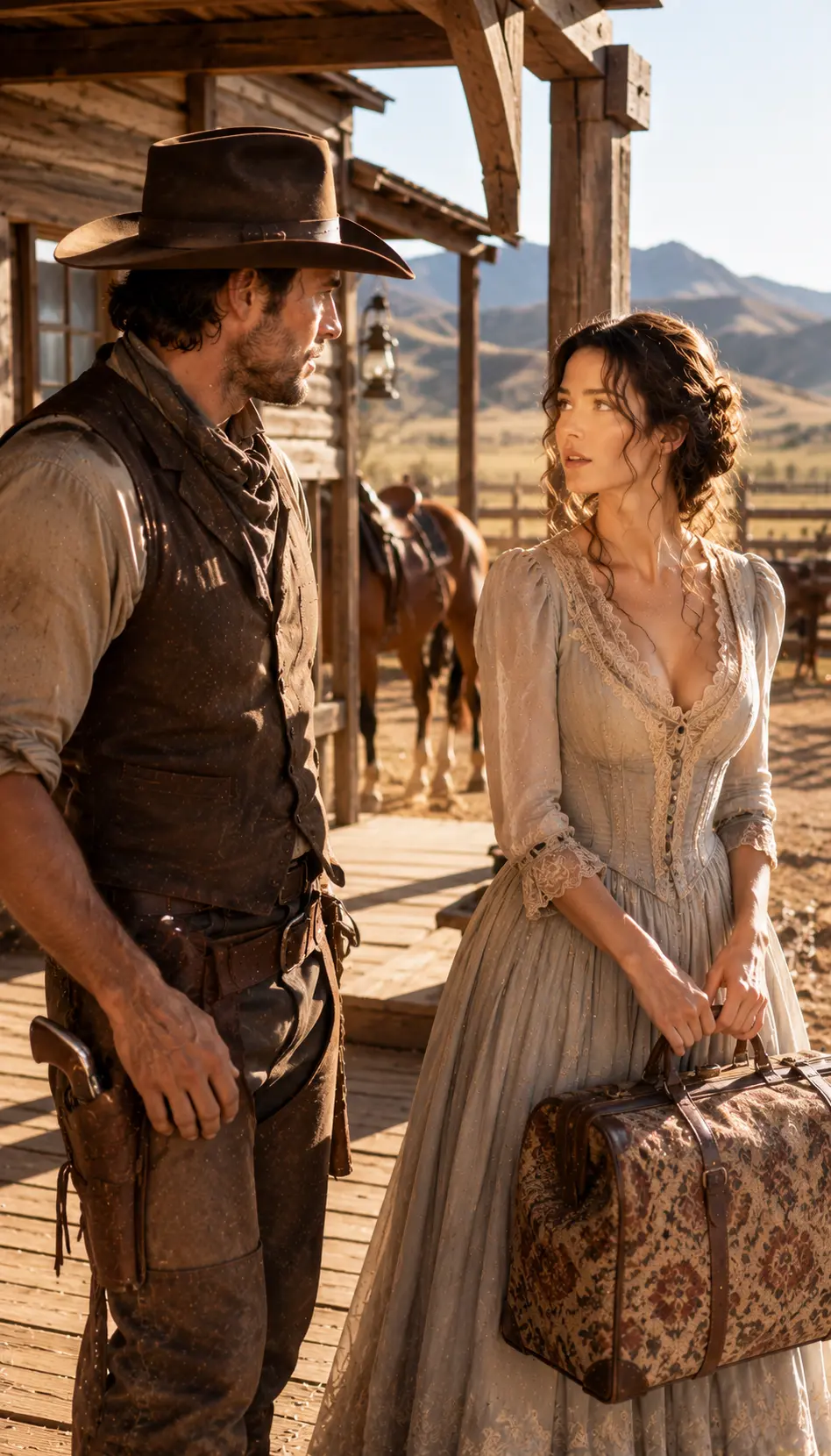
He stood behind the wooden post of his porch, calloused hands gripping the rail, suddenly aware of every rough thing about himself. His work shirt had a patch near the elbow. His boots were cracked at the crease. His hat had seen too many summers. The porch needed painting. The yard needed sweeping. The house, which had seemed clean an hour earlier, now looked to him like something a woman of refinement might inspect once and quietly decide she had made a terrible mistake.
Then the coach door opened.
And ordinary stepped down looking like a lie.
The woman who emerged from the dusty stagecoach did not belong on a remote ranch where the closest neighbor lived twenty miles away.
She looked as if she belonged in the finest parlors of Boston, beneath chandeliers, near velvet curtains, with a silver teacup in one hand and men speaking softly around her because refinement demanded it.
Her auburn hair caught the afternoon light in a way that made Sawyer’s chest tighten before he could stop it. Her features were striking, almost too carefully arranged, as if some patient artist had shaped them with attention and sorrow. Her dress, though stained at the hem from three days of travel, was cut from fabric finer than anything sold in the nearest town. Even her gloves, dusty now, were clearly expensive.
She moved with grace.
Not the awkward stiffness of someone pretending to be a lady.
The ease of someone who had been trained since childhood never to forget she was being watched.
Sawyer’s stomach twisted.
This could not be right.
Maybe she had gotten on the wrong stagecoach.
Maybe some wealthy man in another territory was waiting for this woman, and Sawyer would have to explain that he was not her intended husband, only a struggling rancher foolish enough to believe a woman from back east might truly want a life beside him.
The driver was already unloading her trunk, a dark polished piece of luggage that looked absurd beside the dust, sun-bleached boards, and rough corral fence.
Then the woman did something that made Sawyer stop breathing.
She pulled a folded letter from her purse.
She glanced at it.
Then she looked directly toward the ranch house where he stood hidden halfway behind the porch post.
Their eyes met across the yard.
For a moment, neither moved.
And in that moment, everything about her beauty became less important than what he saw behind it.
Fear.
Not the trembling fear of a helpless woman.
Something sharper.
Hidden.
Managed.
The fear of someone who had already made a dangerous choice and was waiting to learn what it would cost.
Behind those striking features and polished manners was a flicker of desperation, like a candle protected behind glass. She had come here for reasons far more complicated than a simple marriage arrangement.
When she finally smiled and began walking toward him, Sawyer understood with sudden certainty that whatever had brought this impossibly beautiful woman to his doorstep, it was not going to be the quiet, predictable life he had prepared himself to offer.
He forced his legs to move.
Each step across the dusty yard felt like a betrayal of common sense.
Up close, she was even more unsettling. Her skin bore none of the weathered marks of outdoor labor. Her hands were smooth beneath her gloves. Her posture remained perfect despite the exhaustion of travel. When she spoke, her voice carried the refined accent of education and privilege.
“Mr. Briggs, I presume.”
She extended a gloved hand with the practiced ease of someone accustomed to formal introductions.
“I am Iris Quaid. I believe you have been expecting me.”
Sawyer took her hand carefully, afraid his rough palm might feel like a tool handle against silk.
“Yes, ma’am. Though I have to say, your letters did not quite…”
He stopped, gesturing helplessly.
There was no way to finish the sentence without insulting her or exposing his own sense of inadequacy.
“Did not quite prepare you for my appearance?” she finished.
A knowing smile touched the corners of her mouth.
“I find written words often fail to capture the full truth of a person. Don’t you agree?”
There was something layered in the way she said it.
Something that sounded less like light conversation and more like warning.
Sawyer studied her face, trying to understand what kind of woman would travel hundreds of miles to marry a man she had never met and arrive looking like she had stepped out of a life far too grand to abandon without reason.
The longer he looked, the more certain he became.
There was a crack beneath the porcelain.
A secret beneath the lace.
A woman running from something.
“Your ranch is exactly as you described,” Iris continued, turning slightly to survey the modest buildings, the simple corral, the dusty yard, the garden patch struggling near the side of the house. “Peaceful. Remote. Far from the complications of civilized society.”
The way she said those last words made Sawyer’s chest tighten.
Most women seeking marriage arrangements spoke of partnership. Of work. Of homes. Of children perhaps, if courage allowed them to imagine that far.
Iris Quaid spoke like someone seeking cover.
Not romance.
Refuge.
“Ma’am,” Sawyer said, his natural honesty overriding his discomfort, “I have to ask. Are you certain you meant to come here?”
Her eyes flashed.
“Why would I not be certain?”
“Because if there has been some mistake, if you were meant to meet someone else, there is no shame in saying so.”
“There has been no mistake.”
The response came too quickly.
Too sharply.
She caught herself and softened her tone.
“Forgive me. The journey was taxing. I am exactly where I intended to be, Mr. Briggs.”
But as she spoke, her eyes flicked briefly toward the horizon.
It was quick.
Almost nothing.
A glance that might have meant exhaustion, nerves, or habit.
But Sawyer saw it.
She was checking whether anyone had followed.
The stagecoach driver finished unloading her trunk and approached with the efficiency of a man eager to keep moving.
“That’ll be everything,” he said. “Next stop won’t be through for another week, so you folks had best be sure about your arrangements.”
Sawyer looked at Iris.
Iris watched the stagecoach.
When the driver climbed back up, snapped the reins, and rolled away in a cloud of dust, she followed it with her eyes until it disappeared beyond the ridge.
Her expression did not look uncertain.
It looked relieved.
The silence after the coach left stretched between them.
Sawyer became painfully aware of every flaw in his world: the sagging porch step, the unpainted rail, the rust stain on the pump, the fact that his shirt sleeve had a patch and her gloves probably cost more than his best saddle.
Iris stood perfectly still, her composure so complete it seemed rehearsed.
“Perhaps you could show me where I will be staying,” she said. “I assume you have made appropriate arrangements for a lady’s privacy.”
“Yes, ma’am. I cleared out the back room of the house. It has its own entrance and a good strong lock.”
Something flickered in her face at the word lock.
Relief again.
Or fear.
Sawyer hefted her trunk, surprised by its weight.
Whatever she had brought, it was more than the practical belongings one might expect from a frontier bride.
“I’ve been sleeping in the barn since your letter confirmed you were coming,” he added.
“That was very considerate of you.”
Her words were polite, but her voice had changed slightly.
As they walked toward the house, Sawyer noticed how carefully she stepped, avoiding the worst of the dust and debris in the yard. Her boots, while practical enough for travel, were fine leather that had never known hard use.
Everything about her spoke of comfort.
And everything about her eyes spoke of someone who had never been safe inside it.
At the porch steps, she stopped.
“Mr. Briggs,” she said, “I feel I should clarify something about our arrangement.”
He set down the trunk.
“All right.”
“While I appreciate your consideration in providing separate quarters, I hope you understand I will need time to adjust to this new life. The transition from my previous circumstances has been rather sudden.”
Previous circumstances.
The phrase hung between them like smoke from a distant fire.
“What kind of circumstances were you leaving behind, Miss Quaid?”
For the first time since she arrived, her composure cracked.
Her hand moved instinctively to her throat, where Sawyer caught a glimpse of something hidden beneath her high collar. A chain, perhaps. A necklace. Something she did not want seen.
“The kind that make a woman reconsider everything she thought she knew about her life,” she said, voice barely above a whisper. “The kind that make even the most unlikely choices seem reasonable by comparison.”
Before Sawyer could answer, the sound of approaching horses echoed across the valley.
Three riders crested the ridge at the edge of his property, their silhouettes dark against the burning afternoon sky.
Iris went rigid.
All the color left her face.
“Are you expecting visitors?” she asked.
Her tone suggested she already knew the answer.
“No, ma’am,” Sawyer said, turning toward the riders. “Out here, unexpected visitors usually mean trouble.”
Her hand gripped his arm with surprising strength.
“Mr. Briggs, I need you to understand something.”
He looked down at her fingers, then back at her face.
“Whatever those men might say about me, whatever claims they might make, I am exactly who I told you I was in my letters. But there are people who would prefer to remember me differently.”
The riders came closer.
Well-dressed men on good horses.
The kind who could afford to travel far from civilization when they had business to conduct. The kind who did not ride to isolated ranches unless they were looking for something specific.
Sawyer’s jaw tightened.
“Just how much trouble did you bring to my doorstep, Miss Quaid?”
She did not answer.
The men approached at the measured pace of people who believed their quarry had nowhere left to run. The lead rider was tall, silver-haired, and dressed in expensive dark cloth that had never been patched by necessity. His companions flanked him with the easy alertness of hired protection.
The silver-haired man reined in twenty feet from the porch.
“Miss Peyton,” he called. “Or should I say, the future Mrs. Hartford. You have led us quite a chase.”
Sawyer felt Iris stiffen beside him.
Peyton.
Not Quaid.
Even her name had been false.
The knowledge landed cold in his stomach. Every letter. Every careful reply. Every word exchanged across distance had been built on a lie.
“I’m afraid you are mistaken,” she said, her voice steady despite the fear radiating from her. “My name is Iris Quaid, and I am here to marry Mr. Briggs.”
The silver-haired man dismounted with smooth confidence.
“Miss Victoria Peyton, your father has been very worried about you. Running away three days before your wedding to Charles Hartford was most inconsiderate.”
Victoria.
Her real name struck the air like a snapped branch.
Sawyer pieced it together quickly.
A wealthy woman fleeing an arranged marriage.
A false name.
A mail-order arrangement used as cover.
He had not been chosen.
He had been useful.
A convenient fiction.
A way to disappear.
The thought stung more than he expected.
Still, he stepped forward, placing himself slightly between her and the men.
“I believe there has been a misunderstanding.”
The silver-haired man smiled without warmth.
“Mr. Briggs, is it? I’m afraid you are the victim of an elaborate deception. Miss Peyton is engaged to marry the son of one of the most prominent families in St. Louis. Her father has authorized me to bring her home to fulfill her obligations.”
“And if she refuses?”
The man’s smile thinned.
“Then we involve the authorities. You see, when Miss Peyton fled, she took certain family heirlooms with her. Valuable items that do not belong to her. That makes this a legal matter.”
Victoria’s hand went again to her throat.
Sawyer saw it.
The necklace.
Whatever hung beneath her collar was valuable enough to bring these men hundreds of miles.
“Mr. Briggs,” she said quietly.
For the first time, there was raw desperation in her voice.
“I know I deceived you about my circumstances. I know you have every right to be angry. But if you have any kindness in your heart, please do not let them take me back.”
The silver-haired man’s patience cracked.
“We can do this the easy way or the difficult way, Miss Peyton. But make no mistake, you are coming back with us.”
Sawyer looked at the woman beside him.
Not Iris Quaid, the mysterious bride who had stepped from the coach.
Not Victoria Peyton, the rich man’s runaway daughter.
A frightened young woman caught between impossible choices.
Whatever she had done, whatever name she had used, she had risked everything to escape a life she could not bear.
Sawyer weighed the situation.
Three armed men.
One rancher.
One terrified woman.
Poor odds.
But the frontier had never given him good odds.
“Gentlemen,” he said, voice steadier than he felt, “I am going to have to ask you to leave my property.”
The leader’s expression hardened.
“Mr. Briggs, you are making a serious mistake.”
“Miss Quaid came here freely, and she is free to stay or go as she chooses.”
“Miss Peyton is a thief and a fugitive from lawful obligations.”
“What crime?” Sawyer demanded. “Running from a marriage she did not want? Last I checked, that was not against the law in any territory.”
One of the mounted men moved his hand closer to the revolver at his hip.
Sawyer kept his own hands visible.
He had no desire for bloodshed.
He had even less desire to let armed men drag a woman from his porch.
“The jewelry she stole belongs to the Hartford family,” the silver-haired man said. “A necklace worth more than your ranch and everything on it. Return it now, and we may overlook your involvement.”
Victoria stepped closer to Sawyer.
Her voice, meant only for him, barely carried.
“It was my mother’s necklace. Charles Hartford’s father demanded it as part of the marriage contract. It is the only thing I have left of her.”
Sawyer felt his anger settle into something colder.
The leader took several steps forward.
“Miss Peyton, you have one minute to retrieve that necklace and come with us voluntarily. After that, we will take whatever measures are necessary.”
Victoria trembled beside Sawyer.
Then, suddenly, she stepped out from behind him.
Her hand went beneath her collar.
With shaking fingers, she withdrew a necklace that caught the afternoon light like captured fire. Even Sawyer, who knew little of fine things, could see it was extraordinary. Old. Beautiful. Worth more money than he could imagine.
The silver-haired man’s eyes fixed on it with hunger.
Victoria held it up.
“This is what you came for,” she said.
No one moved.
“My mother wore this necklace on her wedding day. Her mother wore it before her. It represents love freely given, not traded like cattle in a market.”
The man’s mouth twisted.
“Miss Peyton, you are being dramatic. Marriage is a business arrangement between families. Love is a luxury few can afford.”
Victoria’s voice strengthened.
“Then perhaps it is time I learn to live without luxury.”
Before anyone could stop her, she hurled the necklace as far as she could into the scrub beyond the corral.
It disappeared into the thorny undergrowth with barely a sound.
For a heartbeat, everyone froze.
A fortune had vanished into miles of brush, rock, dust, and thorns.
The leader’s face transformed from smug control to raw fury.
“You foolish girl,” he snapped. “Do you have any idea what you have just done?”
“I know exactly what I have done,” Victoria said. “I have made it impossible for anyone to use my mother’s memory as currency in their business arrangements.”
Sawyer looked at her with growing admiration.
Whatever lies she had told him, she had just thrown away more wealth than he would ever see, simply to keep from being treated like property.
The mounted men scanned the scrub, already calculating the difficulty of searching acres of thorn and dust.
“You could spend days searching,” Sawyer said. “Maybe longer. And if you do it, you will be trespassing on my land.”
The silver-haired man’s hand hovered near his weapon.
Sawyer moved casually toward the rifle leaning against the porch post. He did not lift it. Did not point it. Only rested his hand near enough to make the message clear.
“I don’t take kindly to armed men threatening women on my property.”
The standoff stretched taut as wire.
Then one of the hired men spoke for the first time.
“Boss, that brush runs for miles. Could take weeks to search proper. No guarantee we find anything smaller than a saddle out there.”
The leader’s jaw worked silently.
At last, he stepped back toward his horse.
“Miss Peyton,” he said, voice cold as winter steel, “your father will be most disappointed.”
Victoria lifted her chin.
“Then he will have to learn to live with disappointment. I have had enough practice.”
“This is not over. Your father knows where you are now. So does Mr. Hartford. They have influence beyond what you can imagine.”
“Influence cannot make me love a man.”
“No. But it can make you regret defiance.”
Sawyer stepped forward.
“That sounds like a threat.”
“It is a warning.”
“Then carry it back with you.”
The man mounted sharply.
As the three riders turned away, he looked over his shoulder.
“Mr. Briggs, I suggest you consider whether protecting her is worth the trouble it will bring to your door.”
The hoofbeats faded.
Dust settled.
The valley returned to silence.
Victoria stood perfectly still, staring at the scrub where the necklace had vanished. For the first time since she arrived, she looked not polished, not mysterious, not impossibly refined.
She looked young.
Tired.
Alone.
“I’m sorry,” she whispered. “I brought you nothing but trouble, and you do not even know who I really am.”
Sawyer turned to face her.
The fading light softened her beauty into something more human. Exhaustion marked her face. Fear shadowed her eyes. She had lied to him, yes. But she had also arrived with a courage so desperate it made his anger seem smaller than it had a right to be.
“I reckon I know enough.”
She looked up.
“You are a woman who threw away a fortune rather than be forced into a marriage you did not want. That tells me more about your character than any name.”
Tears gathered in her eyes, though she fought them.
“My father will not stop. Neither will the Hartfords. They will come back with more men, legal papers, whatever it takes. They will destroy you for helping me.”
“Let them try.”
“You don’t understand.”
“I understand men who think land and women can both be claimed because they have enough money to say so.”
Her breath caught.
“Why would you risk everything for someone who lied to you?”
Sawyer considered the question.
His eyes drifted to the scrub where the necklace had disappeared.
“Maybe because I’ve spent enough time alone out here to recognize courage when I see it. And maybe because I know what it feels like to have people decide what you’re worth before they ever learn who you are.”
“What were you trapped by?” she asked.
The question surprised him.
So did the fact that he answered.
“Poverty. Other people’s expectations. The kind of family history that makes folks look at you and see failure before you open your mouth. This ranch was scrub land no one wanted. Took me eight years to make it profitable. Most people still look at me like I’m one bad season from losing everything.”
Victoria moved closer.
“I don’t see a failure.”
He looked at her.
“I see a man who built something with his own hands,” she said softly. “And stood between a stranger and three armed men because it was right.”
The space between them changed.
Not romantic exactly.
Not yet.
But charged with the recognition of two people who had both been underestimated in different languages.
“If I stay,” Victoria said, “everything becomes complicated.”
“Everything already is.”
“They will return.”
“Likely.”
“They may ruin you.”
“They may try.”
“If I go, I will spend the rest of my life as Charles Hartford’s wife, bearing his name, his children, and his expectations while pretending gratitude for the privilege.”
Her hand tightened around her own wrist.
“I will become everything I swore I would never be.”
Sawyer covered her hand with his, surprised by how naturally it fit against his palm.
“Then don’t go.”
“It is not that simple.”
“Maybe it is.” He turned fully toward her. “Sometimes the simple choice is the right one, even when it is not the easy one.”
For a moment, Victoria looked at him as if she wanted to believe him but had spent a lifetime being taught that her choices belonged to other people.
That night, she slept little.
Sawyer did not sleep much either.
He stayed in the barn as promised, but every sound woke him. Wind against the door. A horse shifting. Coyotes beyond the ridge. His mind kept returning to the woman in the back room and the trouble that would surely come with morning.
Morning came cold.
Too cold for the season.
Sawyer had just stepped into the yard when he heard riders again.
More this time.
He crossed quickly to the house and knocked on the back room door.
Victoria opened before the second knock.
She was already dressed.
“How many?” she asked.
“Six, maybe seven. One flying a territorial marshal’s flag.”
Her face paled.
“They made it official.”
“You expected that?”
“My father would have claimed I stole something valuable enough to involve authorities.”
“The necklace?”
“More than that, if he is clever.”
The riders crested the ridge in formation.
At their head rode a man wearing a marshal’s badge, flanked by the silver-haired man from the previous day. Behind them came five additional riders, armed and alert.
“Miss Victoria Peyton,” the marshal called as they approached. “I have a warrant for your arrest on charges of theft and fraud. You need to come with me.”
Sawyer stepped forward, hands visible.
“Marshal, I would like to see that warrant and know what jurisdiction you claim over a woman who has committed no crime here.”
The marshal dismounted.
His face was weathered, not unkind, but accustomed to being obeyed.
“The warrant is valid across territories. Issued by a federal judge in St. Louis. Miss Peyton stands accused of stealing property valued at over ten thousand dollars.”
Victoria stepped beside Sawyer.
“What property?”
The silver-haired man smiled thinly.
“Not just the necklace, my dear. Bearer bonds from your father’s safe. Worth considerably more than family jewelry.”
Victoria’s confusion was genuine.
“I took no bonds. I never even saw the inside of my father’s safe.”
“The evidence suggests otherwise,” the marshal said. “Mr. Peyton provided documentation showing the bonds were in his possession until the night you disappeared. Their absence was discovered the next morning.”
Sawyer heard the trap close around her.
“Convenient timing,” he said. “Almost as if someone needed legal justification to bring her back.”
“Mr. Briggs,” the marshal warned, “interfering with a federal arrest is a serious crime.”
Victoria was already reaching into her dress pocket.
“Marshal, before you arrest me, you should see this.”
She handed him a folded paper.
Sawyer had never seen it before.
“It is a letter from my father written three months ago,” she said. “He disowned me for refusing to marry Charles Hartford. In it, he specifically states I will inherit nothing from the family estate and have no claim to Peyton property.”
The marshal read carefully.
His expression changed.
“This appears genuine.”
“It is,” Victoria said. “Which means I had no access to family property to steal. My father barred me from accounts, safes, papers, and inheritance months ago. The bonds he claims I took were never mine, never accessible to me, and conveniently became missing only when I disappeared.”
For the first time, uncertainty crossed the silver-haired man’s face.
The marshal examined the paper longer.
Then he looked at the man beside him.
“Mr. Thornton, this document raises serious questions about the charges.”
Thornton’s composure cracked.
“Marshal, you do not understand the complexities. The girl is manipulative. She likely forged it.”
“The paper is aged,” the marshal said coldly. “The ink has settled. The seal appears authentic.”
Victoria lifted her chin.
“There is more.”
The marshal looked at her.
“The night before I left St. Louis, I overheard my father and Mr. Hartford discussing the possibility of claiming I stole bonds, whether I had or not. They needed legal justification to force my return. Theft charges provided that.”
“That is a serious accusation.”
“It is also the truth. They assumed I would be too frightened to defend myself. Too dependent on their protection to risk exposing them.”
Her voice grew stronger.
“They underestimated how badly I wanted to live free.”
Thornton made one final attempt.
“Even if the theft charges are questioned, she still violated her obligation to fulfill a marriage contract. The Hartford family has significant investments tied to the union.”
The marshal turned sharply.
“Marriage contracts are not enforced by federal arrest. Pursuing false criminal charges to force one may be.”
The hired men shifted uneasily.
Sawyer stepped forward.
“Marshal, if there are no valid charges against Miss Peyton, I’d appreciate these men leaving my property.”
The marshal nodded.
“Mr. Thornton, you and your associates will depart immediately. I suggest you inform Mr. Peyton that any further attempt to pursue false charges may result in federal inquiry.”
Thornton looked as if rage might choke him.
“This is not over,” he said. “Victoria, your father has resources you cannot imagine.”
“Then he should apply them to accepting reality,” she replied with quiet dignity. “I am no longer his daughter to command or his property to dispose of.”
The men left in dust and fury.
The marshal remained a moment longer, handed the letter back to Victoria, and tipped his hat.
“Ma’am, I cannot promise they will stop trying through other means. But this warrant is dead.”
“Thank you, Marshal.”
He looked at Sawyer.
“You may want to stay alert.”
Sawyer almost smiled.
“I was planning on it.”
When the marshal rode away, Victoria stood very still.
Sawyer watched her.
“How long have you been planning this?”
She looked toward the horizon where the riders had disappeared.
“Since the day I turned eighteen and realized my father intended to trade me like livestock. Two years gathering evidence. Saving money. Learning which clerks could be trusted. Which letters mattered. Which laws men used as weapons and which ones might protect me if I survived long enough to use them.”
Sawyer saw her clearly then.
Not as the mysterious mail-order bride.
Not as a polished runaway.
As a woman who had orchestrated her own escape with patience, intelligence, and unbearable courage.
“So what happens now?” he asked.
Victoria looked around the ranch that had become her sanctuary before it had become her home.
The weathered porch.
The barn.
The dry grass.
The garden patch.
The ridge where trouble had appeared twice and might appear again.
Then she looked back at him.
“Now I discover whether Victoria Peyton can learn to be happy as Mrs. Victoria Briggs, if that offer is still available.”
Sawyer’s answer was not immediate.
He had been deceived.
He had been used as cover in a dangerous plan.
He had nearly lost his peace, his land, maybe even his freedom.
And yet, looking at her standing there with dust on her hem, defiance in her eyes, and nothing left of the life she had been born into but the name she had chosen to stop obeying, he knew with absolute certainty that some gambles were worth taking even when the odds looked impossible.
“The offer is available,” he said.
“But?”
“But this time, no false names.”
Her mouth trembled into a smile.
“No false names.”
“No secrets that can bring armed men to my door without warning.”
“I will do my best.”
“And you will have to learn that ranch life is not a refuge from hardship.”
She looked toward the corral.
“I never expected it to be.”
“You will blister your hands.”
“I imagine they are tired of being useless.”
“You will curse the wind.”
“I already have.”
“You may miss silk sheets and fine china.”
“I will miss my mother,” she said softly. “Not the china.”
That answer ended his list.
Sawyer stepped closer.
“Then stay.”
Victoria’s eyes filled again, but this time the tears did not look like fear.
They looked like a door opening.
“I want to.”
“Then we start there.”
They did not marry that day.
Sawyer insisted on time, not because he doubted her, but because he believed choices made under panic deserved a chance to breathe. Victoria, who had spent years being pushed toward decisions that benefited everyone but herself, respected him for that more than she could say.
So she stayed in the back room.
The one with its own entrance and strong lock.
At first, she locked it every night.
By the third week, she forgot.
Ranch life did not transform her overnight.
The first time she tried to carry a full water bucket, she spilled half down her skirt and nearly cried from frustration. The first loaf of bread she baked came out hard enough that Sawyer tapped it against the table and asked whether he should serve it or use it to mend the fence.
She laughed despite herself.
Then made another.
She ruined gloves.
Tore hems.
Burned her wrist on the stove.
Learned to feed chickens without flinching when they crowded her ankles.
Learned that cows had more opinions than she expected.
Learned that dust entered a house with the confidence of a relative.
But she also learned fast.
She kept accounts beautifully. Within a month, Sawyer’s chaotic supply records became clear enough to reveal that two buyers in town had been underpaying him for hides. She organized seed orders, repaired torn linens with tiny precise stitches, and turned the back room into a space that looked less like a hiding place and more like someone intended to stay.
Sawyer watched her change.
Not soften.
Not shrink.
Root.
That was the word.
Victoria Peyton had arrived like a cut flower carried from a grand house, beautiful and severed from everything familiar. But Victoria Briggs-in-waiting, as Mrs. Murphy in town teasingly called her after the rumors softened, began taking root in hard ground.
One evening, after a day of wind and fence work, she sat on the porch rubbing salve into her palms. Blisters had opened across the soft skin and hardened into the first signs of callus.
Sawyer sat beside her.
“You regret it yet?”
She looked at him.
“My hands hurt.”
“That was not the question.”
“The bread still hates me.”
“That is between you and the flour.”
“I miss hot baths.”
“Fair.”
She looked out at the sunset, where the sky burned orange behind the ridge.
“No,” she said finally. “I do not regret it.”
He leaned back in his chair.
“Why?”
“Because pain chosen honestly feels different from comfort purchased by obedience.”
Sawyer did not know what to say to that.
So he said the truest thing he could.
“You belong here more each day.”
Victoria turned toward him.
“Do I?”
“Yes.”
“Even when I burn bread?”
“Especially then. Keeps me humble.”
She smiled.
And he realized, with a quiet force that startled him, that her smile no longer made him feel unworthy.
It made him feel home.
Her father tried twice more.
Not with armed men.
Not openly.
A letter came first, sealed in expensive wax, addressed to Miss Victoria Peyton as if the woman who now mucked stalls and balanced ranch ledgers had never existed. She did not open it alone. She brought it to the porch and sat beside Sawyer while she read.
Her father wrote of disgrace.
Family duty.
Forgiveness if she returned immediately.
Disinheritance if she did not.
Victoria folded the letter carefully and placed it into the stove.
Sawyer watched it burn.
“Nothing you want to keep?”
“Only the lesson.”
The second attempt came through money.
A banker in the nearest town offered to buy Sawyer’s ranch for twice its market value. The offer was too generous to be honest. Sawyer refused before the man finished speaking.
That night, Victoria stood in the doorway of the barn watching him brush down the mare.
“I am costing you.”
Sawyer continued brushing.
“You are not a debt.”
“That offer was because of me.”
“That offer was because your father thinks every man can be bought if the number is flattering enough.”
“And you cannot?”
He looked at her then.
“Not for land I bled into. Not for a woman who chose me when she finally got to choose.”
Her eyes softened.
“I did choose you.”
“You did.”
“Even before I said it properly.”
“I know.”
“How?”
Sawyer looked back at the mare.
“You stopped looking toward the horizon like you wanted to run.”
Winter came early.
The wind grew sharp. Frost silvered the pasture. Sawyer taught Victoria how to bank the fire so coals lasted through the night. She taught him to read aloud by lamplight from one of the books she had brought in that impossibly heavy trunk.
He had wondered what filled it.
Now he knew.
Books.
Letters.
A few dresses.
Legal papers.
Her mother’s Bible.
And a small framed sketch of a woman with Victoria’s eyes.
She placed the sketch on the mantel.
“My mother,” she said.
Sawyer removed his hat.
That was all.
It was enough.
In December, the first true storm trapped them inside for two days. Snow pressed against the door. The animals were secure. The pantry held. The ranch disappeared beneath white silence.
Victoria stood near the window, wrapped in a shawl, watching the world vanish.
“Are you afraid?” Sawyer asked.
“Less than I expected.”
“Of the storm?”
“Of peace.”
He looked up from mending harness.
She continued softly.
“When you have spent years preparing for pursuit, peace feels like a trick. Some mornings I wake and listen for hooves before I remember I am allowed to stay.”
Sawyer set the harness aside.
“You are allowed.”
“I know.”
“Do you?”
She turned from the window.
“I am learning.”
He crossed the room slowly and held out his hand.
No demand.
No assumption.
Victoria took it.
His palm was rough.
Hers was no longer smooth.
Their hands fit better now.
They married in spring, when the land thawed and the first green pushed through the hard soil.
There was no grand church, no father giving her away, no Hartford family, no silver-haired envoy watching from the back. A circuit preacher spoke the words beneath a cottonwood near the creek. Mrs. Murphy from town stood as witness, along with old Caleb the stage driver, who had brought three extra pies and claimed he had known from the start that “the lady was too stubborn to be temporary.”
Victoria wore a simple cream dress she had altered herself.
No jewels.
No silk gloves.
No necklace at her throat.
Sawyer wore his best coat and looked more nervous than he had facing armed riders.
When the preacher asked her name, she answered clearly.
“Victoria Anne Peyton, freely choosing to become Victoria Briggs.”
The word freely made Sawyer’s throat tighten.
When the vows were spoken, she looked directly at him, eyes steady, no false name between them, no borrowed identity, no fear hiding under lace.
“I choose this life,” she said.
Not required by the ceremony.
Not prompted.
Simply true.
“I choose you.”
Sawyer forgot the line he was supposed to repeat.
The preacher coughed gently.
Victoria smiled.
And Sawyer, who had spent years feeling too rough for anything beautiful, finally said, “I choose you too.”
They built the rest slowly.
The way lasting things are built.
Victoria turned the struggling vegetable patch into a real garden. She learned which seeds took to the soil and which ones refused. She turned her fine dresses into practical skirts, keeping one blue sleeve folded in her trunk not because she missed the old life, but because she wanted proof that she had survived it.
Sawyer built shelves for her books.
She taught him to keep accounts properly.
He taught her to ride the safer mare.
She taught him that refinement was not the same as weakness.
He taught her that work could be love when it was shared instead of demanded.
By summer, she could knead bread without turning it into a weapon. By autumn, she could mend a fence rail well enough to annoy Sawyer by doing it before he got there. By winter, she could hear a shift in the wind and know when to bring extra wood inside.
Sometimes, travelers stopped at the ranch asking for water or directions.
They saw a woman with auburn hair pinned back, sleeves rolled, hands calloused, eyes bright with intelligence. Some recognized traces of refinement and wondered what had brought her there.
Victoria never explained unless she wished to.
Her story no longer belonged to people who wanted to use it.
In time, word arrived that Charles Hartford had married someone else. Then that her father’s business dealings had come under investigation after the marshal’s report raised questions. Then, years later, that Mr. Peyton had died in St. Louis with more money than friends.
Victoria received the final notice on a warm evening in May.
She read it once, standing near the garden fence.
Sawyer watched from the porch.
“You all right?”
She folded the paper.
“I am.”
“Do you need time?”
“I already took it.”
Then she placed the letter beneath a stone near the garden rows and returned to watering tomatoes.
Later, Sawyer found her at the edge of the scrub where she had thrown the necklace years before.
They had searched once in spring, not for the wealth, but because Sawyer thought she might want it back. They never found it. The land had swallowed it completely.
Victoria stood looking out at the brush.
“Do you ever wonder if it is still there?” she asked.
“The necklace?”
“Yes.”
“Probably.”
“It was beautiful.”
“I believe that.”
“My mother loved it.”
Sawyer stepped beside her.
“Do you regret throwing it?”
She was quiet for a long time.
Then she shook her head.
“No. I regret that they made me choose between memory and freedom. But I do not regret choosing freedom.”
The wind moved through the scrub.
Somewhere beneath thorn, dust, and years, a fortune lay hidden.
But Victoria had learned something no Hartford, Peyton, or silver-haired messenger had understood.
Some things are worth more when no one can use them against you.
Years later, people told the story of Sawyer Briggs and the beautiful woman who arrived by stagecoach under a false name. Some told it as scandal. Some as romance. Some as a tale of a runaway heiress who chose poverty over privilege. Some said Sawyer had been a fool to risk everything for a woman who lied.
Those people never understood.
Sawyer had not protected a lie.
He had protected a choice.
And Victoria had not come west because she was helpless.
She came because she refused to remain trapped.
The ranch never became grand. It grew, yes. The barns improved. The garden flourished. The cattle multiplied. The porch got painted at last because Victoria claimed she refused to spend another summer looking at “weathered boards pretending to be character.”
But it remained what it had always been at heart.
A place built by hand.
A place far from the complications of civilized society.
A place where a woman once arrived with a false name and found the courage to live under her own.
On quiet evenings, when sunset turned the yard gold and the wind combed through the grass, Sawyer and Victoria would sit on the porch together. Sometimes she read. Sometimes he sharpened tools. Sometimes they said nothing because peace, once trusted, does not always need words.
And every so often, Sawyer would look toward the ridge where the three riders had first appeared.
Victoria would notice.
“They are not coming back,” she would say.
“I know.”
“Do you?”
He would smile slightly.
“I am learning.”
She would take his hand, her once-soft fingers now marked by work, soil, bread, reins, and seasons.
The first day she arrived, Sawyer had thought she was too beautiful for his rough life.
He had been wrong.
She was not too beautiful for it.
She was too alive to be locked away from it.
She had not come to be rescued by a rancher.
She had come to rescue herself, and in doing so, had opened a door neither of them expected to find.
Because sometimes freedom arrives in a dusty stagecoach.
Sometimes it wears gloves that do not belong to the land yet.
Sometimes it lies about its name because truth has been made dangerous.
Sometimes it throws a fortune into the thorns and stands shaking in the silence afterward.
And sometimes, if mercy is waiting on the porch in the shape of a rough-handed man with more honor than polish, freedom becomes more than escape.
It becomes home.
Victoria Peyton lost a necklace that day.
Iris Quaid lost a lie.
Sawyer Briggs lost the lonely certainty that no woman of grace could ever belong beside him.
And from everything they lost, they built a life no one else had the power to arrange, purchase, command, or take away.
A life chosen freely.
A love earned honestly.
A home strong enough to hold the truth.