They Sent a “Lazy Bride” To Shame The Cowboy — But She Built His Ranch With Bare Hands
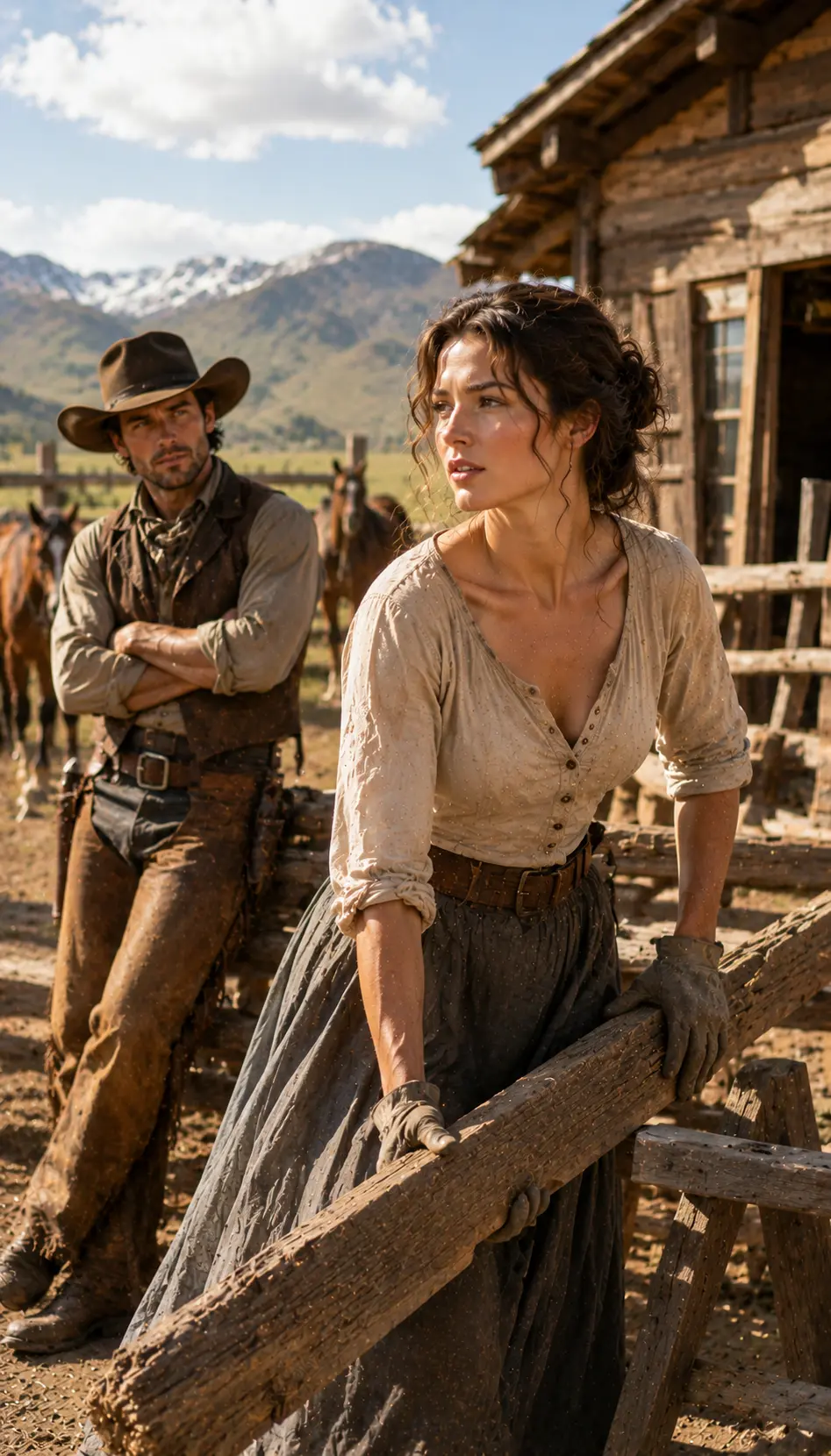
They sent Wade Langston a bride as a joke.
That was the part no one in town bothered to hide.
They dressed it up with polite words, of course, because people who enjoy cruelty rarely like to hear its real name. They called it charity. They called it community support. They called it an arrangement that would help a struggling rancher make it through the coming winter. They said every man needed a wife, and every dying ranch needed a second pair of hands.
But Wade knew what laughter sounded like when it wore church clothes.
He had heard it behind the general store, low and ugly, when the councilmen thought he was too far away to catch the words. He had seen it in the sideways smiles of men who had never fixed a roof in a storm but felt qualified to judge the man whose roof was failing. He had watched women look at him with pity sharpened into amusement, as if his loneliness had become a form of public entertainment.
They were sending him Bonnie Hallstead.
The name had traveled faster than the wagon that carried her.
Three towns back, people said she was lazy.
Two towns back, they said she could not lift a bucket without resting twice.
At the last saloon before Langston land, someone told the driver she had once let a whole household fall apart around her while she sat inside doing nothing, waiting for others to serve her.
Lazy.
Useless.
A burden.
A woman no decent man had wanted and no sensible family had kept.
That was what Wade had been told.
And now the wagon stopped at the edge of his property, right where the fence posts leaned like broken teeth against a sky the color of old brass.
Wade stood on the porch with his jaw locked and his hands at his sides, trying not to show how much the whole thing humiliated him. His ranch spread before him in the late afternoon light, every failure exposed. The house roof sagged on the west side. The barn door hung crooked from stripped hinges. The corral fence had collapsed in two places. The well rope needed replacing. The water trough leaked faster than he could fill it. The earth was cracked from drought, the grass thin, the creekbed nearly empty.
Two seasons alone had taken more from him than he wanted to admit.
The drought had taken the creek.
The wind had taken the barn door.
Time had taken everything else.
He had needed help.
Real help.
Not a joke dressed in a torn hem and sent to shame him.
The wagon driver did not even wait for payment. He pulled the reins, turned the horses, and left without looking back, dust rising behind the wheels like the end of a bad dream.
Bonnie Hallstead stood in the yard with a single canvas bag at her feet.
It was the kind of bag that held almost nothing.
She did not call after the wagon.
She did not ask Wade for help.
She did not look frightened in the way he expected.
She stood still, hands at her sides, and surveyed the ranch.
Not with disgust.
Not with fear.
Not even with disappointment.
Her eyes moved across the broken roof, the leaning barn, the cracked trough, the empty corral, the fence line barely holding its shape against the wind. She looked at everything as if she were measuring it, not against failure, but against possibility.
That was the first thing that bothered him.
The stories had prepared him for laziness. Resentment. Weakness. A woman who would step down from the wagon and immediately complain about the dust, the cold, the distance, the condition of the house. A woman who would confirm every rumor before the sun dropped behind the hills.
Bonnie did none of that.
She stood there in a travel-worn dress, the hem torn and dusty, her shoulders narrow but straight, her cheeks hollow from something more than one hard ride. Her hands were hidden partly in the folds of her skirt, but when she shifted her grip on the canvas bag, Wade saw the skin of her palms.
Calluses.
Fresh ones.
Raw across the base of her fingers.
Not the soft, idle hands of a woman who never worked.
Wade pushed the observation down before it could soften him.
He had been fooled by appearances before.
He stepped off the porch, boots scraping against wood that needed replacing, and stopped three paces from her.
Close enough to see the dust clinging to her dress.
Far enough to keep his doubts private.
“You Bonnie Hallstead?”
His voice came out harder than he meant.
She turned to face him.
Up close, her eyes were steady. Not avoiding his. Not challenging him. Just looking, as if she had spent years having men decide who she was before she opened her mouth and had finally stopped wasting energy on surprise.
“I am.”
“They say you can’t work.”
“They say a lot of things.”
Wade felt his jaw tighten.
He did not have patience for riddles. Not with winter pressing against the calendar. Not with a ranch falling apart around him. Not with people in town waiting to laugh when the whole arrangement failed.
“Can you work or not?”
Bonnie looked past him again, toward the house. Then the barn. Then the trough. Then the fence.
When her eyes came back to his, something had shifted in them.
Not fear.
Not shame.
A spark.
“Guess we’ll find out.”
She picked up her bag and walked past him toward the house.
Wade stood where he was, caught between irritation and confusion.
The woman everyone called useless had just walked past him like she owned the place.
Not arrogantly.
Not grandly.
But with the certainty of someone who had already begun arranging the broken parts in her mind.
He turned to follow her, but she was already at the door, pushing it open, stepping inside before he had even decided whether to invite her.
The sun was setting behind the hills, painting the dying ranch in shades of red and gold. Wade looked at the barn, at the work that needed doing, at the impossibility of surviving another season if nothing changed.
Then he looked at the house where Bonnie Hallstead had disappeared.
Tomorrow, he told himself, he would know.
Tomorrow he would find out if the rumors were true.
Tomorrow he would see if this was the final joke before everything fell apart.
But that night, as cold settled over the land and the wind pushed through the gaps in the walls, something kept him awake longer than anger should have.
Those calluses.
The way she had looked at the barn.
The way she had said, “Guess we’ll find out,” not like someone defending herself, but like someone accepting a challenge.
Wade woke before dawn, as he always did.
The cold had crept into the house overnight and settled in the floorboards. He could see his breath in the gray light. For a few seconds he lay still, listening to the silence, expecting nothing but the usual sounds: the wind around the eaves, an animal shifting near the barn, the empty house reminding him he was the only one responsible for keeping it standing.
Then he smelled smoke.
Not danger.
Stove smoke.
He sat up.
The kitchen was already warm.
When he stepped into the main room, still buttoning his shirt, he found orange embers glowing in the belly of the stove and a pot of water heating on top. The floor had been swept. The dishes he had left stacked in a shameful pile were clean and set neatly on the shelf. The table had been wiped down. Someone had folded the rag he usually tossed over the chair.
Wade stopped with one hand on the doorframe.
Outside, the first faint light crept across the yard.
Bonnie was already near the barn.
She stood by the crooked door, not staring helplessly at it, but examining it with the attention of a carpenter. She ran her fingers along the frame, checked the wood near the hinges, pushed lightly at the door, stepped back, looked at the angle, then walked toward the side of the barn where Wade kept what remained of his tools.
She picked up a hammer.
Weighed it.
Set it down.
Chose a heavier one.
Wade grabbed his coat and went outside.
The ground was hard with frost. His boots crunched across the yard. Bonnie did not turn when he approached. She was measuring the barn door against the frame with her eyes, lips pressed together in concentration.
“You know how to fix that?”
He tried to keep his voice flat.
Bonnie glanced at him, then back at the door.
“Hinges are stripped. Frame is rotted on this side. Door’s too heavy for what’s holding it.”
She pointed to the split wood near the top hinge.
“Needs new mounting points and a support beam across the top. Otherwise, you can fix the hinge ten times and it’ll fail eleven.”
Wade blinked.
Those were not the words of someone who could not work.
Those were the words of someone who understood structure.
Weight.
Strain.
The difference between patching a problem and solving it.
“You know how to do that?”
Bonnie set the hammer down and looked at him directly.
“Your problem isn’t the door. It’s the frame.”
He did not answer.
“You fix the door without fixing the frame, and you’re wasting time.”
Then she walked past him toward the house.
“I’ll need breakfast before I start. You have flour?”
Wade stood in the cold yard, feeling something uncomfortable rise beneath his irritation.
Respect.
He followed her back inside, mind racing.
The stories did not match.
None of this matched.
A woman who could not lift a bucket did not wake before dawn, clean a kitchen, warm a stove, and diagnose a barn door before sunrise.
Inside, Bonnie was already mixing flour and water in a bowl, her hands moving with practiced efficiency. Not pretty little motions meant for display, but practical ones. Press, turn, fold, judge by feel.
Wade sat at the table and watched.
“Who taught you?”
“Which part?”
“The door.”
“My father built houses.”
She did not look up.
“I helped him from the time I could hold a nail steady.”
“Then why do they say you can’t work?”
Her hands stopped moving.
For a moment, the only sound was the stove crackling softly.
When she spoke, her voice was quieter, but there was steel under it.
“Because I said no to the wrong man.”
Then she went back to the dough.
Wade sat very still.
He understood stories.
Not the kind in books. The kind people used to trap other people. The kind that spread from porch to saloon to church steps until nobody remembered who first told it or whether it had ever been true. He had been living under his own share of them for years.
The biscuits baked while the sun rose.
They ate in silence.
Wade had not tasted food that good in months.
Bonnie finished her plate, rose, and went to the door. She paused with one hand on the frame and looked back.
“The barn won’t fix itself. You coming?”
Wade pushed back from the table and followed her into the cold morning.
Whatever she was, whoever she was, the stories had been wrong.
And if they were wrong about her, maybe this ranch still had a chance.
By midday, Wade stopped pretending to lead.
Bonnie worked with a precision that made his own efforts seem clumsy. She measured twice before cutting wood. Marked support beam placements with charcoal. Drove nails with clean, direct strikes that did not bend or miss. Wade held boards in place while she secured them, handed her tools when she asked, and tried not to stare at the way she moved through the work like someone who had done it a thousand times.
The barn door hung straight for the first time in a year.
Wade tested it, swinging it open and closed. Smooth. Solid. No grinding. No sagging. No groan of wood preparing to fail.
He looked at Bonnie.
She was already walking toward the water trough.
“This won’t last another week,” she said, kneeling beside it. Her fingers traced the cracks running through the boards like spiderwebs. “When did it start leaking?”
“Two months ago.”
“I patched it with tar.”
“Tar’s temporary. Wood is too dry. It needs replacement, not patching.”
She stood and looked across the corral, the leaning posts, the fallen rails, the gaps he had learned to walk past because admitting the size of the work felt worse than doing only what he could.
“How long has this place been falling apart?”
Heat rose in Wade’s face.
“Long enough.”
He stood too, defensive now.
“I’ve been doing what I can alone.”
“I know.”
Bonnie’s voice was not accusing. That made it worse somehow.
“But alone isn’t enough for a place this size. You need help. Real help.”
“That’s why you’re here.”
The words came out sharper than he intended.
Bonnie turned to face him.
For the first time since she had arrived, he saw something close to hurt move across her face. It was brief, quickly buried, but real.
“I’m here because they sent me as a joke,” she said. “Because they wanted to watch you fail with a useless woman at your side.”
She stepped closer, voice low and firm.
“So yes, I’m here. And yes, I’m working. But don’t pretend you asked for me. Don’t pretend you wanted this.”
Wade opened his mouth.
Thunder rolled across the sky before he could answer.
Both of them looked up.
Dark clouds were gathering in the west, moving faster than seemed natural. The wind shifted, cold and sharp, carrying the scent of rain.
Bonnie’s expression changed immediately.
Not fear of the storm itself.
Fear of what it would do to a house already too broken to take another beating.
“The roof,” she said.
Then she was running.
“Wade, the roof has holes. If this storm hits hard, everything inside will be ruined.”
He followed, mind racing through what little they had in the house: blankets, flour, tools, ammunition, the few papers he could not afford to lose. All of it would be soaked if rain poured through unchecked.
By the time he reached the house, Bonnie was dragging a ladder from behind the barn.
“You can’t go up there,” he said, grabbing the ladder. “Not in this wind.”
“Then help me or get out of my way.”
She pulled the ladder from his grip with surprising strength.
“I didn’t come here to watch another thing fall apart because someone was too afraid to act.”
The first raindrops hit fat and cold.
Thunder cracked overhead. The wind gusted hard enough to make the ladder shake in her hands.
Wade looked at the roof.
Then at Bonnie.
Then at the storm bearing down on them with the kind of fury that could destroy what little was left if they did not move now.
He grabbed one end of the ladder.
“Together. We do this together or not at all.”
Bonnie nodded once.
They moved.
The ladder went up against the side of the house just as the rain began in earnest. Wade climbed first with Bonnie right behind him, both of them carrying canvas, nails, rope, and every scrap of material that might hold. The wind tried to tear them from the roof. Rain turned the shingles slick beneath their boots. Thunder shook the boards under their knees.
They worked side by side.
Covering holes.
Securing canvas.
Driving nails.
Tying rope.
Bracing where wood had softened.
Below them, the ranch that had been dying piece by piece seemed to fight for survival in a single night.
And on the roof, soaked through and shaking from cold, Wade Langston realized the woman everyone had called useless might be the only reason he had any chance at all.
Lightning split the sky.
For one bright second, the whole yard flashed white.
That was when Wade saw the sign.
Near the road, tied to a fresh fence post with a rope, barely visible through the rain.
The storm passed near midnight, leaving the land soaked, steaming, and suddenly colder.
Wade and Bonnie climbed down from the roof with water dripping from their clothes and exhaustion sitting heavily in every movement. Neither spoke as they walked toward the fence line where the sign hung crooked in the dark.
Wade’s boots sank into the mud.
Bonnie walked beside him, breathing steady, though he knew she had to be running on nothing but stubbornness.
The sign was carved deep enough to read in the dim light from the house.
Lazy bride for lazy land.
Below it, smaller and crueler:
Watch them both rot.
Wade stopped three steps away.
Rage moved through him so fast his hands shook.
Bonnie stood beside him, rainwater still running from her hair, face pale and unreadable.
He reached up and tore the sign down.
Wood splintered under his grip.
The post beneath it was fresh. Planted recently. Someone had come onto his land while they worked on the roof, while they fought the storm, while they saved what they could. Someone had stood in the rain and left this for them to find.
“They want us to fail,” Wade said, voice rough. “They’re watching.”
Bonnie took the broken sign from his hands and examined the letters in the faint light.
“These were carved today. Wood’s still wet inside.”
She looked toward the road.
“Whoever did this was here during the storm. They wanted us to see it right away.”
Wade felt something cold settle in his stomach.
Not fear.
Violation.
His land. His fence. His home. Their struggle turned into someone else’s entertainment.
“Who would do that?”
Bonnie’s face hardened.
“People who need us to be a joke. People who sent me here hoping we’d both give up.”
She dropped the sign into the mud and stepped on it, pressing it down with her heel.
“They don’t know who they’re dealing with.”
Wade looked at her.
Really looked.
She was soaked through. Hair plastered to her face. Dress clinging to her legs. Her hands were torn where splinters had cut into her palms on the roof. She should have been broken by now. Crying. Demanding to be taken back to town. Asking why she had been sent to this failing place with a man who had not even wanted her.
Instead, she stood in the mud, defiant and ready to keep fighting.
Something in Wade’s chest tightened.
An emotion he did not want to name.
“You need to dry off,” he said. “Before you catch something worse than splinters.”
Bonnie did not move.
“Tomorrow we fix the water trough. Day after, the corral.”
Her eyes found his in the dark.
“They think we’ll quit. We’re going to prove them wrong.”
Wade nodded slowly.
“Every fence post. Every broken board. We fix it all.”
They walked back to the house together, leaving the broken sign behind in the mud.
Inside, Wade built up the fire while Bonnie changed into dry clothes in the back room. When she emerged, she moved to the stove without a word and began heating water for tea.
Wade watched her.
Methodical.
Calm.
Still moving forward.
Most people would have fallen apart. Most would have demanded comfort, explanations, rage, promises.
Bonnie just kept going.
She handed him a cup and sat across from him at the table. The fire crackled between them, and outside, the night settled into an uneasy quiet.
Wade wrapped his hands around the warm cup.
“How long have you been fighting this?”
Bonnie looked into her tea.
“Since I was old enough to understand that some people measure worth by obedience instead of ability.”
Her voice remained steady, but he heard the weight beneath it.
“My father taught me to build. My mother taught me to think. Both taught me never to bow just because someone demanded it.”
“And that got you labeled lazy?”
Her mouth tightened.
“A man named Gerald Pritchard. He owns half the businesses across three settlements. He wanted a wife who would smile, sit still, and make him look generous. When I said no, he made sure no one would hire me. Made sure every room I entered already knew what to think of me.”
She took a slow sip.
“Made sure that when I finally had to accept help, it would come from someone desperate enough not to care about the rumors.”
“Someone like me,” Wade said.
Bonnie met his eyes.
“They sent me here because they thought we’d both fail together.”
Wade set his cup down.
“And they thought I would blame you for it.”
“Yes.”
She stood and walked to the window, looking out over the dark land.
“But they were wrong about something important.”
“What?”
“They thought we’d accept failure.”
For three days, they worked like the insult had become fuel.
The water trough was rebuilt with new boards, fitted and sealed properly so it held water for the first time in months. The corral fence was straightened, posts dug deeper, rails secured with joinery instead of nails and hope. The barn door remained steady. The house roof held through another short rain. Wade repaired the well rope, and Bonnie reorganized the tool shed so thoroughly that he found things he thought he had lost the previous spring.
Bonnie worked until her hands bled, wrapped them, and kept working.
Wade found himself matching her pace, pushing harder than he had in months. Maybe years. Not because she shamed him, but because her determination dragged something buried out of him. The part of him that had first come to this land believing he could build a life from nothing.
On the fourth morning, Wade woke to find Bonnie already outside, standing still near the barn.
He dressed quickly and joined her.
She pointed to the ground.
Tracks.
Bootprints that were not theirs.
They circled the barn, crossed near the house, moved along the fence line, stopped by the tool shed, then returned toward the road.
Fresh from sometime in the night.
“Someone was here,” Bonnie said.
Her voice was flat in a way that made Wade’s skin crawl.
They followed the prints together.
Nothing was taken. Nothing broken. The barn latch remained locked. The house door had not been touched. The point had not been theft or damage.
“They were checking everything,” Bonnie said. “Seeing what we fixed.”
Wade crouched beside one print, measuring it against his hand. Bigger than his own boot. A heavy man. Confident enough not to hide his path.
“They want us to know they can come here whenever they want,” she said.
Anger flared hot in Wade’s chest.
This was his land.
His home.
The idea of someone walking it in the dark, circling like a predator, made every muscle in his body tighten.
“We set watch tonight.”
Bonnie nodded, though her eyes remained troubled.
“What happens when watching isn’t enough?”
Wade had no answer.
He looked at the ranch, at everything they had repaired, at how fragile progress felt when someone powerful wanted it undone.
“They want us afraid.”
“Then we don’t leave,” Bonnie said. “We keep fixing. We show them we’re not going anywhere.”
That day, they reinforced the barn door with a heavy crossbar that could be dropped from inside. They added a similar bar to the house door. Checked sight lines from the windows. Moved lanterns. Cleared brush too close to the barn. Practical preparations that made the danger feel more real.
When evening came, they ate in silence.
Both too aware of the darkness gathering outside.
Wade checked the windows once more, then looked at Bonnie across the table.
“I’ll take first watch. You should rest.”
She shook her head.
“We both watch. If something happens, we need to be ready together.”
So they sat in the dark kitchen with the fire banked low, watching through the windows as night settled over the land.
Hours passed.
Nothing moved but wind through the grass and moonlight sliding across the yard.
Wade felt his eyes growing heavy despite his determination. Beside him, Bonnie remained perfectly still, focused on the yard as if she could hold danger back by refusing to blink.
Near midnight, they both saw it.
A light on the road.
Small.
Swaying.
A lantern being carried.
Wade stood slowly, hand moving to the rifle leaned against the wall. Bonnie rose too, face pale but composed.
The lantern stopped at the edge of the property.
Right where the sign had been planted.
For several seconds, it hung there in the dark like an eye.
Then it moved toward the barn.
Slow.
Deliberate.
Whoever carried it wanted to be seen.
Wade’s heart hammered against his ribs.
The lantern reached the barn door.
Stopped.
Then came the sound.
Liquid splashing against wood.
The sharp smell of kerosene drifted on the wind.
Wade grabbed the rifle and was out the door before Bonnie could stop him.
Cold air hit his face as he ran. Behind him, Bonnie followed, steps quick and determined. The lantern swung wildly as the figure turned at the sound of their approach. Wade saw him now: a bulky man in dark clothes, tall, matching the heavy bootprints from morning.
The man dropped the lantern and ran.
Glass shattered against the barn wall.
Flames spread instantly across the kerosene-soaked wood.
For one terrible second, Wade froze between chasing the intruder and stopping the fire.
Bonnie made the decision for both of them.
She sprinted toward the well.
The bucket dropped fast.
Rope burned through her palms as she hauled water up with desperate speed. Wade took the first full bucket and ran to the barn, throwing water against the flames already climbing toward the roof.
The fire fought back.
Fed by kerosene.
Dry wood.
Wind.
Bonnie was already back with another bucket.
Then another.
They moved in brutal rhythm.
Draw water.
Run.
Throw.
Repeat.
The heat singed Wade’s face and hands. Smoke burned his lungs. His arms ached. Bonnie stumbled once, caught herself, and kept going. The barn held what remained of his hay, tools, winter supplies, spare boards, every chance the ranch had of surviving the next season.
If it burned, they were finished.
Bonnie staggered near the well.
Wade caught her arm.
“Keep going,” he rasped. “We’re winning.”
And they were.
Slowly.
Painfully.
The flames began to shrink.
The intruder had splashed kerosene on one wall only. If he had taken time to soak the whole structure, nothing could have saved it. Maybe he had been rushed. Maybe frightened. Maybe he had expected them asleep and panicked when they came running.
The fire gave way.
Steam rose where water met heat.
At last, only smoking blackened wood remained.
They collapsed beside the well, both coughing, soaked in sweat, water, and ash.
The barn wall was scarred but standing.
One section would need replacing. Part of the roof had burned through. But the hay inside remained mostly safe, and the structure had not collapsed.
They had saved it.
Barely.
But they had saved it.
Bonnie shook beside him, not from cold, but from the aftermath of fear and exhaustion. Her hands were raw from the rope. Soot streaked her face. Wade reached out without thinking and brushed a dark smudge from her cheek.
The gesture was gentle.
Too gentle to hide behind practicality.
They both went still.
Bonnie looked up at him, eyes reflecting the dying embers.
“You saved it,” Wade said, voice rough. “If you hadn’t moved so fast, I’d be watching it all burn right now.”
She shook her head.
“We saved it together.”
Something cracked open in Wade’s chest.
This woman everyone had called worthless had fought beside him like a partner. Like someone who belonged. Like someone who cared about the ranch as much as he did, though it had been nothing but cold walls and broken boards when she arrived.
He wanted to say something.
Needed to.
But words would not come.
Then they heard hoofbeats.
Fast.
Coming closer.
Wade grabbed the rifle again and stepped in front of Bonnie by instinct.
Three riders came into view with torches held high.
As they drew near, Wade recognized the man in front.
Gerald Pritchard.
Tall.
Well-dressed even at that hour.
Face composed with the kind of cruelty that never had to hurry because it believed the world would wait for it.
He stopped at the edge of the yard and looked at the smoking barn, at Wade and Bonnie covered in soot, and smiled.
“Heard you might be having trouble out here,” Pritchard said. “Thought I’d check. Make sure everyone was all right.”
Wade raised the rifle, not aiming to harm, but clear enough to make the boundary unmistakable.
“Get off my land.”
“Your land?” Pritchard looked around theatrically. “Barely standing structures. Dying grass. Burned barn. This does not look like anyone’s land. It looks like failure.”
His gaze moved to Bonnie.
“Miss Hallstead, you look tired. Perhaps it is time to admit you made a mistake coming here. I’m sure we could find something more appropriate for you back in town.”
Bonnie stepped forward, placing herself beside Wade instead of behind him.
“I am exactly where I choose to be.”
Pritchard’s expression darkened.
The two men behind him shifted in their saddles.
The standoff held.
Wade’s hands stayed steady despite exhaustion pulling at every muscle. Bonnie stood unarmed but unflinching, her presence a statement all its own.
Pritchard broke the silence first.
“You know, Langston, I heard stories about you too before you bought this worthless piece of land and tried to make something of it.”
Wade felt ice spread through him.
“They say you walked away from a partnership back home. Left your own brother with debts you helped create. That’s why you’re out here alone, isn’t it? Because no one would work with you after what you did.”
The past hit like a fist.
Wade had buried it when he rode west.
He had hoped distance could outrun a story.
But stories always followed.
Truth or lies or something twisted between them, they found a way to arrive.
“I paid every cent I owed,” Wade said, voice low. “My brother made his own choices after I left.”
Pritchard shrugged.
“Maybe. But people remember the story they want. Just like they remember Miss Hallstead as lazy and useless. Just like they’ll remember your barn burned because you couldn’t protect it.”
Bonnie’s voice cut through the night.
“The barn is still standing.”
Pritchard looked at her.
She took one step forward.
“Your man failed to burn us out. That is the real story.”
His jaw tightened.
“From where I sit, you are exhausted, broke, and one bad storm away from losing everything anyway.”
He straightened in the saddle.
“I am a reasonable man. I’ll make you both an offer. Langston, sign this land over to me at a fair price. Not much, but enough to start somewhere easier. Miss Hallstead, come back to town under my protection, and I will make sure the stories about you change. People will know you tried your best, but this place was beyond saving.”
Wade felt Bonnie tense beside him.
The offer was poison dressed as mercy.
Pritchard wanted the land.
He wanted Bonnie under his control.
He wanted proof that resistance always ended at his feet.
“And if we refuse?” Wade asked.
Pritchard smiled again.
“Stories get worse. Accidents happen. Fires start. People talk. Eventually you’ll have no choice but to leave. And when you do, you’ll leave with nothing.”
Wade looked at the ranch.
The smoking barn they had just saved.
The trough and corral they had repaired.
The fence posts reset with bleeding hands.
The home he had tried to build from nothing.
Then he looked at Bonnie.
At the woman who had fought beside him, who had proved every story wrong and now faced the man who had destroyed her reputation without lowering her eyes.
She met his gaze.
And in that moment, Wade saw his answer reflected back.
They had both been judged by stories.
Both condemned by people who preferred lies because lies were convenient.
But here, on this struggling ranch, they had found something worth fighting for.
Not just land.
Not just buildings.
Proof.
Proof they could be more than what others said.
Wade lowered the rifle slowly.
Pritchard’s smile widened, mistaking the gesture for surrender.
Then Wade spoke, his voice carrying across the dark yard with absolute certainty.
“Get off my land.”
The smile vanished.
“We’re not leaving. We’re not selling. And if you send another man to damage what we build, I will make sure every family from here to the county seat knows who stands behind it. Your name. Your threats. Everything.”
Pritchard’s face went hard as stone.
The men behind him shifted again, but Pritchard raised one hand to stop them. He stared at Wade and Bonnie for a long moment, anger and calculation battling in his eyes.
Then he turned his horse.
“You’ll regret this. Both of you.”
His voice was cold.
“When this ranch fails, and it will fail, do not come begging for help.”
He rode away with his men behind him, torches shrinking into the night.
Wade and Bonnie stood in the yard listening to the hoofbeats fade.
They had drawn a line.
And they knew there would be consequences.
For six weeks, they lived like people expecting the next blow.
They rebuilt the burned barn wall with salvaged timber. They patched the roof again, this time stronger. They reset fence lines, repaired the chicken coop, cleaned the well, organized tools, and reinforced every weak place they could find.
No more signs appeared.
No more footprints circled the barn.
But the road always felt watched.
Every rider on the horizon made Wade reach for caution. Every strange sound at night woke Bonnie before dawn.
Yet fear did not stop the work.
If anything, it hardened it.
Bonnie’s hands changed in those weeks. The raw wounds became calluses. The calluses cracked, then toughened. Her movements grew easier around the ranch. She stopped asking where tools were because she had reorganized them herself. Wade stopped expecting her to leave because each morning she rose before him and set the day in motion.
They argued, of course.
About how deep to set posts.
About whether the west wall needed bracing first or the barn roof.
About whether Wade was working too late.
About whether Bonnie was working too hard.
Their arguments became part of the rhythm of the ranch, not proof of failure but proof that both of them cared enough to fight for the best way forward.
One evening, after a long day repairing the shed roof, Wade found Bonnie sitting on the porch steps, rubbing salve into her palms. The sunset painted her hair copper and gold. Her dress was patched at both elbows. Her face was tired, but peaceful in a way he had not seen before.
He sat beside her.
“They were wrong about you.”
She did not look at him.
“You’ve said that.”
“I mean it different now.”
“How?”
“At first I meant they were wrong because you could work.”
She turned slightly.
“And now?”
“Now I mean they were wrong because they thought work was the measure of your worth.”
Bonnie’s hands went still.
Wade looked out across the yard, toward the barn standing solid against the evening.
“You were worthy before you fixed a single thing.”
She said nothing for a long time.
When she finally spoke, her voice was quiet.
“So were you.”
The words landed in him gently and painfully at the same time.
He had not known how badly he needed to hear them.
Six weeks after Pritchard rode away, three wagons arrived at the ranch unannounced.
Wade was reinforcing the new barn wall when he saw them coming down the road. Bonnie stood beside him, handing nails with hands that had callused completely over. Both stopped, watching the wagons approach with the wary stillness of people who had learned not to trust unexpected visitors.
But these were not Pritchard’s men.
The first wagon held a family: a husband and wife, two children tucked between them. The second carried an older man and his grown son. The third carried supplies, lumber, tools, and sacks under canvas.
The wagons stopped at the edge of the property.
The first man climbed down, hat in hand, expression uncertain but determined.
“Mr. Langston. Miss Hallstead.”
He glanced between them.
“My name is Thomas Brennan. We’re from the settlement east of here. We heard what happened. Heard about the fire. Heard about Pritchard’s threats.”
Wade stepped forward slowly.
“What are you doing here?”
Thomas Brennan looked back at the other wagons, then at Wade.
“Pritchard’s been doing this for years. Buying land from people he bullied into selling. Spreading lies about anybody who wouldn’t bend. Most of us were too afraid to say anything.”
He straightened.
“But you did. Both of you. We figured if you were brave enough to fight, maybe we ought to be brave enough to help.”
The older man climbed down from the second wagon.
“Pritchard came to me last week. Said he heard I was thinking of expanding my farm onto land he wants. Made threats. Made it clear I should sell to him instead.”
His jaw tightened.
“Then I heard you told him to leave.”
He looked at the ranch, at the repaired barn, the straightened corral, the reset fence posts.
“Figured that makes you the kind of neighbors worth having.”
Bonnie’s eyes widened as understanding hit.
“You came to help us build.”
“Not just build,” Thomas said. “We came to make sure this ranch stands. Pritchard cannot burn people out or threaten them into giving up if we stop pretending each family is alone.”
Over the next four days, the ranch transformed.
The burned barn wall was replaced with lumber the neighbors brought, stronger than before. The roof was redone, sealed tight against weather. The corral was expanded. Fencing was extended. The porch was rebuilt with straight boards that did not creak underfoot. Windows were repaired so they closed properly against the cold. The foundation under the west wall was reinforced.
Wade and Bonnie worked beside their new allies until exhaustion gave way to something stronger.
Hope.
Real, physical hope.
The kind that sounds like hammering.
Like laughter over lunch.
Like children carrying nails in coffee tins.
Like someone shouting, “Hold that beam steady,” and five hands rising to help.
On the morning of the fifth day, another rider came.
A young man from town.
He carried a letter, handed it to Wade, tipped his hat nervously, and left before anyone could ask questions.
Wade opened it with Bonnie reading over his shoulder.
The town council had written in formal language, but the meaning was plain.
Gerald Pritchard had been asked to leave the territory after multiple families came forward with complaints of threats, intimidation, and suspicious property dealings. An investigation had been opened into the fire at Langston Ranch. Pritchard had departed three days earlier, heading east.
Unlikely to return.
Wade read it twice.
Then he handed it to Thomas Brennan, who read it aloud to everyone gathered in the yard.
The cheers started quietly.
Then grew.
Someone clapped Wade on the back. Someone else hugged Bonnie before realizing she had not expected it and stepping back with a shy apology. The children laughed because adults were laughing and that was enough.
The celebration was brief.
Practical.
Real.
That evening, after the families returned home, Wade and Bonnie stood on the new porch watching the sun set over land that finally looked like it might survive.
The ranch was not perfect.
There was still work to do. Seasons to endure. Cattle to protect. Crops to try. Storms to face. Money would be tight. Winter would still be winter. The land would not become generous just because people had helped.
But the structures stood strong.
The fences held.
The barn was solid and dry.
The house no longer looked like it was apologizing for existing.
And most importantly, the stories had begun to change.
Wade turned to Bonnie in the golden light.
Her hair was tied back with a strip of cloth. Her dress was patched and worn from labor. Her hands carried permanent marks now: rope burns, splinter scars, the rough proof of building something real.
She was the furthest thing from lazy he had ever seen.
“They were wrong about you,” he said softly. “Every single person who said you couldn’t work, couldn’t build, couldn’t do this. They were all wrong.”
Bonnie smiled.
A real smile.
One that reached her eyes.
“They were wrong about you too.”
He looked at the ranch.
She followed his gaze.
“About this place,” she said. “About what was possible.”
The sun dropped lower, painting the sky red and gold.
“We built this with bare hands,” Bonnie said. “Bare hands, stubbornness, and refusal to accept what other people decided we were.”
Wade felt something settle in his chest.
A piece he had not known had been missing for years.
“Yes,” he said. “We did.”
She turned toward him.
“What now?”
He looked at her, then at the house, then at the land that no longer felt like a burden he carried alone.
“Now we keep building.”
Bonnie held his gaze.
“Together?”
The word was simple.
But everything waited inside it.
The roof. The barn. The mud. The fire. The sign. The broken stories. The nights they sat awake watching for danger. The days they worked until hands bled. The neighbors who came because two people refused to fall.
Wade reached for her hand.
“Together.”
She let her fingers close around his.
Neither of them spoke for a long moment.
They did not need to.
The ranch stood solid in the gathering dusk, no longer dying, no longer abandoned to slow ruin. Behind them, the house glowed warm through repaired windows. Ahead of them, the land stretched wide and difficult and waiting.
People would tell the story for years.
Some would say the town sent Wade Langston a lazy bride to humiliate him and instead she rebuilt his ranch with her bare hands.
Some would say Wade was a failing man saved by the stubborn woman everyone underestimated.
Some would say Bonnie Hallstead got revenge on every person who called her useless by refusing to break.
All of that was true.
But not the whole truth.
The whole truth was quieter.
Wade did not save Bonnie.
Bonnie did not save Wade.
They recognized each other in the wreckage of other people’s lies.
He saw the calluses beneath the dust.
She saw the man beneath the failure.
He gave her a place where her strength could finally be used instead of mocked.
She gave him proof that alone was not the only way to endure.
Together, they turned a joke into a foundation.
A curse into a home.
A dying ranch into a place strong enough for neighbors to gather around.
And if the best revenge is simply refusing to fall, then Wade Langston and Bonnie Hallstead took theirs every morning the sun rose over that rebuilt barn.
Every time the trough held water.
Every time the porch boards stayed firm.
Every time the door opened smooth on hinges Bonnie had set herself.
Every time someone passed the ranch and saw smoke rising from the chimney instead of ash.
Gerald Pritchard had thought stories had power.
He was right.
But he had forgotten something.
Stories can change.
And when they do, the people who once used them as weapons often find themselves standing on the wrong side of the ending.
Bonnie Hallstead was not lazy.
Wade Langston was not a failure.
And the ranch they were meant to lose became the place where both of them finally proved that no rumor is stronger than work, no insult is stronger than dignity, and no person is truly finished until they decide to stop standing back up.
That autumn, when the first frost silvered the fence rails, Bonnie stood in the yard before dawn and watched the ranch breathe in the cold.
The barn stood straight.
The house held warm.
The sky brightened slowly over the hills.
Wade came out with two cups of coffee and handed one to her.
She took it, fingers brushing his.
“Cold morning,” he said.
“Good roof,” she answered.
He smiled.
“Strong barn.”
“Better door.”
“Stubborn woman.”
She looked at him over the rim of the cup.
“Stubborn man.”
They stood side by side as the sun rose, and the land that had once looked like a punishment now looked like a promise.
Nothing about the future would be easy.
But easy had never been the point.
The point was this:
They were still there.
Still standing.
Still building.
And that was the story no one had expected to tell.