“You Can’t Love Me,” said the Mountain Man — “Too Late,” She Whispered
The November wind screamed through the Colorado high country like it had a living throat.
Snow fell so thick over the ridges that the whole world seemed to vanish under white cloth. Trees bent beneath it. Rocks disappeared. Trails became guesses. The sky was gone, the mountains were gone, and the earth itself felt swallowed by a storm that had no mercy left in it.
Ezra Stone knew winter.
He had survived forty-eight of them in those mountains, and every scar on his hands could name a different season. He knew when snow was soft enough to trust and when it was hiding a drop that could break a man’s leg. He knew when the wind was only loud, and when it was trying to warn you. He knew how cold could sneak into a body quietly, politely, and sit there until the heart forgot why it had been beating.
He should have stayed inside.
He knew that too.
His cabin was warm enough. His firewood was stacked. His mule, Prophet, was already restless from the weather. The traps could have waited. Any sensible man would have poured coffee, shut the door against the world, and let the storm spend its anger without him.
But Ezra Stone had never been good at sitting still when the mountains were speaking.
So he pulled his bearskin coat tight, saddled Prophet, and pushed into the white.
The wind hit them like a wall.
Prophet lowered his head and moved forward, stubborn as only an old mountain mule could be. Snow rose to his knees, then his chest in the drifts. Ezra kept one hand on the reins and one against his hat, leaning into the storm as ice needled his beard and lashes. His breath turned white and vanished instantly.
By the time he reached the lower ridge, he was ready to turn back.
Then he saw it.
A shape in the snow that did not belong to the land.
Not rock.
Not fallen timber.
Not a stump.
A wagon.
Small. Broken. Half-buried. Its canvas cover had been torn apart by the wind and snapped loose from the ribs. One wheel leaned at a wrong angle. The shafts were empty, the mule that had once pulled it gone into the storm or taken by it.
Ezra felt his stomach tighten.
Wagons did not break in country like that without a story behind them. Sometimes the story was carelessness. Sometimes desperation. Sometimes both.
He guided Prophet closer and circled once, calling over the wind.
“Hello?”
No answer.
Only the storm.
He dismounted and searched the snow around the wagon, moving fast now, eyes sharp. A trunk had spilled open. A blanket lay frozen stiff against a wheel. A tin cup rolled beneath the wagon bed. Tracks were already disappearing under fresh snow, but he saw enough to know someone had tried to walk away.
Then he found her.
Twenty feet from the wagon.
A woman, half-buried in white, lying on her side as if she had simply lain down to rest and the storm had begun claiming her piece by piece.
Her coat was far too thin even for autumn. Her gloves were missing. Snow covered her skirt and legs. Her hair, pale gold beneath the ice, clung to her face. Her skin had almost no color at all.
Ezra dropped to his knees beside her.
“Ma’am?”
Nothing.
He brushed snow from her face with his bare hand and leaned close.
There.
The faintest rise and fall of her chest.
He pressed two fingers to her throat and found a pulse so weak it felt like butterfly wings fading against his skin.
“Stay with me,” he said.
His voice came rougher than he expected.
He gathered her into his arms.
She weighed almost nothing.
A frozen whisper of a person.
He carried her back to Prophet, tucked her inside his bearskin coat against his own body, and climbed into the saddle with awkward urgency. The mule shifted under the double weight but did not complain. Ezra wrapped one arm around the woman and held the reins with the other.
“Home,” he told Prophet. “Take us home.”
The mule pushed through the storm.
Ezra kept talking to the woman, not because he thought she could hear him, but because silence felt too much like surrender.
“You did not come all this way to die in the snow,” he muttered. “Not today. Not here. Stay with me if you can. Just keep breathing.”
The storm screamed around them.
Prophet stumbled twice. Ezra nearly lost his seat once. Snow filled his collar and burned his skin with cold. He held the woman tighter, sharing what little warmth he had, feeling her faint breath against his chest and counting every one like a prayer.
Ezra Stone had not prayed in eight years.
Not since his daughter died.
But as the white swallowed the trail and his cabin failed to appear where it should have, he found himself whispering words he thought had gone out of him forever.
“Please. Let her live.”
At last, the cabin emerged through the storm like a promise.
A low log structure tucked against the pines, smoke pulling sideways from the chimney. Ezra kicked the door open, carried the woman inside, and set her straight onto his own bed—the only bed he had.
Then he worked.
There was no time for panic.
Panic was for later, if later came.
He built the fire high until it roared. He cut away the frozen outer layers of her clothing only where he had to, keeping her covered with every blanket he owned. He warmed stones by the hearth and wrapped them in cloth. He pressed warm bottles near her sides, rubbed life back into her hands and feet, and kept checking her breath because each one seemed too fragile to trust.
The storm beat against the cabin walls.
Inside, the firelight held.
Hours passed.
The room smelled of smoke, wet wool, pine sap, and fear. Ezra sat beside the bed with his elbows on his knees, watching her face. Every shallow breath mattered more than anything in his world.
“Please let her live,” he whispered again.
Near midnight, the woman gasped.
Ezra leaned forward so fast the chair nearly tipped beneath him.
Her eyes fluttered open.
They were gray-green, sharp despite the feverish confusion in them, and full of the kind of fear that does not come from waking in a stranger’s cabin alone. It comes from remembering too quickly that the world is dangerous.
“You’re safe, ma’am,” Ezra said softly. “I found you in the snow.”
She tried to sit up, then cried out and fell back.
Ezra raised both hands where she could see them.
“Easy. You are in my cabin. Colorado high country. A storm hit you hard. You were nearly frozen.”
She looked at the fire.
The blankets.
The rifle above the door.
Then she looked at him.
Really looked.
Something in her expression shifted from terror to exhaustion, then to a deeper kind of pain.
“How long was I out there?” she whispered.
“Long enough.”
He did not tell her how close she had come to dying. Some truths do not help when a person has only just survived them.
He brought her water and helped guide the cup to her lips when her hands shook too hard to hold it. She drank slowly, as if every swallow had to fight its way down.
“What’s your name?” he asked.
She hesitated.
“Sarah,” she said. “Sarah Mitchell.”
“Ezra Stone.”
Her eyes moved again toward the window, where snow still slammed against the glass.
“What were you doing out there, Sarah?”
She did not answer immediately.
Her fingers tightened in the blanket.
“Running,” she said at last. “I was running from something.”
Ezra heard what she did not say.
Not from the storm.
From someone.
He did not push. He had lived long enough to know that fear tells the truth in pieces. Force it, and it closes its fist.
“All right,” he said. “Then you rest.”
Her eyes filled with something that might have been gratitude, but she was too tired to shape it into words.
The storm raged for days.
The cabin became its own little world, surrounded by white and noise. Sarah slept more than she woke at first, drifting between fever dreams and exhausted stillness. Ezra fed the fire, made broth, changed warm cloths, and kept his distance when she was awake.
He gave her space.
Not because she asked, but because every flinch told him she needed it.
When he handed her a cup, he placed it within reach and stepped back. When he brought food, he sat across the room. When she slept, he kept his chair angled toward the door instead of the bed, as if silently promising that any danger would have to pass him first.
By the fourth day, the wind finally slowed.
Sarah stood by the window wrapped in a blanket, pale but upright. Outside, the storm had left the world shining and dangerous, every tree bowed beneath snow, every ridge softened into light.
“It’s beautiful,” she said.
“And terrible,” Ezra answered. “The Rockies are both.”
A quiet settled between them.
Not heavy.
Not cold.
Something fragile.
Sarah’s hand moved unconsciously to her stomach, then stopped as if she had not meant for him to notice.
Ezra noticed anyway.
“I should tell you where I came from,” she said.
“You do not have to.”
“Yes,” she whispered. “I do.”
She turned toward him. Firelight touched the hollows beneath her eyes. Fear, shame, and pain moved through her voice like weather.
“I am married,” she said. “Or I was. It is complicated.”
Ezra stayed still.
“My husband’s name is Robert Mitchell. In Denver, people call him respectable. He owns mining supply contracts. Knows judges. Drinks with men who write laws and men who break them.”
She swallowed.
“At home, he was different.”
Ezra said nothing.
She held the blanket tighter.
“He hurt me. Not always where people could see. Not always with his hands. Sometimes with money. Sometimes with threats. Sometimes by making sure everyone thought I was delicate, unstable, ungrateful. For three years, he made my life smaller and smaller until I forgot what it felt like to breathe without permission.”
Ezra felt something cold settle in his chest.
“I tried to leave twice,” she said. “He found me both times. Brought me back. Made sure I understood that nobody would believe me over him.”
Her voice broke.
“When I found out I was carrying a child, I knew I had to run. I could not let him own a baby too. So I took his wagon, his mule, whatever I could carry, and I drove into the storm.”
Tears slipped down her face.
“I knew I might die out there. But it still felt safer than staying.”
Ezra moved closer, slow enough that she could step away if she needed.
“You survived,” he said quietly. “That means something.”
“I shouldn’t have.”
His voice came firm.
“Do not say that.”
She closed her eyes.
“I don’t know if I deserve—”
“You deserve to live. You deserve to be safe. So does that child.”
Silence filled the cabin again.
This time it did not feel like emptiness.
It felt like shelter.
Sarah wiped her face with the edge of the blanket.
“You saved me.”
Ezra looked toward the fire.
He did not say what he was thinking.
That maybe she had saved him too.
Because before he found her in the snow, Ezra’s life had become little more than firewood, traps, mule tracks, and memory. Eight years earlier, he had buried his daughter under a pine after fever carried her away faster than any prayer could reach. His wife had already been gone by then, taken by the hard life of the mountains and a grief that wore her down from the inside. After their child died, the cabin had stopped being a home and become only a place where one man kept breathing.
Then Sarah Mitchell arrived half-frozen in his arms.
And the fire seemed to matter again.
The danger did not end with the storm.
It only waited.
Sarah grew stronger each day. She ate more. Walked more. Helped with small chores when Ezra allowed it. She learned the rhythm of the cabin: coffee before sunrise, wood before noon, Prophet fed before breakfast, traps checked when weather allowed, water carried from the creek in buckets that steamed when brought inside.
But fear stayed in her eyes.
Ezra saw it when she stood too long at the window. When distant branches cracked beneath snow. When Prophet brayed suddenly in the barn. When a shadow moved where it should not.
She tried to hide it.
He saw anyway.
Three weeks after the blizzard, Sarah was kneading bread at the table when Ezra came in from outside with snow on his coat and tension in every line of his face.
“What’s wrong?” she asked, dropping the dough.
“Tracks.”
Her hands stilled.
“Fresh ones,” he said. “Single rider. Did not come to the cabin. Stayed by the tree line, watched, and rode off.”
Sarah’s face went pale.
“What kind of rider?”
“Hard to say. Good horse. Good boots. Not a trapper.”
Her breath quickened.
“Ezra… how long would it take someone to go from Denver to Leadville and back if they were searching?”
“Four weeks. Maybe less.”
“And how long have I been gone?”
“Nine.”
Tears filled her eyes.
“Then he could be here. Or someone he hired.”
Ezra stepped closer.
“You are safe here.”
Sarah shook her head.
“You do not understand. If Robert sent someone, they do not stop. He pays men enough to make cruelty look like work.”
“Then we face them,” Ezra said. “Together.”
For the first time, she did not argue.
That night, Ezra saddled Prophet and rode into Leadville.
He had to know if strangers had been asking questions. The ride was cold, the road silver beneath moonlight, and by the time he pushed through the doors of McGinty’s saloon, his coat was stiff with frost.
Pat McGinty looked up from behind the bar. Pat was a wide man with tired eyes, an old burn scar across one hand, and the kind of loyalty he tried to hide under grumbling.
“Ezra,” Pat said. “You look like weather dragged you here.”
“Anyone been through town asking about a woman?” Ezra asked. “Blonde. Traveling alone. Maybe from Denver.”
Pat’s expression changed.
“Yeah.”
Ezra’s gut tightened.
“Man came through ten days ago. Said he was looking for his employer’s wife. Offered money for information. Good money.”
“How much?”
“Fifty dollars just to talk. Another fifty if someone helped bring her back.”
Ezra looked around the room. Men stared into drinks, cards, walls—anywhere but at him.
That much money could make decent men hesitate.
And make indecent men eager.
“What was his name?” Ezra asked.
“Garrett. Said he worked for Robert Mitchell. Mining supply.”
Ezra left before his temper could speak for him.
He rode home fast, snow flying beneath Prophet’s hooves. Sarah was waiting by the fire when he returned, fear already in her face.
“You found something.”
He told her everything.
Her hands flew to her mouth.
“Garrett,” she whispered. “Robert’s foreman. Loyal. Dangerous. He once smiled while Robert destroyed a man’s business over a debt that was not even real.”
“We will be ready.”
Her voice shook.
“You are risking everything.”
“I know.”
“Why?”
Ezra looked at her then.
Because you are here.
Because he had heard her crying in her sleep.
Because a child who had not yet seen daylight already deserved better than Robert Mitchell’s shadow.
Because once, years ago, Ezra had failed to save someone he loved, and the grave had not let him forget.
“I would do it again,” he said.
The next morning, the world looked peaceful.
Snow sparkled beneath a hard bright sun. The pines stood still. Smoke rose clean from the chimney.
Then Ezra spotted riders on the southern trail.
“Sarah,” he said quietly. “Inside.”
She ran to the window.
Four men moved slowly through the snow, purposeful, spread out like they knew how to approach a place that might resist them.
Garrett rode in front.
Ezra handed Sarah the carbine.
“Stay behind me. Do not fire unless you must.”
“I will not run again,” she whispered.
Ezra looked at the fear in her face, and the strength beneath it.
Then he nodded.
Together, they stepped onto the porch.
The riders stopped twenty feet from the cabin. Garrett was tall, broad-shouldered, with a long coat and a face as cold as winter stone.
“Morning,” he called calmly. “Name’s Garrett. I am looking for a woman.”
“You best turn around,” Ezra said. “No one here belongs to you.”
Garrett’s gaze slid to Sarah.
“There she is. Mrs. Mitchell, your husband has been worried sick.”
Sarah’s voice trembled, but it held.
“I am not going back.”
Garrett sighed as if dealing with a child.
“Your place is with your husband.”
“No,” Ezra said. “Her place is wherever she chooses.”
Garrett studied him.
Then laughed quietly.
“You think this is your fight? You think a mountain man can stand against Robert Mitchell?”
“If he threatens her, I will stand against anyone.”
One rider shifted toward his gun.
Ezra raised his rifle faster.
“Do not.”
Garrett lifted a hand, and the man froze.
“You are brave,” Garrett said. “But bravery will not save you. Robert Mitchell has money, connections, legal papers. You are nothing compared to him.”
“Then tell him this nothing says he does not get her back.”
Garrett leaned forward in the saddle.
“I will give you one chance. Bring her to McGinty’s by tomorrow morning. I will forget this little mistake. If you do not, we come back. And next time, we will not talk first.”
The four men turned and rode away, their horses breaking the bright crust of snow.
Ezra lowered his rifle.
Sarah collapsed against him.
“You should not have done that,” she cried. “You should have let me go.”
“Never.”
“Ezra, they will hurt you.”
“Maybe.”
He held her tighter.
“But you are worth the risk.”
She looked up at him with tears in her eyes.
Then she kissed him.
Quick.
Desperate.
Like she feared he might disappear if she did not hold him to the earth.
“Whatever comes,” she whispered, “we face it together.”
The next morning, the saloon in Leadville went silent the moment Ezra and Sarah walked in.
Garrett sat at a table with three men behind him. The room smelled of tobacco, wet wool, stale whiskey, and tension. Every miner and farmer in the place seemed suddenly interested in their cups.
Ezra stood in the center of the room.
“She is not going anywhere.”
Garrett rose slowly.
“You are interfering in a marriage.”
Sarah stepped forward.
Her voice cracked, but stayed strong.
“I am leaving a man who made my life unsafe. That is all.”
Garrett smiled.
“Careful, Mrs. Mitchell. Your husband is prepared to be generous if you return before this grows unpleasant.”
Pat McGinty stepped from behind the bar with a shotgun held low.
“She stays.”
Garrett’s eyes moved to him.
“This is not your business.”
“Woman says no in my place, I hear it.”
One by one, chairs scraped.
A miner stood.
Then a farmer.
Then two teamsters.
Then an old woman who ran the laundry and had heard too many stories from women who had nowhere else to speak.
The fight drained slowly from Garrett’s eyes as he measured the room and realized the price had changed.
“For now,” he said. “You win for now.”
He turned to leave.
“But Mitchell does not give up.”
Ezra took Sarah’s hand as Garrett stepped into the street.
“We bought time,” he said quietly. “But we are not safe yet.”
Sarah looked at him.
“What happens now?”
“We prepare. And we stay together.”
He did not say the rest.
That whatever came next might break them.
But he would not let it take her without a fight.
For several weeks, they lived between hope and danger.
Ezra checked tracks each morning. Sarah kept the carbine near the door. Pat sent word from town whenever strangers arrived. The men who had stood up in the saloon began to stop by the cabin under harmless excuses: bringing flour, asking about traps, checking fence lines that were not theirs. It was their quiet way of saying Sarah was no longer alone.
Then William was born.
He arrived on a night so still it felt like the mountains had paused to listen. Pat’s wife rode out from Leadville to help. Ezra waited outside in the snow with his hands shaking so badly he could barely hold the lantern. When the baby finally cried, strong and angry and alive, Ezra sank onto the porch step and covered his face.
A son.
Not his by blood.
But when Sarah placed the baby in his arms the next morning, Ezra looked down at that red, wrinkled, furious little face and felt something in his chest open that he had believed sealed forever.
“What will you name him?” he asked.
“William,” Sarah whispered. “After my father. He was kind.”
Ezra nodded.
The baby curled one tiny hand around his finger.
From then on, the cabin changed.
Not all at once.
But undeniably.
A basket near the hearth. Small blankets drying by the fire. Sarah humming under her breath. Ezra walking softer than a man his size had any right to walk. Prophet watching the baby with suspicious interest from the barn door whenever Ezra carried him outside.
For a little while, love felt stronger than fear.
Then smoke rose over Leadville.
Ezra saw it from the ridge one afternoon while stacking wood.
“Town fire,” he said, already reaching for his coat.
Sarah came to the door with William in her arms.
“Go. We will be safe.”
He hesitated.
She gave him a brave smile.
“Go, Ezra.”
He kissed her forehead, then William’s, and rode hard.
It took twenty-five minutes at a gallop.
When he reached Leadville, the courthouse was burning. Men shouted. Water buckets passed from hand to hand. Smoke choked the street. Ezra joined the line and worked until his arms shook and his lungs burned.
By the time the flames died, little remained but blackened beams.
Pat McGinty found him near the steps, face streaked with soot.
“Ezra.”
Something in his tone made Ezra turn cold.
“Someone set it,” Pat said. “On purpose.”
“Why?”
Pat’s jaw tightened.
“The court records were inside. Including Sarah’s petition. Her statements. Witness notes. Everything that could prove she had reason to leave and that Mitchell had no claim over the child.”
Ezra felt the world tilt.
“No.”
“If Robert did this, he is not finished.”
Ezra did not wait.
He ran for Prophet and rode faster than he had ever ridden in his life.
“Please,” he whispered into the wind. “Let them be safe.”
But as he crested the last hill above his land, he saw smoke.
Not the cabin.
The storage shed.
Burning.
Ezra kicked Prophet hard.
“Sarah!”
When he reached the cabin, the door stood open.
Inside was Robert Mitchell.
Ezra knew him instantly, though they had never met. Tall. Well-dressed. Handsome in the way polished knives are handsome. His coat was too fine for the mountains. His gloves were clean. His smile held no warmth at all.
He stood near the hearth with baby William in his arms.
Sarah was on her knees a few feet away, hands raised, one of Robert’s men standing behind her with a pistol.
Robert smiled.
“Welcome home, Stone. We have been waiting.”
Ezra raised his empty hands slowly.
“Let them go. This is between you and me.”
Robert tilted his head.
“Is it? Because from where I stand, you took something that belonged to me.”
“She is not yours.”
Robert’s smile widened.
“Funny thing about that. The courthouse burned today. Without records, without papers, without proof, what is she? My wife. And if she is mine…”
He glanced down at William.
Ezra’s blood went cold.
“No child belongs to a man like you.”
Sarah’s voice broke.
“Ezra, do not. He wants you angry.”
Robert bounced William slightly, making the baby cry.
Ezra forced himself to stay still.
“If I give myself up,” he said, “if I walk inside and let you take me, will you swear not to hurt them?”
Robert blinked, surprised.
“You would sacrifice yourself?”
“Yes.”
The hired man narrowed his eyes.
“It is a trick.”
Robert waved him off.
“Stone is not clever enough for tricks.”
Ezra slowly removed his gun belt and dropped it to the floor. Then his knife. Then the small pistol in his coat.
“I am unarmed,” he said. “Now keep your word.”
Robert relaxed.
Only a fraction.
That was enough.
Ezra moved.
He lunged forward, caught Robert’s wrist, and twisted hard enough to make the man cry out. William slipped from Robert’s arm, but Ezra caught him against his chest with one arm and shoved Robert backward with the other.
The hired man swung his weapon toward Ezra.
Sarah grabbed the barrel and forced it upward.
The shot cracked into the ceiling, showering dust and splinters.
Ezra shoved William into Sarah’s arms.
“Go!”
Robert recovered, reaching for a pistol hidden beneath his coat. Ezra slammed his wrist against the doorframe until the weapon dropped.
“It is over,” Ezra growled. “You lost.”
Robert’s face twisted.
“Never.”
The hired man tried to move again, but Sarah raised the fallen pistol with both hands, trembling but resolute.
“Do not,” she said.
Her voice was quiet.
But every soul in the room heard it.
“I said I would never go back.”
For one suspended second, no one moved.
Then hoofbeats thundered outside.
Pat McGinty’s voice rang across the yard.
“Drop it!”
Robert saw his chance and ran for the horse tied near the shed. Ezra chased him, but the smoke, the snow, and the injured shoulder he had earned in the struggle slowed him. Robert swung into the saddle, snatched a rifle free, and aimed toward the cabin.
Toward Sarah.
Toward William.
Ezra stepped into the line of fire without thinking.
“Run!”
The shot struck him in the shoulder and drove him to his knees.
Sarah screamed.
Robert raised the rifle again.
A shotgun boomed from the yard.
Robert fell from the saddle into the snow, wounded and no longer able to threaten anyone. Pat McGinty lowered the shotgun, his face pale with fury and fear.
“Got here as fast as I could.”
After that, everything blurred.
Sarah was on the ground beside Ezra, pressing cloth to his shoulder, William crying against her chest.
“Do not leave me,” she whispered. “Do not you dare leave me.”
Ezra forced a weak smile.
“Can’t get rid of me that easy.”
Then the world went dark.
He woke four days later in Leadville’s doctor’s office.
The room smelled of herbs, soap, and boiled cloth. Pain pulsed through his shoulder. Sunlight lay thin across the floor. For a moment he did not know where he was.
Then he saw Sarah.
Asleep in a chair beside him.
William slept in a small basket at her feet, one fist curled near his mouth.
They were alive.
Ezra closed his eyes.
And for the first time in eight years, he thanked God without bitterness.
Robert Mitchell survived long enough to face the law he had tried so hard to bend. Pat had not come alone. Half of Leadville had ridden behind him after word spread that the courthouse fire was no accident. The men who once might have looked away did not look away this time.
New statements were taken.
Witnesses spoke.
Sarah spoke too.
Not trembling in a corner. Not hiding behind Ezra. She sat before the judge with William in her arms and told the truth plainly. She did not dress it in drama. She did not soften it to make men comfortable. She said what had happened, what she had survived, and what she would never again allow.
Robert lost the one thing he valued most.
Control.
Three months later, in a small room above McGinty’s saloon, Sarah Mitchell stood beside Ezra Stone before a judge.
William slept in Pat’s wife’s arms near the window.
Ezra’s shoulder still ached when it rained. Sarah still woke some nights reaching for the baby, certain danger had found the door again. Healing was not neat. It did not erase the past because a paper was signed or a bad man was taken away.
But she was free.
Truly free.
And when the judge asked if Ezra took Sarah as his wife, his voice was steady.
“I do.”
When the judge turned to Sarah, she looked at Ezra—the man who had found her in the snow, given her warmth without demand, believed her without proof, stood between her and fear without making her feel owned by his protection.
“I do,” she said.
Ezra kissed her gently.
This time, nothing stood between them.
Not storms.
Not fear.
Not Robert Mitchell.
Not the past.
Spring returned to the mountains.
Ezra rebuilt the storage shed stronger than before. He repaired the cabin door, replaced the damaged roof boards, and added a room for William because Sarah insisted that babies deserved more than a basket by the hearth. William learned to crawl, then pull himself up on furniture, then take wobbly steps across the floor while Ezra held both arms out as if coaxing a miracle.
Months later, Sarah grew round again.
This time, when she placed Ezra’s hand against her stomach and the child kicked, there was fear in his eyes, yes. But there was joy too.
“She is strong,” Sarah whispered.
“Like her mother,” Ezra said.
“Like the man who carried me through the storm.”
He shook his head.
“I still do not understand why you love me.”
Sarah smiled softly.
“Too late for that.”
“What?”
“Too late to question it. Too late to run from it. Too late to pretend you are not home.”
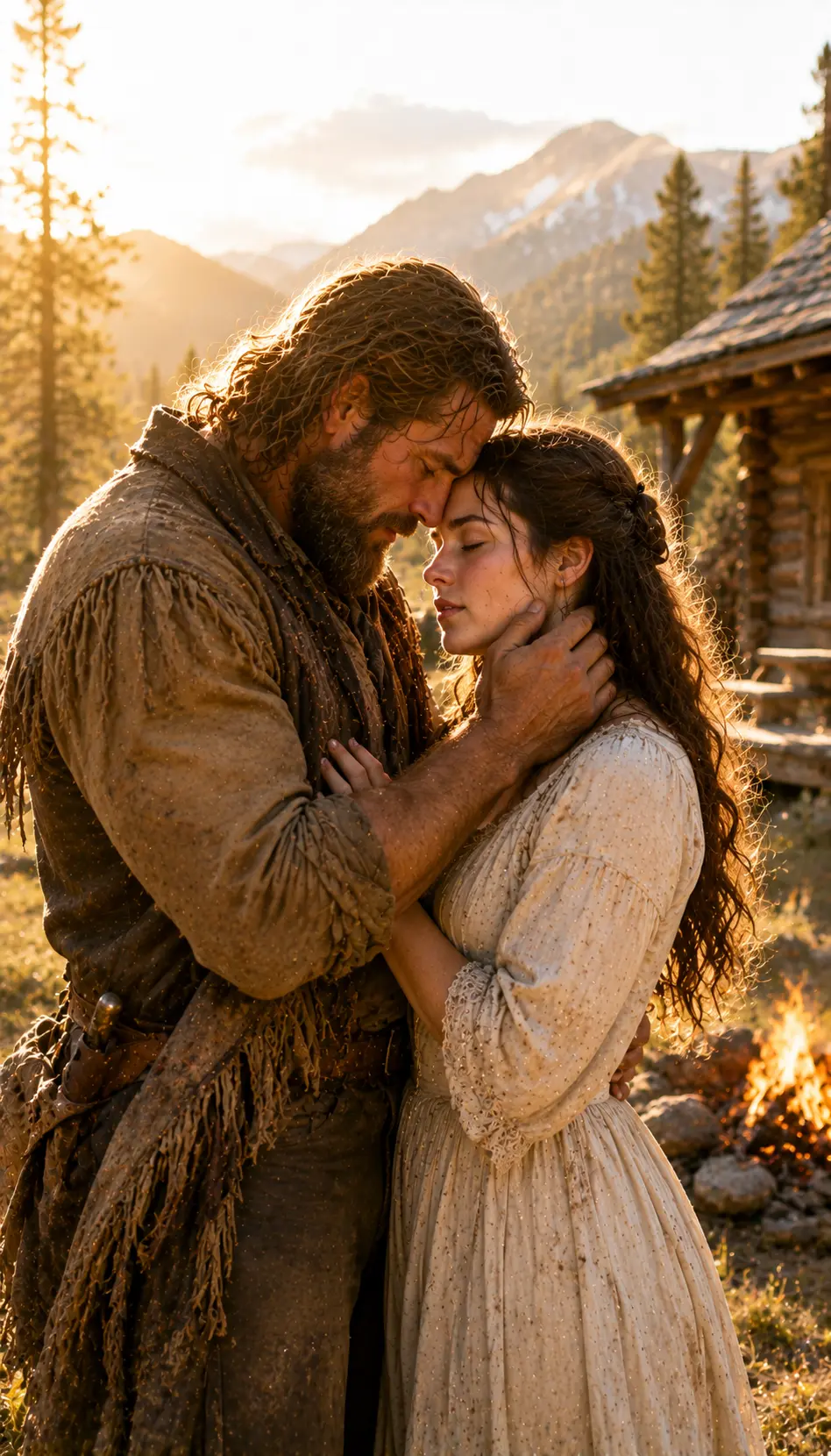
He held her close on the porch as evening laid gold over the mountains.
William played in the dirt with a wooden horse Ezra had carved. Prophet grazed near the fence. Smoke rose from the chimney in a clean blue line. The world was still hard. Winter would come again. Troubles would come again. Fear, perhaps, would sometimes knock softly on old doors.
But it would not find the same people inside.
Broken people had found each other in the snow.
They had fought for love.
For safety.
For the right to choose where a life begins again.
And in that Colorado cabin, beneath the mountains that had nearly taken Sarah and then sheltered her, hope stopped being a word.
It became the sound of William laughing.
The warmth of Ezra’s hand.
The strength in Sarah’s voice when she said no and meant it.
The porch light burning through every storm.
And the quiet certainty that the past might chase a person a long way, but it could not own a heart that had finally found somewhere safe to stay.