Homeless at 17, She Bought a Rusted Barn for $10 — What She Found Inside Shocked Everyone
Clara Briggs walked into Deadwood with one dime in her pocket and mud dried up to the knees of her skirt.
That was all she owned that could be counted.
One dime.
A folding knife on her belt.
A horse blanket over her shoulders.
A compass wrapped in cloth and tucked inside her bodice, because it had belonged to her father and she trusted it more than she trusted roads.
Everything else she carried was harder to measure.
Her father’s voice.
Her mother’s silence.
The memory of a horse left two days east of town because the animal had pulled up lame in the mud and Clara could not afford a farrier.
The ache in her stomach from too many skipped meals.
The stubbornness that had kept her walking after her boots began to split.
And a grief so deep she had stopped trying to feel it all at once.
She was seventeen years old in the autumn of 1883, young enough for people to call her a girl when they wanted to dismiss her and old enough to know the world would not soften itself simply because she had no one left to stand between her and hunger.
Deadwood smelled like smoke, livestock, wet wool, and ambition gone sour.
Main Street was a river of noise. Wagon wheels grinding through frozen ruts. Men shouting through saloon doors. Horses snorting steam into the cold air. A blacksmith’s hammer striking iron somewhere beyond the haze. Boots slapping boardwalks. Coins changing hands. Laughter that sounded too rough to be joy.
It was not a town that stopped to pity anyone.
It had been built by men who came looking for gold and stayed because either they found too little to leave or too much trouble to escape. It had mud in its streets, smoke in its lungs, and secrets under nearly every roof.
Clara paused at the edge of Main Street and let the town move around her.
No one looked at her long.
That was another kind of mercy.
A tired seventeen-year-old girl with a horse blanket over her shoulders and a dime to her name was not unusual enough in Deadwood to become a spectacle. The town had seen too many ruined men, too many widows, too many hungry boys, too many people arriving with maps in their pockets and hope already beginning to rot.
Clara stepped into the current and kept walking.
Her father, Clem Briggs, had been a trail surveyor. He understood distance better than most people understood their own names. He could look at a ridge, a creek bend, a stand of timber, and tell you what the land was trying to hide. He had taught Clara to read a compass before she could read a book. Taught her to pace off measurements with her eyes closed and count the steps back. Taught her never to trust a straight trail unless she knew who had made it and why.
“The West does not care how you feel about it,” he used to say. “It only cares what you do in it.”
When fever took him outside Pierre, Clara had not cried.
Not then.
She had watched him dying for a week. She had known the shape of it before the last breath came. When it was over, she wrapped him in his bedroll, carried stones from the creek, marked the place as best she could, and stood there until the wind took the warmth from her face.
Then she kept moving.
There was nothing west she needed.
But there was nothing east she could return to.
So west became the only direction that made sense.
In Deadwood, she asked for work at three establishments before sundown.
At the first, the man behind the counter did not even look up.
At the second, a woman with flour on her apron told Clara to try the laundry on Mill Street, then closed the door before Clara could ask where Mill Street was.
At the third, a saloon owner looked her over from the cracked toes of her boots to the horse blanket at her shoulders and said he might think about it, which Clara had already learned was a polite way of saying no without wanting to watch the hope leave someone’s face.
By nightfall, the cold had sharpened.
Clara found shelter in the narrow gap between a hardware store and a tannery, where the walls cut the wind if she sat with her knees drawn up and the horse blanket tucked around her. The mud under her boots had begun to freeze. The lantern light from the saloons painted the street orange and gold, but none of that warmth reached her.
She had eaten nothing since morning.
The dime in her pocket felt heavier than a coin should.
It was the last proof that she had not yet reached absolute nothing.
She was wondering how cold a person could get before sleep became dangerous when a voice spoke from the alley mouth.
“You dead or stubborn?”
Clara looked up.
A woman stood there with a tin cup in one hand and a heel of bread in the other. She was older, solidly built, wearing a dark dress and a shawl wrapped tight across her chest. Her hair, streaked with gray, was pinned in a practical knot, and her eyes had the sharp warmth of someone who had seen every kind of trouble and not yet lost the habit of answering it.
Clara did not move.
“Stubborn,” she said.
The woman nodded as if that was the preferable answer.
“Good. Dead girls are harder to feed.”
She held out the bread.
Clara’s pride rose first.
Then hunger rose faster.
She took it with both hands.
The woman handed her the tin cup next. Coffee. Bitter, hot, and strong enough to make Clara’s throat tighten.
“Name?” the woman asked.
“Clara Briggs.”
“Dorothea Hale.”
The woman said it like a fact that required no further decoration.
“I run the boarding house on the north end of Main. I got a chair near the stove and a pot that still has something in it. You got people here?”
“No.”
“People coming?”
“No.”
“People looking?”
Clara hesitated.
“No.”
Dorothea studied her face. Not unkindly. Not softly either. She looked at Clara the way practical women look at problems they have already decided to do something about.
“Come inside, then.”
“I can’t pay.”
“I didn’t ask if you could pay.”
“I don’t take charity.”
Dorothea’s mouth twitched.
“Good. I don’t give much of it. You can haul water tomorrow if you’re still breathing.”
Clara stood.
Her knees nearly failed, but she locked them before Dorothea could offer a hand.
Dorothea noticed.
She did not comment.
That was the first reason Clara trusted her.
Dorothea Hale’s boarding house was warm in the way only a crowded frontier room can be warm. Stove heat. Damp wool. Coffee. Old wood. Onion stew. Men’s boots lined near the door. Beds upstairs rented by the week, by the night, or by whatever arrangement hardship allowed. The place did not pretend to be fine. It pretended only to stand, which Clara respected more.
Dorothea sat her near the stove and put stew in front of her.
Clara ate slowly at first, then gave up pretending she was not starving.
Dorothea said nothing until the bowl was empty.
Then she poured more coffee and told Clara about Harlon Dodd.
Not all at once.
Dorothea never gave a whole story before knowing what kind of ears were listening.
She began with the facts.
Dodd had been a prospector. One of the early ones. Came in with the rush of ’76, back when Deadwood was still a raw, illegal camp on Lakota land and men were too hungry for gold to care what laws or treaties they had to step across. He had been quiet, perhaps fifty when he arrived, perhaps older. Age was hard to judge on men who lived outdoors and spoke mostly to weather.
He panned creeks like everyone else.
Never registered a significant claim.
Never spent money he did not need to spend.
Never drank.
Never gambled.
Never married.
Never made enemies loudly.
“He died last April,” Dorothea said, stirring the stove with a poker. “In his cabin off the south end. Alone. No family anyone could find. No will anyone could prove.”
Clara warmed her hands around the coffee cup.
“What happened to his place?”
“Cabin was sold for scrap and unpaid taxes. Tools went to auction. What’s left is the barn.”
“A barn?”
Dorothea looked at her.
“Bad one.”
“How bad?”
“Leaning bad. Roof failing. Floor soft. County doesn’t want liability. Bank doesn’t want taxes. Sheriff Pruitt wants it off his books before the next windstorm drops it into somebody’s lawsuit.”
Clara’s fingers tightened around the cup.
“How much does he want?”
Dorothea gave a short laugh.
“For that? Probably nothing if you ask right.”
The next morning, Clara found Sheriff Walt Pruitt in his office near the center of Main.
The building smelled like tobacco, cold ashes, and old paper. Pruitt was a broad man in his fifties, deliberate in the manner of men who had survived long enough to stop rushing toward anyone’s emergency. He sat behind a desk with a ledger open before him and looked Clara over the way he probably looked over everything: measuring risk, cost, and whether it was likely to become his problem twice.
“I want to buy the Dodd barn,” Clara said.
Pruitt leaned back.
“You want to what?”
“The Dodd barn. South edge of town.”
“You seen it?”
“No.”
“That’s a poor start to ownership.”
“I’ve heard enough.”
“From who?”
“Mrs. Hale.”
Pruitt’s expression shifted slightly. Dorothea’s name carried weight in Deadwood, not loudly, but firmly.
“You got money?”
Clara reached into her pocket and placed her dime on the desk.
Pruitt looked at it.
Then at her.
Then at the dime again.
“That all?”
“I owe you nine dollars and ninety cents.”
“For a barn you have not seen.”
“For a barn nobody wants.”
He almost laughed.
Almost.
It moved across his face like a weather change that decided against rain.
“And how do you expect to pay the rest?”
“I’ll get it.”
“That a promise?”
“Yes.”
Pruitt studied her for a long moment.
Clara stood still.
Her father had taught her how to stand before men weighing her future. Feet even. Chin level. No pleading. A person who begs gives the other side permission to enjoy the refusal.
At last, Pruitt pulled a sheet of paper toward him.
“What is your full name?”
“Clara May Briggs.”
He dipped the pen.
“Seventeen?”
“Yes.”
“You got a guardian?”
“No.”
“You got anyone likely to come yelling at me later that I sold a falling-down barn to a minor?”
“No.”
“Good. I dislike yelling before noon.”
He wrote the bill of sale, slow and proper. When he finished, he slid it across the desk.
Clara signed carefully.
Her hand shook only after the pen left the paper.
Pruitt took the dime and dropped it into the drawer.
“You owe the county nine dollars and ninety cents.”
“I know.”
“You sleep in that barn, you watch the west wall. Wind hits it wrong, you’ll be part of the floor.”
“I’ll watch it.”
Pruitt folded the bill of sale and handed it over.
Clara walked out of the sheriff’s office holding a piece of paper that said she owned something.
It was the first time in her life that had ever been true.
The Dodd barn stood on the south edge of Deadwood, backed against the treeline where ponderosa pine climbed the ridge and the town noise fell away enough for a person to think.
Clara stood in front of it for a long time.
It was worse than Dorothea said.
Three of the four walls leaned, not entirely compromised yet, but thinking seriously about surrender. The roof existed in patches, open to the sky over the back quarter. The floor was warped wood over packed earth, soft in several places, blackened where rot had swallowed the grain. A loft ran along the east wall, reachable by a ladder missing two rungs. The whole structure groaned when wind came down from the ridge, a long tired sound like an old animal deciding whether to stand.
But it was standing.
And it was hers.
That mattered more than beauty.
Clara walked the perimeter once. Twice. Then a third time, slower. She tested posts with her shoulder. Marked the worst boards with bits of charcoal from an old fire ring. Checked the roof gaps. Found a place where rainwater had been running down the interior wall for months, maybe years. Found animal bones in old straw. Found rusted tack, a broken hinge, two bent nails, and half a horseshoe buried under dirt.
By afternoon, she had begun.
She cleared debris from the floor with her hands and folding knife. Old straw. Broken leather. Rotten boards. The remains of small animals she carried out and buried near the treeline because even forgotten things deserved not to be slept beside. She found a half-buried timber behind the building and used it to shore the weakest wall temporarily. She climbed to the loft, tested each plank before trusting it, laid her horse blanket down, and decided that was where she would sleep.
The first night, the wind pushed through every gap.
The roof showed stars.
The barn creaked as if unhappy to host a living soul.
Clara lay awake in the loft with her knife near her hand and her father’s compass beneath her palm.
For the first time since Pierre, she did not feel entirely adrift.
A falling barn was not much.
But it was a fixed point.
And fixed points mattered.
She worked for tools.
Two mornings hauling water at Dorothea’s boarding house earned her a coil of rope and a handsaw. An afternoon splitting wood paid for three hot meals and the right to wash properly in the back room. Burl Fitch, the hardware store owner, lent her a level with the warning that if she broke it, he would curse her name until spring.
“I’ll bring it back,” Clara said.
“That is what people say before they don’t.”
“I’m not people.”
Burl looked at her for a moment.
Then handed over the level.
On the third morning, she found a hatchet leaning against a fence post at the edge of the treeline.
No note.
No footprints she could clearly read.
Just a hatchet, handle up, left where she would see it.
Clara stood over it a long time.
Then picked it up and went back to work.
That evening, from the shadows of the pines, a figure watched the lamplight in the barn loft glow orange against the October sky.
He did not come closer.
Clara knew he was there anyway.
She did not call out.
He turned and disappeared back into the trees.
Dorothea knew more about Harlon Dodd than she had let on.
Clara sensed it.
Over the following days, when Clara came by the boarding house for meals earned through hauling water, scrubbing floors, cutting kindling, and mending a torn mattress seam, Dorothea offered pieces of Dodd’s story the way someone offers bread: a little at a time, testing whether the person receiving it understands hunger.
“Harlon came in summer of ’76,” she said while peeling potatoes. “Quiet from the start.”
“Quiet how?”
“Not scared quiet. Not foolish quiet. Private quiet.”
Clara tucked that away.
“There’s a difference?”
Dorothea gave her a look.
“Big one. A scared man hides because he thinks the world is after him. A private man hides because he has something worth keeping.”
The next day, Dorothea added more.
“People thought he was unlucky. Prospector who never found his share. Plenty of those.”
“But you didn’t think so.”
“No.”
“Why?”
Dorothea sliced bread in clean, strong motions.
“Because unlucky men talk about luck. Harlon never did.”
That stayed with Clara longer than it should have.
A man who never registered a claim.
Never spent coin.
Never drank.
Never complained.
Never left a will.
Never appeared hungry.
A man who owned a barn nobody wanted.
A man whose privacy outlived him.
Clara began looking at the barn differently.
Not as a ruin.
As a question.
And then there was Silas Greer.
He was the land agent in Deadwood, the man who brokered property transactions in and around town. He had an office on the corner of Main and Lee, wore a clean coat, kept his nails trimmed, and possessed the smooth, pleasant face of a man who preferred conversations where the other person did not realize they were losing until after the handshake.
Clara noticed him on the second day.
He rode past the barn in the afternoon, slow but not too slow.
His eyes went to the building.
Not to her.
Not first.
To the barn.
By the fourth day, she was watching for him.
Every afternoon, he passed. Every afternoon, his gaze moved over the barn’s walls, roof, floor, and the rear quarter where the rot was worst. He never stopped. Never spoke. Never acted curious enough to admit curiosity.
That made him more interesting.
Clara kept working.
She had learned from her father that when someone watches the land, you watch what they watch.
The rear stall gave way first.
She had known it would.
The boards in the back quarter were the worst, soft all the way through, punky with rot, breaking apart under her boot if she stood too long in one place. She had saved that section for when the walls were braced enough that pulling boards would not invite the whole barn to twist.
On a Tuesday morning in early November, she began lifting the floor.
She worked with the hatchet and saw, prying boards loose, stacking what could be salvaged outside the wall, throwing the worst into a pile for burning. Dust rose. Old straw clung to everything. Mice fled into gaps along the foundation. By noon, her arms ached from the shoulders down.
The rot ran deeper than she expected.
Under the top boards lay an older subfloor, darkened almost black with age and moisture. It had been hidden beneath the later planks, older than the rest of the repair work, laid down by hands that knew what they were doing.
Clara crouched.
She worked the hatchet blade under one of the deeper boards and pried.
The plank cracked.
Lifted.
Then the hatchet punched through into hollow space below.
She stopped breathing.
The silence inside the barn changed.
She leaned closer and peered through the gap.
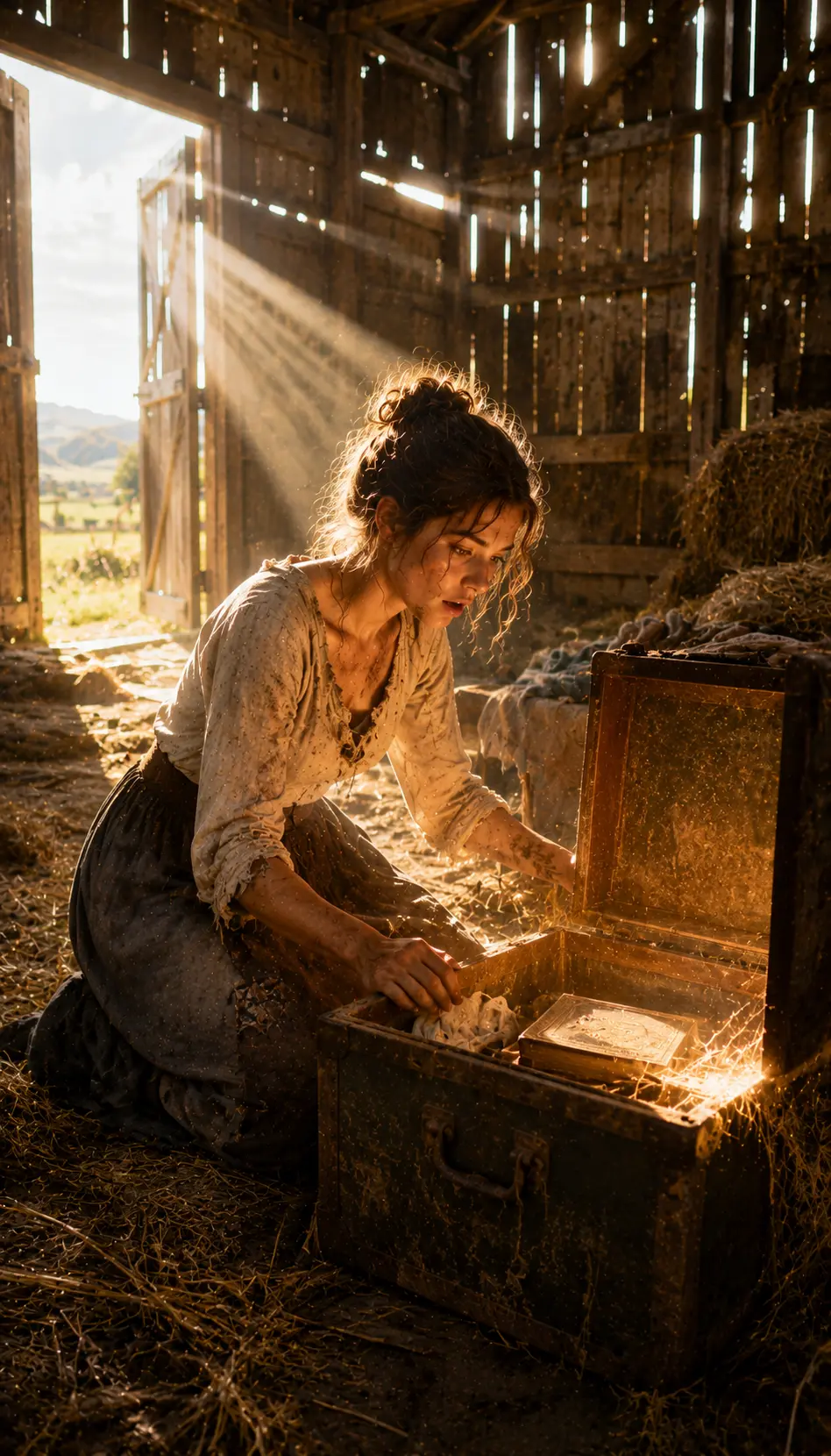
The hollow beneath was not natural. The packed earth had been excavated into a rough rectangular pit, perhaps two feet deep, lined along bottom and sides with oilskin cloth. In the center of it sat a black iron strongbox.
Clara sat back on her heels.
For a long moment, she did not move.
Outside, Deadwood kept making noise.
Somewhere a dog barked.
A wagon rattled far off.
Wind moved through the pines.
Inside the barn, the whole world seemed to have narrowed to that black iron box hidden under rotten boards.
She widened the gap carefully, removing more planks, setting them aside without haste. Her father’s voice moved in memory.
Anything that matters has patience. You have more.
The box was heavy.
Genuinely heavy.
The kind of weight that tells a person something before the latch opens.
She dragged it out onto the barn floor, closed the loose boards over the pit, and sat before it until evening light faded.
The lock was solid iron.
The hinge screws were corroded.
Clara had worked iron fastenings before. She waited until dark, when the barn’s lamplight would not be easily seen from the road. Then she took her knife blade to the screws, slow and careful. She could have broken the lock with the hatchet, but that would have made noise. It might also have damaged whatever was inside.
Patience.
More patience than the thing.
Late that night, the last screw gave.
She lifted the lid.
Inside, wrapped in cloth so old it crumbled at the edges when she touched it, were three things.
The first was a leather pouch closed with a drawstring. It was heavier than it looked. Clara opened it and tilted it toward the candle.
Gold dust ran into the crease of the cloth.
Fine.
Bright.
Unmistakable.
She had never held that much gold in her life.
She had never held any gold at all.
Her hands began to shake, so she closed the pouch and set it aside.
The second was a folded document on thick official paper, covered in careful handwriting and bearing a seal from the Yankton land office. Clara unfolded it and read slowly. Then read again.
It was a deed.
Forty acres of Black Hills timberland, five miles east of Deadwood, surveyed and recorded in 1880 under a land trust. The terms were irregular, but clear enough: physical possession of a sealed letter found with the deed conveyed the right of transfer to whoever presented it properly through the Yankton office.
The third thing was that letter.
It was folded plainly.
On the outside, in simple handwriting, were the words:
To whoever has the grit to find this.
Clara opened it.
My name is Harlon Dodd.
I came to Deadwood in the summer of 1876 with the rest of the fools. I found what I found and kept it quiet because in this town the men who knew what you had were always the men who came for it. I surveyed the timberland myself in 1880 and filed the deed in Yankton because no one in Deadwood pays attention to Yankton.
I have no family and no one I trust enough to leave this to.
So I am leaving it to whoever lives in my barn.
If you are living in my barn, you needed it.
That is qualification enough.
The land is yours.
Take care of it better than this town took care of itself.
Harlon Dodd.
March 1883.
Clara sat in the dark a very long time.
The candle burned low.
Gold dust lay in a pouch beside her.
A deed rested on her lap.
And for the first time since her father died, the future did not look like a road vanishing into fog.
It looked like a door.
Not open yet.
But real.
She found Jesse Cutter at the treeline the next morning.
She had known he was there.
The hatchet had told her enough, and the careful way pine branches shifted near the edge of the trail told her the rest.
He stood partly in shadow, tall and lean, wearing a dark coat patched at one elbow. His hair was tied back. His face carried the quiet watchfulness of someone used to being read wrongly from every direction.
Dorothea had mentioned him once.
Jesse Cutter.
Lakota on his mother’s side, Scottish on his father’s.
Welcome in neither world completely, comfortable only in the spaces between. He scouted for survey crews and wagon trains. Sometimes for the county sheriff, when Pruitt needed someone who could read land better than men who thought maps made them wise.
“You left the hatchet,” Clara said.
Jesse looked toward the barn.
“You needed one.”
“I could have stolen it.”
“You didn’t.”
“You didn’t know that.”
“Yes,” he said, “I did.”
He spoke quietly, without showing off.
Clara held out the folded letter and deed.
“I need you to read something.”
Jesse did not ask why.
That was the second reason she trusted him.
He read the letter twice.
He read the deed once more slowly.
Then his expression changed.
Not dramatically.
But enough.
“What am I holding?” Clara asked.
“Trouble.”
“I know that much.”
“The timberland east of town,” Jesse said, tapping the document lightly. “These Black Hills stands were surveyed again last year. Not by the county.”
“By who?”
“Railroad interest out of Chicago. They’ve been quietly buying land along a planned spur line east from Deadwood.”
Clara’s mouth went dry.
“Timber rights.”
“Exactly.”
“Greer.”
Jesse nodded once.
“He’s been buying for them?”
“Through names that don’t point straight back. But yes.”
Clara looked toward Deadwood, hidden beyond the slope and smoke.
“Dorothea said Greer went through Dodd’s cabin before Sheriff Pruitt got there.”
“He was looking for this.”
“And he did not find it.”
“No. But he knows it exists.”
Jesse folded the papers and handed them back.
“If he does not know you have it yet, he suspects you might find it soon.”
Clara thought of Greer riding past every afternoon.
His eyes on the barn.
The rear stall.
The rotten floor.
The pit beneath.
“He’ll come.”
“Yes.”
“What do I do?”
Jesse looked at her for a long time.
“Do not sell cheap. Do not speak alone. Do not show fear to a man who profits from it.”
That afternoon, Silas Greer came to the barn directly for the first time.
He arrived on horseback, smiling as if they were old neighbors. His coat was clean. His gloves looked soft. His horse was well fed and better groomed than half the children in Deadwood.
“Miss Briggs,” he called. “You have been industrious.”
Clara stood near the barn door with the hatchet in one hand.
“Mr. Greer.”
He looked past her into the barn.
“You have done admirable work with a difficult structure.”
“Thank you.”
“Most people would have walked away.”
“I’m not most people.”
His smile remained polite.
“No, I can see that.”
He dismounted without being invited and took two steps closer. Clara did not move from the doorway.
“I heard you bought the old Dodd property from Pruitt. Frankly, I admire the courage. But such courage can become burden. Taxes. Repairs. Liability. Winter.”
“I’m familiar with winter.”
“Of course. Still, I may be able to ease your situation.”
There it was.
A kindness with teeth.
“I would be willing to purchase the barn and surrounding rights from you. Two hundred dollars cash. More than fair.”
Clara looked at him.
Two hundred dollars.
More money than she had imagined holding a month earlier. Enough to buy proper boots, a bed, tools, food through winter, perhaps even a horse if she chose carefully.
A fortune to a girl who had entered Deadwood with a dime.
A joke to a man who knew what lay beneath the barn.
“I found nothing here but rotten wood and hard ground,” Clara said.
Greer’s eyes flickered.
Only once.
But she saw it.
“I did not imply otherwise.”
“No?”
“Merely offering opportunity.”
“I have one.”
His smile thinned.
“Do you?”
“Yes. I own a barn.”
“A failing barn.”
“A standing barn.”
“For now.”
The words were soft, but the threat beneath them was clear.
Clara stepped back and began closing the door.
“Good day, Mr. Greer.”
Greer mounted again.
“I hope pride keeps you warm, Miss Briggs.”
Clara barred the door after he left.
That night, someone tried the latch.
Not loudly.
Not clumsily.
A careful hand at the door after midnight.
Clara was awake in the loft with the strongbox beside her and the hatchet within reach. She had braced the door with the hatchet handle and rope. The latch lifted once, twice, then stopped.
She did not breathe.
The person outside waited.
Then footsteps retreated through mud.
In the morning, Jesse stood at the treeline.
Clara lifted one hand.
He nodded.
No words were needed.
Judge Rufus Alderman held court in a wood-frame building on Sherman Street that also served, depending on the day, as meeting hall, church, and place where men with expensive suits learned the limits of their importance.
He was in his late sixties, deliberate, deeply unimpressed by anyone who entered with too much confidence. He had sat on the bench in Dakota Territory long enough to have seen nearly every legal maneuver money could devise and had developed a broad immunity to all of them.
Clara and Jesse arrived first.
She brought the strongbox, the letter, the deed, and the pouch of gold dust because she wanted the judge to understand the whole of what Harlon Dodd had hidden and why. Dorothea came too, though she claimed she was only there because she happened to be walking that way with no basket, no errand, and no convincing explanation.
Sheriff Pruitt stood near the back wall.
He did not say he was there for Clara.
He did not need to.
Silas Greer arrived twenty minutes later with a lawyer from Rapid City named Caldwell, a narrow man in a suit that cost more than Clara’s barn and carried a leather case full of objections.
Caldwell presented three arguments in order, each smoother than the last.
First, Clara Briggs could not be identified as a proper legal claimant under the trust terms because the language was irregular and potentially invalid.
Second, the deed had been filed under a trust instrument that had never been probated through territorial court.
Third, and here he paused long enough to let the insult settle, a minor female could not hold title to real property in Dakota Territory without a lawful male guardian.
The room went quiet after that.
Clara felt every eye turn toward her.
Seventeen.
Female.
Alone.
Those three facts had been used against her so often they had begun to sound like charges.
Judge Alderman listened without expression.
He read the deed.
He read Harlon Dodd’s letter.
He examined the bill of sale from Sheriff Pruitt.
Then he asked Clara two questions.
“Did you purchase the Dodd barn through lawful bill of sale?”
“Yes, sir.”
“Have you maintained physical possession of the strongbox and its contents since discovery?”
“Yes, sir.”
He looked at Jesse.
“You witnessed the contents after discovery?”
“After,” Jesse said. “Not before.”
Alderman nodded, as if the distinction mattered.
It did.
Then the judge turned to Caldwell.
“The trust language is irregular, not invalid.”
He cited a territorial statute with the dryness of a man reading weather.
“The deed was properly filed in Yankton, which is within jurisdiction. Probate is not required because the transfer condition was established before death through the instrument itself.”
Caldwell opened his mouth.
Judge Alderman lifted one finger.
“As for the third argument…”
The room seemed to hold its breath.
“The Dakota Territory legislature amended property statutes eight months ago. A woman may hold title to real property in her own name.”
He looked down at Clara.
“Age does not void lawful possession in this matter where no competing guardian, creditor, or kin has presented claim, and where the estate property in question was transferred by written instrument tied to possession.”
Caldwell had no answer.
Greer went pale.
The judge dipped his pen.
“Clara May Briggs is hereby recognized as lawful transferee of the Dodd timber deed pending final recording. Sheriff Pruitt will witness the update. Mr. Greer, any attempt to interfere with Miss Briggs’ possession of said deed, barn, or related property rights will be treated as unlawful coercion.”
The gavel came down.
Clara did not feel victorious.
Not at first.
She felt as if the floor had returned beneath her feet.
She walked out of the courthouse holding the deed, now bearing her name in Judge Alderman’s steady hand.
Jesse walked beside her.
He did not say anything.
That was how she knew it was real.
That afternoon, Clara went to Sheriff Pruitt’s office and paid him the remaining nine dollars and ninety cents she owed for the barn.
She counted it from coin exchanged through the assayer on Main Street, who had weighed a small portion of Dodd’s gold dust and treated Clara with startling seriousness after realizing what she had.
Pruitt looked at the coins in his palm.
Then placed them in his drawer.
“Debt settled,” he said.
“Yes.”
“You still plan to sleep in that barn?”
“Yes.”
“Roof’s bad.”
“I know.”
“Door’s worse.”
“I know.”
Pruitt nodded.
“Then fix it before snow.”
That was as close as he came to congratulations.
Clara appreciated it.
Some transactions do not need commentary.
Winter came hard.
Clara hired two carpenters and rebuilt the barn properly. She paid them fairly and in coin, which made them work honestly and speak respectfully, two things money did not always buy but helped encourage. The floor was replaced. The walls straightened. The roof completed. A proper door installed with a proper lock. The loft reinforced. A small stove pipe added safely through the wall. By the time deep cold settled over Deadwood, the barn stood the way barns were supposed to stand.
Square.
Solid.
Not asking anyone’s permission.
Dorothea cried the first time she saw the finished door.
She pretended she had smoke in her eye.
Clara pretended to believe her.
Jesse disappeared back into the treeline as winter deepened, as he often did, but the hatchet remained on Clara’s fence post.
He did not take it back.
Not that season.
Not the next.
By spring, Clara had leased the timberland to a logging crew under terms Judge Alderman reviewed because she asked him and he saw no reason not to help. The lease did not make her rich overnight, but it provided steady income, which Dorothea said was better than sudden wealth because sudden wealth made people stupid and steady income bought flour.
Clara kept the gold dust mostly untouched.
She used only what she needed.
Boots.
Tools.
Repairs.
Taxes.
A lock for the strongbox.
A bed.
A ledger.
The rest she placed safely through the assayer and banker under terms she understood because she read every line twice.
Silas Greer left Deadwood before summer.
Some said the railroad interest cut ties after the courthouse embarrassment. Some said he had debts elsewhere. Some said he still believed the land should have been his.
Clara did not care.
Men like Greer were not the center of her story unless she allowed them to be.
She did not.
On the first warm morning of 1884, Clara stood in the doorway of her barn and looked out at Deadwood in mud-thaw light.
The town still smelled like smoke, livestock, and ambition.
Main Street was still loud.
Men still argued in saloons.
Wagons still sank into ruts.
The blacksmith’s hammer still marked time.
But something had changed.
Not in Deadwood.
In Clara.
She thought about her father and the long road west. About the compass he had wrapped in cloth. About his voice telling her that the West gave nothing, that it only held things until a person became stubborn enough to find them.
He had been right.
Harlon Dodd had been right too, in his strange private way.
If you are living in my barn, you needed it.
That is qualification enough.
People later told the story as if Clara had been lucky.
A homeless girl bought a barn for a dime and found gold under the floor.
That version was easy.
People like easy versions because they make miracles sound accidental.
But Clara knew better.
Luck did not walk from Pierre to Deadwood on split boots.
Luck did not leave a lame horse behind and keep going on foot.
Luck did not haul water at Dorothea’s boarding house for tools.
Luck did not sleep under a broken roof and brace walls before wind took them.
Luck did not notice Greer’s eyes, or pry rotten boards, or read a deed twice by candlelight, or stand in court while a suited lawyer tried to turn age and womanhood into reasons she should own nothing.
Luck might have hidden the strongbox.
But grit found it.
Years later, when Clara Briggs became a name people in Deadwood spoke with respect, she still kept the first dime she had paid Sheriff Pruitt. He had given it back to her quietly the winter before he retired, claiming his drawer had no room for sentimental nonsense.
She placed it in the strongbox beside Harlon Dodd’s letter.
Dorothea lived long enough to see the barn become more than shelter. It became a place where travelers could sleep if they needed a roof, where tools could be borrowed if returned, where hungry girls could find coffee without having to say they were hungry. Clara never called it charity. Dorothea would have laughed at that.
She called it keeping the door useful.
Jesse came and went with the seasons. Sometimes he brought news from survey crews. Sometimes he left venison wrapped in cloth. Sometimes he sat outside the barn in the evening and said almost nothing, which Clara had learned was one of his kinder habits.
The hatchet stayed by the door, handle worn smooth from use.
The timberland east of town remained hers.
She walked it each spring with a compass and ledger, measuring not only what could be cut, but what should be left standing. Men who wanted fast money did not like that. Clara did not care. Harlon Dodd’s letter had been clear.
Take care of it better than this town took care of itself.
She intended to.
And whenever someone came to Deadwood with more hunger than coin, whenever someone young and alone stood too long near a doorway pretending not to need anything, Clara saw herself in the angle of their shoulders.
Not helpless.
Never helpless.
Just not yet found.
She would offer bread.
Coffee.
Work if they wanted it.
A chair near the stove.
And if they said they did not take charity, Clara would smile and say, “Good. I do not give much of it. There is water to haul in the morning.”
Because sometimes dignity needs a task before it can accept kindness.
Sometimes ownership begins with a dime and a piece of paper no one else wanted.
Sometimes treasure is not what changes a person’s life.
Sometimes it only reveals the strength already there.
Clara Briggs entered Deadwood with one dime, no horse, no family, and nowhere to sleep.
By the next spring, she owned a barn that stood square against the wind, forty acres of timberland, a name written into legal record, and the kind of respect nobody in a gold town gives freely.
She had not been saved by the West.
The West did not save people.
It tested them.
It stripped them.
It buried things under rot and dirt and waited to see who would be stubborn enough to pull up the boards.
Clara was.
And that made all the difference.