They Threw Her in Free With Two Horses—The Cowboy Didn’t Know She’d Secretly Save Everything He Had
The first thing Silas Cain noticed was the laughter.
It rolled across the dusty auction yard like summer thunder, loud and careless, shaking loose from men who had decided the world in front of them was nothing but a show. It rose over the snorting horses, over the stomp of boots, over the auctioneer’s sharp voice, over the dry rattle of the wind moving through the rail fence.
Silas stood at the back of the yard with his hands in his pockets and dust drying in his throat.
He had not come to town for entertainment.
He had come because two of his best horses had gone lame in the same week, and a ranch that depended on thin margins could not afford bad luck. Without replacements, he could not move the herd to summer pasture. Without summer pasture, the cattle would lose weight before winter ever came. And if winter caught them weak, it would not care that Silas had worked himself half to death trying to keep the Cain place alive.
So he stood there among men he barely liked, under a hard white sun, waiting for something he could afford.
The auctioneer slapped one palm against the rail.
“Next lot. Two big geldings. Sound enough if you ain’t picky.”
The horses were led into the ring. Their coats were dull, their ribs showed too clearly, and their tails flicked weakly at flies. They had not been treated kindly. Anyone with eyes could see that. But Silas studied their legs, not their shine. Strong joints. Clear eyes. No limp. A little feed, a little patience, and they would work.
That was enough.
“I’ll start at twelve dollars,” the auctioneer called.
A hand went up near the front.
“Twelve. Do I hear thirteen?”
The bidding crawled.
Most men in that yard did not want skinny horses in a dry summer. Feed cost money. Hay cost money. Everything cost money when the sky would not rain and the banks did not wait.
Silas held still.
Patience had been beaten into him by ranch work, by hunger years, by parents who had taught him never to hurry a decision just because other men were shouting. Sometimes survival was not won by strength, but by waiting until foolish people spent their money first.
“Fourteen,” someone called.
“Fourteen and a half.”
The bidding slowed. Heads shook. One rancher spat into the dirt and walked away.
Silas raised his hand.
“Fifteen.”
The auctioneer pointed toward him.
“Fifteen from the man in the back. Do I hear sixteen?”
Silence.
The crowd shifted.
A fly buzzed near Silas’s ear.
“Going once.”
Silas did not move.
“Going twice.”
The hammer fell.
“Sold.”
Silas let out a slow breath.
Fifteen dollars was nearly everything he had left after buying flour, salt, and wire. But the horses would work. They had to.
Then the auctioneer grinned.
It was not a friendly grin.
It was the kind of grin that meant a man had saved his ugliest trick for the end.
He jerked his chin toward the far side of the ring.
“And since Cain bought the lot, he can take the woman too. She came in with the shipment.”
The yard exploded with laughter.
Silas frowned.
“What?”
The crowd parted slightly.
Two handlers shoved someone forward from behind the horses.
A woman.
For a moment, Silas thought his eyes had tricked him. Then she stumbled barefoot into the dirt, her wrists bound with thick rope, her dress torn and dust-stained, dark hair hanging in tangled strands across her face.
She did not cry out.
Did not beg.
Did not look around for rescue.
She simply stood behind the horses with her head lowered, perfectly still, like someone who had learned that movement only gave cruel men something else to laugh at.
The auctioneer shrugged as if a human being tied in the dirt were an inconvenience no larger than a cracked saddle.
“Came with the stock shipment. No papers. No name. No one claiming her. Can’t sell her proper, so there she is. Take her or leave her.”
More laughter rolled across the yard.
A man near the front leaned against the rail.
“Probably dumber than the horses.”
Another voice shouted something worse.
Silas felt something inside his chest tighten.
He had known hard men. He had known desperate men. He had known men who would cheat, lie, steal water rights, poison a neighbor’s reputation, or drink away a month’s wages. But there was a particular ugliness in a crowd laughing at someone who could not safely answer back.
“I did not buy a woman,” Silas said flatly.
The auctioneer spread his hands.
“Didn’t charge you for one either. Consider her a burden tossed in with the bargain.”
Before Silas could respond, another voice cut through the noise.
“I’ll take her.”
Silas turned.
Virgil Creed pushed away from the fence two rails down.
Everyone knew Creed. Men did not say his name loudly unless they had to. He was big through the middle, heavy in the shoulders, with a face that always seemed to be measuring what belonged to other people. His eyes lingered too long on land, horses, cards, money, and women who were alone.
Silas had seen women disappear from town after being seen with Creed.
Creed smiled slowly.
“I’ll give you two dollars for the trouble.”
The laughter changed.
It softened into something uglier.
The woman did not move.
But Silas noticed one small detail.
Her fingers curled tightly into fists.
It was the only sign of life she had shown.
Silas stepped forward.
“Untie her.”
The yard went silent.
Creed blinked.
“Now hold on.”
Silas did not look at him.
“I said untie her.”
He did not raise his voice.
He did not need to.
The auctioneer looked from Silas to Creed, then to the men watching from the rail. He was trying to decide which trouble was more expensive.
Finally he shrugged.
“Cut the rope.”
A young boy stepped forward with a knife and sliced through the bindings.
The rope fell away.
For a moment, the woman swayed like she might collapse. Her hand shot out and caught the mane of the nearest horse to steady herself.
Creed scowled.
“This is foolish, Cain.”
Silas ignored him.
He took the geldings’ reins and led them through the gate.
Behind him, soft and almost soundless, came the faint rhythm of bare feet following.
They walked in silence for nearly a quarter mile before Silas stopped.
The noise of the auction yard faded behind them. Dust drifted through the summer air. Dry grass hissed in the wind. The road ahead stretched empty and white beneath the sun.
He turned around.
The woman stood about six feet away, head lowered, arms at her sides.
Waiting.
“You do not have to follow me,” Silas said.
No answer.
“I did not buy you. I bought two horses.”
Still nothing.
Silas studied her carefully now that the crowd was gone. Her hands were scraped raw, but the shape of them caught his attention. Long fingers. Fine bones. Not the hands of someone raised doing hard field labor. Her posture was too controlled, her stillness too deliberate, her silence too intelligent.
“Can you talk?” he asked.
Silence.
Silas sighed.
“All right. I have a ranch about four hours east. You can stay the night. Eat something. Wash if you want. Tomorrow, you can go wherever you choose.”
For the first time, she moved.
She lifted her head slightly.
Her eyes met his.
Dark.
Sharp.
Watching him carefully, as if measuring whether his words had teeth hidden behind them.
Then she lowered her gaze again and stepped forward.
Silas turned back toward the road.
“All right, then.”
The walk home took most of the afternoon.
The summer sun hung low and cruel, flattening the land into faded yellow waves. The two geldings plodded behind Silas, tired but obedient. The woman walked beside them barefoot, step for step, without complaint.
Not once did she stumble.
Not once did she ask to stop.
Not once did she make a sound.
By the time the Cain ranch came into view, Silas had looked back at her at least twenty times.
Each time, she was still there.
The ranch was small. A weathered house. A crooked corral. A barn leaning slightly to one side. A bunkhouse that had once held hired men, before money grew thin and Silas learned to do the work of three people alone. The place did not look like much, but it had survived more than some bigger ranches had.
Silas led the horses to the trough and pointed toward the bunkhouse.
“Water’s in the barrel by the door. Stove inside. Blankets in the chest if mice have not carried them off.”
She walked past him without speaking, stepped into the bunkhouse, and closed the door.
Silas stood there looking at the shut door for a long moment.
Then he went to the house and put together a plate of bread, beans, and dried beef. He carried it back and knocked once.
“Food’s here.”
No reply.
He left the plate on the step and walked away.
That night he sat at his kitchen table trying to eat, but the food tasted like dust. His mind kept returning to the auction yard. The rope. The laughter. Creed’s eyes. The woman’s fists. The way the auctioneer had tossed her into the bargain like a cracked bucket no one knew what to do with.
A knock came at the door.
Silas opened it.
She stood there holding the empty plate.
Every scrap was gone.
He took it from her.
“Thank you,” he said quietly.
She nodded once and turned away.
The bunkhouse door clicked shut behind her.
Silas washed the plate slowly, staring through the dark window above the basin.
He woke before sunrise.
Habit pulled him from bed before the light did. He dressed, stepped outside, and stopped.
The bunkhouse door stood open.
The woman was crouched beside the corral fence with a hammer in hand, repairing a loose board. Each strike was careful, measured, precise. She had found the right nails, chosen the right angle, and set the board straighter than it had been in years.
Silas walked over.
“You do not have to do that.”
She drove one last nail.
Then she set the hammer down.
For the first time, she spoke.
“The bottom hinge on your barn door is rusted through,” she said calmly. “It will break within the week.”
Silas stared at her.
“You talk.”
“Yes.”
“They said you couldn’t.”
“They said many things.”
Her voice was steady, educated, and nothing like the broken silence she had worn at the auction.
Silas crouched beside the fence.
“You let them believe you were worthless.”
She looked at him.
“A woman who cannot speak becomes invisible. Invisible people survive.”
Silas absorbed that slowly.
“What is your name?”
She hesitated, then answered.
“Ruth.”
She lifted her chin slightly.
“Ruth Callaway.”
Silas tipped his hat.
“Silas Cain.”
For the first time since the auction yard, something close to a smile touched the corner of her mouth.
Neither of them understood yet that the quiet moment beside a broken fence was the beginning of a war that would tear down the most powerful man in the territory.
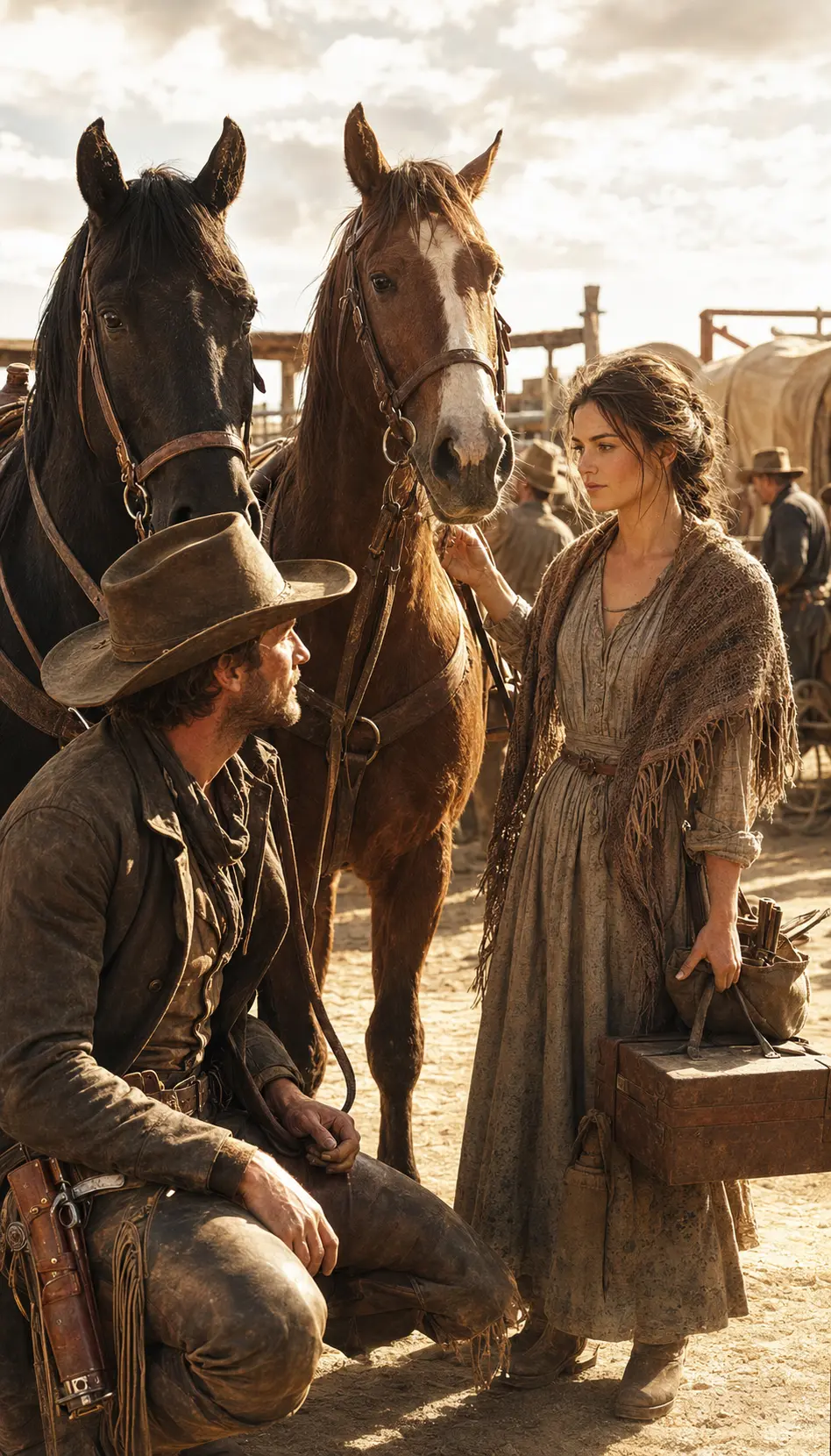
Morning spread over the Cain ranch, turning dry fields gold. Silas leaned against the corral fence while Ruth worked with the bay gelding he had bought at the auction. The animal stood calm beneath her hands, ears flicking lazily as she brushed dirt from its coat and checked each hoof with practiced care.
“You know horses,” Silas said.
Ruth finished examining the animal’s leg before answering.
“I know many things men do not expect me to know.”
She straightened and wiped dust from her hands.
“We need to talk.”
Silas rested both arms on the fence.
“About what?”
“Helena.”
His brows drew together.
The territorial capital was four long days away by horse, farther if a person avoided the main road. Ranchers did not speak of Helena unless something serious needed settling.
“Why are we talking about Helena?”
Ruth crossed her arms and looked out over the fields.
“Because the men who put me in that auction yard were working for my father.”
Silas went still.
“Your father?”
“Yes.”
She turned to him.
“Harlon Mercer.”
The name hit him like a hammer.
Everyone in Montana Territory knew Mercer.
Mercer Land and Rail had swallowed half the small ranches between the river and the northern route. Men said Harlon Mercer could move survey lines without touching a stake, buy judges without leaving fingerprints, turn debt into a weapon, and make families abandon land their grandparents had bled over.
Silas’s jaw tightened.
“Mercer stole my father’s south pasture.”
Ruth nodded once.
“I know.”
The silence that followed was heavy enough to stand on.
“How?”
“Because I saw the papers.”
She spoke calmly, but her hands trembled slightly.
“My father built his empire by changing survey records. Land markers moved a few yards at a time. Titles rewritten. Loans arranged through banks he controlled. Families pushed into debts they could not escape. Your ranch was one of them.”
Silas gripped the fence rail.
“My father missed payments. That is what the bank said.”
“No,” Ruth said. “Your cattle were poisoned.”
He stared at her.
“What?”
“Forty head died that winter. Your father could not pay the loan after that. Mercer filed foreclosure two months later.”
Silas felt the world tilt under him.
For years he had carried the story he had been given: that his father had made bad decisions, borrowed too much, failed to protect the ranch, and died with shame sitting on his chest. Silas had been sixteen when he watched his mother close the ledgers at night with cracked hands and red eyes, whispering numbers that never lined up.
“How do you know?” he asked.
“I read the letter ordering it.”
The fence creaked under his grip.
“My father spent the rest of his life thinking he failed.”
Ruth’s voice softened.
“He did not fail. He was robbed.”
Silas said nothing for a long time.
Then he asked the question that mattered.
“Why tell me this now?”
Ruth’s expression hardened.
“Because I copied every document I could before my father discovered what I was doing.”
“You have proof?”
“I had proof on paper,” she said. “Some of it was taken. Some burned. Some hidden. But the most important parts…”
She tapped her temple.
“I memorized them. Every name. Every survey number. Every false foreclosure. Every bribe. Every judge. Every sheriff. Every cattle shipment that was made to look like sickness or accident.”
Silas let out a slow breath.
“Ruth, men get killed over things like that.”
“I know.”
She stepped closer.
“That is why I need to reach Helena. The federal records office. If we enter testimony and identify the records before Mercer buries them, he cannot make them disappear quietly. If we do nothing…”
“He wins,” Silas finished.
The wind moved through the dry grass around them.
Silas looked over his ranch: the crooked corral, the leaning barn, the thin pasture, the land his mother had fought to keep until the day she died.
Then he looked back at Ruth.
“When do we leave?”
She blinked.
“You are coming?”
Silas gave a small, humorless smile.
“Lady, your father already ruined my family once. Seems only fair I return the favor.”
Something softened in Ruth’s face.
“All right,” she said. “We ride tomorrow.”
They spent the afternoon preparing.
Silas packed food, water, ammunition, bandages, coffee, and a little money hidden under a loose floorboard. Ruth studied the maps he kept rolled in a drawer. Her eyes moved quickly across the paper, memorizing roads, rivers, ravines, ridges.
“There are Mercer checkpoints on the main road,” she said.
“How do you know that?”
“Seven months of being transported from one place to another like cargo.”
Silas looked at her.
“You remember everything.”
“I had nothing else to do.”
By sunset, two horses were ready and supplies were tied down. They slept lightly that night, both understanding what the ride meant.
Once they left the ranch, there would be no going back to the lives they had known.
They were in the saddle before sunrise.
The land stretched wide and empty ahead of them. For several hours they rode without speaking, letting the rhythm of hooves fill the silence. Ruth rode well, not like someone showing off, but like someone who had learned the hard way that falling behind was dangerous.
Near midday, she suddenly raised one hand.
“Stop.”
Silas reined in.
“What is it?”
She pointed toward a distant ridge.
A thin cloud of dust rose against the sky.
“Riders.”
“How many?”
“Three. Maybe four.”
“Following us?”
“Yes.”
Silas cursed under his breath.
“That did not take long.”
“They probably wired Mercer last night.”
Silas checked the rifle in his saddle scabbard.
“You think they will shoot?”
“No.”
“Why not?”
“Because I am worth more alive.”
He looked at her.
“That supposed to comfort me?”
“Not particularly.”
The dust cloud grew larger.
“They are gaining,” Silas said.
Ruth studied the terrain.
“There is a ravine half a mile south. We can lose them there.”
“We can try.”
She gave him a look.
“Try faster.”
They kicked the horses into a hard gallop.
The wind rushed past them. The ravine opened ahead, narrow and rocky, cutting through the land like a wound. Loose stone made the descent dangerous, but Ruth guided her horse down with steady hands. Silas followed close behind.
The riders behind them slowed.
“They will not risk breaking horses in there,” Ruth called.
They rode along the ravine floor until the dust cloud disappeared from view. When they climbed out the other side, the pursuers were gone.
“For now,” Silas said.
Ruth glanced over.
“You are good under pressure.”
“I learned by surviving.”
They stopped near a small spring to water the horses. Silas knelt, splashing his face, letting cold water run down his neck.
Then Ruth spoke again.
“There is something else you should know.”
Silas looked up.
“What now?”
“My father did not just steal land.”
She hesitated.
“He had people removed.”
Silas’s stomach tightened.
“Ranchers who refused to sell. Men who fought back. Accidents happened. Fires. Bad water. Broken bridges. Missing witnesses.”
She looked directly at him.
“Your father was one of them.”
Silas’s hands curled into fists.
“Mercer poisoned your cattle so the foreclosure could happen,” Ruth said quietly. “But your father had begun asking questions. He wrote to a territorial surveyor. The letter never reached Helena. My father had him watched.”
Silas closed his eyes.
For years, he had blamed his father.
Blamed weakness.
Blamed bad judgment.
Blamed a dead man for not being able to stand against a machine he had never even known was built around him.
When Silas finally spoke, his voice was steady.
“Then we ride faster.”
They pushed through the afternoon and into evening. The Bitterroot Mountains rose ahead like dark shadows against the sky. Ruth guided them along narrow paths that avoided main trails and known crossings.
“You have been through here before,” Silas said.
“Yes.”
“As a prisoner?”
“As a daughter,” she said. “Sometimes there was not much difference.”
They made camp under a cluster of cottonwoods. No fire. Too visible. They ate bread and dried beef in silence while the horses cropped what grass they could find.
After a while, Ruth spoke quietly.
“Tell me about your mother.”
Silas leaned back against his saddle.
“Margaret Cain. Toughest woman I ever knew.”
He stared up at the first stars.
“She ran the ranch after my father died. Worked herself to the bone trying to keep it alive. I remember her sitting at the table every night with the ledger open, doing numbers she already knew would not balance.”
“How old was she when she died?”
“Forty-two.”
Ruth looked down at her hands.
“My mother died when I was twelve. Fever. After that, my father stopped pretending there was anything in him worth loving.”
The silence between them changed.
It became less guarded.
Less like two people traveling together because danger required it, and more like two people beginning to understand the shape of each other’s wounds.
Finally Ruth lay back against her saddle.
“We should sleep. You first.”
Silas studied her.
“You trust me?”
She raised one eyebrow.
“You said ‘untie her’ in a yard full of men who thought I was nothing.”
“That was not an answer.”
“No,” she said. “But it is the closest thing I have.”
Within minutes, she was asleep.
Silas stayed awake with the rifle across his knees. Stars turned slowly overhead. The anger inside him, the old useless anger that had sat in his chest for years, now had direction.
Mercer had stolen land.
Stolen futures.
Stolen dignity.
But Harlon Mercer had made one terrible mistake.
He had thrown his daughter away.
And that daughter remembered every secret he had.
Silas looked at Ruth sleeping beside the saddle.
“Tomorrow,” he murmured. “Tomorrow we start taking it back.”
The coyote screamed just before dawn.
Silas’s eyes opened instantly.
Across the small camp, Ruth was already sitting up, one hand on the revolver Silas had given her the day before.
“You hear that?” she whispered.
He nodded.
But it was not the coyote that worried him.
It was what came after.
Hooves.
Slow. Careful. Moving through the dim hills behind them.
“Two riders,” Ruth said quietly. “Maybe three.”
Silas stood and began saddling the horses.
“They found us.”
“They never lost us,” Ruth replied.
They packed quickly. No wasted movement. No panic. Within minutes they were riding through the gray light of early morning. The hills stretched around them like sleeping animals.
For a while, the hoofbeats behind them faded.
Then returned.
Closer.
“They are stubborn,” Silas said.
“They are paid to be.”
They rode harder. The mountains slowly gave way to open land, and in the distance the first buildings of Helena appeared, small shapes rising from the valley floor.
Hope stirred in Silas’s chest.
“How far?” he asked.
“Four miles,” Ruth said.
Then she went still.
Silas followed her gaze.
Three riders waited on the road ahead.
One wore a marshal’s badge that caught the morning sun.
Ruth’s voice turned cold.
“Wade Pruitt.”
“Who?”
“My father’s fixer.”
The riders behind them were closing fast.
They were trapped.
Pruitt rode forward slowly, placing his horse in the center of the road.
“Well now,” he called. “Miss Mercer.”
Silas looked sharply at Ruth.
She did not correct the name.
Pruitt’s eyes slid to him.
“You must be Cain.”
Silas said nothing.
Pruitt rested one hand near his pistol.
“You are harboring a fugitive.”
“Got a warrant?” Silas asked.
Pruitt smiled.
“I am a United States Marshal.”
“That is not what I asked.”
The smile faded.
Ruth leaned toward Silas.
“We do not have time for this.”
“I know.”
“When I say go,” he murmured, “ride.”
“Silas—”
“Ride.”
Pruitt lifted his voice.
“Last chance, Cain. Hand over the woman.”
Silas kicked his horse forward suddenly.
The movement startled Pruitt’s mount, which sidestepped hard. At the same instant, Silas shouted, “Go!”
Ruth did not hesitate.
Her horse burst forward and shot past the line of riders before they could react. Pruitt swore and wheeled his horse. One of his men spurred after her.
Silas blocked the road.
Pruitt raised his pistol.
“Move.”
Silas did not.
“Shoot me in front of the whole valley,” he said calmly. “Let us see how that plays in court.”
Pruitt hesitated.
That moment was enough.
Ruth disappeared down the road toward Helena.
Pruitt’s jaw tightened.
“You are a dead man, Cain.”
“Maybe.”
The pistol came down hard.
Pain exploded through Silas’s face. He nearly fell from the saddle. Pruitt struck him again. Stars burst behind his eyes. Blood filled his mouth.
“You think you are a hero?” Pruitt asked quietly.
Silas tasted blood.
“My father lost land because of your boss.”
Pruitt’s expression flickered.
“Your father lost land because he was weak.”
Silas smiled through the blood.
“No. He lost it because Mercer poisoned his cattle.”
Pruitt went still.
Silas leaned forward.
“And now Mercer’s daughter is riding into Helena with every dirty secret he ever wrote down.”
For a moment, Pruitt said nothing.
Then he turned sharply.
“Ride.”
The men thundered toward Helena.
Silas stayed where he was, barely upright in the saddle.
Two minutes.
That was all the time he had bought her.
Two minutes.
Sometimes history only needs that much.
Ruth’s horse was nearly spent by the time she reached Helena’s main street. Foam streaked its neck. People scattered as she rode through wagons, mud, and shouting voices.
Behind her, she heard riders.
“Stop her!” someone yelled.
She ignored them.
At the far end of the street, she saw the building she was searching for. Stone steps. Tall windows. A brass plate beside the door.
Federal Court.
She pulled the horse to a hard stop and ran up the steps.
The door was locked.
She pounded on it.
“Judge Kratic!”
No answer.
Behind her, hoofbeats thundered closer.
She struck the door again.
“Judge Kratic, please!”
The lock turned.
The door opened.
An older man in a vest and spectacles looked down at her in confusion.
“Yes?”
“My name is Ruth Mercer,” she said breathlessly. “I have evidence of land fraud across this territory.”
She pointed down the street.
“And a marshal coming to stop me before I can tell you about it.”
Judge Kratic looked past her and saw Pruitt riding toward the building.
His expression sharpened.
“Inside.”
Ruth stepped in.
The door slammed shut.
The bolt slid into place.
Seconds later, Pruitt hit the door with his fist.
“Open up.”
Judge Kratic remained calm.
“What is it you wish, Marshal?”
“That woman is under arrest.”
“For what charge?”
“Theft.”
“Do you have a warrant?”
Silence.
“No.”
“Then you have no authority here.”
Pruitt’s voice hardened.
“You are making a mistake.”
“Perhaps,” Kratic said.
Then he turned to Ruth.
“Start talking.”
For two hours, Ruth spoke.
Names.
Dates.
Survey numbers.
False debts.
Poisoned cattle.
Moved markers.
Burned records.
Judges bought.
Sheriffs paid.
Widows pressured.
Families ruined.
Ranches swallowed.
Judge Kratic wrote everything down. He asked questions only when necessary, and when he did, Ruth answered with frightening precision. She named parcels by number. She described letters. She repeated phrases from contracts she had read once by candlelight and stored forever in the only place her father could not search.
Her mind.
When she finished, the judge leaned back slowly.
“If this is true,” he said, “it will destroy your father.”
Ruth nodded.
“That is the idea.”
Kratic stood and signed several documents.
“I am placing you under federal protection.”
Outside, Pruitt had stopped pounding on the door.
For the first time in twenty years, Harlon Mercer had reached a door he could not open.
They found Silas outside town an hour later.
A deputy brought him in on horseback, bruised, bloodied, and stubborn enough to remain conscious out of spite. Ruth was waiting on the courthouse steps.
She hurried down and helped him dismount.
“You look terrible,” she said softly.
Silas winced.
“You should see the other fellow.”
“There were three other fellows.”
“Then imagine them all uglier.”
The doctor cleaned his wounds while Ruth sat nearby. Silas did not complain, though the stitching pulled at swollen skin and his head throbbed like a hammer striking iron.
After the doctor left, the room grew quiet.
“You made it,” Silas said.
“You gave me two minutes.”
“That is all I could give.”
“That was everything.”
Ruth reached across the table and took his hand.
“Do you know what I thought at the auction?” she asked.
Silas shook his head.
“I thought my life was over. I thought I had finally become what my father wanted me to be: voiceless, nameless, useful only as punishment.”
Her voice trembled.
“Then you said two words.”
Silas knew them.
Untie her.
“You saw me,” Ruth whispered.
Silas squeezed her hand gently.
“You were always there. I just refused to pretend you weren’t.”
The hearing happened three days later.
The courtroom filled with ranchers from across the territory. Men with sunburned necks and worn hats. Women in black dresses with ledgers clutched to their chests. Sons who had inherited debt instead of land. Daughters who had grown up hearing their fathers apologize for losses that were never truly their fault.
Ruth stood before them all.
She did not lower her head.
She did not disappear.
“My father stole sixty-three parcels of land,” she said clearly. “And I can name every one.”
The room erupted.
Farmers stood. Widows cried. Men who had lost everything stared as if the air had been knocked from their lungs. Judge Kratic brought the gavel down until order slowly returned.
Then Ruth spoke for two hours.
By the time she finished, the truth could no longer be buried.
Mercer’s empire cracked open like dry earth under rain.
Investigations spread across Montana Territory. Federal clerks pulled records. Surveyors returned to old lines. Witnesses came forward now that someone powerful had finally spoken first. Papers Mercer thought destroyed were found in bank archives, private offices, courthouse basements, and one locked trunk belonging to a frightened accountant who had been waiting ten years for someone else to be brave.
Wade Pruitt lost his badge.
Virgil Creed vanished from town the day subpoenas arrived.
The auctioneer claimed he had not understood what he was doing, though every man who had laughed that day remembered differently.
Land was returned where it could be.
Compensation funds were created where it could not.
And Harlon Mercer, who had built a kingdom by making honest people feel helpless, was indicted by a federal grand jury.
One evening, long after the trials began, Silas stood beside the rebuilt corral at the Cain ranch.
The barn had been repaired too. Stronger this time. The lower hinge Ruth had noticed that first morning had been replaced with new iron. The two geldings from the auction had filled out well with feed and care, their coats shining in the low sun.
Behind him, Ruth stepped onto the porch.
“You are staring at that pasture again,” she said.
Silas smiled slightly.
“I was thinking about my mother.”
Ruth came to stand beside him.
“What about her?”
“She used to say something every night after the books did not balance.”
“What?”
Silas looked across the land.
“She would close the ledger and say, ‘Tomorrow, we will find a way.’”
Ruth slipped her hand into his.
“She was right.”
Silas nodded.
“Yes. She was.”
The sun dipped low over the fields. The ranch was quiet in a way it had not been in years. Not empty quiet. Not defeated quiet. A working quiet. A living quiet.
Months earlier, Ruth had been shoved into an auction yard behind two neglected horses, treated like something worthless by men who mistook cruelty for power.
Now she stood beside the man who had refused to leave her tied.
Together, they had done something no one believed possible.
They had brought down an empire.
But the victories that matter most are not always the ones printed in newspapers or recorded in court.
Sometimes victory looks like a woman speaking her own name without fear.
Sometimes it looks like land returned to hands that know how to love it.
Sometimes it looks like a barn door fixed before it breaks.
A corral rebuilt straight.
Two tired horses growing strong.
A ranch that should have been lost standing under gold evening light.
Silas looked at Ruth.
“You staying?”
She turned to him, and the faint smile that touched her mouth was no longer guarded.
“I thought that was already clear.”
“I like hearing it.”
“Then yes,” she said. “I am staying.”
He squeezed her hand.
In the distance, cattle moved slowly across the pasture Mercer once tried to steal. The wind carried the smell of dust, grass, and coming rain. Ruth leaned her shoulder lightly against Silas’s arm, and for the first time since he was a boy, he felt the Cain land breathe like it had been holding itself together until the truth came home.
Harlon Mercer had believed money could buy silence.
He had believed power could turn lies into law.
He had believed his daughter could be discarded, hidden, and erased.
But he had not counted on Silas Cain standing at the back of an auction yard with fifteen dollars to his name and enough decency left to say the only words that mattered.
Untie her.
Those two words did not just free Ruth’s wrists.
They opened the door to every truth Mercer had buried.
They gave a dead father his dignity back.
They gave a ruined ranch its name back.
They gave Ruth Callaway Mercer the chance to become something no empire could own.
Herself.
And on the land where greed once wrote its false claims, two stubborn people began building something stronger than money, stronger than fear, stronger even than revenge.
A future.
One fence post at a time.