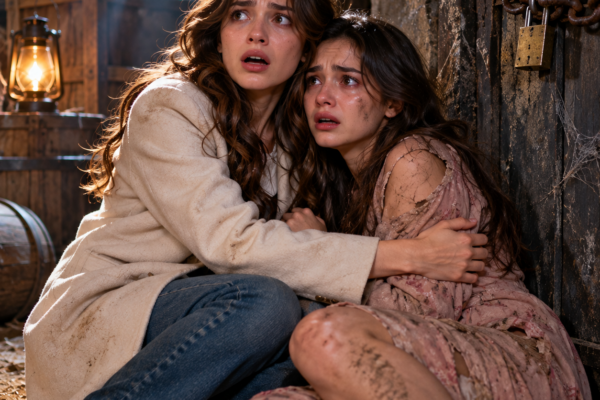
She Was Called Worthless, The Cowboy Answered, “You’re My Treasure”
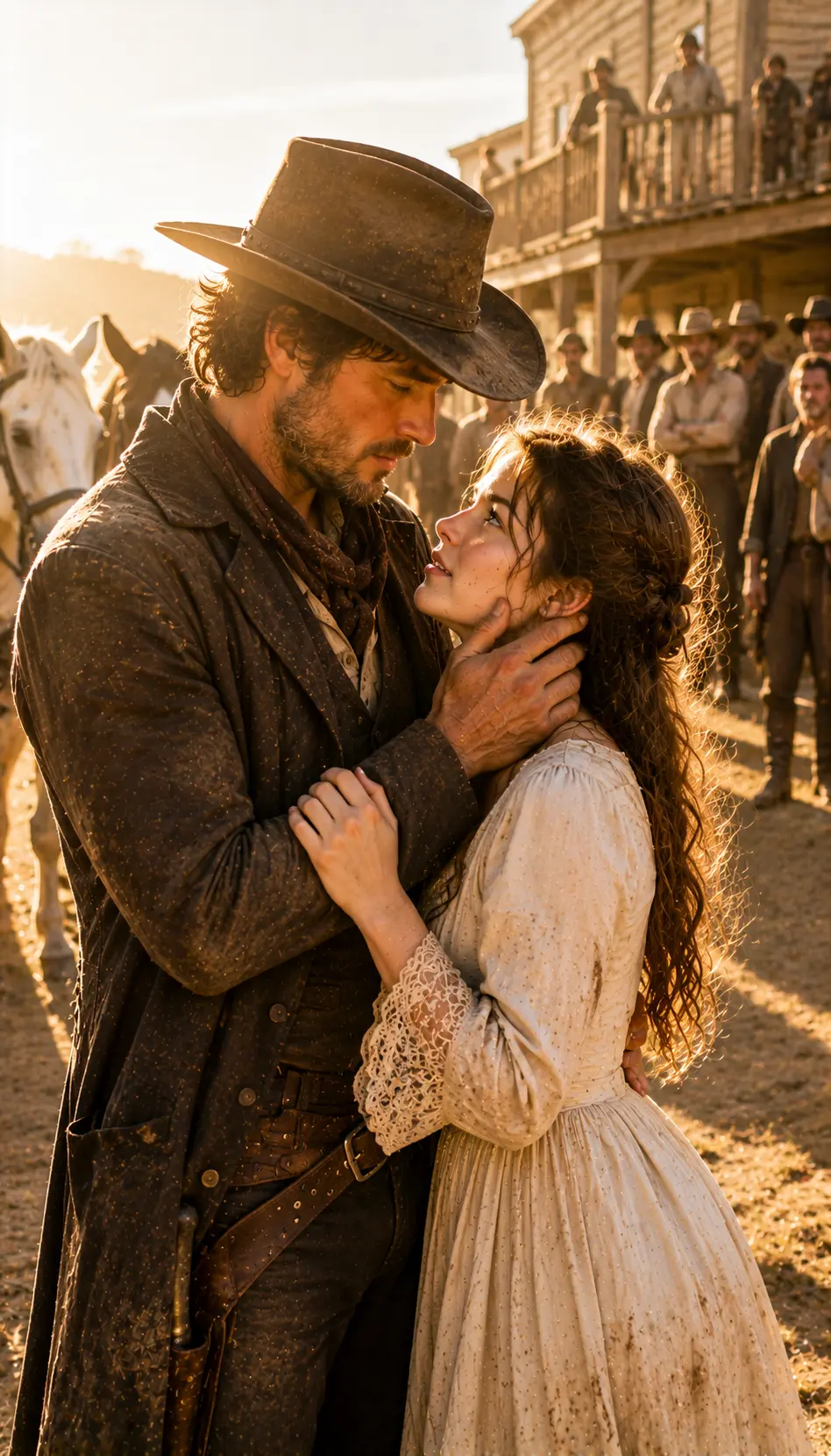
The stagecoach left Penelope Parker standing in the dust as if she were one more unwanted thing shaken loose from its wheels.
For a long moment, she did not move.
The Wyoming sun burned white over the plains, hard and merciless, flattening the world into heat, grit, and distance. The coach rattled away from Promise Creek in a cloud of dust, carrying strangers, trunks, mail sacks, and the last visible piece of the life she had been forced out of. Penelope stood at the edge of town with one hand gripping the handle of a small carpetbag and the other clutching the torn side of her dress, trying very hard not to cry where anyone could see.
Worthless.
Her stepfather’s final word stayed behind after the coach disappeared.
It rang in her ears louder than the wheels, sharper than the wind, crueler than the miles that now lay between her and everything familiar.
Worthless.
He had said it with the calm satisfaction of a man who had finally rid himself of a burden. Not a daughter. Not even a stepdaughter. A burden. A mouth at his table. A woman he could not sell into the marriage he had arranged because, for once in her life, Penelope had said no.
Her mother had died three years earlier, and with her death the small mercy in Penelope’s life had gone into the ground. After that, everything belonged to Harold Pike: the house, the accounts, the furniture, the last silver spoons, and eventually, he seemed to believe, Penelope herself. When his gambling debts grew too heavy, he promised her hand to a wealthy rancher nearly forty years older than she was. The man had smiled at her like she was livestock already half purchased.
Penelope refused.
Harold did not strike her. That would have made him too honest.
Instead, he packed her carpetbag, bought her a stage ticket west, and left her at Promise Creek with barely enough money for a week’s lodging.
“Maybe hunger will teach you your value,” he had said.
Then he called her worthless.
Now she stood alone in a town she had never heard of, at twenty-two years old, with dust on her hem, tears in her eyes, and a heart so tired it felt older than the mountains on the horizon.
But she wiped her cheeks before the tears could fall.
No.
If that word was going to follow her, it would have to chase a woman still walking.
Promise Creek was small but alive. Wooden buildings lined the main street, their weathered fronts facing the sun like old men too stubborn to sit down. A general store stood beside a blacksmith shop. A modest church raised its white steeple toward the empty sky. A dress shop displayed bonnets in the window. At the far end of the street, a saloon leaned into the dust with swinging doors and too much noise spilling out into the afternoon.
Penelope straightened her spine and walked toward the boarding house.
Mrs. Holloway, the proprietor, was a stern-faced woman with gray hair pinned tight enough to hurt just looking at it. She looked Penelope up and down from behind the front desk, taking in the worn dress, the battered carpetbag, the absence of a wedding ring, and the nervous dignity of a woman trying not to appear desperate.
“Where’s your husband, girl?”
Penelope lifted her chin.
“I have none.”
Mrs. Holloway’s mouth tightened.
“We do not take in just any woman off the street.”
“I am looking for work,” Penelope said. “I can cook, clean, sew, keep accounts. I can pay for one week.”
That softened the woman’s eyes by a fraction.
“One room in the attic. Five dollars a week. It is small, but clean. And I expect you to find employment promptly. I will not have idlers under my roof.”
“Yes, madam.”
Penelope followed her up creaking stairs to a narrow attic room with a sloped ceiling, a washstand, and a bed that looked too thin to promise much sleep. But the window had a view of the plains, and the door had a latch, and for that moment, it was enough.
Once alone, she sat on the mattress and pressed both hands over her mouth.
Only then did she allow herself to shake.
Not loudly.
Never loudly.
She had learned in Harold Pike’s house that grief made cruel people curious.
She had one week.
One week to find work.
One week before the little money in her bag disappeared.
One week before she discovered what a woman truly had when the world decided she was alone.
The next morning, Penelope put on her least worn dress, pinned her hair carefully, and set out before the sun grew too fierce. She tried the general store first. No position. The dress shop next. No need for help. The schoolhouse had already hired a teacher months ago. The blacksmith laughed when she asked whether he needed someone to keep accounts.
By midday, hope had thinned.
That was how she found herself standing outside the Silver Dollar Saloon.
She had no desire to work in such a place. But hunger has a way of walking a person toward doors they would rather pass.
The saloon owner looked her over with a smile that made her skin tighten.
“We need a girl who can sing, pour drinks, and look pretty enough to keep the men cheerful,” he said. “You are a bit plain, but I suppose you might do.”
Penelope’s cheeks burned.
“I am asking about kitchen work.”
“Kitchen work?” He laughed. “We have men for that. But if you are interested in making real money—”
He reached for her arm.
Penelope stepped back quickly.
“Thank you for your time.”
His smile turned sour.
“Suit yourself. But worthless girls do not have many options in a town like this.”
There it was again.
Worthless.
The word followed her out the door and into the afternoon sun.
She walked until her feet ached.
No one needed help.
No one trusted a stranger.
No one wanted a young woman with no husband, no references, and no story respectable enough to make them comfortable.
By late afternoon, she reached the last building on the main street: a modest ranch office with ARROWHEAD RANCH painted above the door. Inside, a grizzled old man with spectacles perched on his nose looked up from a ledger.
“Help you, miss?”
“I am seeking employment,” Penelope said. “I can cook, clean, sew, and keep accounts.”
The man studied her.
“Our foreman dismissed the cook at the main house yesterday. Owner is coming back from Cheyenne tomorrow, and there will be trouble if there is no hot meal waiting.”
Hope rose so suddenly Penelope almost felt dizzy.
“You ever cooked for ranch hands before?”
“I managed my family’s household for years,” she said. “I can prepare hearty meals.”
“Ten dollars a week. Room and board included. Ranch is three miles north. Stage heading that way leaves in twenty minutes.”
He scribbled a note and handed it to her.
“Give this to Mrs. Abernathy at the main house. Weston Archer owns the place.”
Penelope took the paper with both hands.
“Thank you, sir.”
Within the hour, she was riding toward Arrowhead Ranch on a buckboard wagon beside a weathered driver who had little interest in conversation. The town fell behind. The land opened wide. Her stomach twisted with nerves and hunger and fragile hope.
As they crested a rise, the ranch appeared.
It was larger than anything she expected. A sprawling main house stood at the center, with outbuildings, a bunkhouse, corrals full of horses, and broad pastures stretching toward the horizon. Cattle moved like dark spots across the golden land. Smoke curled from chimneys. Men rode in the distance. The whole place seemed alive with purpose.
“That there’s the bunkhouse,” the driver said, pointing. “Main house is where you’ll work. Cook’s quarters are around back.”
Penelope clutched her carpetbag tighter.
This was her chance.
Perhaps her only one.
Mrs. Abernathy, the housekeeper, was thin, efficient, and sharp-eyed. She showed Penelope to a small but clean room off the kitchen.
“Breakfast at five for the hands. Dinner at noon. Supper at six. Mr. Archer takes his meals in the dining room when he is here. The rest eat in the kitchen or outside. You will be cooking for about fifteen men, plus Mr. Archer and any guests.”
Penelope nodded, storing every detail.
“When will Mr. Archer return?”
“Tomorrow afternoon. Do your work well, and there will be no trouble. He is fair, if quiet.”
That night, Penelope inventoried the pantry and nearly cried with relief. Flour, sugar, beans, potatoes, salt pork, dried apples, spices, coffee, molasses, oats, cornmeal, butter, and a great black stove that looked intimidating but well kept.
For the first time in years, excitement kept her awake.
Before dawn, she was already at work.
She prepared biscuits, fried bacon, stirred oatmeal, made coffee strong enough to satisfy men who had been awake since dark, and set everything out just before the ranch hands began filing in. They eyed her curiously at first. A stranger in the kitchen always drew attention. But the moment they tasted her biscuits, suspicion softened.
By the time breakfast ended, several men had complimented her cooking.
Penelope accepted each word quietly.
Inside, however, something tender lifted its head.
Maybe she could be useful here.
Maybe useful could become respected.
Maybe respected could become safe.
The day passed in a blur. Stew for dinner. Fresh bread. Apple cobbler for supper because the pantry had dried apples and she wanted, desperately, to begin well.
She was elbow-deep in bread dough when she heard horses outside.
Mrs. Abernathy appeared beside her and glanced through the window.
“That is the boss.”
Penelope looked up.
A group of riders approached the house, with one man clearly leading them. He rode a magnificent black stallion and sat the saddle like he had been born there. Tall, broad-shouldered, dusty from the trail. Not dressed like the wealthy ranch owner she had imagined, but like a man who worked alongside his men and expected no praise for it.
“Best finish that bread,” Mrs. Abernathy said. “He will want supper soon.”
Penelope worked with renewed determination.
By the time the kitchen door opened, the roast was ready, the bread cooling, and the cobbler bubbling in the oven.
The man who entered was younger than she expected.
Weston Archer could not have been more than thirty. Sun-browned skin. Dark hair curling slightly at his collar. Blue eyes that seemed to take in everything at once. He removed his hat the moment he noticed her.
“You must be the new cook.”
Penelope wiped her hands on her apron and straightened.
“Yes, sir. Penelope Parker.”
His gaze moved over her, not in the intrusive way of the saloon owner, but with quiet assessment. As if he judged by steadiness, not appearance.
“Mrs. Abernathy says you came recommended from town.”
Penelope hesitated, unsure whether to correct the assumption.
Before she could, he continued.
“Whatever your story is, Miss Parker, I judge people by their work. Do that well, and we will get along fine.”
“Yes, Mr. Archer. Supper will be ready in twenty minutes.”
He nodded and turned to leave.
Then paused.
“What is that smell?”
“Apple cobbler, sir.”
For the first time, something almost like a smile touched his mouth.
“Have not had that since my mother was alive.”
Then he was gone.
Penelope stood in the warm kitchen with flour on her sleeves and the strange feeling that she had passed a test no one had announced.
The weeks that followed became a rhythm she could trust.
She rose before dawn. Cooked breakfast. Baked bread. Prepared dinner. Planned supper. Kept lists, measured supplies, learned which ranch hands hated onions, which ones slipped extra biscuits into their coat pockets, and which old cowboy pretended not to care for sweets but always appeared when pie cooled by the window.
The men were polite and grateful.
Mrs. Abernathy even admitted, grudgingly, that Penelope had “a uncommon fine way with pastry.”
Weston Archer remained something of a mystery.
He took his meals in the dining room, often alone with ledgers, maps, or correspondence spread before him. Sometimes he sent a compliment through Mrs. Abernathy. Sometimes he passed through the kitchen only long enough to refill his coffee. He never lingered without reason.
But Penelope noticed things.
She noticed how he spoke to his men. Firm, never belittling. She noticed how gently he handled difficult horses. She noticed he was first out in the morning and last to return at night. She noticed that he never raised his voice unless distance required it.
One evening, while placing his dinner in the dining room, she saw maps and documents spread across the table.
“Planning a cattle drive, sir?”
He looked up, surprised she had spoken.
“Yes. To the railhead in Cheyenne. We leave in two weeks.”
“Will you require packed provisions?”
“The chuck wagon cook handles most of it,” he replied. Then added, “But we will need extra baking before we leave. The men complain about Hank’s biscuits compared to yours.”
Warmth spread through her at the implied compliment.
“I would be happy to prepare extra.”
As she turned to go, he spoke again.
“Miss Parker.”
“Yes?”
“How are you finding Arrowhead?”
The question caught her off guard.
“Very well,” she said honestly. “It feels safe here.”
Something flickered in his eyes at her choice of words.
“Good,” he said. “That is good.”
The following Sunday was her day off.
After a morning of baking, the kitchen felt too hot, so Penelope took a book and walked toward the creek that ran through the property. She found a perfect spot beneath cottonwood trees where the water moved clear over smooth stones. She removed her shoes and stockings, dipped her feet into the cool creek, and sighed.
For a while, she forgot everything.
The stagecoach.
Harold Pike.
The saloon owner.
The word worthless.
She was simply a woman with a book, a creek, and sunlight moving through leaves.
She did not hear the horse until it was close.
Looking up with a start, she found Weston Archer watching from the saddle.
“Mr. Archer,” she said, quickly pulling her feet from the water. “I am sorry if I am trespassing.”
He dismounted and led his horse to drink.
“It is your day off. You are entitled to enjoy the property.”
His eyes fell to her book.
“What are you reading?”
“Jane Eyre.”
“A favorite?”
“Yes.”
“My mother liked that one,” he said. “Though I preferred adventure stories when I was young.”
Penelope smiled at the thought of him as a boy, restless and bright-eyed over tales of pirates and distant seas.
“Every book is an adventure in its own way.”
He studied her a moment.
“You speak like an educated woman.”
“My father was a schoolteacher,” she said. “Before he died, he made certain I received a proper education.”
Weston sat on a nearby rock, seemingly in no hurry to leave.
“How does a schoolteacher’s daughter end up cooking at a cattle ranch in Wyoming Territory?”
The question was not cruel.
That was why she answered.
“My mother remarried after my father died. Her new husband had different ideas about my worth.”
She swallowed.
“When I refused to marry a man of his choosing, he left me in Promise Creek with little more than the clothes on my back. He called me worthless as the stage pulled away.”
Weston’s expression darkened.
“No person is worthless.”
“Some days it is easier to believe that than others.”
He looked toward the creek.
“My father was quick to point out my shortcomings. Nothing I did was ever good enough. Not until I built Arrowhead into something even he could not criticize.”
“Did he praise you then?”
Weston’s mouth tightened.
“Grudgingly.”
Penelope’s voice softened.
“You built something remarkable here.”
“It is not just me. It is every person who works this land.”
He stood, as if embarrassed by how much he had revealed.
“Enjoy your book, Miss Parker. The creek is lovely this time of year.”
As he rode away, Penelope realized it was the longest conversation they had ever shared.
Something had shifted.
Not dramatically.
Not loudly.
But enough.
A bridge had begun forming between two people who both knew what it meant to have their value measured by someone who could not see them clearly.
Preparations for the cattle drive consumed the ranch.
Penelope baked from dawn until dusk: bread, biscuits, pies, cookies, hard rolls, and anything that would hold long enough on the trail. Weston began stopping by the kitchen more often, supposedly to check on supplies, though he sometimes lingered to taste a biscuit or ask how much flour she needed.
She learned that he had built Arrowhead from a small inheritance and a few dozen cattle. He had survived drought, blizzards, debt, and men who expected him to fail because he was young. In return, she told him about Pennsylvania, her father’s books, her mother’s garden, and the small school she had once dreamed of opening.
The night before the drive, Penelope stayed up late preparing a special meal. The hands would be gone nearly a month, and she wanted them to leave full, warm, and remembering home.
She was finishing a chocolate cake when Weston entered the kitchen.
“You should be resting. Tomorrow comes early.”
“I wanted everything to be perfect.”
“Why?”
“Because the men deserve it. They work hard.”
She hesitated.
Then added softly, “Because it matters to you.”
Something changed in his eyes.
A warmth.
A danger of a different kind.
“You have brought something to Arrowhead that was missing, Miss Parker.”
“Please,” she said, before she lost courage. “Call me Penelope.”
He repeated it quietly.
“Penelope.”
Her name sounded different in his voice.
“I am Weston to my friends,” he said.
Friends.
Was that what they were becoming?
Before she could decide, he reached out and gently brushed flour from her cheek. His fingers lingered only a second, careful and questioning, then withdrew.
“You should sleep,” he said, voice lower than before. “Good night, Penelope.”
The morning of the cattle drive dawned clear and cool.
The ranch was full of noise: cattle bawling, men shouting, horses shifting, leather creaking, wagons being loaded. Penelope had breakfast ready before sunrise. The men ate quickly, eager to begin.
Weston came to the kitchen as the last of them filed out.
“Thank you for all your work.”
“The ranch will be quiet with most of the men gone.”
“Will you be comfortable here?”
She nodded.
“I will be fine.”
“Mrs. Abernathy is staying in town with her sister while we are gone. Her rheumatism is troubling her. The Jorgensens at the neighboring ranch will check on you every few days. I left Samson behind. He is too old for drives, but still handy with a rifle.”
His concern touched her.
“Thank you, Weston.”
He looked as though he wanted to say more, but the foreman called from outside.
With one final nod, he left.
Soon the thunder of hooves and cattle filled the morning, then faded into distance.
The first week of solitude was peaceful.
Penelope explored the ranch, read by the creek, experimented with recipes, and ate supper with old Samson, who checked on her each evening and told stories of Arrowhead’s early days. He was thin, gray, and bent in one shoulder, but his eyes were sharp.
“Boss worries over you,” he said one night over stew.
“He worries over the ranch.”
Samson chuckled.
“That too.”
The second week, the weather turned.
Dark clouds rolled in from the mountains, bringing rain so hard it turned the yard to mud and made the creek rise dangerously. Thunder shook the windows. Lightning split the sky. The house felt too large with everyone gone.
On the third evening of rain, a pounding came at the door.
Penelope opened it cautiously and found three men she did not recognize standing on the porch, soaked to the skin.
“Evening, ma’am,” the leader said, removing his hat. “Wagon broke an axle about a mile back. Wondered if we might shelter in your barn till morning.”
Something about his smile did not reach his eyes.
“Mr. Archer is not here,” Penelope said carefully. “But I can send Samson to help with your wagon.”
“No need to trouble the old man.”
He stepped forward, forcing her back.
“We just need a place out of the rain.”
The other two followed.
Penelope’s fear coiled tight, but she kept her voice steady.
“The kitchen is warm. I can offer coffee while you dry.”
The leader looked around the entryway.
“Mighty big house for one little lady.”
In the kitchen, Penelope busied herself with the coffee pot while her mind raced. Samson usually came around seven. It was nearly that now. If she could stall them, if she could keep them talking—
“Nice setup,” the leader said, eyeing the silver serving pieces on the sideboard. “Archer must be doing well.”
“Those belong to Mrs. Abernathy,” Penelope lied. “Family heirlooms.”
He snorted.
“Check upstairs,” he told his companions. “See what else our host has lying around.”
The two men left.
Penelope’s hand closed around the handle of a heavy cast-iron skillet.
The leader approached.
“Now, why don’t you tell me where Archer keeps his cash box?”
“I know nothing about Mr. Archer’s finances.”
He grabbed her arm.
“Do not play dumb.”
The back door creaked.
Samson’s voice called out, “Miss Parker, you still up?”
The distraction was all she needed.
Penelope swung the skillet with both hands, striking the man’s shoulder hard enough to make him howl and stumble back.
She darted past him.
“Samson, run! Get help!”
Chaos followed.
Samson had brought his rifle and fired one warning shot into the porch roof, loud enough to scatter the men upstairs. One of the thieves rushed him, and Penelope grabbed a rolling pin from the counter, striking the attacker’s arm so Samson could regain his footing.
But the leader seized the rifle.
“That was stupid,” he snarled, aiming it at them. “Now both of you sit still while my boys finish searching.”
A terrible hour passed.
Penelope and Samson were tied in the kitchen while the men ransacked the house. Drawers slammed. Furniture scraped. Glass shattered upstairs. Penelope sat rigid, fear and fury burning together in her chest.
She prayed for the storm to end.
For help.
For Weston.
For any miracle that could cross miles of rain and mud.
The miracle came as lightning.
A tremendous crack shook the house, followed by the frightened whinnying of horses outside. The thieves had left their mounts near the barn, and the storm had spooked them.
“Check the horses,” the leader snapped to one of his men.
The distraction gave Samson his chance.
He had been working at his bonds and managed to free one hand. As the leader turned toward a locked cabinet, Samson slipped loose and lunged for a knife on the counter.
Everything happened fast.
The leader swung the rifle around. Samson threw the knife, striking the man’s arm. The rifle discharged into a ceiling beam above Penelope’s head, spraying splinters across the table. Samson tackled him, and both men crashed to the floor.
The next shot went wild.
Samson slumped, wounded but breathing.
Penelope screamed.
The leader staggered upright, clutching his side where the struggle had grazed him. His face twisted with rage as he reached for her.
The kitchen door burst open so violently it tore from one hinge.
Framed in the doorway stood Weston Archer.
Soaked.
Mud-spattered.
Eyes blazing with a fury so controlled it was more frightening than shouting.
The thief raised the rifle.
Weston moved faster.
His fist struck the man’s jaw and sent him sprawling. The rifle clattered across the floor. Weston kicked it away and stepped between Penelope and danger.
“Touch her again,” he said, voice deadly calm, “and you will regret drawing breath.”
The other two thieves rushed into the kitchen.
They stopped when they saw not only Weston, but half a dozen ranch hands behind him, wet, armed, and furious.
The fight was brief.
When the thieves were secured, Weston cut Penelope’s bonds and gently removed the cloth from her mouth.
“Are you hurt?”
She shook her head, tears streaming down her face.
“Samson.”
Weston knelt beside the old ranch hand.
“He is breathing,” he said with relief. “Get Doc Matthews. Now.”
Later, after Samson had been tended and the doctor declared he would likely recover, after the thieves had been hauled to Promise Creek, after the rain had finally stopped and a strange quiet settled over the ranch, Penelope sat wrapped in a blanket on the porch.
Weston joined her with a cup of hot tea.
“You should rest.”
“I keep seeing it happen,” she whispered. “If you had not come back—”
“But I did.”
He sat beside her, solid and warm.
“The cattle spooked in the storm. We decided to postpone the drive and bring them back. I have never been so grateful for bad weather.”
Penelope looked at him.
Really looked.
At the concern in his eyes. The tightness in his jaw. The tenderness beneath the anger.
“Why did you come to the house first?” she asked. “Why not the bunkhouse or barn?”
His answer was simple.
Devastating.
“Because you were here.”
Something shifted between them in that moment.
Weston reached for her hand.
“When I saw that man near you,” he said, voice rough, “I realized I could not bear the thought of losing you. Not because you are the best cook Arrowhead has ever had, though you are.”
A small smile touched his mouth.
“But because you have become precious to me, Penelope.”
Her heart swelled.
“When I was afraid, I thought of you,” she admitted. “It gave me courage.”
He lifted her hand and pressed a gentle kiss to her palm.
“You are the bravest woman I have ever known.”
Her eyes filled.
“My whole life, I have been made to feel worthless.”
Weston’s expression darkened.
“Whoever told you that was a fool.”
His thumb brushed her knuckles.
“You are worth everything, Penelope Parker.”
She did not resist when he drew her into his arms.
For the first time in her life, being held did not feel like being trapped.
It felt like being treasured.
The weeks that followed became a season of healing.
Samson recovered slowly but steadily, complaining loud enough that everyone knew he would live. The cattle drive was completed later than planned. Penelope returned to her kitchen, but nothing was quite the same.
Weston courted her openly.
He brought wildflowers from the plains. Sat with her by the creek and read poetry aloud in a voice too serious for the words. Walked with her under star-filled skies. Asked about her dream of teaching and listened as if dreams were practical things, as worthy of planning as cattle and fences.
Their first kiss came on a golden autumn evening beneath the cottonwoods, leaves drifting around them like pieces of sunlight.
“I love you,” Weston whispered. “I never thought I would say those words to anyone, but I love you, Penelope.”
She touched his face, memorizing the line of his cheek, the steadiness of his eyes.
“And I love you, Weston Archer. With all my heart.”
On Christmas Eve, with the ranch house dressed in evergreen boughs and red ribbons, Weston proposed before the hearth. The ring was his mother’s, a simple gold band with a small diamond that caught the firelight.
“I do not want you only as Arrowhead’s cook,” he said, kneeling before her. “I want you as its heart. My partner in everything. Will you marry me?”
Her answer was yes.
Joyful.
Tearful.
Immediate.
They married in the spring of 1879, with wildflowers carpeting the plains and new calves dotting the pastures. Promise Creek turned out for the celebration, along with ranchers from miles around. Mrs. Holloway proudly told anyone who would listen that she had known from the start the girl had promise.
Penelope only smiled.
As lanterns glowed and music carried across the yard, Weston held her close.
“Happy, Mrs. Archer?”
“More than I ever dreamed possible.”
“You were never worthless,” he murmured.
“I know that now.”
He pressed his forehead to hers.
“You are my treasure, Penelope. You always will be.”
In the years that followed, Penelope and Weston built a life greater than either of them had dared imagine. She established a small school at Arrowhead for the children of ranch hands and neighboring families. Weston expanded the ranch with care rather than greed, earning loyalty instead of fear. Their family grew with a son first, then twin daughters two years later.
The main house that had once intimidated Penelope became warm with laughter, books, bread, lessons, muddy boots, and love.
On their tenth anniversary, they sat on the porch watching their children play in the yard as the sun painted the Wyoming plains gold and rose.
“Do you ever think about the day you came to Arrowhead?” Weston asked.
Penelope smiled.
“I was afraid you would send me away when you learned I had never cooked for a ranch before.”
“I knew from the first apple cobbler that you belonged here,” he said. “It took me longer to realize you belonged with me.”
She leaned against his shoulder.
“I am glad you found me worth keeping.”
Weston turned her face gently toward his.
“Not just worth keeping. Worth cherishing. Worth protecting. Worth loving for a lifetime.”
The word worthless no longer had power over her.
It had been buried beneath years of kindness, work, respect, laughter, and the steady love of a man who had seen her clearly.
Penelope looked out over Arrowhead Ranch, over the cattle and children and open land that had become her world.
She had arrived with one carpetbag and a broken heart.
She had been abandoned in dust.
She had been called nothing.
But life, in its strange and merciful way, had carried her to a kitchen where she could prove her strength, a creek where she could speak her truth, a storm where courage found her, and a man who never once mistook her scars for her value.
From worthless to treasured.
Not because Weston gave her worth.
But because he helped her see what had been there all along.