Widow Hid Her Face From the Town, The Cowboy Lifted It and Called Her Beautiful
The sound of the gunshot lived longer than the man it took from her.
It rolled through the Wyoming valley, cracked against the hills, scattered birds from the cottonwoods, and left Harriet Blackmore on her knees in the yard with both hands pressed into the dirt, screaming a name the wind could not return.
Thomas.
One moment her husband had been standing beside the barn, shoulders squared, refusing to surrender the only working horses they owned. The next, he was on the ground, and the three men who had ridden in like trouble itself were already laughing, already tearing the reins loose, already vanishing down the road with the animals Thomas had tried to protect.
Harriet remembered the sunlight most.
That was the cruel part.
It had been a beautiful afternoon. The kind of day when the sky looked washed clean and the fields smelled of warm grass. A day for fixing fences, planning supper, talking about the future. She had been in the kitchen with flour on her hands when the riders came. Thomas told her to stay inside. The shotgun hung over the fireplace. She saw it. She knew it was there.
And still, when the shouting began, when one of the men drew his weapon, when her husband turned his head just enough for her to see his eyes one last time, Harriet froze.
She did not run to him.
She did not reach for the shotgun.
She did not scream until the men had already gone.
That was the part that haunted her worse than the sound.
The town was kind at first. Sweetwater Springs brought food, coffee, blankets, and quiet condolences. Women sat in her kitchen and squeezed her hands. Men helped bury Thomas and repaired the broken corral gate. The preacher spoke of strength and heaven and burdens no soul should carry alone.
But kindness had ears.
Harriet heard the whispers beneath it.
She stood in the doorway.
The shotgun was right there.
Maybe if she had acted faster.
Maybe if she had loved him enough to move.
No one said those words to her face. They did not have to. She saw them in lowered eyes, in shortened conversations, in the pity that turned away too quickly whenever she entered the general store.
Perhaps they were right.
That thought became her punishment.
For two years, Harriet lived like a woman who had survived only because she had not deserved to.
She kept the farm running through sheer stubbornness. She rose before dawn, milked the cow, fed the chickens, weeded the garden, hauled water, mended fence, cut kindling, patched leaks, and did the work of two people with hands that had once been soft. But she avoided town whenever she could. When necessity forced her to ride into Sweetwater Springs for flour, coffee, salt, or nails, she wore a dark veil over her face.
At first, people assumed it was grief.
Then they decided it was shame.
Harriet let them think what they wanted.
The veil made the world simpler.
Behind it, no one had to see the woman who had failed her husband.
Behind it, she did not have to see judgment reflected back at her.
Behind it, she could disappear without truly leaving.
They called her Widow Blackmore in hushed tones. Some with pity. Some with curiosity. Some with the cruel satisfaction people feel when sorrow belongs to someone else.
And Harriet lowered her head, paid for her supplies, and went home alone.
She did not know that the life she had buried beside Thomas was about to stir again.
She did not know it would begin with a stranger in a dusty hat, a spilled sack of flour, and a man who looked at her not like a story to gossip over, but like a person still standing.
Grant Patterson rode into Sweetwater Springs at the end of a long cattle drive from Texas, saddle-worn, sun-darkened, and tired enough to dream about a real bed in broad daylight. Six months on the trail had left dust in every seam of his clothes and an ache in every joint. Most of the men he rode with went straight to the saloon the moment they saw the town.
“First round is on me,” he called, smiling as they whooped and headed for the swinging doors.
But Grant turned his horse toward the general store.
He had plans beyond wasting his wages.
At thirty, he had spent most of his adult life working cattle for other men. He had slept under wagons, eaten beans from dented tins, ridden through lightning storms, crossed swollen rivers, and saved nearly every spare dollar because someday he meant to own a small piece of land that answered to his name. He had heard there was grazing land near Sweetwater Springs. Not grand land. Not rich land. But decent enough for a man willing to work.
That was all he needed.
He dismounted outside the store, tied his horse, and saw her.
A slender figure in black stepped out with a small bundle of supplies clutched tight against her chest. Her face was hidden beneath a heavy veil, but there was something about the way she moved that caught his attention. Tension in her shoulders. Care in every step. A person trying very hard not to be noticed, which somehow made her impossible to ignore.
Grant tipped his hat as she passed.
“Afternoon, ma’am.”
She lowered her head further and hurried past him.
He would have let her go.
Then one of her packages slipped.
A small sack of flour hit the street and burst open across the dust.
The woman made a soft sound of distress, so small and contained that it bothered him more than if she had cursed.
Grant immediately knelt to gather what he could.
“Please,” she said, voice barely above a whisper. “You need not trouble yourself.”
“No trouble at all.”
He collected the coffee, the remaining flour, and a few other staples. Her gloves and boots were worn but good quality once, the kind that spoke of better days and careful keeping.
“I am new in town,” he said, standing. “Grant Patterson.”
A long pause.
Then she accepted the goods with trembling hands.
“Mrs. Blackmore.”
A widow, then.
“A pleasure to meet you, Mrs. Blackmore.”
She gave a stiff nod.
“I should be going.”
“Do you live far?”
“Three miles east.”
“That bundle looks heavy for such a ride. I would be happy to escort you and help carry it.”
The veil shifted as she shook her head.
“That is kind, but unnecessary. Good day, Mr. Patterson.”
She mounted her tired mare awkwardly, settled the parcels as best she could, and rode away without looking back.
Grant watched until the black figure disappeared down the road.
The storekeeper, who had observed the whole exchange from the doorway, gave a low chuckle.
“Do not take it personal, mister. Widow Blackmore does not take to company these days.”
Grant turned.
“What is her story?”
The man sighed.
“Tragic business. Husband was killed by outlaws two years back. Right in front of her, from what folks say. She has not been the same since. Keeps that little farm alone. Never shows her face in town.”
“Never?”
“Always wears that veil. Some say grief. Some say shame.”
The storekeeper leaned closer, lowering his voice.
“People say her husband was shot trying to protect their property while she stood in the doorway and did nothing. But you know how folks talk. Half the time they do not know truth from weather.”
Grant frowned.
He had seen enough danger in his life to know that men who had never been tested loved to judge those who had. Fear was easy to criticize from a safe porch.
“She maintains a farm alone?” he asked.
“That she does. Too proud to sell. Too stubborn to ask for help.”
Grant looked down the road again.
Something about the veiled widow stayed with him long after he entered the store to ask about land.
Two days later, Grant became the owner of the old Miller place: a small cabin in need of repair, a barn leaning in a tired way, and fifty acres of grazing land that would do if a man was patient. It was not much, but when he stood in the yard and looked at the fence line, he felt something settle in him.
Mine.
The word felt strange.
Good, but strange.
On his ride out to inspect the property more closely, he realized he would pass near the Blackmore farm. He told himself it was neighborly curiosity that made him turn down the narrow road.
The farm came into view gradually.
It was better kept than he expected. A small but solid house with a wraparound porch, a well-tended garden, a barn that had seen years but still stood, and fields that showed the marks of careful labor. Not enough help, perhaps. But plenty of pride.
He spotted Harriet in the garden, kneeling among rows of vegetables. She wore a dark skirt and plain shirt for work, but the veil remained, fastened beneath a wide-brimmed hat.
Before he could turn away, she sensed him and stood abruptly, one hand flying to her throat.
Grant stopped his horse at a respectful distance.
“Mrs. Blackmore. It is Grant Patterson. We met in town.”
She stood frozen, then nodded.
“Mr. Patterson. What brings you this way?”
“I bought the old Miller place down the road. Thought I should introduce myself properly, since we are neighbors now.”
“I see. Congratulations.”
Silence fell.
Grant glanced around, noting the good order of the garden, the clean yard, the repaired fence. He also noticed the sagging south corner of the barn roof and several posts that would not survive a hard winter.
“You have done an impressive job keeping this place up,” he said sincerely.
She seemed surprised.
“Thank you. It was important to Thomas.”
Her husband’s name caught in her throat.
Grant felt the weight of it and did not step carelessly over it.
“I do not mean to impose,” he said, “but that barn roof could use attention. I would be happy to look at it. Neighbor to neighbor. No strings.”
Her veiled face turned toward him.
“Why would you do that?”
The directness startled him.
“Because it might come down in the next heavy rain. And because neighbors help.”
For a long moment, she said nothing.
Then, almost imperceptibly, she nodded.
“The south corner has been leaking since the spring storms.”
“I can come by tomorrow, if that suits.”
“Tomorrow, then.”
She paused, then added as if remembering manners that grief had nearly taken from her, “Would you care for water before you go? It is a warm day.”
“That would be appreciated.”
She led him to the well and drew a bucket with practiced efficiency. Grant drank deeply from the dipper, then handed it back.
“Mrs. Blackmore,” he ventured, “if I am overstepping, say so.”
She stilled.
“But does that veil not make working outdoors difficult?”
Her hands tightened on the bucket.
“I manage.”
“I am sure you do. I only wonder why you wear it when you are home.”
The question hung between them.
At last she said, “I am not accustomed to company, Mr. Patterson. The veil simplifies things.”
Grant nodded slowly.
He had pushed far enough.
“I will be by tomorrow.”
As he rode away, he looked back once.
She stood beside the well, dark and still against the summer light, like a woman guarding a door no one had been allowed to open in years.
True to his word, Grant arrived the next morning with tools and lumber loaded in a borrowed wagon. Harriet was already in the garden, and she straightened when he approached.
“Good morning,” he called. “Ready to tackle that roof?”
“I made coffee,” she said. “If you would like some before you start.”
The offer surprised him.
He accepted.
On the porch sat a pot of coffee and a single cup. When she turned to fetch another, he said, “This is fine. I do not mind waiting while you have yours first.”
Her hand stopped on the door.
“I do not take coffee in the morning.”
The stiffness in her voice told him that was not entirely true.
Then he understood.
She could not drink with the veil on.
He accepted the cup without comment.
“This is good coffee,” he said after a sip. “Better than what I have been making.”
“The secret is a pinch of salt in the grounds.”
There was the faintest hint of pride in her voice.
He smiled to himself.
For hours he worked on the barn roof, replacing rotted boards and patching holes. Harriet insisted on helping, passing tools, holding boards, and even climbing the ladder despite his objections. She was practical, observant, and more capable than she seemed to believe. They worked well together.
As the day wore on, the heat thickened. Grant removed his outer shirt and worked in his undershirt, sweat darkening the fabric. From below, Harriet watched now and then, her expression hidden, but her attention unmistakable.
“Almost done,” he called. “One more section.”
A sudden gust swept through the yard.
Harriet reached up as her hat and veil lifted in the wind. In trying to catch them, she lost her footing on the ladder.
Grant reacted instantly.
He dropped the hammer, scrambled down, and lunged just as she fell. He caught her before she hit the ground, but the momentum carried them both into the soft earth.
For one stunned moment, they lay still, breathing hard.
Then Harriet realized her veil had come off.
A small sound escaped her.
She turned away sharply, both hands rising to cover her face.
“Are you hurt?” Grant asked.
“My veil,” she whispered. “Please.”
He saw the black fabric a few feet away and picked it up. But instead of handing it over immediately, he knelt beside her.
“Harriet,” he said gently. “You do not need to hide from me.”
“Please give it to me.”
“Are you hurt from the fall?”
“I am fine. The veil, please.”
Grant sighed softly and placed it in her hands.
“Here. But I wish you would not.”
She fastened it back with frantic movements. Once hidden, her voice turned formal again.
“Thank you for catching me. And for fixing the roof.”
Grant stood, frustrated by the barrier between them but trying not to show it.
“Why do you hide like this?”
“That is none of your concern.”
“Maybe not. But I would like to understand. Not from gossip. From you.”
She was silent so long he thought she would not answer.
Then she said, “The town has seen enough of my shame. I prefer to keep it covered.”
“Shame?” he asked softly. “What shame could possibly—”
“Mr. Patterson.”
Her tone closed the door.
“You have been kind. But I think it is time you went. The roof is fixed, and I have chores before dark.”
Grant recognized the dismissal.
“All right. I will come back after the next rain to make sure it holds.”
She nodded once.
“Goodbye, Mr. Patterson.”
As he gathered his tools, he looked back at the straight-backed figure on the porch. Even in her discomfort, she had dignity. Even in fear, she did not collapse.
He made a silent promise to himself.
He would find a way to help her see what he was beginning to see.
Not because he wanted to satisfy curiosity.
Because Harriet Blackmore needed a friend more than she was willing to admit.
Over the next weeks, Grant found reasons to visit. A tool he had left behind. A loose fence post. A wagon wheel that needed help. An offer to lift something too heavy. Harriet resisted at first, but slowly, quietly, she began to accept his presence.
They repaired fences.
Tended the garden.
Prepared for harvest.
He did not mention the veil again.
Instead, he listened.
Little by little, she gave him pieces of herself.
She told him she had grown up in Missouri. That she had married Thomas at eighteen and come west with more hope than furniture. That they had planned cattle, crops, and children. She spoke of those early years with tenderness, but never of the day he died.
Grant did not ask.
In return, he told her about Kentucky, about leaving home at sixteen, about cattle drives, bad coffee, river crossings, and the small dream of land that had kept him saving when other men spent freely.
One evening, after a long day repairing apple crates, they sat on her porch watching sunset turn the fields copper.
“Why are you not married, Grant?” she asked.
It was the first time she used his given name.
The sound of it from her startled him.
“Never found the right woman, I suppose. Or maybe I never stayed in one place long enough to look.”
“And now?”
He looked at her, wishing he could see her eyes.
“Now I am looking.”
The air between them changed.
Harriet stood abruptly.
“It is getting late. You should go before dark.”
Grant accepted her retreat with a sigh.
“All right. I will come by after tomorrow to help with the apple trees, if that is still agreeable.”
“Yes,” she said. “Thank you.”
Summer faded into early autumn.
The bond between them strengthened, careful and quiet. Grant found himself thinking of her constantly. Worrying over whether she had enough firewood. Wondering if she had eaten. Listening for the sound of her mare on the road. Looking toward her farm before he looked toward his own.
Then came Edgar Reynolds.
Grant arrived one crisp September afternoon to find a stranger’s horse tied outside Harriet’s house and raised voices coming from within. Concern tightened his chest. He mounted the porch steps just as the front door opened hard.
A red-faced man in an expensive suit stormed out, nearly colliding with him.
Behind him, Harriet stood in the doorway, rigid with anger beneath the veil.
“This is not over, Harriet,” the man snapped. “Be reasonable.”
“I have given you my answer, Mr. Reynolds. Leave my property.”
Her voice was cold in a way Grant had never heard.
Reynolds noticed Grant and scowled.
“Who is this? Your hired hand?”
Before Grant could respond, Harriet stepped forward.
“Mr. Patterson is my neighbor and my friend. Not that it concerns you.”
“Friend, is it?” Reynolds looked Grant over with disdain. “Well, friend, you should know Mrs. Blackmore is about to lose this farm because of stubborn pride. I offered a fair price.”
“The farm is not for sale,” Harriet said. “At any price.”
Reynolds mounted his horse.
“You will change your mind when winter comes and you cannot feed yourself. My offer will not last forever.”
When he rode away, Harriet trembled despite her brave front.
Grant stepped closer.
“Are you all right?”
“I am fine.”
Her voice broke on the word.
“Who was that?”
“Edgar Reynolds,” she said. “Largest rancher in the county. He has been trying to buy my land since Thomas died.”
“Why does he want it?”
“Water rights. The creek through my west field is one of the few reliable sources in the area. He wants control of it for his cattle.”
Grant’s jaw tightened.
“And he is pressuring you.”
“He started politely. Lately he has become more insistent. He says I cannot manage alone. That sooner or later I will fail.”
“Is he right?”
Her hands tightened.
“The mortgage is paid. Taxes are due. Harvest was not as good as I hoped. But I will not sell. This land was Thomas’s dream. Our dream.”
Inside, she made tea with movements too precise to be calm. Grant watched the way she turned slightly to lift the veil just enough to sip.
Everything about her spoke of control.
Of a woman holding herself together by force.
“Harriet,” he said softly, “you do not have to do everything alone.”
She set the cup down sharply.
“Yes, I do. I learned that lesson two years ago.”
It was the closest she had come to mentioning Thomas’s death.
Grant took the chance carefully.
“What happened that day? I have heard the town’s version. I would rather hear yours.”
For a long moment, she said nothing.
Then, in a voice so low he had to lean forward, she began.
“It was clear and warm. Thomas was in the barn. I was in the kitchen. Three men rode up looking for trouble. Thomas told me to stay inside.”
Her voice grew distant.
“They wanted our horses. Our only team. Thomas refused. There was shouting. Then one of them drew a gun.”
She wrapped her arms around herself.
“The shotgun was above the fireplace. I saw it. I knew I should move. But I froze. I just stood there and watched. I did not even scream until after they rode away.”
“Harriet,” Grant said gently. “That was not your fault.”
“The town does not think so.”
“Then the town is wrong.”
“They whisper that I stood by and let Thomas die. And they are right. I failed him.”
“So that is why you wear the veil? Because of what people think?”
Her voice shook.
“I wear it because I cannot bear to see judgment in their eyes. Or pity. And because…”
She hesitated.
“Because I do not recognize myself anymore. The woman I was died that day with Thomas.”
Grant reached across the table and took her hand.
She stiffened, but did not pull away.
“The woman you were did not die,” he said firmly. “She is still here. Stronger than she knows. Look at what you have done. You kept this farm alive. You stood up to Reynolds. You survived.”
Her hand trembled in his.
“You do not understand.”
“I think I do. You are punishing yourself. But have you not punished yourself enough?”
“It is easier this way.”
“Easier, maybe. But is it living?”
She pulled her hand away and stood abruptly.
“You should not care about me.”
“I do.”
“I cannot—”
“Cannot what?”
“Feel. Let anyone close. Begin again.”
“I do not believe that.”
“Please.” Her voice cracked. “I am not ready.”
Grant stopped, respecting the space she needed.
“All right. But Harriet, you cannot hide forever. Sooner or later, you have to step back into the light.”
“I do not know how,” she admitted.
“Maybe I can help. If you let me.”
She turned away, gripping the back of a chair.
“I think you should go.”
Grant nodded slowly.
“I will. But whatever you decide, I am here.”
He rode home that evening unable to shake the image of Harriet alone in the kitchen, trapped behind a veil made of grief, shame, and stories other people had written for her.
Three days later, a storm tore across the countryside.
Rain came hard, slashing sideways through the dark. Thunder shook Grant’s cabin. He had just risen to add wood to the fire when frantic pounding struck his door.
He opened it and found Harriet on his doorstep.
Soaked.
Shaking.
Her veil plastered to her face by rain.
“Harriet!”
He pulled her inside.
“What happened? Are you hurt?”
“The creek,” she gasped. “It is flooding. The north pasture is underwater, and it is rising toward the house. My mare spooked, and I could not catch her, so I ran.”
“You ran in this? That is over a mile.”
“I did not know what else to do. Everything I have is there.”
Grant was already reaching for his coat.
“Get those wet things off. There are dry clothes in the chest. They will be too big, but clean. Warm yourself by the fire while I saddle the horses.”
As he turned to go, she caught his arm.
“Grant.”
Her voice was barely audible over the storm.
“Thank you.”
He covered her cold hand with his.
“Always.”
Twenty minutes later, they rode through the rain toward Harriet’s farm. Grant insisted she ride behind him, too shaken from the run to manage alone. She held his waist tightly, her body pressed to his back for warmth and balance.
When they reached the farm, the situation was worse than she described.
The creek had become a roaring brown torrent. Water lapped at the garden and surrounded the barn on three sides. Mud surged through the yard.
“The animals first,” Grant shouted. “Then whatever we can carry.”
For the next hour, they worked frantically. They led the frightened cow and calf to higher ground. Caught Harriet’s mare. Gathered chickens into crates. Then they turned to the house, racing against rising water to save what mattered most.
“My mother’s quilt,” Harriet cried, wading through ankle-deep water. “Thomas’s papers in the bureau.”
They moved furniture, gathered papers, lifted boxes, stacked precious items onto the kitchen table. The urgency stripped away every barrier between them. Harriet moved with fierce purpose, her veil torn loose in the storm, forgotten in the mud.
Then came a terrible crash from the barn.
The swollen creek had undermined one corner. Part of the roof gave way.
“No!” Harriet started toward it.
Grant caught her arm.
“Too dangerous. The rest could come down.”
“But all our work—”
“Is wood and nails,” he said firmly. “It can be rebuilt. You cannot.”
She stared at the collapsing barn, then at the house standing in muddy water.
“Everything I have,” she whispered. “Everything Thomas and I built.”
“Not everything.”
He turned her toward him.
That was when she realized.
Her face was bare.
Rain streamed down her cheeks. Her hair clung to her skin. Her hazel eyes, uncovered for the first time before him, were filled with fear, grief, and something fragile that looked like hope.
Grant’s breath caught.
Not because she was flawless.
Because she was real.
Because the woman he had been trying to reach was suddenly standing in the storm, uncovered and trembling, and he had never seen anyone braver.
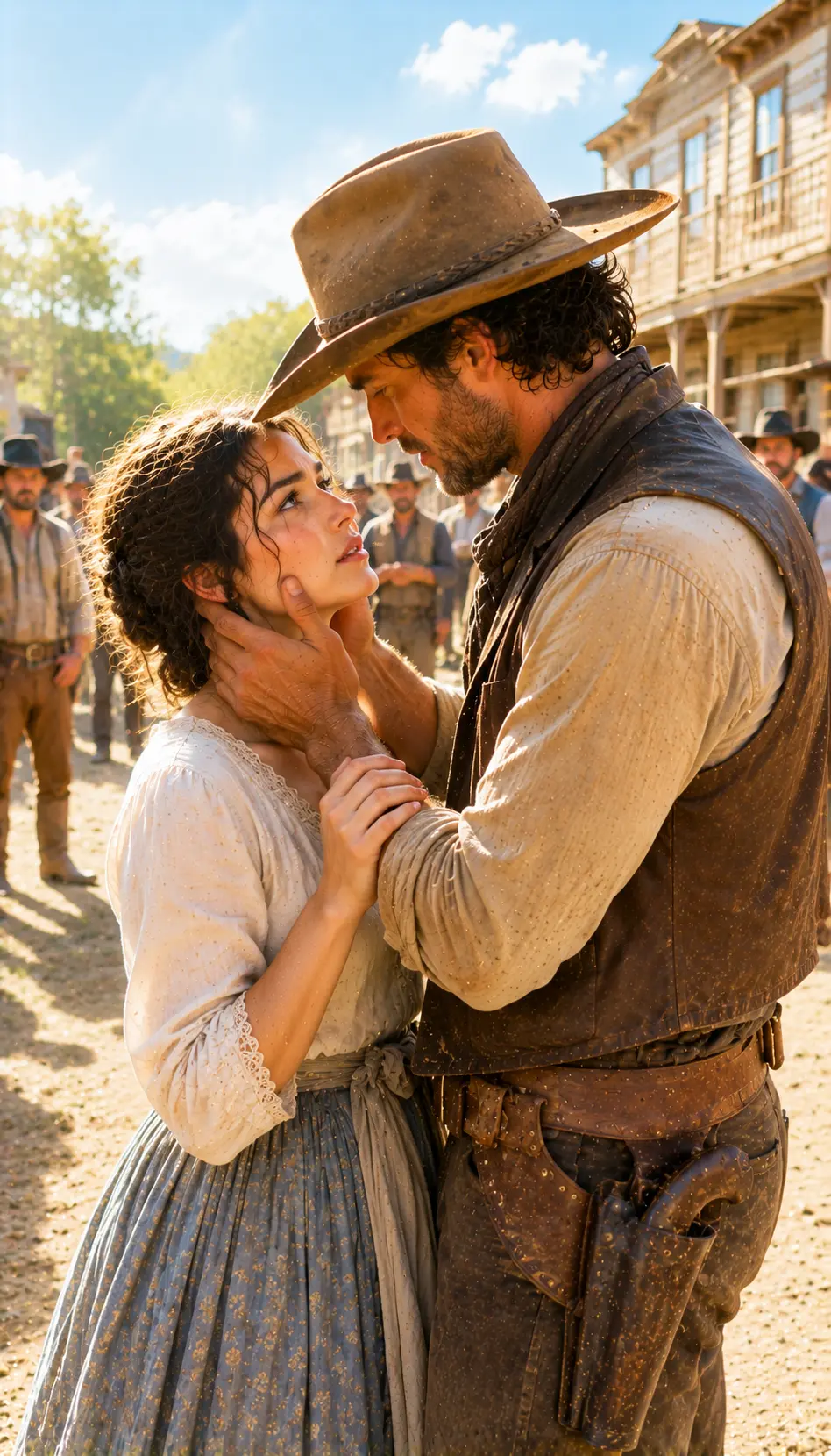
“Harriet,” he said softly, brushing wet hair from her cheek. “You are beautiful.”
She froze.
Her hand flew up to cover her face, but he gently caught it.
“Do not. Please.”
“I cannot.”
“Yes, you can.”
Grant cupped her face in his hands, not forcing, only steadying.
“You are the strongest woman I have ever known. You faced terrible loss and kept going. You maintained this farm alone. You ran through a storm in the middle of the night to save what you could. That is not weakness. That is extraordinary courage.”
A sob escaped her.
Then another.
Then the grief she had held behind black fabric for two years broke open.
Grant pulled her against his chest, holding her as the storm raged around them and the farm slowly surrendered to the flood.
“I have you,” he murmured into her hair. “I have you, and I am not letting go.”
When her sobs finally eased, Harriet looked up at him with a face streaked by tears and rain.
“I do not know what to do now. Where to go.”
“Home,” Grant said simply. “With me. Until we know what can be saved.”
“Home,” she repeated, as if testing a word she thought she had lost.
Then, surprising them both, she touched his face.
“Why do you care so much, Grant Patterson? About a broken widow who hides behind veils?”
He turned his head and pressed a kiss to her palm.
“Because behind that veil, I saw a woman worth knowing. Worth caring for. Worth loving, if she could let herself be loved again.”
Her eyes filled fresh.
“I do not know if I remember how.”
“Then we figure it out together. Day by day.”
Dawn broke over Sweetwater Springs as the storm finally eased. Harriet’s farm stood damaged but not destroyed. The house still held. The barn was wounded but standing in part. The fields were soaked and torn, but the land remained.
As they drove a wagon of salvaged belongings and rescued animals toward Grant’s place, Harriet felt grief beside her, yes.
But not only grief.
Peace rode there too.
When they reached his cabin, Grant helped her down, his hands strong and sure at her waist. She stood before him in pale morning light, face bare, and did not turn away.
“Welcome home, Harriet,” he said softly.
For the first time in two years, Harriet Blackmore looked directly into another person’s eyes without shame.
And smiled.
Rebuilding began slowly.
The flood had damaged much, but not everything. The house foundation remained solid. With Grant’s help and the unexpected assistance of townspeople who came after hearing of the disaster, the most urgent repairs were finished before winter.
Harriet stayed at Grant’s cabin while the work continued. At first, she took his bedroom while he slept in the main room. Every boundary was respected. Every fear given room. But as weeks passed and their hearts moved closer, the distance between rooms began to feel less like safety and more like a habit grief had taught her.
One cold November evening, they sat by the fire while Grant mended a bridle.
“Grant,” Harriet said softly. “I have been thinking.”
He looked up.
“About?”
“Us.”
The word filled the room.
She twisted her hands in her lap, nervous but determined.
“When I am with you, I feel safe. Not hidden. Not pitied. Safe. Like I matter.”
“You do matter,” he said. “More than anything to me.”
“When Thomas died, I thought the part of me that could love died too. I wrapped myself in grief and shame like that veil. I hid from everyone, including myself.”
She reached for his hand.
“But you would not let me disappear. You saw me when I could not see myself.”
Grant brought her fingers to his lips.
“I saw a woman of extraordinary courage and grace. A woman I fell in love with a little more each day.”
“Love,” she whispered, as if the word might break.
“I love you, Harriet.”
Her hazel eyes lifted to his, clear and unguarded.
“I love you too. And it terrifies me. Because loving means risking loss again.”
“Yes,” Grant said. “It does. But is what we could build together not worth facing that fear?”
Instead of answering, Harriet leaned forward and kissed him.
It was not a kiss that erased the past.
Nothing honest could.
It was a kiss that made room for the future beside it.
They married in the spring of 1879 in Sweetwater Springs.
Harriet wore blue instead of black.
Her face was unveiled.
When she walked down the small church aisle, people turned with surprise. Some had never truly seen her face. Some had forgotten the brightness of her smile. Some looked ashamed of the stories they had repeated without knowing the weight of them.
Grant stood waiting, eyes full, hands steady.
After the ceremony, Edgar Reynolds approached with one final offer for her land, dressed in politeness sharp enough to cut.
Grant started to answer, but Harriet laid a hand on his arm.
“Mr. Reynolds,” she said calmly, meeting his gaze directly, “my husband and I appreciate your interest. But that land is not for sale. Not now. Not ever.”
Reynolds looked from Harriet to Grant, then back again.
For once, he seemed to see her.
Not as a widow.
Not as a weakness.
As a woman with roots.
He tipped his hat and left.
“Our land,” Grant said softly when he was gone.
Harriet smiled.
“Our life.”
By the summer of 1880, the Patterson place was thriving. They combined their lands, rebuilt the barn stronger than before, repaired the flood damage, and expanded the herd carefully. Harriet’s old house became part of their shared home, not a shrine to sorrow but a place where memory and new joy could live under the same roof.
Harriet was expecting their first child in the fall.
On warm evenings, she and Grant sat on the porch, watching the Wyoming sky turn gold and rose over the fields. His arm rested around her shoulders. Her hand lay over the gentle swell of her belly.
“I never thought I could be this happy again,” she admitted one night. “After Thomas died, I thought my life was over.”
Grant kissed her temple.
“And now?”
She smiled, placing her hand over his where it rested on their unborn child.
“Now I know life can surprise you. That even after the darkest storm, the sun returns. That love can find you even when you are hiding from it.”
“Especially,” Grant said, “when the man looking is stubborn.”
She laughed softly.
“Persistent.”
“Determined.”
“Perfect,” she corrected, turning in his arms. “For me.”
As the last light gilded the distant mountains, Grant kissed his wife with all the tenderness that had grown between them. A love built not on forgetting, but understanding. Not on rescue alone, but respect. Not on pretending the past had never happened, but choosing not to let it rule the rest of their days.
Harriet Blackmore Patterson, once hidden behind a veil of grief and shame, now stood in the full light of morning whenever she went to town. She looked people in the eye. She spoke clearly. She laughed when joy found her. And when whispers followed, they no longer had anywhere inside her to land.
She had not failed Thomas by being afraid.
She had honored him by surviving.
She had honored herself by living again.
And on the land where sorrow once nearly buried her, Harriet lifted her face to the sun—beautiful, beloved, and finally free.