A Woman Cast Off by the Wagon Train Was Found by a Cowboy, He Carried Her to His Camp
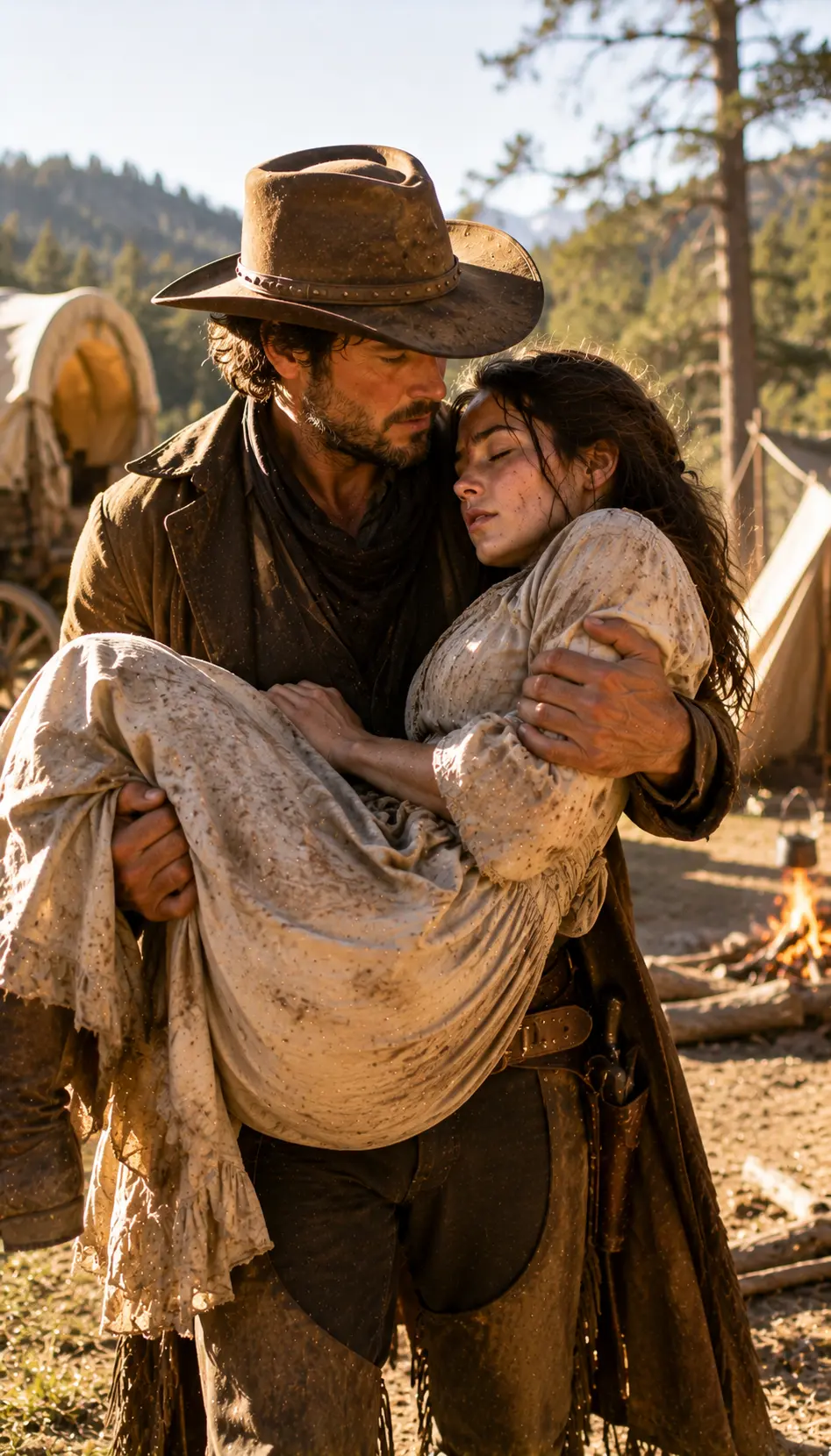
The first thing Sawyer Zane saw was not the woman.
It was the stillness.
In Wyoming Territory, in the hard blue heat of July 1873, nothing on the plains stayed still unless it was dead, dying, or waiting for something worse. The grass bent under wind. Dust moved in little devils over the trail. Hawks circled. Mesquite branches rattled dryly beneath the sun. Even the air shimmered as if the earth itself were trying to escape the heat.
But there, beside a twisted mesquite on the far horizon, was a shape that did not belong to the land.
Sawyer reined in his horse.
Dust rose around him like smoke.
At first, he thought it might be a bundle of cloth blown loose from a wagon. Then he saw the skirt. Torn hem. Faded calico. A bonnet hanging by one ribbon from a branch. One arm lying too still against the ground.
A woman.
Alone.
In the middle of nowhere.
Sawyer’s hand tightened on the reins.
He had seen enough of the frontier to know that a person did not end up abandoned beneath a mesquite by accident. Trails had stories, and most of them were not kind. People fell behind. Wagons broke. Fever took hold. Greed made men cruel. Fear made groups selfish. Sometimes a person became a burden, and the West had a way of teaching the worst kinds of people to leave burdens behind.
He swung down from the saddle and approached slowly.
Not because he was afraid of her.
Because wounded people often mistook help for another threat.
“Ma’am,” he called, voice low and careful.
The woman’s head lifted.
Her face was sunburned, streaked with dirt, her lips cracked so badly they looked painful to move. A dark line marked one side of her temple where she must have struck stone or wagon wood. Her eyes, pale brown beneath lashes heavy with dust, blinked at him as if he had come out of a dream she did not trust.
“Do not touch me,” she rasped.
The words barely held weight.
Sawyer stopped where he stood.
“I will not hurt you.”
He unfastened the canteen from his saddle, crouched, and held it out by the strap.
She stared at it.
Then at him.
Then back at the canteen.
Her hands shook when she reached for it. She drank too fast and coughed hard, her whole body trembling from the effort.
“Slow,” Sawyer said. “Little at a time.”
She obeyed, but her eyes never left his face.
“What happened?” he asked.
Her gaze flicked past him toward the west, toward the trail.
“Wagon train left me.”
Sawyer’s jaw tightened.
“Why?”
“I got sick. Fever took me for a few days. When I woke, they were gone.”
Her voice cracked.
“They left my son and daughter too. Took everything else.”
Sawyer felt something inside his chest go cold.
“Where are your children?”
She looked toward a patch of rocks behind the mesquite.
There.
Two small shapes huddled in the shade.
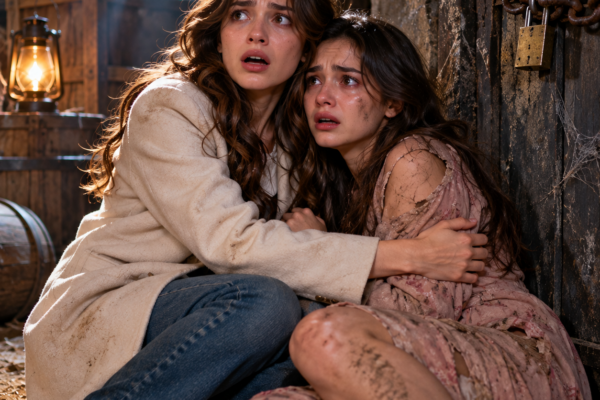
Sawyer moved quickly, but not so fast he frightened them. A boy, maybe five, sat with one arm wrapped around a little girl no older than three. Both were filthy, exhausted, and watching him with eyes too wide for children. The boy’s chin lifted as Sawyer approached, trying with all the strength in his small body to look brave.
Sawyer had seen grown men with less courage.
He turned back to the woman.
“How long have you been here?”
“Four days,” she whispered. “Maybe five. I cannot walk far. My leg.”
Her face tightened.
“I fell.”
Sawyer looked down and saw her right ankle swollen badly, the skin bruised dark beneath the dust. No way she could stand on it. No way she could carry two children. No way she could survive another day under that sun.
“What is your name?”
She swallowed.
“Evelyn Dorsey.”
“I am Sawyer Zane.”
He looked into her eyes and made his voice as plain as a vow.
“I am not leaving you here.”
Her mouth trembled.
“You do not know me.”
“I do not need to.”
She flinched when he moved closer, so he stopped and waited until she gave the faintest nod. Only then did he slide one arm behind her back and the other beneath her knees.
She was light.
Too light.
Like the plains had already begun taking pieces of her.
The children followed silently as he carried her toward his horse. The boy stood close to his sister, one hand gripping the torn back of her dress.
“You cannot carry me and ride,” Evelyn said weakly.
“I will walk.”
He wrapped his coat around her shoulders, lifted Victor—the boy—into the saddle, then lifted little Viola in front of him. He tied a length of rope carefully around them, not to bind, but to keep them steady. Then he hoisted Evelyn up behind them, supporting her with one hand until she found what balance she could.
Sawyer took the reins and began walking.
For nearly two hours, he led the horse through dry rolling country while the sun hammered down. Evelyn drifted in and out of sleep, her cheek resting against his shoulder whenever he walked close enough to steady her. The children dozed too, swaying gently, too tired even to ask where they were going.
Sawyer did not stop.
Not until the cottonwoods appeared.
His camp sat near a narrow creek tucked in a green seam of shade, hidden from the open plains. It was not much. A canvas lean-to. A fire ring. A bedroll. A split log for sitting. A few traps hanging from a branch. A tin pot, two blankets, a saddle, and the kind of quiet a man could disappear inside if he had a mind to.
But it was safe.
At least for now.
He laid Evelyn on his bedroll, checked her ankle again, and gave her more water. Then he handed her a strip of jerky.
She chewed slowly, watching him with the wary focus of a woman who had learned not to trust rescue too quickly.
“You live out here alone?” she asked.
“For now.”
“Why?”
Sawyer took his time answering.
The wind moved through the cottonwoods. The creek whispered over stones. Victor and Viola sat beside the water, too cautious to approach it yet.
“I needed quiet,” he said at last. “After the war. After other things.”
Evelyn said nothing, but her expression changed.
Not pity.
Recognition.
Later, when the heat loosened and the sun started lowering toward the hills, Sawyer took the children to the creek. He let them splash first, to remember water as something gentle. Then he washed the dirt from their hands, faces, and hair. Victor stood stiff at first, but Viola giggled when the cold water ran over her toes, and the sound broke something open in the air.
Evelyn watched from the bedroll, her eyes shining.
“Thank you,” she said when Sawyer wrapped the children in clean blankets.
He glanced over.
“You do not need to thank me.”
“I do.”
Her voice cracked.
“No man has ever carried me to safety before.”
Sawyer crouched beside her.
“You are safe now.”
That night, he wrapped her ankle snugly with cloth soaked in willow-bark tea and propped it on folded blankets. He set the children close beside her, close enough that she could touch them whenever fear woke her.
They fell asleep quickly.
Sawyer did not.
He sat by the fire with his rifle across his knees, watching the darkness beyond the cottonwoods. A wolf howled far off. The wind shifted. The horse stamped once in the grass.
Evelyn stirred before dawn.
“You should sleep,” she whispered.
Sawyer looked over.
“You should heal.”
A faint smile touched her mouth.
Her eyes were tired, but there was strength beneath the exhaustion.
“You have kind eyes.”
He blinked.
“I have been told I look like a bear.”
Her smile trembled wider.
“A kind bear, then.”
He looked down at the fire and found himself smiling too.
“I will take that.”
Silence stretched between them.
But it was not empty.
It felt like something beginning.
“You saved my life,” she said softly.
“It was the right thing to do.”
“No one else thought so.”
Sawyer looked at her long and steady.
“Then they were fools.”
Evelyn’s breath caught.
Her hand reached out and touched his wrist, light as a falling leaf.
He did not pull away.
The fire cracked. The sky paled. Morning crept over the hills, and Sawyer Zane knew with quiet certainty that he had found something on those plains he had not been looking for.
Something worth carrying home.
By the second morning, the bruising around Evelyn’s ankle had deepened, darkening along her calf. Sawyer crouched beside her and pressed gently along the joint. She gripped the edge of the blanket but did not cry out.
“You ever set a bone?” she asked, voice dry as cotton.
“Reset a shoulder once,” he said. “But this is not broken. Tendons are pulled bad, maybe torn. Hurts worse than a clean break sometimes.”
“Feels like a wolf chewed it.”
“Then we will make sure the wolf does not win.”
He soaked another strip of linen in bitter willow-bark tea and wrapped the ankle tightly. Evelyn’s jaw hardened, but she held still.
“You are stubborn,” Sawyer said.
She tilted her head.
“I was a midwife back in Missouri. Stubborn got me through the war with two babies and a mule.”
He looked toward the children, sleeping in the shade.
“You have kin out here?”
“No.”
The word seemed to cost her.
“My husband died at Pea Ridge. The wagon train was all I had left.”
Sawyer leaned back on his heels.
“Where were they headed?”
“Bozeman, they said. But truth is, most of them were running from something. They cared less about where they were going than what they were escaping.”
“And you?”
She hesitated.
“I was not running. I was trying to find a place no one could take from me.”
Sawyer nodded.
“That is fair.”
She reached beside her and pulled out a small folded cloth. Inside was a needle, a bit of blue thread, and a thimble worn shiny from years of use.
“If you have anything that needs mending,” she said, “my hands still work.”
Sawyer stood, went to his pack, and returned with a torn shirt.
“Been meaning to fix this for months.”
She took it and set the needle between her fingers as if it belonged there.
“This will give me something to do while I wait for the leg to come back to me.”
That day, the quiet between them settled deeper.
Sawyer checked traps along the creek, caught a fish, and set rabbit meat to cook slowly over the fire. When he returned to the lean-to, Evelyn had finished mending his shirt and hung it over a branch to dry. The stitches were so neat he barely recognized the tear.
“You did better than I could have.”
“I would hope so,” she said, lifting one brow.
Victor watched everything Sawyer did. The boy stood with arms folded when Sawyer cleaned fish, copied the way he tied knots, studied how he struck flint to steel and coaxed flame from dry grass. He did not ask many questions. He simply watched with a seriousness that made him seem older than five.
“You think he will take to woodcraft?” Evelyn asked.
“Already is. He has a good head. Does not ask questions he does not need answered.”
“Neither do you.”
Sawyer glanced at her.
“That a compliment?”
“It is.”
Later, she told him about the house where she grew up. Three rooms. Whitewashed walls. A cherry tree in the back that never bore fruit but bloomed beautifully every spring as if beauty alone was reason enough. She had delivered her first child in that house with her mother holding one hand and a Bible in the other.
Sawyer told her about the cattle outfit he had worked for near Laramie, the one that folded after two dry seasons and a blizzard that killed half the herd. He spoke of the war only in pieces. Long roads. Too much smoke. Men too young to die. The kind of silence that followed a battlefield and never fully left a man’s ears.
By dusk, he had built a small stool from pine branches so she could sit closer to the fire with her leg propped comfortably. When Evelyn ran her hand along the wood, her fingers paused over a small mark carved into the side.
“This yours?”
“Used it when I branded fence posts. Just habit now.”
“It is a good mark,” she said. “Steady.”
Night cooled the plains.
The children curled beneath a wool blanket. Sawyer added another log to the fire, its glow catching gold in Evelyn’s hair. She sat quiet for a while, watching the flames.
“You do not owe us anything,” she said.
Sawyer did not look away from the fire.
“I know.”
“You could have left us where we were.”
“I did not want to.”
She studied his profile.
The strong line of his jaw. The tiredness around his eyes. The careful way he held himself, as if he had learned that gentleness took more discipline than force.
“You ever think about settling somewhere?” she asked.
“Sometimes.”
“With someone?”
That made him turn.
Slowly.
“That part I had not thought through yet.”
“Maybe now you might.”
They did not speak after that.
There was no need.
The fire cracked. The stars turned overhead. The wind carried the scent of sagebrush and cooling earth. Something shifted between them—not sudden, not sharp, but quiet and undeniable.
Like two branches leaning toward the same light.
Over the next days, Evelyn regained strength. The swelling in her ankle eased. She began using a walking stick Sawyer carved from juniper, taking short careful steps from the bedroll to the fire, then to the creek and back. Each step cost her, but she took it anyway.
Victor gathered kindling.
Viola threaded wildflowers into loops of twine and placed them proudly in her mother’s hair.
The children began to sleep deeper.
That was what Evelyn noticed most.
“They slept through the night,” she said one morning, looking at their small forms beneath the blanket.
Sawyer was rinsing a tin cup in the creek.
“That is good.”
“No,” she said quietly. “You do not understand. They have not done that since Missouri.”
He looked over.
She was watching him with an expression too open to hide behind words.
“I used to think I would never speak to a man again without flinching first,” she admitted.
Sawyer did not answer. He simply reached into his coat, pulled out a small cloth bundle, and set it in her lap.
She opened it slowly.
Inside were two tin buttons, a folded scrap of muslin, and a length of lace yellowed at the edge.
“My mother’s sewing kit,” he said. “I have carried it since Shiloh. Figured you would make better use of it than I ever did.”
Evelyn’s fingers moved over the lace as though touching something sacred.
“This was hand-tatted.”
“She made it while waiting for my father’s letters.”
“I have not held lace like this since my wedding day.”
Sawyer watched her.
“You speak of your husband quietly. Was he cruel?”
Evelyn’s face changed, not closing, but deepening.
“No. He was kind. But his kindness bent too easily to fear. When the war came, he went gladly because everyone said a good man should. I stayed because the children needed me. When he did not come back, I did not cry at first. I just held the babies and kept going.”
Sawyer understood that.
Sometimes grief had to wait its turn.
“You ever love someone?” she asked.
“Once. Before the war. I was nineteen and thought I knew what love meant.”
“What happened?”
“She married a banker from Cheyenne while I was east.”
“That must have cut.”
He shrugged.
“I do not blame her.”
They sat with that truth between them, not bitter, just worn smooth by time.
“I have never known a man to give me something without expecting a piece of me in trade,” Evelyn said.
Sawyer looked at the fire.
“I am not most men.”
“No,” she said softly. “You are not.”
That night, when the fire had burned low and the air turned cold, Evelyn tried to shift closer to the children. Her injured leg caught, and she hissed in pain. Sawyer was beside her before she could call him.
He slipped an arm behind her back and eased her down beside them, careful not to jar her ankle.
“You have a gentle way,” she whispered.
“I learned not everything needs force.”
Her hand brushed his sleeve.
“You could have left us there.”
“I did not want to.”
She looked up at him, firelight shining in her eyes.
“I do not want to be alone anymore.”
Sawyer did not speak.
His hand found hers where it rested near the blanket, and his thumb traced the ridge of her knuckle.
Above them, the stars wheeled on.
But on the ground, in the warmth of that small camp beneath the cottonwoods, something stilled into certainty.
A place neither had searched for.
A future neither had dared name.
The morning opened with low clouds and the kind of hush that comes before rain. Sawyer stood near the fire, sharpening his skinning knife in slow, practiced strokes. Evelyn sat beneath the lean-to with her leg propped, following the motion of his hands.
“You always keep to yourself this far out?” she asked.
“Not always. Did fence work near Green River last fall. Stayed through wind season, then came back here.”
“You prefer the quiet.”
“I do not mind work. But I do not sleep easy with too many voices around.”
She nodded.
“You ever think of building something of your own? A place with walls?”
Sawyer set the knife down.
“I have thought on it. Land near Elk Hollow is good for stock. Water is steady. Soil holds. But a strong back is not enough to make a place last.”
Evelyn looked toward the trees.
“A place like that could grow food. Raise chickens. Plant cottonwoods for shade.”
“You know planting.”
“I was raised by a man who believed if God gave you hands, you had better use them. I do not wait for someone else to break the soil.”
A quiet shift moved through the air.
“I have claim papers,” Sawyer said. “Filed last spring. Just have not settled the ground yet.”
“Why not?”
He looked at her.
“I did not see a reason to build something no one else would share.”
Evelyn did not answer right away. She unwrapped the cloth from her ankle, checked the swelling, then rewound it carefully.
“I was born in a cabin with a dirt floor,” she said. “It had a stovepipe that whistled in the wind and a door that stuck during spring rain. But my mother kept the hearth burning year-round. That was what made it home.”
Sawyer watched her hands.
“Do you think you could make a home again?”
She looked up, steady now.
“With someone who understands quiet and does not need to fill it with noise?”
“Yes.”
Victor came back from the trees with kindling bundled in both arms.
“Good haul,” Sawyer told him, standing to help.
The boy glanced between them.
“Can we stay here a while?”
Sawyer looked at Evelyn.
“That is not just my decision.”
Viola, kneeling in the grass, held up a little circle of flowers.
“Mama, look. For your hair.”
Evelyn took it gently, brushing one thumb over the petals.
“It is beautiful, little one.”
Then she looked at Sawyer.
“We need a roof before first frost. You think those claim papers are still good?”
“They are mine. Still waiting.”
She tucked the flowers behind her ear.
“Then let us not wait too long.”
Sawyer crossed the space between them slowly. When he offered his hand, it was not for show. It was a question, quiet and sure.
Evelyn took it.
No ceremony. No promise spoken loud enough for the world. Just a choice made in the shade of cottonwoods, born from survival and softened by care.
Thunder rolled low across the plains.
Rain would come.
But they had shelter enough for now.
And more yet to build.
The wagon Sawyer borrowed from a freighter outside Rawlins creaked under the weight of salvaged lumber, sacks of seed, tools, a second bedroll, and everything they had gathered toward the beginning of a life. He drove it south with Evelyn beside him, her ankle wrapped but strong enough now to manage short walks. Victor and Viola nestled between sacks of oats and a straw mattress tied in canvas.
The trail was rough, winding through draws still damp from recent rain, but it led true to the land Sawyer had claimed the year before.
When they reached the rise above Elk Hollow, the view opened.
Wide grass bending in the wind. A narrow stream cutting along the foot of the ridge. Cottonwoods scattered like sentinels. Low hills cupping the hollow as if protecting it from the worst of the weather.
Evelyn leaned forward, fingers tightening on the wagon seat.
“It breathes,” she said.
Sawyer looked at her.
“What does?”
“This land. Like it has been waiting to be useful again.”
They built slowly.
The first week, Sawyer raised the cabin frame with rough-sawn beams and notched braces, working from dawn until the light failed. Evelyn kept the fire going, cooked over stones until the stovepipe could be set, and studied his work with practical eyes.
“The roof needs a steeper pitch,” she said one afternoon. “Snow will sit too heavy otherwise.”
Sawyer paused, looked at the angle, then nodded.
“You are right.”
She looked surprised.
“You do not mind being corrected?”
“Not if the roof stays up.”
That made her laugh.
The children gathered stones from the streambed for the garden border. Victor carved his initials into a porch post until Sawyer showed him how to make the letters cleaner. Viola found wild mint and carried it back proudly in her apron.
One evening, as the ridge cooled and the sky turned amber, Sawyer stood on the half-finished porch watching Evelyn tie a strip of muslin around her wrist where she had scraped it hauling water. Her sleeves were rolled. Her hair was tied back with the yellowed lace from his mother’s sewing kit.
She caught him looking.
“You thinking something?”
He stepped down from the joist.
“Wondering if you would let me build a room on this place that is yours as much as mine.”
“You already did.”
Then she added, softer, “But I would not mind a door that shuts.”
He smiled.
“I can make that.”
She came closer, her steps steadier now.
“You always this steady?”
“I was not. Not for a long time.”
“Neither was I.”
Her hand brushed his shoulder and stayed there.
First frost came early.
By then, the roof was on, the walls sealed with clay and straw, and smoke rose clean from the chimney. Sawyer dug the trench for a privy while Evelyn built shelves from reclaimed planks. Victor helped stack wood. Viola placed stones around the hearth because she said fire deserved a pretty edge.
One night, with wind howling through the hollow and the cabin warm with stew, Evelyn pulled a tin box from beneath her bag. Inside were letters wrapped with twine.
“My mother’s,” she said. “I read them when I thought I had lost everything.”
Sawyer opened the top one and scanned the neat script.
“She was strong.”
“So is her daughter.”
Evelyn looked away, but her eyes shone.
The children slept near the hearth, curled close together but no longer tense even in dreams. The wind pressed softly against the shuttered windows.
Evelyn turned toward Sawyer.
“I want this place to hold.”
“It will.”
“How can you be sure?”
“Because we will.”
She leaned forward then and kissed him.
Not shy.
Not uncertain.
His arms came around her, pulling her close. For the first time since the day she had been left beneath the mesquite tree, Evelyn let herself lean fully into the strength of another person without fear.
They married simply, with the stream behind them and a ring Sawyer shaped from smooth river stone and wire he polished until it shone. The preacher came from town on a cold morning, his hands cracked from weather, his voice warm despite the wind. Victor held Viola’s hand while they watched.
There was no fanfare.
Only truth.
Evelyn wore a calico dress stitched from fabric she had bartered for with jars of wild mint jelly. Sawyer wore his best shirt, the one she had mended by firelight that first week. They spoke their vows quietly, but every word held.
Then he kissed her.
And she kissed him back.
The cottonwoods bent in the wind as if they too had come to witness.
Years passed.
The land held.
So did they.
Victor built a chicken coop at twelve and claimed it was sturdier than the cabin had been at first. Sawyer pretended offense. Evelyn sided with Victor because, as she said, “The boy uses a square better than you did when you started.”
Viola planted marigolds each spring along the cabin steps. She grew up bright and fearless, with her mother’s hands and Sawyer’s habit of watching the horizon before speaking.
Evelyn’s hair silvered at the temples. Sawyer’s shoulders thickened with work and weather. They added a second room, then a third. A braided rug lay by the hearth. Beans simmered most days. Sawyer read aloud from newspapers when he brought them back from town, stumbling over politics and laughing when Evelyn corrected him.
The cabin became a place travelers remembered.
Not because it was grand.
Because the hearth was always warm.
Because Evelyn never let a hungry person leave without bread.
Because Sawyer never passed a stranded wagon without stopping.
People said Elk Hollow was a hard place made gentle by the family who settled there.
They were not wrong.
One night, many years later, with stars bright above the hollow and the fire low, Sawyer sat beside Evelyn in the rocking chair he had carved for her birthday. She leaned her head against his shoulder, her hand resting on his knee.
“Do you remember that first night?” she asked.
“In the cottonwoods?”
“No. Before that. When you carried me out of the dust.”
Sawyer looked toward the fire.
“I remember every step.”
“I thought I was too heavy.”
“You weighed almost nothing.”
“I do not mean my body.”
He turned to her.
Evelyn’s eyes were soft with memory.
“I thought my grief, my children, my fear, my ruined plans—everything about me would be too much for anyone to carry.”
Sawyer kissed her brow.
“You were never too much.”
She closed her eyes.
“I never thought peace would feel like this.”
“You earned it.”
“No,” she whispered. “We built it.”
They sat long after the fire burned low, the silence between them deep and good. Outside, the wind moved through the grass. Inside, the warmth of the life they had made held steady.
Once, a wagon train had abandoned Evelyn Dorsey and her children beneath a mesquite tree because they believed she had become a burden.
They were wrong.
She was not a burden.
She was a beginning.
And Sawyer Zane, who had gone into the plains looking for quiet, found a family where the world had left one behind.
He carried them to safety.
Then together, they carried each other home.