Cowboy Wanted A Quiet Bride—Got A Fierce One Who Rode Him Till Dawn
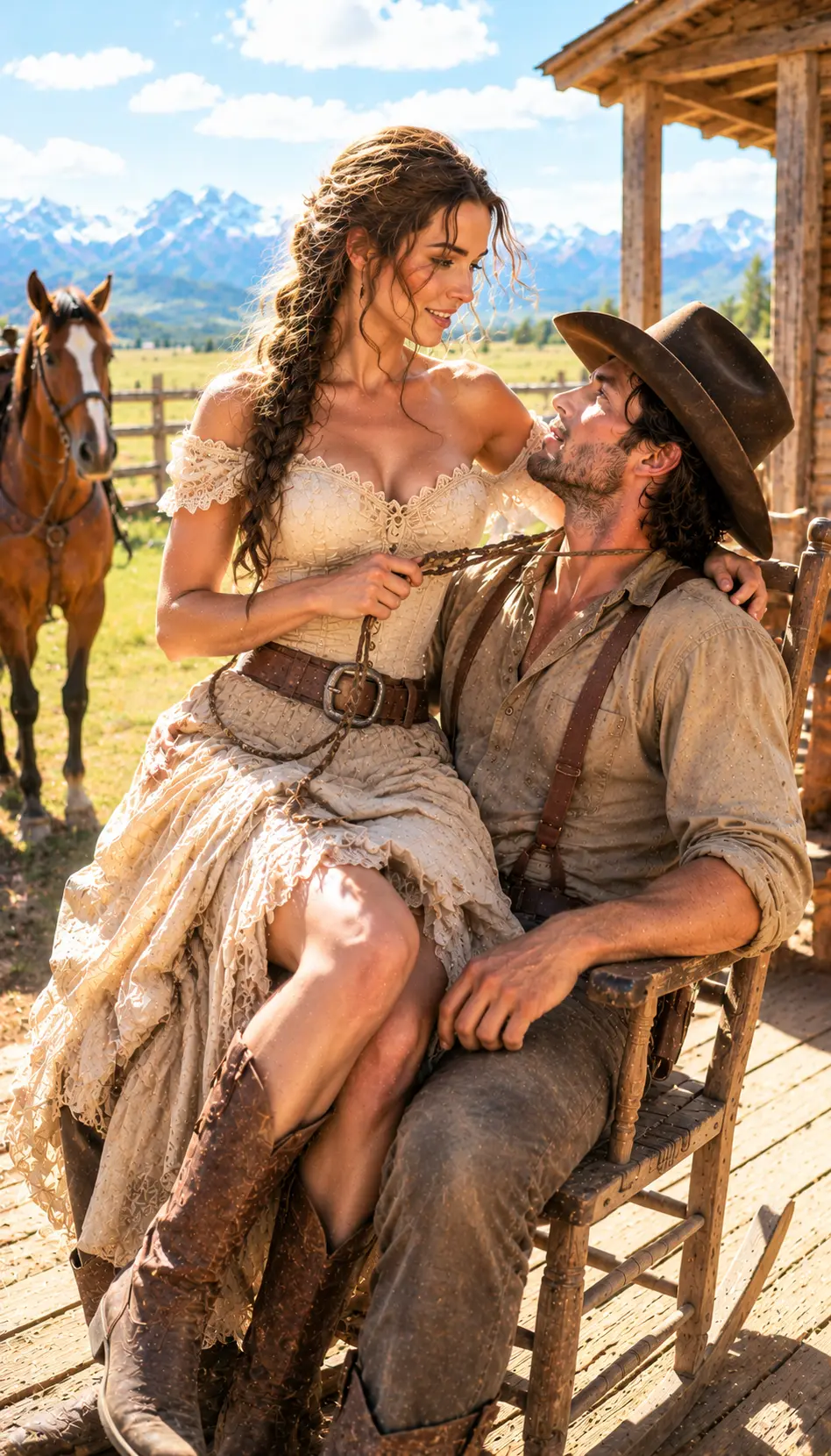
The dust hung over Clearwater Railway Station like a golden curtain, thick enough to taste, soft enough to make the whole town look like it had been painted in the same tired color.
Jackson Wade stood on the wooden platform with his hat pulled low and his boots planted as if the earth itself might shift under him if he moved too much. At thirty-two, he had spent half his life on horseback, driving cattle across open country, sleeping beneath stars, waking to coyotes, and learning that the frontier did not care whether a man was lonely.
But that afternoon, even Jackson Wade felt uneasy.
The 3:15 train from Kansas City was due any moment.
And according to the letter folded inside his vest pocket, his future was supposed to step off it.
Behind him, Clearwater was hardly more than a scattering of weathered buildings under the Texas sun: a saloon with warped doors, a church painted white enough to look hopeful from a distance, a general store, a few houses, a livery, a water trough with mud around its base, and streets that turned to dust with the slightest wind. Civilization had been creeping westward for years, but out here it still came slow, careful, and thirsty.
Jackson preferred it that way.
He had built his ranch five miles north of town, on land that had fought him from the first day and slowly, grudgingly, become his. Strong fences. A good herd. Clean water. A barn that could withstand a hard wind. A house that did not leak anymore.
The only thing missing, according to everyone in Clearwater, was a wife.
“You can’t live out there alone forever, Jack,” old Mrs. Harriet had scolded after church one Sunday, shaking a gloved finger at him like he was still a boy. “A man needs a woman if he wants a home instead of just a house.”
Jackson had smiled politely and changed the subject.
But the words stayed.
They stayed through cold suppers eaten alone.
Through long evenings when the wind moved over the roof and there was no voice in the house except his own muttering over ledgers.
Through nights when he sat on the porch watching lantern light glow in neighboring homes and pretended not to wonder what it felt like to be expected somewhere.
So, after months of letters through his cousin Martha back east, he had agreed to an arrangement.
A mail-order bride.
Her name was Eleanor Prescott.
Twenty-three years old. Educated. Modest. Calm. Ladylike. Known for her manners. “The perfect wife for a cowboy ready to settle down,” Martha had written in her careful slanted handwriting. “Quiet, gentle, and proper.”
Quiet, gentle, and proper.
Jackson had repeated those words until they sounded like a promise.
That was what he wanted, or at least what he thought he wanted. A woman who would bring order to the house. Someone steady. Someone who would not make trouble. Someone who understood that a ranch was built on work, not dreams. Someone who would not stir up feelings he had spent years keeping under control.
Then the train whistle cut across the heat.
His pulse jumped like a horse startled by a snake.
Black smoke curled above the tracks. The locomotive came into view, iron and noise and power, wheels shrieking against steel as it rolled into the station. Jackson tightened his grip on his hat and tried to look like a man who had not spent the last hour questioning every decision he had ever made.
Passengers spilled out.
Businessmen in city coats.
A family with tired children.
A salesman dragging two cases and complaining about the heat.
Two painted women laughing too loudly as they crossed toward the saloon.
Jackson barely saw them.
His eyes searched for one face.
Then he saw her.
Eleanor Prescott stepped down from the train as if the dusty platform had been expecting her.
Her traveling dress was deep blue, buttoned neatly to the throat, fitted with quiet elegance and dusted at the hem from the journey. A small bonnet framed dark hair swept up in careful waves. Her gloves were pale, her posture straight, her expression composed. Every inch of her spoke of refinement and discipline.
Everything he had been told to expect.
Everything he had hoped for.
Then she lifted her head.
And Jackson caught her eyes.
Green.
Bright as new spring grass after rain.
Behind the proper posture, behind the careful dress, behind the polite face of a woman raised to control every movement, there was something untamed.
A spark.
Like a mustang that had learned to wear a saddle but had never forgotten open country.
Their eyes met across the platform.
She did not look away.
She did not blush.
She did not lower her gaze the way most women did when men stared too long.
She studied him.
Steady.
Curious.
Almost amused.
As if she were measuring what kind of man she had traveled a thousand miles to marry.
Then she smiled.
Not shyly.
Not nervously.
As if she knew something he did not.
“Mr. Wade?”
Her voice carried clearly through the clatter of luggage and train steam, smooth with an eastern polish but edged with confidence.
Jackson stepped forward and lifted his hat.
“Yes, ma’am. Miss Prescott.”
“Eleanor,” she corrected, extending a gloved hand.
He hesitated only because he had expected a nod, not a handshake. When he took her hand, her grip was firm.
Unexpectedly firm.
“I trust you received my letter about the arrangements,” she said.
“Yes, ma’am. Reverend Morrison is expecting us.”
His voice sounded rougher than he intended. Talking about marriage felt strange enough. Talking about it while she stood there smelling faintly of lavender water and long travel made his collar feel too tight.
Eleanor looked around Clearwater, eyes sharp as a hawk’s.
“It is smaller than I imagined.”
“It’s growing,” Jackson said, feeling oddly defensive. “We got a new schoolhouse last year. Doc Henley built himself a proper surgery.”
“Very progressive,” she said.
There was a small smile in her voice, and Jackson could not decide if she was teasing him.
Before he could think of a response, she nodded toward the baggage car.
“Shall we collect my trunk? I assume you are eager to complete the formalities.”
Formalities.
The word landed in his chest with a strange weight.
Her belongings were modest. One trunk and one carpetbag. As the station boy helped load them onto Jackson’s wagon, he noticed how Eleanor watched everything: the saloon across the road, the cowboys leaning against posts, the town women whispering behind gloved hands, the clerk pretending not to stare from the depot window.
Eleanor Prescott saw everything.
And missed nothing.
The ride to the church was quiet.
She sat straight beside him, hands folded neatly in her lap, but Jackson sensed tension beneath her calm surface. Not fear exactly. Readiness. Like a woman holding a door closed with one hand while preparing to open another.
“Your cousin Martha spoke highly of you,” she said finally.
“Martha is prone to exaggeration.”
“She said you were honest.”
Jackson glanced at her.
“I try to be.”
“That matters more than the size of your herd.”
The words struck him harder than expected.
He had expected polite questions. Weather. Distance. The ranch. Perhaps the church. Instead, she spoke as if honesty were not a nice quality but a necessary one. As if she had lived long enough around polite lies to prefer rough truth.
The wedding was short.
Reverend Morrison performed the ceremony in the little white church with Mrs. Morrison and the town clerk as witnesses. Dust turned lazily in the shafts of afternoon light. The church smelled of sun-warmed wood, old hymnals, and lemon soap.
Eleanor spoke her vows clearly.
Her eyes never left Jackson’s face.
When the time came for the kiss, she lifted her chin, not timidly, not reluctantly, but with quiet command. Jackson bent carefully, almost respectfully, and touched his lips to hers.
It was brief.
Proper.
But not empty.
Her composure made it feel less like she was accepting affection and more like she was granting permission for the first step into unfamiliar territory.
Afterward, they signed the register.
Her handwriting was beautiful, flowing and confident beside his rougher scrawl. Mrs. Morrison handed Eleanor a bundle of biscuits wrapped in cloth.
“For your new home,” she said kindly.
There was pity in her voice, though she tried to hide it. The kind people used when sending a young bride toward hardship. Eleanor heard it. Jackson saw that she heard it. But she only smiled.
“Thank you,” she said.
The sun was sinking when they left town.
The prairie glowed gold and crimson around them. Dry grass bent in the wind. A hawk circled somewhere far off, dark against the bright sky.
Jackson drove in silence for a while, then said what he always said when he felt the need to warn someone before they could be disappointed.
“It’s not much.”
Eleanor turned her face toward him.
“The ranch?”
“House is sturdy. Roof doesn’t leak. Barn holds. Water is good. But it’s plain.”
“I do not mind plain.”
“You might when you see it.”
She did not answer immediately.
Then the ranch came into view.
A sturdy log house. A stone chimney. A barn near the corral. Fences running clean along the pasture. Beyond it, miles of open land breathing under sunset. It was not elegant. It was not easy. But it had the look of something built with sweat instead of money.
Eleanor studied it.
Then she surprised him with a small, genuine smile.
“It is perfect.”
Jackson nearly laughed from disbelief.
“You haven’t been inside yet.”
“You built this yourself?”
“With help. Took near two years.”
“That matters.”
When he helped her down from the wagon, her shoulder brushed his arm. He caught the scent of lavender again, mixed now with dust, train smoke, and something earthier. Something alive.
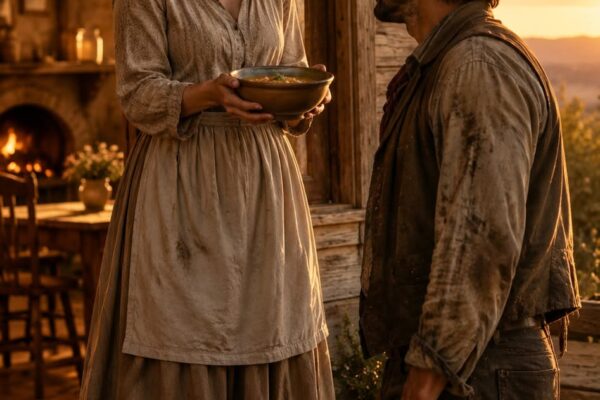
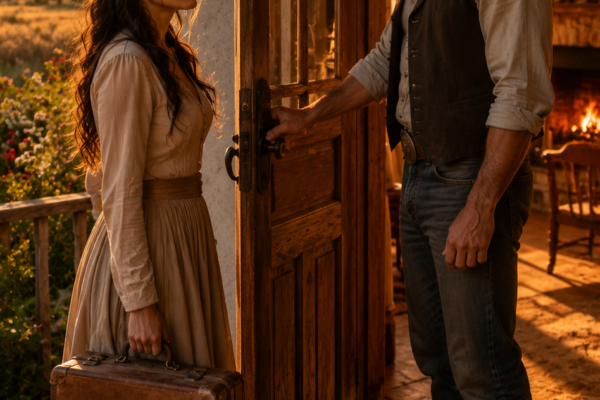
Inside, the house was plain but tidy. A stone fireplace. Simple furniture. A kitchen corner. A table polished by use. A bedroom door down the hall. Jackson had spent the week preparing, but beneath Eleanor’s polished gaze everything seemed rougher than before.
“I will start supper,” she said at once, removing her gloves.
Jackson blinked.
“You don’t need to start right away. You’ve traveled all day.”
“And married before dinner. That does make a full afternoon. But I assume we still need to eat.”
He stared.
She arched one brow.
“You do have food, I hope.”
“Yes, ma’am. Bacon, beans, cornmeal, coffee.”
“Good.”
She moved through the small kitchen like she already belonged there. Quick. Efficient. Confident. She found the skillet, the kettle, the flour tin, and a knife with hardly a question. Jackson stood there for a moment watching her, realizing that she was not the shy, quiet woman he had imagined.
There was something stronger beneath the fine exterior.
Something he could not yet name.
By the time he returned from checking the barn, the smell of frying bacon filled the house. They ate mostly in silence. But it was not empty silence. Her eyes met his often, steady and unreadable, as if she were still studying the terms of the life she had accepted.
When supper was done, she cleared the table, washed the dishes, and finally turned to face him in the lamplight.
The open bedroom door waited beyond the hall.
Jackson cleared his throat.
“I know this is sudden. If you need time to settle in, I can sleep in the front room for a while.”
Eleanor looked at him for a long moment.
Then she stepped closer.
Not hurried.
Not timid.
Her green eyes caught the lamplight like fire under glass.
“Mr. Wade,” she said softly, “you think you married a quiet woman.”
He hesitated.
“That is what I was told.”
Her mouth curved.
“Tell me, what kind of quiet woman answers an advertisement to marry a stranger and rides a thousand miles into the frontier?”
Jackson had no answer.
She laid her hand lightly against his chest, not improper, not careless, but direct enough that his breath changed.
“I came here by choice,” she said. “Do not mistake good manners for weakness.”
Then she stepped back, calm as ever, as if she had not just shifted the floor beneath him.
Jackson Wade realized, standing in his own house with his new wife before him, that everything he thought he knew about women, marriage, and himself might be too small for the truth that had arrived on the 3:15 train.
Outside, coyotes called under the rising moon.
Inside, something unpredictable had just begun.
The morning sun streamed through the cabin window, soft and gold, revealing dust motes drifting in the light. Jackson woke before dawn out of habit and lay still for a moment, listening to the quiet house.
Eleanor slept peacefully.
Her dark hair had loosened from its pins, spilling across the pillow like ink. Even at rest, she did not look helpless. She looked as if she had claimed sleep because it was useful and would wake when she was ready to face the day.
Jackson rose carefully, intending to begin chores before she stirred.
Her eyes opened instantly.
Alert.
Sharp.
“Running off already, cowboy?”
He froze with one boot in hand.
“Cattle don’t feed themselves.”
“Then I had better get dressed too.”
He stared.
“You don’t need to come out.”
She sat up and looked at him as if he had said something very foolish.
“I did not travel here to sit by a window and embroider while you wear yourself out.”
An hour later, Jackson led the horses from the barn and nearly dropped the bridle.
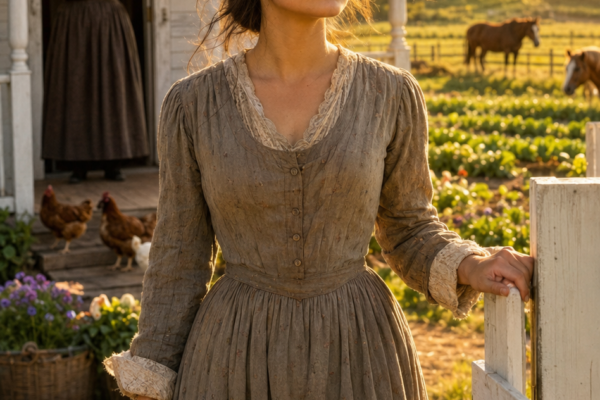
Eleanor stepped from the house wearing no bonnet, no blue traveling dress, no lace at her wrists. She had changed into a split riding skirt, boots, and a simple blouse rolled at the sleeves. Her hair was braided back. She looked less like a delicate bride and more like someone about to inspect his entire ranch and decide whether it met her standards.
“Where in the world did you get that outfit?” he asked.
“I told you,” she said, crossing the yard. “You made assumptions. Which horse is mine?”
“Yours?”
“Yes.”
“These aren’t stable ponies. They’re working stock. Half wild, some of them.”
She looked into the corral.
“That bay mare.”
“Rosalind?”
“She has sense.”
“She has opinions.”
“So do I.”
Before he could stop her, Eleanor stepped into the corral. Rosalind lifted her head, wary, ears flicking. Jackson tensed, ready to move if the mare spooked. But Eleanor slowed her body, lowered her voice, and approached with the patience of someone who understood animals were not machines to be commanded, but minds to be persuaded.
Within minutes, Rosalind’s ears softened.
Eleanor’s gloved hand rested on the mare’s neck.
“Bring me a saddle,” she said without looking back.
Jackson obeyed mostly because disbelief had outrun argument.
She saddled with practiced movements, checked the cinch properly, then swung into the seat with smooth confidence. Rosalind danced sideways, testing her. Eleanor sat deep, heels down, hands steady.
“Well?” she said, grinning down at him. “Are you coming, or should I check the herd myself?”
Jackson mounted, still shaking his head.
“You can ride.”
“I told you I was not raised in a cage.”
They rode into the open prairie where sunlight turned the grass to gold and the cattle moved in slow dark shapes across the land. Eleanor looked over the herd with eyes that missed nothing.
“Good stock,” she said. “Longhorn crossed with something heavier. Hereford, perhaps.”
Jackson stared.
“How would you know that?”
“My uncle bred horses in Kentucky. I spent summers on his farm. He taught me to ride, rope badly, and judge animals better than people.” She smiled faintly. “My aunt nearly fainted every time I came home with a torn skirt.”
They spent the morning checking the herd.
When they found a cow with a wound that needed tending, Eleanor did not flinch. She listened to Jackson’s explanation, asked two practical questions, then helped without complaint. When he reached for his lariat, she took it first.
The throw was not perfect.
But it held.
Jackson stared.
“Where did you learn that?”
“My uncle said I had good wrists.”
“Your uncle sounds like a dangerous influence.”
“He was the only adult who ever thought my curiosity was a gift instead of a problem.”
They treated the cow quickly and cleanly. Eleanor’s sleeves were rolled up. Dust streaked one cheek. Sweat darkened the hair near her temples. She was focused, capable, and alive in a way that made Jackson feel as if he had been looking at a painted portrait and suddenly discovered it could breathe.
By the time they rode back for noon, he had stopped trying to fit her into the mold he had built in his mind.
On the way home, they passed the Hendricks place.
Mary Hendricks stood by the wash line, clothespins in hand, her mouth falling open when she saw Eleanor astride Rosalind.
“Morning, Mary,” Jackson called.
“Morning,” Mary answered stiffly, her eyes moving over Eleanor’s riding skirt. “Mrs. Wade.”
“Please call me Eleanor,” Eleanor said warmly, though there was steel beneath it.
Mary’s lips thinned.
“It is not exactly ladylike to ride astride on your first day married. Folks will talk.”
“Then let them talk,” Eleanor replied. “Better they talk about me than about someone who cannot defend herself.”
Jackson nearly laughed at the look on Mary’s face.
They rode on, the silence between them full of shared amusement.
“She isn’t wrong,” Jackson said at last. “People will talk.”
Eleanor looked ahead.
“I did not cross a thousand miles to live by someone else’s rules.”
That afternoon, she insisted on learning to mend fences.
Her hands blistered.
She did not quit.
When Jackson told her she had done enough, she fixed him with a look.
“Would you stop if you were tired?”
He had no answer.
Days passed, and life settled into a strange rhythm. They worked together from dawn until dusk: checking cattle, hauling water, fixing gates, tending the kitchen garden, mending tack, sorting supplies. At night they sat under lamplight, sometimes speaking, sometimes simply sharing the tired quiet of two people who had earned rest.
Jackson discovered quickly that Eleanor was not merely energetic.
She was disciplined.
She learned a thing once, asked questions until she understood it, then did it better the next time. She was not reckless, though she appeared bold to people who mistook obedience for virtue. She was careful where care mattered and fearless where fear served no purpose.
She could make biscuits with the same seriousness she brought to treating livestock.
She could add columns in a ledger faster than Jackson.
She could ride Rosalind through a stubborn patch of cattle with more patience than half the men he had hired.
And when people in town tried to wrap her in rules, she smiled politely and stepped out of them.
By the second week, Jackson no longer thought of her as the quiet wife he had ordered from a letter.
He thought of her as weather.
Bright when she entered a room.
Dangerous when underestimated.
Necessary once you understood the land needed it.
Then the drought came.
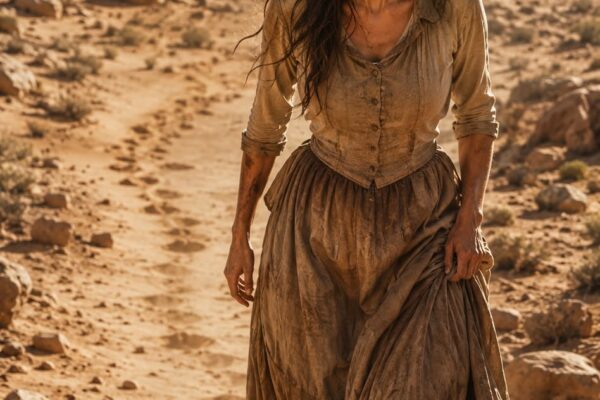
By June, the grass turned brittle as straw. It crunched under the cattle’s hooves. The creek shrank to a muddy thread. Dust rose with every step and settled on skin, dishes, bed linens, and hope. The air shimmered with heat so fierce it seemed to bend the horizon.
Every morning, Jackson and Eleanor hauled barrels of water from the river five miles away. It was slow, punishing work. The wagon wheels cut deep into dry ruts. The horses labored. Their hands cracked. Their clothes clung with sweat and dust.
The other ranchers’ wives watched from wagons when they met on the road. Fans fluttered. Whispers followed.
“That is man’s work,” one woman said loudly enough to be heard.
Jackson was tired, hot, and worried enough to answer before he thought better of it.
“Then it’s a good thing she married a man who doesn’t believe such nonsense.”
Eleanor looked at him.
Her smile made the brutal day almost bearable.
But the drought worsened.
Calves grew weak. Cows stood with ribs showing. The water barrels emptied too quickly. Jackson lay awake at night listening for wind and hearing only dry grass. He began calculating losses he did not want to name.
One evening, he found Eleanor sitting near the dry creek bed, knees drawn up, her hat beside her in the dust. Tears had made clean tracks down her cheeks.
He approached quietly.
“Ellie?”
She did not look up at first.
“That calf today,” she whispered. “She had such beautiful eyes.”
Jackson sat beside her.
The dying bothered him too. It always had. But ranch life taught a person to swallow grief quickly because chores did not pause for sorrow. Eleanor had not yet learned to harden every tender place, and part of him hoped she never would.
“You could go back east,” he said quietly. “No one would blame you.”
Her head snapped up.
“Is that what you want? To be rid of your troublesome wife?”
“No. God, no.”
“Then don’t insult me by thinking I would run.” Her voice trembled, but it did not break. “I chose this life. I chose you. I will not let a drought chase me off because the land decided to test whether I meant it.”
“A little drought,” he said, half smiling despite the ache.
She wiped her face.
“Very well. A cruel, miserable, hateful drought. But still.”
Together, they began planning.
They rotated the herd more carefully. Dug deeper into the old well. Sold a few cattle early before weakness took the value from them. Cut waste. Traded with a neighboring ranch for feed. Eleanor’s ideas were sharp, practical, and bold.
“Half a herd alive is better than a full one dead,” she told him.
When Jackson met with a rancher who tried to use their desperation to force a bad price, Eleanor stood beside him, listened quietly, then asked for cash on the spot and a written receipt before any cattle left the property. The rancher laughed at first.
Then he realized she was not joking.
Jackson signed the deal only after she nodded.
Outside, he said, “You just saved us from being cheated.”
“I know.”
“You are enjoying this.”
“A little.”
By August, the heat became almost biblical.
Fires burned on the horizon some evenings, turning the sky copper and making the whole ranch smell faintly of smoke. Eleanor’s face grew thinner. Her hands, once soft beneath gloves, became calloused. She tied her hair back each morning and worked until Jackson made her stop. He had learned not to order her. He negotiated now.
“Half an hour,” he would say.
“Twenty minutes.”
“Thirty.”
“Twenty-five and coffee.”
“Done.”
Then, one night, the wind changed.
Jackson stepped onto the porch and froze.
The air felt different.
Heavy.
Electric.
He smelled it before he believed it.
Rain.
Eleanor came up behind him.
“Is that—”
The first drop hit the porch rail.
Then another.
Then hundreds.
Within minutes, the sky opened, and the prairie drank like a dying man given water.
They ran into the yard laughing, arms out, faces turned upward. Rain soaked Eleanor’s hair, plastered Jackson’s shirt to his skin, turned dust to mud beneath their boots. She spun once like a girl and then threw her arms around him.
“See?” she said breathlessly. “We only had to outlast it.”
Jackson held her close, tasting rain, dust, and hope in the air.
For the first time in months, he believed they would.
The morning after the rain, the world smelled clean again.
Mud.
Grass.
Wet wood.
Promise.
Jackson stood on the porch watching steam rise from the soaked ground. Behind him, Eleanor hummed softly while cooking breakfast. The sound moved through the house like sunlight. Three months had passed since she had stepped off the train, and the ranch that had once seemed merely solid now felt alive.
The herd was smaller.
The work had not lessened.
The future was still uncertain.
But laughter had returned to the house.
Eleanor joined him with two tin cups of coffee. Her hands were rough now, the soft eastern skin replaced by the honest marks of a ranch woman. To Jackson, she had never looked more beautiful.
“How long since the last trouble?” she asked.
“Too long,” he said. “Almost feels like we’ve earned the quiet.”
She looked toward the horizon, green eyes bright beneath the brim of his spare hat.
“Maybe we have. Or maybe quiet just means another storm is coming.”
He chuckled.
“You always were the cautious one.”
“Careful, cowboy. You’re the one who married trouble.”
He took her hand.
“Wouldn’t change a thing.”
Weeks passed peacefully.
The grass began recovering. The water barrels stayed full. Cattle gained weight. Eleanor became known around Clearwater for reasons that amused her. The men who had once smirked tipped their hats with respect. The women who whispered still whispered, but softer now, and with less certainty.
Then one morning in October, Eleanor rode into the barn with a strange look on her face.
Jackson was checking a bridle.
“Jackson,” she said softly. “I need to tell you something.”
He set the leather down at once.
“What is it?”
“I went to see Doc Henley yesterday while you were out with the herd.”
His mind immediately leapt to danger.
“Are you sick?”
“No.”
She hesitated, then smiled in a trembling way he had never seen before.
“I’m going to have a baby.”
For a long second, Jackson only stared.
His brain refused to catch up with his heart.
“A baby?”
She nodded.
“A baby,” she repeated. “Yours and mine.”
The laugh that came out of him was rough and startled and almost broken. He crossed the barn in two strides and gathered her into his arms with such care that she laughed against his chest.
The scent of dust and lavender filled his lungs.
For a moment, the whole world felt right.
Then worry arrived, because love always seemed to bring fear close behind it.
“You’ll need to be careful,” he said. “No more breaking horses. No hauling feed. No climbing fences. I’ll take the heavy work.”
Her smile faded into something familiar.
“Jackson.”
“You’re carrying our child.”
“And I still have two hands and a mind.”
“You need rest.”
“I need you to understand I am not made of glass.”
He sighed.
He knew that look.
It was the same wild spark he had seen at the station. The same spark that had chosen Rosalind. The same spark that had stood in a drought and refused to run.
“All right,” he said finally. “But promise me you will listen to your body.”
“I will.”
“And to Doc Henley.”
“When he makes sense.”
“Eleanor.”
“Together, remember?”
He gave up, because she was smiling now, and because she was right.
By the time the leaves browned and the air sharpened, everyone in Clearwater knew Eleanor Wade was expecting. Naturally, everyone had an opinion.
Maybe motherhood would settle her down.
Maybe she would finally behave like a proper wife.
Maybe she would stop riding astride.
Maybe she would understand caution now.
Eleanor heard every word.
She held her head high.
At home, she adjusted. She gave up the hardest work, though not without argument. She kept the books, tended the garden, mended tack, planned supplies, and supervised Jackson with such authority that his ranch hands began asking her questions before asking him.
When he tried to lift a light saddle she was already carrying, she swatted his hand.
“If I stop working entirely, I’ll go mad.”
“If you overdo it, I’ll go mad.”
“Then we will both behave sensibly and no one needs to go mad.”
Winter came early.
The nights grew cold. The wind sharpened. Frost silvered the grass some mornings. Jackson reinforced the barn, stocked extra wood, checked the roof twice, and built a cradle from cedar with his own hands. Eleanor caught him sanding the same rail for nearly an hour.
“You’re going to sand it into a toothpick,” she said.
“I want it smooth.”
“She will not inspect the craftsmanship on her first day.”
“She might inherit your standards.”
“Then heaven help you.”
In February, snow began falling before dusk.
Not a gentle dusting, but thick and wind-driven, pressing against the windows and turning the yard white within an hour. Jackson had just banked the fire when Eleanor woke with a sharp cry.
He was beside her in an instant.
“Ellie?”
Her hand gripped his arm.
“The baby is coming.”
His blood went cold.
“It’s too soon.”
Another pain crossed her face, silencing both of them.
Outside, the storm howled.
Riding to town was impossible.
“You have to fetch Doc Henley,” she whispered.
“I can’t leave you in this weather.”
“Then you’ll have to help me here.”
Fear gripped him tighter than any outlaw’s hand ever had.
Jackson Wade, who had faced stampedes, drought, fires, and armed men, stood in his own bedroom and felt helpless before the two lives he loved most.
But there was no time for fear to rule.
Only time to act.
He gathered clean linens, hot water, blankets, whiskey for steadying his own hands more than anything else, and every scrap of instruction he could remember from women, ranch births, and the doctor’s practical warnings. He spoke calmly even when his heart was breaking against his ribs.
Eleanor fought through each wave with the same fierce will she had brought to every trial. She gripped his hand. He wiped her face. He whispered comfort. He prayed harder than he had ever prayed in his life.
Hours passed like years.
Then, just before dawn, a new sound filled the cabin.
A baby’s sharp, beautiful cry.
Jackson froze.
Then laughed and choked at once.
“It’s a girl,” he whispered, his hands trembling as he placed the tiny bundle safely against Eleanor.
Eleanor laughed and cried together, exhausted beyond words.
“She’s perfect.”
For a moment, the storm outside disappeared.
There was only the fire.
The child.
Eleanor’s pale face.
The miracle of breath.
Then Jackson noticed Eleanor fading, too tired, too weak, her eyes fluttering shut in a way that terrified him.
“Stay with me,” he said, pressing her hand between both of his. “Ellie, please. Stay with me.”
Her voice was barely a whisper.
“Her name should be Hope.”
His throat closed.
“Hope,” he said. “All right. Hope.”
“Because that is what she is.”
Jackson did not sleep. He sat beside them through the night, holding his wife’s hand and watching the baby breathe while the storm raged over the ranch. By morning, the snow began to ease. Eleanor’s breathing steadied. Color returned slowly to her lips.
Doc Henley arrived hours later, half-frozen and astonished to find mother and baby alive.
He checked them both, then put a hand on Jackson’s shoulder.
“You did good, son,” he said gruffly. “Real good.”
Three days later, Eleanor opened her eyes fully for the first time and found Jackson sitting beside her, Hope asleep in a basket near the bed.
“You scared me half to death,” he said.
She smiled weakly.
“Can’t get rid of me that easy, cowboy.”
He took her hand and kissed her knuckles.
“You gave me the world, Ellie. You and her.”
Life returned slowly, though never exactly as before.
Eleanor rode again eventually, more carefully, with Hope wrapped close in a sling against her chest when the day was mild and the work was light. The women in town still whispered, but now there was something new beneath it.
Respect.
Not from all.
But from enough.
One spring morning, Jackson was mending fence when he heard riders coming fast.
Six of them.
He recognized the leader as Jake Morrison, a rustler known from Dodge to Abilene, a man with a smile that always looked like it had been sharpened.
Eleanor saw them too.
She handed Hope to Jackson.
“Take her inside.”
“Eleanor—”
“Go.”
He obeyed because Hope came first, and because he knew better than to mistake Eleanor’s calm voice for uncertainty.
When the men rode up, Morrison grinned.
“Nice spread you’ve got here, Wade. Thought we might help ourselves to a few head. Maybe a little something extra for the trouble.”
Eleanor stepped onto the porch holding the rifle steady.
Not wild.
Not reckless.
Steady.
“You take one more step toward this house,” she said, “and you will regret mistaking hospitality for weakness.”
Morrison’s grin faltered.
“You wouldn’t use that.”
“Try me and learn something.”
Before anything could go further, two warning shots cracked from the ridge.
Not aimed at any man.
Just loud enough to change the mood.
Tom Bennett and Will Patterson rode in from opposite sides, rifles visible, faces grim. Jackson stepped back onto the porch with Hope secure inside, his own rifle now in hand.
“Looks like you miscounted,” Jackson said coldly. “Ride out while you still can.”
Morrison spat into the dust.
“This ain’t over.”
But it was.
Men like him were brave only when they believed fear belonged to someone else. That day, they found none waiting for them.
The gang left.
Weeks later, word came that Morrison’s men had been caught two counties over. Clearwater relaxed. The ranch held. Hope learned to laugh. Eleanor laughed more than she had in months.
Years passed.
The house grew bigger.
The herd doubled.
The cedar cradle was saved for the next child, and then another. Hope, wild-eyed and fearless, learned to ride before she could spell her name. She had her mother’s green eyes and her father’s stubborn jaw, which meant Jackson lost arguments to both of them more often than he admitted.
Eleanor often stood on the porch at sunset with Hope at her side, both watching the horizon burn in colors too bright to name.
One evening, when Hope was old enough to ask questions that landed like arrows, she looked up at her mother.
“Is it true, Mama?”
“Is what true?”
“That Papa wanted a quiet wife.”
Eleanor smiled.
“He did.”
Hope giggled.
“And what did he get?”
Eleanor bent and kissed her daughter’s forehead.
“Something much better.”
Jackson came up behind them just in time to hear it.
He wrapped one arm around Eleanor and rested the other hand on Hope’s shoulder.
The wind moved softly through the grass.
For once, all was still.
Not quiet.
Peaceful.
Jackson had thought he wanted a gentle life.
A quiet partner.
A woman who would smooth the edges of his days and never disturb the order he had made.
What he found instead was fire.
Courage.
Laughter.
Storms.
A woman who could cook supper, rope cattle, face gossip, survive drought, bring a child into the world during a snowstorm, stare down danger, and still smell faintly of lavender when she leaned against him at the end of the day.
He would not have traded one moment of it.
Not the fear.
Not the arguments.
Not the dust.
Not the drought.
Not the night he thought he might lose her and learned, in the deepest part of himself, that love was not safe because nothing precious ever is.
Love was worth the danger.
The West remained wild.
So did she.
So did their daughter.
And in the little ranch house north of Clearwater, where smoke rose from the chimney and the porch looked out over miles of open land, Jackson Wade finally understood the truth he had missed when he stood nervous on the train platform.
He had not needed a quiet wife.
He had needed a brave one.
He had needed a woman who would not shrink herself to fit the house he built, but would make the house larger simply by living fully inside it.
He had needed Eleanor.
And Eleanor, who had crossed a thousand miles with a blue dress, a firm handshake, and a spark no one had managed to put out, had not come west to be tamed.
She had come to build a life worthy of her fire.
Together, they made one.
Not gentle.
Not easy.
But real.
And real, in the wide and unforgiving country of Texas, was better than any fairy tale ever promised.