No One Wanted the 3 Orphan Sisters at the Auction — Until a Mail Order Bride Took Them In and
Ara had come to Dust Devil Creek with no plan to live again.
Not truly.
Her body had arrived on the stagecoach, folded into the corner seat with a worn travel bag at her feet and a contract tucked inside her bodice, but the living part of her had been left somewhere far behind, buried beside a small child’s grave under a sky too wide and too bright for mourning.
People later said she came west looking for a husband.
That was only the clean version.
The version fit for church steps and market whispers.
The truth was that Ara had signed the mail-order bride contract because she wanted a quiet place where grief could finish what it had started. She wanted a house where no one knew the sound of her crying. A room where no one would ask why she sometimes pressed both hands against her chest as if holding something inside that kept trying to break loose. A farm where labor might exhaust her enough to sleep without dreaming of tiny fingers, fever heat, and the last breath of the only child she had ever held.
Jedediah Barnes, the farmer who had written to her, had seemed suitable for that.
His letters were plain. He did not promise romance. He did not ask for beauty. He needed a wife to keep house on a small claim outside Dust Devil Creek. He had lost his first wife years before and wrote like a man who had also learned not to expect much from life except work, weather, and the mercy of another sunrise.
That sounded safe to Ara.
Not happy.
Safe.
But by the time her stagecoach arrived, Jedediah was already buried.
Fever had taken him a week earlier.
No one had bothered to send word east.
So Ara stepped down into Dust Devil Creek wearing her brown travel dress and carrying a contract with a dead man’s signature on it. The town looked at her the way people look at a misplaced package: inconvenient, slightly embarrassing, and nobody’s responsibility if enough people pretended not to see.
Dust Devil Creek was not much of a town, but it had learned to behave like a kingdom.
A crooked main street.
A church with peeling white paint.
A general store whose owner smiled only when Judge Thorne was not nearby.
A blacksmith shop, a two-cell jail, a bank, a dry goods office, and a town square where dust gathered in lazy spirals as if the whole place were slowly being buried by its own silence.
And over all of it stood Judge Malachi Thorne.
He was not the tallest man Ara had ever seen, but he made space behave as if he were. His shoulders were broad, his black coat always too clean for the dust around him, his voice deep enough to make weak men mistake it for law. He owned the bank, leaned on the sheriff, controlled credit at the store, and had the talent of making every favor feel like a debt that could never be fully paid.
When Ara presented her contract, Judge Thorne looked at it for less than a minute.
Then he looked at her.
“A contract with a dead man,” he said, “is a promise made by a ghost.”
“I came under lawful arrangement,” Ara replied.
Her voice sounded calm only because it had passed beyond fear into emptiness.
“You came to marry Jedediah Barnes,” Thorne said. “Jedediah is dead. Therefore, the arrangement is void.”
“The contract promised one year of room and board upon arrival.”
“The man who promised it is in the ground.”
Ara held the paper tighter.
“Then his estate—”
“His estate barely covered burial.”
The judge’s mouth curved.
Not a smile.
A closing door.
“You are a stranger in Dust Devil Creek, Mrs…?”
“Ara.”
He waited, as if expecting more.
There was no more she wished to give.
“Ara,” he repeated, making the name sound unfinished. “You have no husband here, no property, no employment, and no family willing to claim you. The town cannot carry every unfortunate woman who loses her footing on the road west.”
“I am not asking to be carried.”
“Good. Then you will leave on the next coach east.”
The words landed with less force than Ara expected.
Perhaps because she had already expected nothing.
Perhaps because the part of her that might have begged had gone quiet months earlier beside a child’s grave.
She stepped out of the town office with the contract folded in her hand and the strange calm of a person whose life has been closed by other people so many times that one more closing hardly makes noise.
The next coach east would not come until morning.
So Ara stood at the back of the town square that afternoon like a ghost among the living, waiting to be sent away.
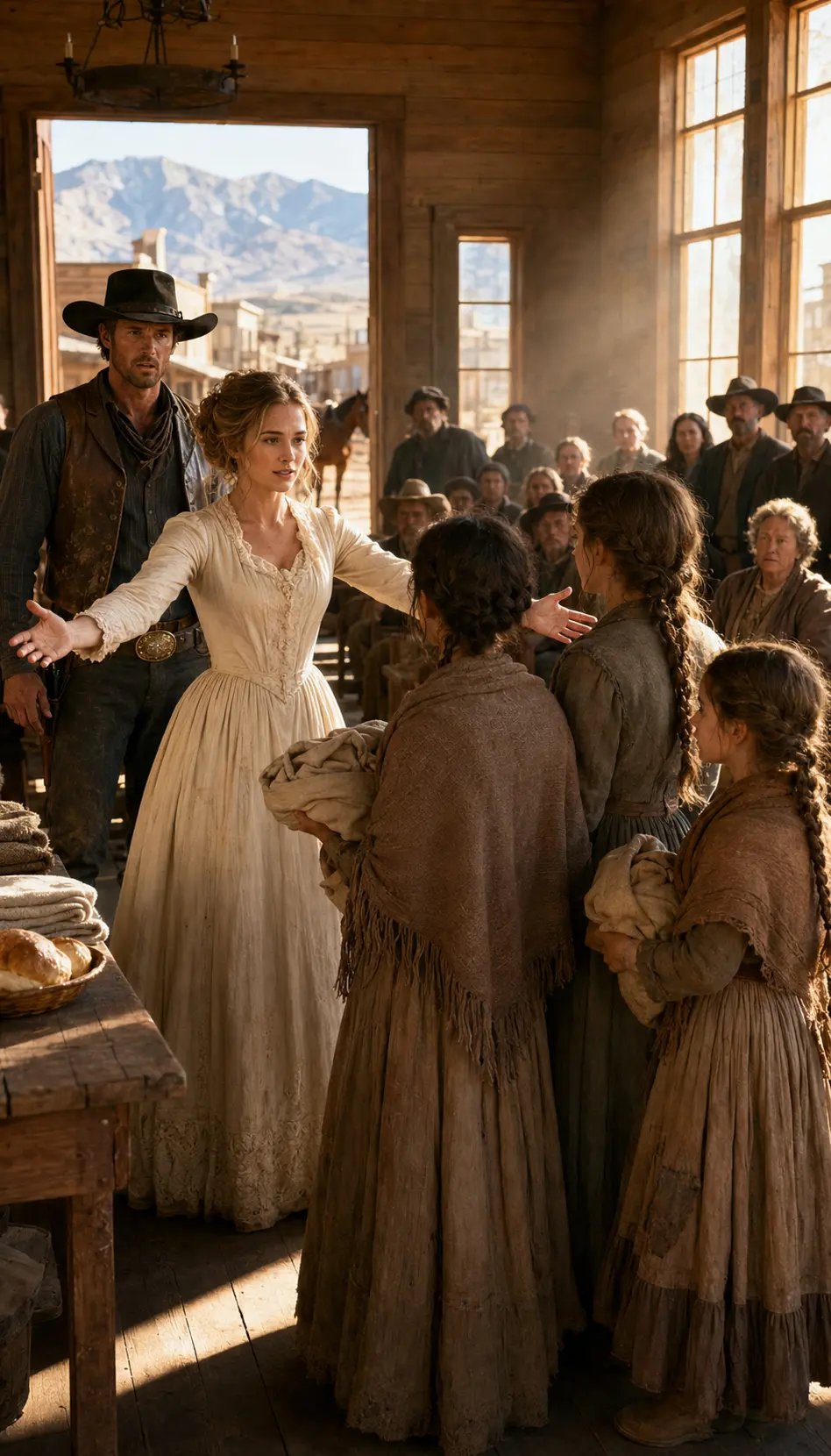
That was when the public ward placement began.
They did not call it an auction at first.
People in Dust Devil Creek had learned to make ugly things sound official. They called it a town placement. A transfer of responsibility. A practical resolution for three orphaned minors whose parents had died in a fire and whose farm had fallen into arrears.
But the wooden platform they used stood in the same square where criminals were sentenced, debtors shamed, and abandoned goods sold after estate seizures.
So everyone understood what it was.
Three small girls stood together on the platform.
Lily Miller was ten, thin and straight-backed, with dark hair braided badly by hands too young to replace a mother’s. She had both arms around her younger sisters, holding them close with the fierce desperation of a child forced to become a wall.
Daisy, seven, clutched a rag doll so worn that one button eye hung by a thread. She did not cry. She watched everything with too much stillness, the way quiet children sometimes do when fear teaches them that sound draws attention.
Rose was barely five. Her cheeks were streaked with dirt and tears. She kept trying to hide behind Lily’s skirt, though there was nowhere to hide on that platform.
The Miller girls.
Everyone in town knew their story.
Their parents, Thomas and Miriam Miller, had lived on a small farm at the edge of the valley, a dry, cracked patch of land most people called worthless. A fire had taken the house two weeks earlier. Thomas and Miriam died before help arrived. The girls survived because Lily had woken to smoke, dragged Daisy from bed, and carried Rose through the back door with her nightdress burning at the hem.
Now they stood under the full gaze of the town while Judge Thorne arranged their future with the satisfied air of a man balancing accounts.
“These poor children,” he said, his voice swelling with false mercy, “require homes where they may be useful, disciplined, and properly supervised.”
Useful.
Ara heard that word as if it had been struck from iron.
Thorne placed one heavy hand on Lily’s shoulder.
“The eldest is strong enough for chores. Farm families in need of help may petition for her labor and care.”
Lily stiffened but did not pull away.
Thorne gestured toward Daisy.
“This one has nimble hands. Mending, kitchen work, laundry.”
Then his eyes moved to little Rose.
“And the youngest…”
A few men near the front chuckled before he even finished.
“Well. The youngest will grow into usefulness eventually, if patience can be found.”
The sound that moved through the crowd was not loud.
It was worse than loud.
A low, shameful ripple. Not agreement exactly. Not protest either. The sound of people letting cruelty pass because stopping it would require courage.
Ara’s stomach turned.
She had been hollow when she arrived in Dust Devil Creek.
But something inside her shifted as she watched Lily’s arms tighten around her sisters.
The grief she had carried like a burial cloth began to change shape.
For months, it had covered her.
Now it burned.
She saw three children being divided into labor, expense, and inconvenience. She saw the crowd avoiding their eyes. She saw Judge Thorne watching them not as orphans but as obstacles between himself and something he wanted.
And beneath all of it, she saw her own lost child.
Not in their faces.
In their terror.
In the way the world had decided they were easier to move than to protect.
The auctioneer, a nervous man named Phelps who looked as if he had been given a task he hated but lacked the spine to refuse, cleared his throat.
“Petitions for ward placement will be accepted. Separate placements permitted. First child—”
“One dollar.”
The words came from Ara.
Thin.
Clear.
Sharp enough to split the silence.
Every head turned.
For a moment, she did not recognize herself.
Then she stepped forward.
Judge Thorne’s eyes narrowed.
“And who,” he asked, “are you to speak in this matter?”
“My name is Ara.”
“You are the mail-order bride without a husband.”
A few people laughed.
Ara kept walking until she stood near the platform.
“I am bidding the legal guardianship bond.”
Thorne’s face hardened.
“You have no property, no husband, no standing, and no means.”
Ara felt every word strike, but none of them knocked her down.
“I have a signed contract that promised me a year of room and board upon arrival to this town.”
“That contract is void.”
“You said the marriage arrangement was void,” Ara replied. “Not the support clause.”
A murmur moved through the crowd.
She had no idea if the argument was strong enough to stand in court.
She only knew that men like Thorne often counted on everyone else believing they knew less than they did.
So she spoke as if the law sat calmly beside her.
“The contract was witnessed. It was accepted by the town office when my travel papers were approved. If Jedediah Barnes died before fulfilling his obligation, then his estate or the town agency that processed the arrangement owes me the housing promised. I will use that claim as bond to keep these children together.”
Thorne stared at her.
The crowd stared at him.
For the first time since Ara had arrived, Judge Thorne stood in a public moment he did not fully control.
That mattered.
Men like him could win almost anything in private.
But public uncertainty was dangerous.
“You expect this town to accept a penniless stranger as guardian to three children?” he demanded.
“No,” Ara said. “I expect this town to admit that separating three grieving sisters for convenience is shameful.”
The words moved across the square like wind over dry grass.
Lily looked at her then.
Really looked.
Hope flickered across the girl’s face so fragilely that Ara almost wished she had not seen it.
Hope is harder to refuse than pleading.
Thorne’s jaw tightened.
“You cannot feed them.”
“Then let the town assist them properly.”
No one moved.
Ara turned slowly, looking at the crowd.
“At least let one of you stand up and say you are willing to separate them.”
Still silence.
But now it belonged to him, not to her.
Thorne felt that shift. She saw it in his eyes.
A small thing.
But real.
At last, he smiled.
It was a terrible smile.
“Fine,” he said. “Let charity have its theater. Temporary guardianship granted under provisional town recognition. Take all three. Keep them on that cursed Miller property if you love noble suffering so much.”
He leaned closer, voice lowering.
“In ninety days, the unpaid property taxes will still come due. When you fail, the land reverts to town control. Then I will place the children as I see fit.”
Ara held his gaze.
“I understand.”
“No,” Thorne said. “You do not.”
The gavel struck wood.
The matter was done.
Ara climbed the platform steps.
Lily moved back a half pace, still holding Daisy and Rose.
Ara did not reach for them as if claiming possession.
She crouched slightly so her eyes were level with Rose’s.
“My name is Ara,” she said gently. “I cannot promise this will be easy.”
Lily’s chin lifted.
“Will you keep us together?”
Ara looked at all three of them.
It was a dangerous promise.
Impossible, perhaps.
But some promises become necessary precisely because they are impossible.
“Yes,” she said. “Together.”
That was how Ara, who had come to Dust Devil Creek prepared to let her own spirit fade quietly, walked away from the town square with three small hands holding hers like she was the last solid thing left in the world.
The Miller farm was worse than Thorne’s cruelty had suggested.
It sat beyond the west road, where the valley widened into dry land and low scrub. The soil was cracked in long pale lines. The fence sagged as if ashamed of itself. The barn leaned, though it still stood. The farmhouse was only a blackened skeleton, charred beams reaching into the sky like bones.
The fire had taken nearly everything.
A stove cracked from heat.
A bedframe twisted.
A few iron pots.
A broken chair.
A pump that gave nothing but dust.
A well ring half hidden behind the burned house, its stones disturbed.
Ara stood in the yard while the girls gathered close behind her.
This was the kingdom she had claimed.
Ash, wind, debt, and three children watching her to see whether she would regret them.
She turned toward the barn.
“We will sleep there tonight.”
Daisy looked at the broken roof.
“Will it fall?”
“I do not intend to let it.”
That answer satisfied nobody.
But it started them moving.
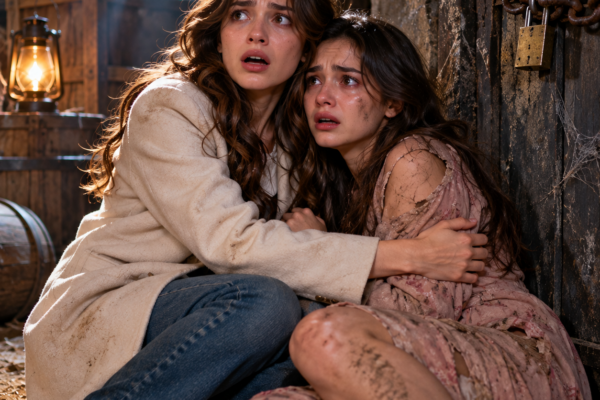
Inside the barn, the air smelled of old hay, dust, and smoke carried from the ruined house. Shafts of light cut through holes in the roof. A manger still stood against one wall. Several boards were loose. Mice had made use of the place before grief moved in.
Ara set her travel bag in the corner.
“We clean first.”
Lily immediately began gathering debris.
Daisy tucked her doll into her apron and helped. Rose followed Ara, small hand clutching the back of her skirt, unwilling to let more than a few inches come between them.
By dusk, they had cleared one corner and spread hay beneath the least damaged part of the roof. Ara hung her shawl over a gap to cut the wind. They ate what little she had: half a heel of bread, a handful of dried apples from her bag, and water she had brought from town in a borrowed jug.
Nobody complained.
That was worse than complaining.
That first night, they lay beneath one threadbare blanket, all four of them pressed close for warmth. The prairie outside seemed too wide. The silence pressed against the barn walls until every creak sounded like danger.
Ara stared into the dark.
What had she done?
She could barely feed herself. Now she had three grieving children depending on her. Three girls who had lost everything and were young enough to believe that being saved in public meant being safe in truth.
She had no money.
No proper house.
No allies she could name.
A judge waiting for her to fail.
A town too frightened to sell her kindness openly.
And somewhere beneath all that, a grief inside her that had not disappeared, only changed direction.
Rose shifted in her sleep and pressed her face against Ara’s shoulder.
Ara closed her eyes.
The ache that followed nearly broke her.
For the first time since burying her child, she let herself place one arm around someone small.
Not as replacement.
Nothing could replace the child she lost.
But love, she discovered, was not a cup emptied once forever.
Sometimes it was a spring buried under ash, waiting for someone desperate enough to dig.
Morning came pale and cold.
Ara woke to hoofbeats.
She sat up quickly, heart already racing.
A man rode toward the barn from the main road. Broad-shouldered. Hat low. Hands worn dark by sun and work. His horse stopped several yards from the open barn door.
Lily was awake instantly, pushing Daisy and Rose behind her.
Ara stood between the girls and the rider.
He dismounted slowly, not reaching for anything at his belt.
“Judge sent me,” he said.
Of course he had.
The man’s name was Silas Vale, Thorne’s foreman. Ara had seen him once in town, standing behind the judge with the still obedience of a man who had learned not to speak unless commanded.
His face was rough, but not cruel. His eyes moved past Ara toward the three girls in the shadows, and something in them tightened.
“The judge wants you reminded,” Silas said, voice flat, “that the taxes on this property are due in ninety days. If they are not paid, the deed reverts to town authority.”
Ara lifted her chin.
“We will manage.”
Silas looked at the burned house.
The collapsed fence.
The dry well.
The barn where children now slept on hay.
His mouth tightened.
“He always gets what he wants.”
“Then he must be very tired of wanting.”
That caught him off guard.
For a moment, the foreman’s expression shifted—not into a smile, but toward one.
Then Rose peeked around Ara’s skirt.
Silas saw her.
His face changed completely.
Pain, quickly hidden.
He looked away.
“I had a daughter,” he said before he seemed to realize he was speaking. “Would be about her size if fever had left her be.”
Ara did not answer.
Some griefs deserve silence at first.
Silas mounted again.
“He is not patient,” he said. “And he does not forgive embarrassment.”
“Then tell him we will try not to embarrass him further.”
This time, Silas almost did smile.
Almost.
He rode away without looking back.
But the warning remained in the yard long after the hoofbeats faded.
Ninety days.
Ara began counting.
The next weeks were a lesson in hunger, pride, and stubbornness.
They patched the barn roof with mud, grass, scraps of charred board, and pieces of Ara’s underskirt she cut without hesitation because modesty meant little when rain could kill hope faster than shame could. Lily proved practical beyond her years, making lists in the dirt with a stick: food, water, firewood, roof, taxes.
Daisy had a gift for finding what others overlooked.
Wild onions near the creek bed.
Bitter greens beneath scrub.
A patch of edible roots under the ridge.
Rose gathered flowers that no one could eat and insisted they mattered.
Ara, who had almost forgotten beauty had any use, placed them in a cracked jar near the barn door.
The girls slowly became less like rescued strangers and more like the rhythm of her days.
Lily serious beside her.
Daisy silent but watchful.
Rose, who laughed once at a grasshopper landing on her shoe, then clapped both hands over her mouth as if laughter might be forbidden now.
“It is allowed,” Ara told her.
Rose blinked.
“What?”
“To laugh.”
The little girl stared at her for one trembling second.
Then laughed again.
The sound entered the broken barn like sunlight.
Ara had to turn away.
Not because she was sad.
Because she was afraid of how much it healed.
When she went into town to buy flour with the last of her coins, the store owner refused to meet her eyes.
Mr. Henderson was a narrow man with nervous hands and shelves full of things Ara needed more than dignity could admit.
“I cannot sell to you,” he whispered.
Ara stared at him.
“You cannot?”
“The judge said no one is to extend trade to you. Not goods. Not credit. Not tools. He says you are encouraging disorder.”
“Three orphaned girls are disorder?”
Henderson looked toward the window as if Thorne might be standing outside.
“Please, Ara. I have a family.”
“So do I.”
The words surprised them both.
She left without flour.
The blacksmith would not mend their broken hoe.
The baker had no bread “to spare.”
The church women lowered their eyes when she passed.
Dust Devil Creek had not attacked her openly.
It simply withdrew the smallest mercies and waited for hunger to do what fear had begun.
By the end of the second week, Lily’s cheeks looked sharper. Daisy began giving Rose part of her portion when she thought Ara could not see. Rose stopped asking when they would have real supper.
That hurt most.
Children should not learn to stop asking.
One evening, as they sat near a small fire built in a ring of stones outside the barn, Lily spoke in a low voice.
“Papa was digging a new well before the fire.”
Ara looked up.
Lily pointed toward the blackened house.
“Behind there. He said he had found it.”
“Found what?”
“I do not know. He said it would change everything.”
The words settled into Ara like a match lowered toward dry straw.
He had found it.
It would change everything.
She looked toward the half-disturbed stones behind the burned farmhouse.
She thought of Judge Thorne’s eagerness to seize a worthless patch of land.
She thought of taxes, silence, a fire too convenient, and a powerful man suddenly impatient to possess cracked soil nobody else wanted.
That night, after the girls slept, Ara took the shovel.
The moon was thin.
The earth behind the house was hard, dry at the top, then stubborn beneath. Her hands blistered quickly. Then the blisters broke. She wrapped cloth around the handle and kept digging. Each scrape of metal against dirt sounded too loud in the sleeping valley.
Near midnight, Lily appeared beside her.
“You should be asleep.”
“So should you.”
Ara wanted to send her back.
Instead, she handed Lily the small tin pan and let her clear loosened soil.
They worked in silence.
Not frantic now.
Determined.
Near dawn, the shovel struck something that was not stone.
Wood.
Ara dropped to her knees and scraped dirt aside with her hands. Lily helped. Together they uncovered a small metal-bound box, sealed with rust and time, wrapped in oilcloth that had nearly fused with earth.
They carried it into the barn.
Daisy woke.
Then Rose.
All three girls sat close while Ara worked the lock with the edge of a knife and a nail.
When the lid finally gave, nobody breathed.
There was no gold inside.
No jewels.
No coins.
Just papers.
A letter on top, written in strong, clear hand.
Ara unfolded it.
To whoever finds this, know that Judge Malachi Thorne is a thief and a liar.
Lily made a sound so small it barely existed.
Ara kept reading.
The letter was from Thomas Miller, the girls’ father. It told the truth of the land beneath their feet.
Years earlier, Thorne and Thomas’s father had been partners in the valley. They discovered something the whole region had long misunderstood. The creeks were seasonal. The surface wells failed in hard summers. But beneath the Miller farm ran a deep artesian spring, an underground river strong enough to feed the valley through drought.
Thomas Miller’s father had registered the primary water rights with the territorial government before Thorne could seize control of them.
The Miller farm was not worthless.
It was the heart of the valley.
The letter described how Thorne forged a deed, manufactured debts, and used his authority to control the surrounding ranches by controlling access to water. The elder Miller’s death, once called an accident, had never sat right with Thomas. He had spent years gathering proof quietly. When he realized Thorne was moving to take the farm, he hid the original water deed and letter near the half-dug well.
If I am gone, the letter said, protect my daughters. The land belongs to them. The water belongs first to them, but it was meant to keep the valley alive, not make one man king.
Beneath the letter lay the deed.
Government seal still clear.
Water rights registered to the Miller family line.
Ara looked at Lily, Daisy, and Rose.
They were not burdens.
They were heirs.
Not to wealth in the simple sense, but to power, responsibility, and the truth Judge Thorne had been trying to bury.
The small barn seemed to tilt around them.
Ara had thought she was fighting for shelter.
Now she understood she was holding a hammer over an empire built on stolen water.
Daisy whispered, “Does this mean we can stay?”
Ara looked at the papers.
Then at the frightened hope on three small faces.
“It means,” she said carefully, “we have proof.”
Lily’s eyes hardened in a way no ten-year-old’s eyes should have to harden.
“Then we show everyone.”
“Not yet.”
“Why?”
“Because truth is powerful only if it survives long enough to be heard.”
That was the new terror.
Thorne could not be allowed to learn too soon.
The sheriff was his man. The bank depended on him. Half the town feared him and the other half owed him. Ara needed the deed before a territorial marshal or magistrate outside Thorne’s reach, but the capital was more than a hundred miles away and she had three children, no horse fit for the journey, and no money.
The proof made them stronger.
It also made them more dangerous to the man already trying to destroy them.
Every sound became a warning.
Every dust cloud on the road tightened Ara’s stomach.
Every crow’s cry above the barn made Rose startle.
The girls felt it too. The fragile routine they had built became quiet again. Hope had entered the barn, but now it had to hide under loose floorboards beside the deed.
Three days later, Judge Thorne came himself.
He arrived in the afternoon, flanked by two men whose faces looked carved from hard stone and bad instructions. His black coat was spotless. His horse gleamed. He dismounted as if the ground had no right to soil his boots.
Ara saw him from the barn doorway and moved quickly.
The box went under the loose floorboard.
The girls went behind her.
Thorne approached with a smile that held no warmth.
“Good day, Ara.”
She hated how he used her name now, as if it amused him.
“Judge.”
“I have come out of concern.”
“No, you have not.”
His smile thinned.
“I will overlook that tone. Your situation is impossible. You know it. I know it. Even the children know it, though you do them no kindness by pretending otherwise.”
He withdrew an envelope.
“I am prepared to offer five hundred dollars.”
Ara’s breath caught despite herself.
Five hundred dollars.
Safety, in the shape of paper.
A wagon east. Food. Clothes for the girls. A rented room. A chance somewhere far from Dust Devil Creek, far from Thorne, far from the barn, hunger, debt, fear, and the constant weight of being responsible for three small lives.
For one terrible second, she saw it.
Escape.
Then Lily’s hand clutched her skirt.
Daisy stepped closer.
Rose pressed into the back of her leg.
Ara thought of their parents, the letter, the land, the spring, the fire, the years of theft dressed as law.
Running was not safety.
It was surrender made comfortable.
“The land is not for sale,” she said.
Thorne’s expression lost all pretense.
“I was not asking.”
One of the men stepped forward.
Thorne held up another document.
“This property has been declared unsafe and abandoned. You will vacate immediately.”
“It is not abandoned. We are standing on it.”
“You have no legal standing.”
Ara’s fear rose so high it became strangely clear.
“I have more standing here than you do.”
His eyes sharpened.
“What did you say?”
Before she could answer, another voice cut across the yard.
“That is far enough, Judge.”
Everyone turned.
Silas sat on his horse near the road, rifle resting across his lap, pointed at no one but present enough to matter. His face no longer held conflict.
Only resolve.
Thorne turned purple with anger.
“Silas, get back to the ranch.”
“No.”
The word was quiet.
It struck harder than shouting.
“I am done carrying out orders that make me ashamed to sleep.”
Thorne’s men shifted.
Then more movement came from behind the ruined farmhouse.
Dr. Elias Adams stepped into view.
He was a quiet, respected man with spectacles, gray hair, and the tired moral authority of someone who had watched wrong too long and finally reached the end of patience. Behind him came farmers from across the valley. A dozen at first. Then more.
Men with hunting rifles held low.
Women with hard eyes.
Ranchers who had paid Thorne’s water fees for years.
Families who had lost land one drought at a time.
Mr. Henderson from the store stood among them, pale but present. The blacksmith too. Even Phelps the auctioneer lingered at the back, hat in hand and shame written plainly across his face.
Thorne stared at them as if people he had counted as possessions had suddenly learned to stand upright.
Dr. Adams lifted a tarnished silver locket.
“Thomas Miller gave this to me the day before the fire,” he said. “He told me if anything happened to him, I should make certain his family was protected.”
His voice trembled, but held.
“I was late in honoring that promise. I will not be absent now.”
Ara looked at him.
Then at Silas.
Then at the crowd.
For the first time since entering Dust Devil Creek, she did not feel alone.
The girls behind her began to cry softly—not from fear this time, but from the shock of seeing people finally step forward.
Thorne’s face hardened.
“You are all trespassing on a lawful proceeding.”
“No,” Dr. Adams said. “We are witnesses.”
Ara knew the moment had arrived.
She reached beneath the loose floorboard and pulled out the deed.
The old paper trembled in her hands, but her voice did not.
“This land was never yours, Judge Thorne.”
The crowd went utterly still.
Ara held the deed high.
“This document proves the Miller family owns the primary water rights beneath this farm. Thomas Miller left a letter explaining how you hid the truth, used false debts, controlled the valley’s water, and tried to take this land after the fire.”
The paper caught sunlight.
For one strange, bright moment, it seemed less like evidence and more like a torch.
Murmurs moved through the farmers.
Names.
Questions.
Old suspicions finding form.
Thorne’s empire had rested on one essential lie: that he controlled the water because God, law, and commerce had arranged it so.
But the deed in Ara’s hand said otherwise.
He was no longer a judge in that yard.
He was a man whose theft had been named.
Thorne made one final mistake.
He stepped toward the children.
Not far.
Only one step.
But Silas moved faster.
He rode between them, horse turning sharply, body placing itself between Thorne and the girls.
“No closer,” Silas said.
Thorne froze.
His men looked at the farmers. Then at Silas. Then at each other.
They had been paid to intimidate lonely people.
Not to stand against an entire valley that had finally remembered its courage.
Slowly, their hands lifted away from their belts.
Dr. Adams stepped forward.
“It is over, Thorne.”
The judge looked around at the faces of men and women he had frightened for years.
He searched for obedience.
He found none.
“You think this changes anything?” he snarled.
“Yes,” Ara said, still holding the deed. “It changes who owns the truth.”
The sheriff arrived too late, as cowards often do when courage has already done the work.
By then, Thorne and his men were surrounded, not by mob violence, but by witnesses. Dr. Adams, who had once served as part-time magistrate before Thorne pushed him aside, took custody of the documents. Silas agreed to testify. Henderson admitted the judge had ordered him to deny trade. Phelps confessed that the ward placement had been arranged before any lawful property review was complete.
The sheriff blustered.
Then saw the crowd.
Then chose self-preservation and quiet.
The next days moved like a storm clearing the valley.
Records were seized from the town office.
Fraudulent water fees were challenged.
Families who had sold land under pressure came forward.
A territorial marshal was sent for.
Judge Thorne’s power did not vanish in a burst of flame. Real corruption rarely dies that quickly. It cracked first. Then split. Then collapsed under the weight of testimony, documents, and the simple fact that frightened people had begun speaking in the same direction.
The Miller deed was confirmed.
The water rights were real.
The artesian spring beneath the farm was real.
And Lily, Daisy, and Rose Miller, three girls nearly separated on a public platform as burdens, were recognized as rightful heirs to the most valuable water source in the region.
Ara was appointed their legal guardian.
Not because she had money.
Not because she had a husband.
Not because anyone powerful approved.
Because she had stood up when no one else did, and because the girls themselves clung to her so fiercely that even the law, for once, seemed to understand the truth before it.
The first time water rose from the completed well, the whole valley gathered.
Silas and two farmers had helped finish the digging. Dr. Adams stood with his hat in his hands. Henderson brought flour, beans, and sugar without being asked. The blacksmith repaired the broken hoe and refused payment. Women from town brought blankets, dresses, and a proper mattress for the barn until the farmhouse could be rebuilt.
Ara stood beside Lily, Daisy, and Rose while Silas worked the pump handle.
At first, only a cough of mud.
Then a shudder.
Then water.
Clear, cold water burst into the trough and spilled over the sides, running across the dry ground in bright ribbons.
Rose laughed first.
Then Daisy.
Then Lily, serious Lily, who had held herself together too long, covered her face and cried.
Ara dropped to her knees and caught the water in both hands.
It was so cold it hurt.
So clean it felt impossible.
A whole valley had been thirsty because one man wanted to be king.
Now the water ran in open daylight.
Ara made her pledge that afternoon with Dr. Adams as witness.
The Miller water would be shared fairly. No family would be starved out by price. No neighbor would be denied access for refusing obedience. The spring would sustain the girls’ future, yes, but it would not be turned into another throne.
Lily stood beside her, holding the deed with both hands.
“This is ours?” Daisy whispered.
“Yes,” Ara said.
“But we share?”
“We share because your father wanted the valley alive, not afraid.”
Rose slipped her hand into Ara’s.
“Does that mean this is home?”
Ara looked around.
At the ruined house that would be rebuilt.
At the barn that had kept them alive.
At the well rising from earth like mercy.
At the three girls who had entered her life when she believed hers was already finished.
She squeezed Rose’s hand.
“Yes,” she said. “This is home.”
The seasons that followed did not become easy simply because the truth had won.
Easy was never promised.
The farmhouse had to be rebuilt board by board. Taxes still had to be sorted. Legal proceedings dragged through months of testimony. Thorne’s remaining allies tried to delay, confuse, and discredit, but the deed held. The letter held. Silas held firm. Dr. Adams held steadier than anyone expected. And the valley, once divided by fear, discovered that unity was a kind of water too.
It made hard ground live again.
Ara changed slowly.
At first, she still woke before dawn with panic in her chest, expecting the girls gone, the barn empty, the well seized, the old grief returned as master. Then she would hear Rose breathing softly beside Daisy. Hear Lily moving quietly near the door, always the first child awake. Smell coffee donated by Henderson. Feel the ache in her hands from work that mattered.
The grief for her lost child never disappeared.
She learned it did not have to.
Love did not ask her to bury one child deeper in order to hold another. It widened her instead. Pain remained, but it no longer ruled every room inside her. It became part of the foundation under something new.
Lily became her right hand.
Too serious still, but less afraid to be young in small moments. She learned accounts beside Ara, measured water shares, and kept lists with the intensity of a tiny magistrate.
Daisy planted beans near the new fence and proved able to coax life from soil everyone else had called exhausted. She spoke little, but when she did, people learned to listen.
Rose filled the rebuilt house with flowers, stones, feathers, ribbons, and questions. She called Ara “Mama” by accident one evening while half asleep, then woke frightened she had done something wrong.
Ara held her until the fear passed.
“You may call me what your heart chooses,” she whispered.
Rose pressed her face into Ara’s shoulder.
The next morning, she called her Mama again.
This time while fully awake.
Ara cried into the bread dough so the girls would not see.
Silas remained nearby.
At first, he came because there was work to do and guilt to repay. Then because the girls trusted him. Then because Ara did.
He rebuilt the fence. Repaired the barn door. Taught Lily how to judge a horse’s temper from its ears and Daisy how to hold a hammer without smashing her thumb. Rose followed him everywhere, asking questions about his daughter, and one day he answered without his voice breaking.
He had served Thorne for years because fear and grief had made obedience seem easier than resistance.
Ara never pretended that did not matter.
Forgiveness, she learned, was not a door thrown open in one grand gesture. Sometimes it was a gate opened gradually, and only after the person outside had proven they understood why it had been closed.
Silas understood.
He did not ask for trust.
He earned it slowly.
So did Dust Devil Creek.
The town that had once watched three girls nearly separated began rebuilding the Miller farmhouse. Men who had stayed silent came with tools. Women who had lowered their eyes came with quilts and canned peaches. Some apologies were clumsy. Some came too late. Some never came at all.
Ara accepted help without pretending help erased harm.
That, too, was a kind of justice.
When the new house finally stood, simple and square under a wide Texas sky, the first supper inside was shared by half the valley. Tables were made from planks set over barrels. Children sat on the floor. Dr. Adams said grace. Henderson cried quietly when Lily passed him bread. Silas stood near the door until Rose dragged him to a chair and ordered him to eat.
Ara stood at the stove, watching steam rise from the pot.
For the first time since her child died, she felt the future enter a room and stay.
Years later, people in the valley told the story of the mail-order bride who arrived with nothing and won back the water.
Some told it as a miracle.
Some as a scandal.
Some as proof Judge Thorne had been evil from the start, which was convenient for those who had once obeyed him and wanted history to forget how quiet they had been.
Ara never told the story that way.
The truth was more complicated.
She had not been brave because she felt no fear.
She had been afraid every day.
Afraid of hunger.
Afraid of failing the girls.
Afraid the law would bend back toward power.
Afraid the box would be stolen.
Afraid that loving children again would open the grave inside her instead of healing it.
But courage is not the absence of fear.
It is a motherless child holding two sisters on a public platform.
It is a grieving woman raising one dollar in a silent crowd.
It is a foreman deciding too late is still better than never.
It is a doctor admitting he failed and then standing up anyway.
It is a town discovering that shame can become action if people stop hiding behind it.
The Miller farm became green in time.
Not all at once.
Green things rarely trust ground that has been thirsty too long.
But water changed everything.
Or perhaps water revealed what had been possible all along.
Fields returned first in patches. Beans. Corn. Squash. Then pasture grass. Cottonwoods near the low draw. A kitchen garden Daisy tended like a kingdom. Roses near the porch because Rose insisted a house needed something pretty that did not apologize for blooming.
The valley changed too.
Water shared fairly made men less desperate. Less desperate men were harder for tyrants to buy. Families who had nearly left stayed. Children who had grown up measuring drought by fear began measuring summers by harvest.
And Ara, who had come west to disappear into grief, found herself written into the life of a place that refused to let her vanish.
One autumn evening, years after the public ward placement that changed everything, Ara stood beside the well with Lily, Daisy, and Rose.
Lily was taller now, nearly a young woman, her seriousness softened but not gone. Daisy had dirt under her nails and seeds in her pocket. Rose wore ribbons in her hair and had spent the whole afternoon teaching Silas how to properly admire her wildflowers.
The sun lowered over Dust Devil Creek, painting the sky orange and violet.
The well handle gleamed from use.
The rebuilt house glowed behind them.
Lily slipped her hand into Ara’s.
“You saved us,” she said.
Ara looked at the water.
Then at the three girls.
“No,” she said softly. “We saved each other.”
Because that was the truth.
Ara had not rescued them from sorrow without being touched by it herself. They had pulled her from the edge of her own ending. They had turned her grief into shelter. They had given her love somewhere to go.
She had come to Dust Devil Creek with a dead contract, an empty heart, and no future she wanted to name.
She stayed because three girls stood on a platform and the world waited for someone else to care.
She became that someone.
And because she did, a hidden spring rose from the ground, a judge lost his throne, a valley remembered its conscience, and a burned farm became a home.
Sometimes life begins where you expected it to end.
Sometimes the family meant for you is not the one you lost, but the one you choose when the whole world tells you there is nothing left to give.
And sometimes one clear voice in a silent square is enough to wake the water under the earth.