The Loner Rancher Waited for a Common Mail Order Bride, But a Woman Too Beautiful for Him Arrived
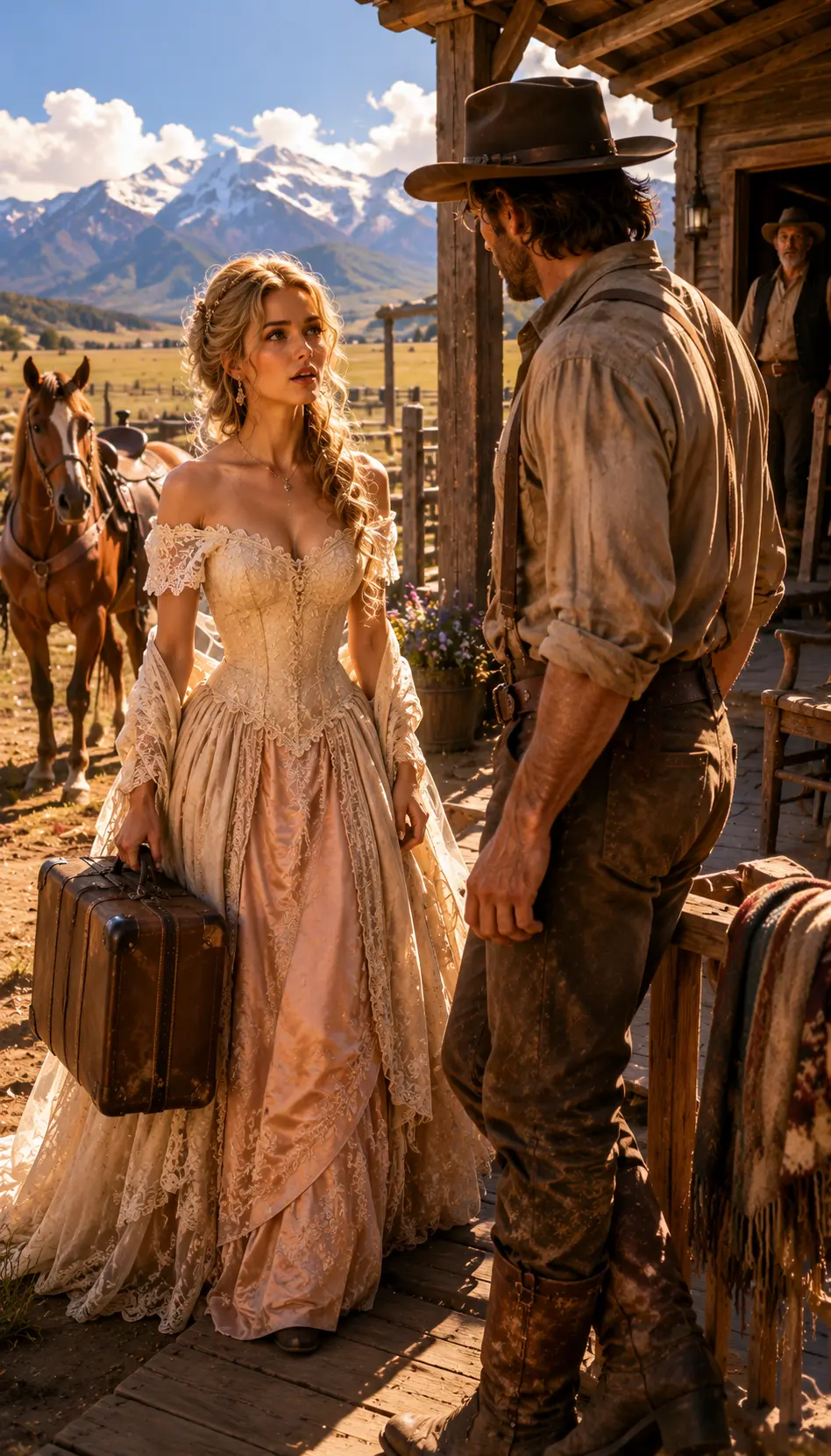
Montana Territory, 1875.
The wind moved across the prairie like something restless and alive, dragging dust through the golden grass and carrying the faint promise of rain that almost never came. It slid over the low hills, bent the dry weeds, rattled the loose boards of a modest cabin, and pressed against the chest of a young rancher who was doing everything in his power not to look nervous.
Wade Prescott was twenty-five years old, but the frontier had already written older lines into his face.
He stood on the porch of the small homestead he had built with his own hands, one shoulder against a rough-hewn post, his green eyes fixed on the trail that cut through the prairie like a scar. The cabin behind him was clean, painfully clean, because he had spent the last two days sweeping, scrubbing, polishing, mending, and trying to make poverty look like simplicity.
It was not much of a ranch, if a man wanted to be honest.
A one-room cabin with a curtained sleeping alcove. A lean-to for storage. A barn that leaned slightly toward the east whenever the wind came hard. A small corral. A few horses. Some chickens. A mare close to foaling. Land that was his because he had broken his back for it, not because anyone had handed him anything.
But it was his.
Paid for in blisters, hunger, winters alone, and a stubborn refusal to quit when easier men would have packed up and gone back east.
Wade ran a hand through his sandy brown hair and muttered to himself.
“You are a fool, Prescott.”
He had said it at least twelve times since morning.
He had said it while shaving badly in a cracked mirror. He had said it while washing in the creek until the cold water made his skin sting. He had said it while putting wildflowers in a tin cup on the table, then moving them to the windowsill, then moving them back again because he did not want to look like he cared too much.
But he did care.
That was the problem.
For years, Wade had convinced himself that the frontier was no place for tenderness. He had seen what this land could do to families. He had seen men bury wives after fever. He had seen children taken by winter. He had seen women grow pale and silent in cabins too far from neighbors, too far from doctors, too far from anything soft. He had watched proud men become hollow after losing what they loved most.
So he had decided early that loneliness was safer.
Loneliness did not die in childbirth.
Loneliness did not cough through the night while a husband prayed over cold hands.
Loneliness did not look at you across a supper table and make you believe in a future the land might steal before spring.
He told himself that was wisdom.
But the truth was simpler and more painful.
He was afraid.
Then came the winter that broke his certainty.
It had been brutal, even by Montana standards. Snow piled against the cabin walls until he had to dig his way out each morning. The wind howled for days without stopping. His nearest neighbor was miles away. Twice he woke in the night convinced he had heard someone call his name, only to realize it was the storm finding gaps in the roof.
By February, he was talking to the horses more than was sensible.
By March, he had written the letter.
Not a romantic letter.
Not the kind a woman would fold and keep near her heart.
A practical advertisement sent through a matrimonial agency back east. He had asked for a sensible woman. Sturdy. Capable. Someone who understood hardship and would not expect luxury. Someone willing to be a partner in work, not a dreamer searching for poetry on a prairie that killed foolishness quickly.
He had written plainly about everything: the small cabin, the hard winters, the modest means, the long distance from town, the endless labor.
Part of him had hoped the honesty would scare every woman away.
Part of him had waited for a reply like a starving man waiting for bread.
And then Lily Daniels answered.
Her letters were thoughtful, direct, and surprisingly calm. She did not sound frightened by hardship. She asked sensible questions about livestock, weather, food stores, tools, nearby families, church, and whether there was room for a garden. She wrote with neat penmanship and a strength that did not announce itself loudly, but settled into the page.
Wade had read her letters until the paper grew soft at the folds.
Now she was coming.
The stagecoach was due before sundown.
A woman he had never met was traveling across half the country to marry him, or at least consider marrying him, and Wade Prescott, who could wrestle a panicked horse into a stall and face a blizzard without flinching, felt like his own knees had turned unreliable.
The distant rumble of wheels broke the prairie silence.
Wade straightened so quickly he nearly struck his shoulder against the porch post. He checked his shirt, then hated himself for checking it. He picked up his hat, turned it in his hands, and tried to remember the greeting he had rehearsed.
Welcome, Miss Daniels. I hope your journey was tolerable.
Too stiff.
Good afternoon, Miss Daniels. I am Wade Prescott.
Too obvious.
I suppose you are tired.
Idiot.
The stagecoach appeared first as a cloud of dust. Then as a dark shape on the horizon. Then as wheels, horses, leather, sun-glare, and the familiar driver Hank grinning as if he had been waiting all month for the pleasure of seeing Wade uncomfortable.
“Special delivery, Prescott!” Hank called as the coach pulled up with a creak of wood and harness.
Wade stepped forward, hat crushed between his hands.
The door opened.
And every word he had prepared died in his throat.
Lily Daniels stepped into the Montana light.
She was not what he had imagined.
Not at all.
He had pictured a plain woman with rough hands and a practical dress, someone hardened by necessity, someone who would not make his heart misbehave. Instead, the woman standing before him looked as if sunlight had decided to rest on her hair.
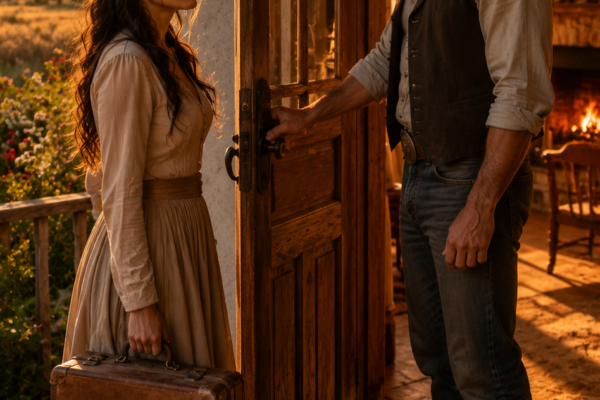
She was twenty-two, with golden blonde hair pinned beneath a traveling bonnet, though several strands had escaped during the journey and caught the late afternoon glow. Her eyes were deep blue, tired from travel, but alert and intelligent. She wore a pale blue cotton dress, dusty at the hem, simple but well kept. One gloved hand clutched a small valise; the other held her bonnet as she looked around, taking in the cabin, the barn, the prairie, and finally Wade.
“Mr. Prescott?”
Her voice carried a gentle Southern lilt that made his name sound less like a name and more like something entrusted to her.
Wade realized he was staring.
He nearly dropped his hat.
“Miss Daniels. Yes. I’m Wade Prescott.”
Hank unloaded her trunk with a grin that Wade wanted to knock clean off his face.
“Got room for one more passenger, so I’ll be moving along quick,” the driver said. “Wouldn’t want to intrude on destiny.”
Wade shot him a look.
Hank only laughed, climbed back up, snapped the reins, and left a trail of dust behind him.
Lily turned to Wade.
“Is something wrong, Mr. Prescott? You seem surprised.”
“No,” Wade said too quickly. “No. Just… the journey must have been difficult. Please, come inside.”
He reached for her valise.
She allowed him to take it, though her eyes studied him with careful uncertainty.
As they walked toward the cabin, panic rose inside Wade like floodwater.
This woman did not belong here.
That was his first thought, and he hated it because it sounded cruel even inside his own mind.
She belonged somewhere with polished floors, good lamps, music in the parlor, bookshelves, clean streets, and neighbors who called before visiting. Not in a rough Montana cabin where winter could trap a person for weeks and the nearest doctor might as well be a myth when snow covered the roads.
She was too refined.
Too beautiful.
Too likely to realize, after one week of smoke, mud, cold water, stubborn chickens, and endless work, that she had made a terrible mistake.
Worse, every unmarried man within fifty miles would wonder what a woman like Lily Daniels was doing with Wade Prescott.
And maybe they would be right.
The moment they entered the cabin, Wade saw every flaw at once.
The low ceiling.
The patched chair.
The table he had made himself, solid but uneven if one looked too long.
The single room that served as kitchen, dining area, sitting room, and everything else.
The curtain that separated his sleeping space from the rest of the cabin.
The wildflowers in the tin cup suddenly looked ridiculous.
He set down her valise.
“It’s not much,” he said stiffly. “I was plain about that in my letter. I added the lean-to last summer. If you decide to stay, I thought I could build an addition for your privacy.”
Lily stood in the middle of the cabin, looking around.
Not recoiling.
Not smiling falsely.
Just looking.
Then she turned back to him.
“Your letter was very forthright about the conditions,” she said carefully. “I appreciate honesty above all things, Mr. Prescott.”
That should have reassured him.
Instead, it made him more nervous.
“Miss Daniels,” he said, forcing the words out before he lost courage, “there may have been a mistake.”
Her smile faltered.
“A mistake?”
“The agency must have misunderstood what I was looking for.”
Her chin lifted slightly.
“And what exactly were you looking for?”
“Someone more…” He gestured uselessly, suddenly unable to say the words plain or ordinary because they would sound like insults. “Someone better suited to this life.”
Lily held his gaze.
“You mean someone less refined. Less educated. Less attractive.”
Heat rose up Wade’s neck.
“I mean someone who won’t be miserable here. Someone who won’t regret coming the moment winter hits and we’re snowed in for weeks. Someone who won’t—”
He stopped himself.
Someone who won’t break my heart when she leaves.
But the words hung there anyway.
Lily removed her gloves slowly, finger by finger, as if giving herself time not to respond too sharply.
“Mr. Prescott,” she said, “perhaps you should allow me to decide what will make me miserable.”
Before he could answer, a loud, distressed sound came from outside.
A horse.
Wade turned toward the window at once.
His mare, Daisy, heavy with foal, was down in the small corral. Even from the cabin, Wade could tell something was wrong. She tossed her head, legs churning weakly, sides heaving.
“Excuse me,” he said, already moving. “I need to—”
“Of course,” Lily said, following him. “How can I help?”
Wade stopped at the door.
“You don’t need to.”
She looked at him with sudden firmness.
“I grew up on a horse farm in Virginia, Mr. Prescott. Now, shall we help your mare, or would you prefer to waste time questioning my capabilities?”
For the first time since she had stepped from the coach, Wade truly looked at her.
Not at her beauty.
Not at the polished way she spoke.
At the strength in her eyes.
He nodded.
They ran to the corral together.
The next three hours changed everything.
Lily did not stand back wringing her hands. She did not faint. She did not complain about dirt, fear, smell, or difficulty. She rolled up her sleeves, knelt in the straw, and spoke to the mare in a low, steady voice that seemed to calm both the animal and the man beside her.
“She’s frightened,” Lily said. “But she trusts your voice. Keep talking to her.”
“You know what you’re doing?”
“My father bred horses. I helped with births before I learned proper embroidery.”
There was no time for embarrassment after that.
The foal was poorly positioned. Wade had dealt with difficult deliveries before, but having Lily there changed the rhythm of the work. She was observant, quick, and gentle under pressure. She followed instructions when needed and offered insight when she had it. Together, they eased the mare through the worst of it, working by lantern light as the sun dropped behind the prairie and the air cooled.
When the foal finally came into the world, trembling and alive, Lily’s face broke open with a smile so radiant that Wade forgot to breathe.
“She’s beautiful,” she whispered.
The newborn struggled, then found her legs in wobbly defiance. Daisy lifted her tired head and nickered softly.
Lily laughed under her breath, a sound of pure relief.
Her hair had loosened from its careful pins. Her sleeves were stained. Her cheeks were flushed from effort. She looked nothing like a fragile Eastern lady.
She looked fierce.
Alive.
Magnificent.
And that terrified Wade more than if she had turned out useless.
Because useless he could have sent away.
This woman was exactly what he needed.
That was the danger.
“Thank you for your help,” he said stiffly once the mare and foal were settled.
Lily’s smile faded just a little at his formal tone.
“I was glad to assist.”
“You should rest. It’s been a long day.”
“Of course.”
Back inside, Wade insisted Lily take the bed behind the curtain while he made himself a pallet near the fireplace. He kept his movements efficient and polite, careful not to let silence become intimacy. She accepted without argument, though he felt her watching him.
That night, Wade lay awake, staring into the low glow of the fire.
He could hear Lily’s soft breathing behind the curtain.
He had expected a practical arrangement.
A stranger.
A helper.
A woman who would cook, tend chickens, perhaps share the work without touching the locked parts of him.
Instead, Lily Daniels had arrived like sunlight, stepped into his rough little world, helped save a mare and foal within hours, and made him feel things he had spent years burying.
She was not unsuitable because she was weak.
She was dangerous because she was strong.
Because she could belong here.
Because she could make him want a life bigger than survival.
Behind the curtain, Lily lay awake too.
Wade Prescott was not what she had expected either. His letter had sounded almost cold, but the man himself was guarded in a way that suggested wounds, not indifference. He was younger than she had imagined, handsome in a weathered, reluctant way, and far more afraid of hope than of hardship.
She had come prepared for the frontier.
She had not come prepared to be rejected because she looked too delicate to a man who had not bothered to know her.
Still, as sleep finally came, she made herself one promise.
She would not beg to be valued.
But she would not leave before showing him exactly who she was.
The following weeks settled into an uneasy rhythm.
Wade built an addition to the cabin with remarkable speed, working from dawn until the last light faded. He framed walls, hauled lumber, hammered, measured, remeasured, and created a small private room for Lily as if privacy were both courtesy and shield. He told himself he was doing the honorable thing. In truth, part of him was building a wall because the one inside him was beginning to crack.
Lily took charge of the household without asking permission in ways that could not be argued with.
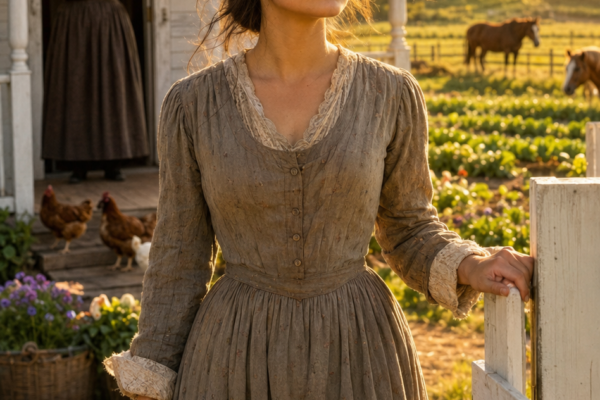
She established a vegetable garden behind the cabin, choosing the sunniest patch and improving the soil with quiet determination. She reorganized the food stores, patched linens, managed the chickens, mended shirts he had been pretending did not need mending, and somehow made the cabin feel less like shelter and more like a place where morning mattered.
Their meals were polite.
Their conversations practical.
Salt. Feed. Weather. Nails. Eggs. Flour. Fencing.
Wade avoided looking at her too long.
Lily noticed.
Of course she noticed.
She watched him when he thought she was busy. Watched the gentle way he handled animals. Watched how he checked the sky before making plans. Watched him stand in the doorway at night, looking out over land that was both his pride and his burden. Watched him pull away emotionally every time warmth came too close.
A man could be lonely for years and still fear company.
She began to understand that.
But understanding did not make it painless.
The turning point came on a sweltering July afternoon.
Heat shimmered over the north pasture, turning the distant fence posts wavy. Wade was repairing a stretch of broken rail under a merciless sun, sweat darkening his shirt and dust clinging to his arms. He had been at it since dawn and, in typical Wade Prescott fashion, had no intention of stopping until the job was done or his body gave out.
Lily appeared carrying a canteen and a cloth-covered basket.
“I thought you might need food and water,” she said, setting the basket in the shade of a lone cottonwood. “It’s too hot to work through midday without rest.”
Wade straightened, wiping his brow.
“Thank you, but I’m fine. Still plenty to do before sundown.”
Lily sighed.
It was not a gentle sigh.
It was a woman reaching the end of her patience.
“Mr. Prescott—”
“You should call me Wade,” he interrupted, surprising himself. “If you’re staying, that is.”
Lily went still.
“Am I staying?”
He looked at her.
She stepped closer.
“I’ve been here nearly a month. Some days you barely say ten words to me. I still don’t know whether you want me to remain or whether you are simply too honorable to send me away.”
Wade looked toward the fence.
“It’s not that simple.”
“Then explain it to me. I came here ready to build a life. Ready to be a partner to a man who said he wanted the same. Instead, I feel like an unwelcome guest in what is supposed to be my home too.”
The word home struck him.
“You don’t belong here,” he said at last.
The words came out harder than he intended.
Lily flinched, but she did not retreat.
“Why?”
“Look at you.” His frustration broke loose because fear always sounds cruel when it tries to protect itself. “You’re educated. Refined. Beautiful.”
The last word came out almost like an accusation.
“The first time we go into town together, every man there will wonder what you’re doing with someone like me. And they’ll be right.”
Her expression changed.
Not anger now.
Something softer and sadder.
“Is that what this is? You think I’m too good for you?”
“I think you’re too good for this life,” Wade said, gesturing toward the land around them. “Winter will come in a few months. Snow higher than your waist. Wind that howls so loud at night you start wondering if silence ever existed. Weeks trapped here if storms get bad enough. Everything becomes work. Everything becomes survival.”
“And you think I can’t handle that?”
“I think you shouldn’t have to.”
Lily’s eyes sharpened.
“Wade Prescott, I did not come here because I wanted ease.”
He fell silent.
She took a breath, and when she spoke again, her voice carried the weight of a life he had never asked about.
“Yes, I was raised with advantages once. I had books. Music. A house with tall windows. A father who believed his daughters should read more than recipes. But the war took most of that. Our home in Virginia was burned. My father died. My brothers scattered, and the world I knew became something people spoke of in past tense. For five years, I worked as a governess in a house where I was treated like furniture that could correct grammar.”
Wade stared at her.
“I answered your advertisement because your letter was honest,” she continued. “It did not promise luxury. It promised work. Purpose. A chance to build something that belonged to the people building it. When you described this place, hard as it was, I felt something I had not felt in years.”
“What?”
“I felt like I could breathe.”
The words moved through him quietly, then deeply.
He had seen Lily as something too fine for the frontier.
He had not seen the woman who had already survived the collapse of one world and was brave enough to choose another.
“I didn’t know,” he said.
“You never asked.”
The truth struck him like a blow.
She was right.
He had judged her the moment she stepped into the sunlight, just as everyone had likely judged her before. Too pretty. Too refined. Too delicate. Too much this, too little that. He had made fear look like wisdom and called it protection.
“I’m sorry,” he said.
The words were small.
But sincere.
Lily studied him, then allowed a faint smile.
“Well. That is a start. Now sit down and eat before you collapse from heat and stubbornness.”
For once, Wade obeyed.
They ate under the cottonwood tree while the heat hummed around them. Lily had packed bread, cheese, cold chicken, and sliced apples. Nothing elaborate. Somehow it tasted better than meals he had eaten alone for years.
For the first time, they talked.
Truly talked.
Lily told him about Virginia before the war, about her mother’s rose garden, about learning horses from her father, about the terrible quiet after loss, about becoming useful because usefulness was the only way she was allowed to remain in certain rooms.
Wade told her about losing his parents to influenza when he was eighteen. About coming west with his father’s pocket watch and a stubborn dream. About nights in Montana when he thought the loneliness might swallow him whole.
“I convinced myself it was better this way,” he admitted as the sun drifted lower. “Attachment just meant eventual pain.”
Lily’s hand found his.
Her touch was light, but certain.
“Pain finds us all, Wade. The question is whether we face it alone or together.”
Something fragile opened in his chest.
His first instinct was to pull away.
But her hand stayed steady.
And for the first time in years, Wade let himself wonder whether shared hardship might not be weakness.
Maybe it was the only reason people survived at all.
After that afternoon, the ranch changed.
Not suddenly.
Not like a storm breaking.
More like dawn.
Wade stopped avoiding Lily’s eyes across the table. Their conversations grew beyond chores. He began asking her opinion about livestock, planting, supplies, and finances. She asked questions that made him rethink habits he had never questioned. He discovered she was not simply willing to work; she was good at seeing what a place could become.
Lily dreamed with practical hands.
A larger garden.
Beehives next spring.
A proper root cellar.
Maybe one day, if more families settled nearby, a small school for children who needed lessons between chores.
“Books matter,” she told him one evening while sorting beans. “Even out here.”
“Especially out here,” Wade said before realizing he agreed.
A week later, he rode into town and came back with supplies and a paper-wrapped parcel.
“What is this?” Lily asked as he set it on the table.
“Open it.”
She unwrapped it carefully.
Inside were three books: a volume of poetry, a novel with a worn but handsome cover, and a guide to western plants.
For a moment she did not speak.
“You said you missed books,” Wade explained, suddenly awkward. “The selection in town was poor. I thought maybe—”
He stopped because Lily had risen from her chair.
She crossed the room and kissed his cheek.
It was quick.
Soft.
Barely more than gratitude.
But Wade stood frozen as if lightning had struck the floor beside him.
“Thank you,” she whispered. “For remembering something small.”
It was not small to him.
That was the trouble.
He wanted to remember everything.
What made her smile. What saddened her. How she took coffee. Which flowers she preferred. What dreams she still guarded behind caution. What stories she had never told because no one had asked properly.
By September, the hills turned gold and crimson.
Wade and Lily moved through the days like partners who had not yet fully named what they were becoming. They worked side by side, planned improvements, shared meals that now carried laughter, and spent evenings by lamplight. Sometimes Lily read aloud while Wade carved pieces for a chess set from scrap wood. Sometimes they sat in companionable quiet while the fire cracked and the prairie wind pressed against the walls.
Their legal status remained uncertain.
They had agreed, silently at first and then aloud, not to rush into marriage simply because a letter and a stagecoach had brought them together. Wade respected that. Lily did too.
But every day made the question less frightening.
And more inevitable.
Then came the first truly cold storm of autumn.
Wade had ridden out at dawn to check for straying cattle near the high pasture. The sky had looked gray but harmless. By afternoon, the temperature dropped so fast his breath turned sharp in his lungs. Clouds gathered low and heavy over the hills. He turned for home, urging his horse faster.
The storm hit like a door slamming shut.
Snow whirled sideways.
Visibility vanished.
The world became white wind and sound.
Wade knew danger when he saw it. This was no gentle early snow. This was a killing storm if a man lost direction or hesitated too long. He trusted his horse, trusted his knowledge of the land, and rode with his body bent low against the gale.
By the time the dim outline of the cabin appeared, relief flooded him.
Then he saw the barn door.
Open.
Swinging wildly in the wind.
His stomach dropped.
Lily.
He dismounted before the horse fully stopped and fought his way toward the barn. The wind shoved him hard enough to make him stumble. Snow cut at his face. He pushed through the open door and found lantern light inside.
Lily was there, pale with cold but determined, securing the last of the frightened horses.
When she saw him, relief flashed across her face.
“You made it back!”
“We need to get to the house!” Wade shouted over the roar. “This storm is dangerous.”
“The animals were panicking. I couldn’t leave them.”
Of course she couldn’t.
That was who she was.
Together they made sure the horses had feed and water, then prepared for the short but perilous journey to the cabin. Twenty yards in clear weather. In that storm, it might as well have been a mile.
Wade wrapped his coat around Lily despite her protests.
“Do not argue with me in a blizzard,” he said.
She almost smiled.
They stepped into the white fury with arms linked. The wind hit them like a wall. Snow swallowed the ground. Wade kept Lily tight to his side, shielding her with his body as best he could. Halfway across, she stumbled, and the fear that shot through him was so sharp it stripped away every last pretense.
He lifted her and carried her the rest of the way.
Inside the cabin, he set her down near the fire and immediately built the flames high. Lily changed into dry clothes behind the curtain while Wade heated coffee and added a little whiskey, hands shaking more from emotion than cold.
When she emerged wrapped in a quilt, he pressed the mug into her hands.
“You could have frozen to death,” he said, his voice rough.
“So could you.”
“Why did you go to the barn?”
“The animals needed securing.”
“Lily—”
“And I was worried about you.”
That stopped him.
She sat near the fire, shivering, hair damp at her temples, hands curled around the mug. The storm raged outside, but Wade could only look at her.
This woman had faced the storm for his animals.
For his ranch.
For him.
Not because she was reckless.
Because she loved what had become theirs.
He sat beside her.
“I have been a fool.”
Lily turned.
“That is not entirely new information.”
Despite everything, he almost laughed.
“I spent so long believing love out here was too dangerous. That the frontier would eventually take anything I cared about. But today, when I couldn’t see the cabin through the snow, all I could think about was getting back to you.”
Her eyes glistened in the firelight.
“Wade…”
“Not the ranch. Not the cattle. You.”
The confession loosened something inside him that had been locked for years.
“I don’t want you here as a helper. Or a guest. Or an arrangement I’m too afraid to name. I want you to stay as my wife, if you’ll have me.”
Lily’s expression softened into something bright and trembling.
“Is that a proposal, Wade Prescott?”
“The most sincere one I know how to make.”
She leaned closer, resting her forehead against his.
“My answer is yes.”
His breath caught.
“It has been yes,” she whispered, “from the moment I stepped off that stagecoach. I was just waiting for you to stop being scared of it.”
Wade kissed her then.
Gently.
With reverence.
With relief.
With the kind of tenderness that does not need to be loud to change a life.
Outside, the storm raged for three days.
Inside, time softened.
They planned. They talked. They laughed at how badly they had misunderstood each other. Wade admitted the wildflowers on her first day had not been accidental. Lily admitted she had noticed them immediately and loved him a little for pretending not to care.
When the storm finally broke, the world outside was transformed.
White.
Brilliant.
Harsh and beautiful in equal measure.
Just like the life ahead of them.
They married two weeks later in the small church in town. Lily wore the dress she had carefully preserved from her journey west, altered with her own hands. Wade wore his best shirt and a new waistcoat he pretended not to be proud of. The neighbors came out of curiosity, kindness, and perhaps a little surprise that the solitary young rancher had somehow won the hand of the most striking woman to arrive in Sage Creek in years.
More than one unmarried man looked at Wade with envy.
Wade noticed.
Lily noticed too.
On the wagon ride home, he glanced at her.
“Any regrets yet?”
She leaned against his shoulder.
“Only that we waited so long.”
Winter came early that year.
Snow piled against the cabin walls. Wind howled across the prairie with vengeful force. There were days when the world beyond the barn disappeared into white. There were nights when the cold pressed so hard against the windows it seemed determined to get inside.
But the cabin was different now.
There were two voices.
Two sets of hands.
Two people measuring flour, mending harness, planning spring, reading by lamplight, playing chess with uneven pieces, laughing when the fire smoked, arguing gently about where the beehives should go, making room in the small house for a life that felt larger every day.
The isolation Wade had once feared became precious.
Not easy.
Never easy.
But shared.
And shared hardship became something almost sacred.
When spring came, it arrived in a rush of melting snow, prairie flowers, mud, birdsong, and work. They expanded the garden. Built a proper chicken coop. Began a larger barn. Lily started lessons once a week for the children of nearby homesteads, teaching letters and sums at the kitchen table while Wade worked with horses outside. Word spread that Prescott had a gift with animals and that Mrs. Prescott had a mind sharp enough to run a schoolhouse if Sage Creek ever became a real town.
A year after Lily arrived, they stood together on the porch at sunset.
The cabin had grown.
The barn stood stronger.
The garden was alive with early summer vegetables.
The mare’s foal, the one Lily helped bring into the world on her first night, ran through the pasture with reckless joy.
Lily rested one hand lightly on the curve of her belly. Their first child would come when winter returned.
Wade stood behind her, one arm around her waist.
“Are you afraid?” he asked softly.
“Of the baby?”
“Of winter. Of what it may bring this time.”
Lily looked up at him.
“No. Whatever comes, we will face it together. That is the difference between surviving and living.”
Wade gazed across the ranch.
Everything he saw was proof of that.
The barn. The garden. The fence line. The smoke rising from the chimney. The woman beside him. The child they had not yet met. The life that had come from one letter, one stagecoach, one misunderstanding, one mare in labor, one argument under a cottonwood, one blizzard that forced a fearful man to admit what his heart already knew.
“When I sent that letter east,” he said, “I thought I was looking for someone practical. Someone who would fit into my small life without changing it too much.”
Lily smiled.
“And instead you got me.”
He turned her gently to face him.
“Instead I got everything I was too afraid to ask for.”
Her eyes softened.
“You once thought I was too beautiful for this place.”
“I was wrong.”
“About my beauty?”
He smiled.
“About what beauty means.”
The first stars appeared above the prairie.
And Wade finally understood what had taken him years to learn.
The frontier was not a place where love could not survive.
It was a place where love was essential.
As necessary as shelter.
As sustaining as water.
As life-giving as the sun after a killing storm.
In the years that followed, the Prescott ranch grew beyond anything Wade had dared to imagine when he stood alone on that porch waiting for a stagecoach. Their family grew too, with children who learned early that work was not punishment when it built something worth keeping, and that courage was not the absence of fear, but the choice to keep loving despite it.
Sage Creek became a proper town eventually, with a schoolhouse where Lily taught when she could. Wade became known for his horses and for the quiet way he treated every animal as if trust mattered. Through droughts, storms, hard births, lean seasons, good harvests, laughter, grief, and the ordinary miracles of daily life, Wade and Lily remained each other’s place of belonging.
Sometimes, many years later, when the children were asleep and the work was done, they would sit together on the porch of the larger home they had built around the bones of that first cabin.
Wade would look at the road where the stagecoach had once appeared in a cloud of dust.
And he would ask, always with the same wonder:
“Do you ever regret it? Coming west to marry a stranger?”
Lily would smile, the same smile that had undone him beside a newborn foal, beside a fire in a blizzard, beneath all the seasons of their life.
“How could I regret finding exactly where I belong?”
And Wade, who had once believed loneliness was safer than love, would take her hand and know the truth in his bones.
Safety had never been the same as living.
Love had not made the frontier gentle.
It had made them brave enough to face it.
Together.