The Mail-Order Bride Said “Don’t Touch Me” — The Cowboy Didn’t Listen… And Her Heart Never Recovered
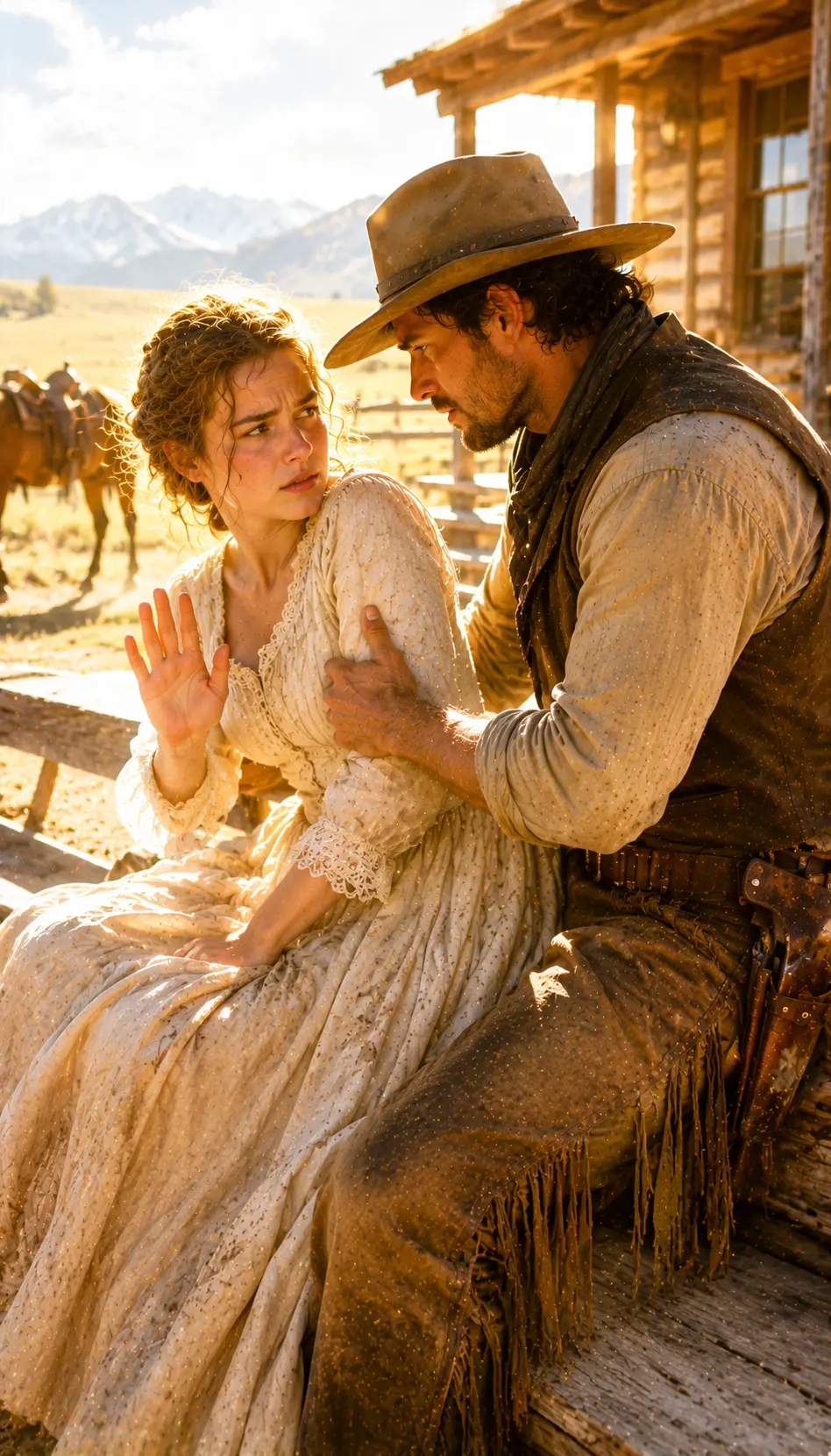
The train hissed to a stop like a wounded iron beast, throwing black smoke into the sharp November sky of Wyoming Territory.
Annabelle Rose sat still for a moment after the wheels stopped, her gloved fingers locked around the handle of her battered leather case. Every other passenger seemed eager to get off, to stretch their legs, to find a warm stove or a waiting family or at least some familiar face in the crowd.
Annabelle had none of those things waiting for her.
Only a stranger.
Only a ranch.
Only a future that had been arranged through a newspaper advertisement because survival sometimes asks a woman to do things her younger self would never have believed.
She pressed her face once more to the grimy window and looked out at Frontier Station.
It was not much of a town. A wooden platform. A small depot building. A few rough storefronts leaning into the wind. A saloon with a crooked sign. Horses tied at a rail. Men in dusty hats. Women in wool shawls. Snow tucked in the corners of the street where the sun had not reached.
Beyond the town stretched a land so wide and empty it almost looked unfinished.
Sagebrush.
Wind-cut hills.
Distant mountains with white teeth.
For one terrible second, Annabelle wondered if she had made a mistake.
Then she remembered St. Louis.
The locked rooms.
The whispered accusations.
The cousin who had sworn she would pay.
The night she had run with nothing but one case, one Bible, one photograph, and the small knife she had hidden at the bottom of her bag.
No.
This was not a mistake.
This was distance.
And distance was the first mercy she had been given in years.
Three months earlier, she had answered a notice printed in the St. Louis Gazette.
Respectable rancher seeks companionship. Must be willing to work. Past circumstances not questioned.
There had been no poetry in it. No promises of romance. No tender words about building a life together. No foolish talk of love waiting under western skies.
Just a plain offer from a man who needed another pair of hands and, perhaps, another heartbeat under his roof.
To another woman, it might have sounded bleak.
To Annabelle, it sounded honest.
And honesty, after what she had survived, felt almost luxurious.
“Frontier Station,” the conductor called. “End of the line for some folks.”
Annabelle rose, smoothing the wrinkles from her faded gray dress. The other passengers avoided her the way they had avoided her since Kansas City, their eyes sliding away just a little too quickly, their whispers tucked behind newspapers and gloved hands.
She ignored them.
She had become skilled at ignoring whispers.
Whispers could not bruise skin. Whispers could not lock doors. Whispers could not drag a woman backward unless she turned around to listen.
She stepped down onto the platform.
The cold hit her first.
It came sharp and clean through her gloves, through her cloak, through the thin soles of her boots. Her breath clouded white in front of her face.
Then she saw him.
Eli McCall.
He stood apart from the small crowd like a mountain that had decided to wear a hat. Tall, broad-shouldered, silent. His long duster coat was worn but neat, his boots scuffed with honest labor, his hat pulled low enough to shadow most of his face. Still, Annabelle caught a glimpse of his eyes.
Gray.
Steady.
Unreadable.
He did not wave.
Did not smile.
Did not rush forward to take her case or pretend they were anything other than two strangers bound by an arrangement neither of them fully understood.
He simply watched as she walked toward him, her boots crunching over the frozen boards.
When she reached him, he spoke.
“Mrs. Rose.”
His voice was rough, quiet, the kind of voice used more often on horses, weather, and stubborn gates than on women.
“Miss Rose,” she corrected softly. “Or Annabelle, if you prefer.”
Something flickered in his eyes.
Surprise, perhaps.
Maybe respect.
Most mail-order brides claimed widowhood whether it was true or not. A clean lie made people comfortable. A dead husband made fewer questions. But Annabelle had made peace with the truth. Lies had already cost her too much.
Eli gave one short nod.
“Annabelle, then.”
No welcome. No compliment. No questions about the journey.
He turned toward a wagon hitched to two sturdy mules.
“Let’s ride.”
She followed with her chin lifted, determined not to need help.
He did not offer any.
That, strangely, comforted her.
The wagon was loaded with supplies: flour, salt, coffee, cartridges, tools, lamp oil, and a folded blanket placed on the seat. His only nod to comfort.
Annabelle climbed up alone and settled her skirts neatly. Eli took his place beside her, careful not to let his sleeve touch hers, though the bench was narrow.
They left the station without another word.
Frontier faded quickly behind them. A handful of buildings, curious eyes, then open land. The wagon wheels groaned over ruts frozen hard by the cold. Harness chains clattered. The mules snorted white steam. Wind pushed loose strands of hair against Annabelle’s cheek.
For a long while, neither of them spoke.
She watched the land change from flat prairie to sparse pine. She had never seen anything so vast. Back east, even distance had edges: streets, fences, houses, alleys, brick walls, church towers, windows where people could watch and judge.
Here, the world opened in every direction.
It frightened her.
It also felt clean.
Honest.
“How far to your place?” she asked at last, keeping her voice even.
“Our place,” he corrected.
The word tightened something in her stomach.
Our.
She had belonged to a man before. In every cruel, legal, church-blessed way a woman could belong. She had worn his ring, carried his name, served his table, endured his temper, and learned how quickly a pretty vow could become a chain.
She had no intention of belonging again.
Eli seemed to sense the tension, because he did not look at her when he added, “Eight miles north. Another hour, maybe less.”
The road turned rougher, climbing through darkening pines. The sharp blue sky softened into gold and gray as the sun lowered behind the peaks. At last they reached a clearing.
There stood the cabin.
Log walls silvered with age. Smoke curling from the chimney. A small barn and corral beside it. The fence mended cleanly. The ground swept of snow near the door. No neighbors. No town noise. No eyes.
Isolated.
Utterly alone.
“It ain’t much,” Eli said quietly. “But it’s dry. Good water from the creek.”
Annabelle studied the cabin.
It was plain, yes.
But plain things did not frighten her.
Pretty things had done more damage.
“It will do,” she said.
“You can take the back room,” he told her after a pause. “I sleep by the fire. Door’s got a latch.”
She understood exactly what he meant.
Privacy.
Safety.
A line between strangers under one roof.
She nodded once.
They reached the porch just as daylight faded. Eli jumped down and went to tend the mules without glancing back. Annabelle carried her own bag to the door and stepped inside.
The cabin was tidy.
That surprised her.
A stone hearth dominated the main room. Shelves lined one wall, stocked with tin plates, jars, folded cloth, and a few books. The furniture was rough and homemade but sturdy. The floor had been swept. Everything smelled faintly of wood smoke, soap, leather, and cold air.
Eli entered a few minutes later, stamping snow from his boots.
They faced each other across the small room, firelight flickering between them.
Annabelle removed her gloves slowly.
“I should make something clear.”
He tilted his head.
“Go on.”
“I will cook. I will clean. I will work hard. I did not come here to sit idle.”
He said nothing.
“But there are conditions.”
His eyes held steady.
“Name them.”
“Do not touch me.”
The words landed heavy in the room.
“And do not ask about my past. Those are my terms.”
Eli did not blink.
Did not laugh.
Did not ask what kind of woman arrived in the territory already drawing lines around her body and her history.
He simply nodded.
“Fair enough.”
She searched his face for mockery.
There was none.
“I have my own reasons for wanting a business arrangement,” he said. “Preacher comes by once a month. If you still want it legal then, we make it legal. Until that day, you are hired help with room and board.”
The tension drained from her shoulders so suddenly she almost swayed.
“Agreed.”
“Stew’s on the fire. Bread in the box. Back room’s yours.”
He reached for the rifle hanging by the door.
“Welcome to the Triple C.”
Then he stepped outside, leaving her alone with the fire.
Annabelle stood still for a long time.
No demand.
No claim.
No husband’s hand reaching too soon.
Only stew on the fire and a room with a latch.
She set her case on the table, unbuckled the worn straps, and began to unpack. Two spare dresses. A threadbare shawl. A small Bible. A photograph wrapped in cloth.
At the bottom lay the knife.
Seven inches of sharpened steel.
Her only true insurance in a world that had taught her never to sleep without one.
She hid it beneath her pillow before sitting on the narrow bed in the back room.
For the first time in months, Annabelle allowed herself to breathe.
Not deeply.
Not freely.
But enough.
Through the wall she heard Eli moving about in the main room. The scrape of a chair. The quiet steps of a man accustomed to silence. The low creak of boards as he settled near the hearth instead of approaching her door.
When the cabin was bolted for the night, she lay awake staring at the ceiling.
She was not safe.
Not yet.
Safety was not a thing one accepted on the first night just because a man spoke gently. Safety had to be proven. Repeated. Earned. It had to survive bad moods, hunger, storms, and misunderstandings.
But she was far from the city.
Far from St. Louis.
Far from Samuel Rose’s shadow.
Far from Jake Hollister’s promise that the law would find her even if God did not.
For now, that was enough.
The blizzard came three weeks after Annabelle’s arrival.
It swept down from the mountains before dawn like a living thing, swallowing the world until the cabin might as well have been floating in white emptiness. Snow piled against the door. Wind screamed through the shutters. The sky vanished. The barn disappeared. Even the fence posts became vague gray ghosts in the storm.
Eli was already up when Annabelle woke, feeding the fire with grim patience.
“Could last days,” he said without looking at her. “Maybe a week.”
She wrapped her shawl tight.
“Comforting.”
He glanced over.
“I ain’t much for comforting talk.”
“I have noticed.”
To her surprise, something like amusement tugged at the corner of his mouth.
Their fragile peace had held since her arrival. He worked outside. She kept the cabin, cooked, mended, cleaned, and learned the rhythm of the ranch. They ate at the same table but rarely spoke beyond necessity. He respected her terms so strictly that sometimes his restraint made her uneasy.
A cruel man was easy to understand.
A careful man was not.
By the second day of the blizzard, the silence pressed against Annabelle’s skin.
She kneaded bread dough with more force than needed, aware of Eli behind her at the hearth. The scrape of his knife as he whittled. The steady rhythm of his breathing. The heat of him too close and yet never crossing the invisible line she had drawn.
“Coffee’s gone cold,” he said finally.
She bit back a sharp reply and moved the pot closer to the flames.
“Storm this bad killed half Tom Morrison’s herd last winter,” Eli said, as if offering conversation. “Found three frozen standing up come spring.”
“How cheerful.”
This time he actually chuckled.
A low, rusty sound, like hinges that had not moved in years.
“Mary used to say that.”
Then he stopped.
The knife went still in his hand.
Mary.
His wife.
The first time he had spoken her name.
Annabelle hesitated.
“How long ago?”
He stared into the fire.
“Four years. She tried to birth our son while I was driving cattle to Cheyenne. Neighbor found them both three days later.”
The words were plain.
Too plain.
No theatrics. No shaking voice. No visible plea for sympathy.
But Annabelle heard what he did not say.
The guilt.
The failure.
The ghost that still sat in the room with him.
“I am sorry,” she said softly.
Eli nodded once.
“Long time ago.”
But she knew better.
Some grief does not care what the calendar says.
That night, the fever came.
Annabelle woke drenched in sweat, her body trembling so violently the bed frame rattled beneath her. Her throat burned. Her chest ached. Her head spun when she tried to rise. The wind outside roared louder, or perhaps that was only the pounding in her ears.
The door creaked open.
Eli’s voice came through the haze.
“Stay down. You’ve been coughing all night.”
“It’s nothing.”
“You’ve got lung fever.”
“I do not.”
“You stay in this cold room, you’ll be dead by morning.”
Before she could argue, his arms slid beneath the quilts and lifted her.
Panic ripped through her faster than fever.
“Put me down.”
“Don’t make me drop you, woman,” he muttered, carrying her toward the fire. “Ain’t no other way.”
She fought him for one terrible second, not because he was hurting her, but because memory had claws. Every man who had touched her without permission lived again in that instant.
Eli carried her to his own bed near the hearth, set her down with the quilts around her, and immediately stepped back.
“I’ll make willow bark tea. Brings fever down.”
Annabelle lay trembling, the heat of the fire stinging her chilled skin. Her vision blurred. Sounds drifted in and out: boots moving, pots clattering, the hiss of water, a low curse when Eli burned his hand, then the cool press of cloth against her forehead.
“I’ll be fine in the back room,” she whispered.
“You’ll be dead in the back room,” he said quietly. “Now hush.”
The fever worsened through the night.
Annabelle drifted in and out of dreams. St. Louis. A locked door. A man’s shadow. The smell of expensive cologne and whiskey. Her own voice trapped in her throat.
Through it all came Eli’s voice.
Calm.
Steady.
“You’re safe. Just breathe. You’re safe.”
Sometimes she felt his hand on her shoulder, careful through the quilt, never touching skin. Sometimes she woke gasping, certain she was back in a house where every room had become a trap. Each time, he was there, helping her sit up, holding the cup to her lips, murmuring nonsense about stubborn mules and bad weather just to keep her tethered to the present.
Once, lost in fever, she whispered, “Touch me and I will leave.”
He did not flinch.
“Then go,” he said softly. “But not tonight.”
Those quiet words broke something inside her.
Not because they were cruel.
Because they were not.
He was not mocking her fear. Not fighting it. Not demanding gratitude. He was simply telling her she had a choice, even when she was too ill to make it.
For the first time in years, Annabelle cried.
Not the silent tears she had trained herself to hide.
Real, shaking sobs that tore through her thin frame until she had no strength left.
Eli said nothing.
He only kept his patient vigil as she wept herself into sleep.
When dawn came, the fever had broken.
Pale light filtered through frost on the windows. Annabelle woke weak, aching, but alive. Eli sat in the chair beside her, eyes ringed with exhaustion, clothes rumpled, one hand still holding the cloth he had used to cool her face.
“You stayed,” she said hoarsely.
He stretched stiffly.
“Said I would.”
“Why?”
His gray eyes softened.
“What else was I supposed to do? Let you freeze?”
The answer was so simple it almost hurt.
Over the next few days, she recovered slowly. Eli took over the cooking, fumbling at first, then improving enough to keep them both fed. One morning, he burned the johnnycakes until the cabin smelled like smoke and regret.
“You always cook like this?” she asked.
“When needed,” he said.
“Your wife must have been a good cook.”
The words slipped out before she could stop them.
He paused, then nodded.
“She was. Would have laughed herself silly to see me at her stove.”
They shared a small smile.
Not happy exactly.
But real.
By the fifth day, Annabelle could stand without swaying. When she tried to return to the back room, Eli stopped her with one hand raised but not touching.
“Fire’s warmer here. Stay until you’re full well.”
She hesitated.
Then nodded.
That night, with the storm finally easing, she lay awake watching firelight move across the rough-hewn ceiling.
“I was married before,” she said suddenly.
Eli stirred in the chair, but did not speak.
“A proper marriage,” she continued. “Church. Flowers. White dress. Everyone said I was lucky.”
She swallowed.
“He was charming when others watched. Successful. Handsome. The kind of man people believed because believing him made life easier.”
Eli’s eyes met hers across the firelight.
“The charm wore off once the church doors closed,” she said.
Her voice turned brittle.
“He had a temper. A taste for control. A way of making every room feel like it belonged to him. One night he came home drunk and told me I would be out by morning.”
The cabin went very still.
“I disagreed.”
Eli held her gaze.
Then he said one word.
“Good.”
No shock.
No judgment.
No moral speech dressed up as righteousness.
Just understanding.
Annabelle searched his face.
“You are not afraid of me? A woman who ended her husband’s cruelty?”
Eli poked the fire with a stick.
“I had a horse once,” he said. “Beautiful mare. A mean man before me ruined her with whip and spur. Everyone said put her down. Took me six months, but she came around. Best horse I ever owned. Loyal to the bone.”
“I am not a horse, Eli.”
“No,” he agreed quietly. “But you are not what he made you either.”
The words sank deeper than any comfort he could have offered.
For the first time, Annabelle wondered if she could become something other than a survivor running from the last locked door.
Outside, the storm clouds drifted away, revealing a cold sky full of stars.
Inside, Annabelle Rose sat in the glow of the fire with her hands trembling, not from fever or fear, but from the first fragile warmth of trust.
Spring came late to the Wyoming mountains.
But when it arrived, it came like forgiveness.
Snow melted into rushing creeks. The air filled with pine and thawing earth. Sunlight reached the cabin earlier each morning and stayed longer in the afternoons. Annabelle stood behind the house one day with her sleeves rolled up, watching Eli dig a patch of soil near the fence line.
“What are you doing?”
“Garden.”
She blinked.
“You garden?”
“Started it last fall,” he said, planting the shovel into the dark earth. “Figured whoever came might want something pretty to look at.”
He stepped aside.
There, lined with rocks and half-buried fence posts, was a small garden patch. In one corner, crocuses had already pushed through the last of the snow: purple and gold blooms trembling in the cold.
Annabelle knelt, brushing her fingers over the flowers.
“They survived winter.”
“Stubborn little things,” Eli said.
“For me?”
“For you. If you stay.”
The words hung between them.
Three months had passed since her arrival. They had shared storms, silence, fever, secrets, and meals at the same table. Still, there had been no promises.
Not yet.
“I do not know how to garden,” she admitted.
“I’ll teach you. Seeds don’t care what came before. They just grow.”
They worked side by side that morning. Eli’s big hands were surprisingly gentle with seed packets. His voice was patient as he explained soil, spacing, water, sun. Annabelle found peace in the rhythm of digging and planting. There was something honest about putting life into the ground and not demanding it bloom immediately.
At midday, they sat in the grass sharing cold biscuits and coffee.
Annabelle studied his profile: the weathered face, gray at the temples, steady calm of a man who had endured too much and still chosen not to become cruel.
“Why did you put that advertisement in the paper?” she asked.
He did not answer right away.
Then he said, “Because silence started talking back.”
She understood before he explained.
“After Mary died, I thought being alone was what I deserved. Then I thought it was what I wanted. Turns out loneliness is its own kind of death.”
Annabelle looked toward the mountains.
“I was dying too before I came here.”
Eli met her eyes.
“Then maybe we both got a second chance.”
The weeks that followed were easier.
The garden sprouted. Buttercup, Eli’s mare, grew heavy with foal. Annabelle’s laugh, hesitant at first, became part of the cabin’s sound. Sometimes Eli smiled without meaning to and looked away quickly, as if embarrassed by the evidence that he could still feel joy.
Then came the argument.
It started on a bright afternoon while Annabelle practiced shooting at tin cans lined along the fence. Eli had taught her how to hold the rifle, how to breathe, how to rest the weight instead of fighting it.
Her shots were wild at first.
Eli came from the barn and leaned on the fence.
“Elbow higher.”
“I know.”
“You’re fighting the weight.”
“I said I know.”
He stepped closer, not touching until she nodded once. Then he adjusted her sleeve, showing her how to brace the stock properly.
For the first time, she did not flinch.
The next shot rang true.
A can flew from the post.
“Better,” he said.
Annabelle lowered the rifle, breathing hard.
“A woman alone needs to protect herself.”
“You’re not alone.”
The words were gentle.
They still struck a nerve.
She turned sharply.
“Aren’t I? You sleep by the fire. You barely look at me unless I am cooking or mending. You keep your distance like I might bite.”
His jaw tightened.
“You said not to touch you. I am keeping my word.”
“There is distance, and then there are walls.”
He stepped closer, frustration showing for the first time.
“Have I ever given you reason to fear me?”
“No.”
“Then why do you look at me like I might turn into a monster?”
Her heart pounded.
“Because that is what happens. Men start gentle. Then they show their true face. I learned that lesson too well to forget it.”
“I am not him,” Eli said firmly. “Not any of them. When are you going to see that?”
“When I can afford to be wrong,” she said, voice shaking. “And I cannot.”
The anger left him.
He looked at her for a long moment and sighed.
“Trying is not the same as trusting,” he said. “But it is a start. I suppose I will take that.”
He walked toward the barn, leaving her standing beside the fence with tears burning her eyes.
That night, she found him sitting beside Buttercup’s stall, rubbing the mare’s neck. The barn smelled of hay, leather, and warm animals. Moonlight cut through gaps in the boards.
“She’s due soon,” Eli said quietly. “If it is a filly, you can have her.”
Annabelle blinked.
“What?”
“A horse that is yours alone might make this place feel more like home.”
“You do not have to give me something every time we argue.”
“I am not giving it because we argued. I decided weeks ago.”
She sat beside him, close enough to feel the warmth from his shoulder.
“You are a good man, Eli.”
He shook his head.
“I am a man trying to do better.”
They sat in silence while Buttercup breathed softly in the straw.
The distance between them did not disappear.
But it no longer felt impossible to cross.
Trouble came on a bright morning in town.
Annabelle had gone with Eli to pick up supplies. While he spoke with Lawson at the counter, she waited near the general store window, pretending not to feel the eyes on her. Frontier had grown used to her, but used to did not mean kind. A woman with a past could never fully stop being a question.
A rider tied his horse outside the saloon.
His hat was tilted low. His coat was dusty from travel. He turned, and their eyes met through the glass.
Annabelle’s blood turned cold.
Jake Hollister.
Samuel Rose’s cousin.
The man who had stood beside Samuel’s grave and sworn that Annabelle would answer for what she had done.
She turned away quickly, hands trembling as she lifted coffee and flour into the wagon.
“Annabelle.”
Eli’s voice came from behind her.
“You’re pale as milk.”
“I want to go home.”
He studied her, expression tightening.
But he did not ask.
Not in town.
That night, she barely slept. Every creak of the cabin made her sit up. Every gust of wind sounded like approaching hoofbeats. She checked the knife beneath her pillow three times before dawn.
By morning, Eli was gone.
“Town,” he had said. “Need to check something.”
When he returned, his face was grim.
“His name is Jake Hollister.”
Annabelle sank into a chair.
“He found me.”
“He has been asking questions about a woman named Rose. Tall. Dark hair. St. Louis.”
She pressed one hand to her stomach.
“My husband’s cousin. He promised to make me pay.”
Eli’s eyes hardened.
“Then he will have to go through me.”
Three days later, Jake Hollister came to the cabin.
He dismounted slowly, smiling toward the doorway where Annabelle stood with the rifle within reach.
“Hello, Belle,” he drawled. “Been a long time.”
“You are trespassing.”
“Just checking on family. Samuel would have wanted that.”
“Samuel wanted many things,” she said coldly. “Most of them cruel.”
His smile faltered.
“You were always mouthy. He said it was part of your charm, until it wasn’t.”
“What do you want, Jake?”
“Justice.”
“Is that what you call revenge now?”
His eyes sharpened.
“You took a good man from this world.”
“A good man does not make his wife fear the sound of his key in the lock.”
Before Jake could answer, hoofbeats broke through the cold air.
Eli appeared on the ridge, rifle leveled, eyes colder than the creek in January.
“You best get off my land.”
Jake turned lazily.
“Your land, maybe. But she is my business.”
“She is my wife,” Eli said.
Annabelle’s breath caught.
He had not said that since the advertisement arrangement began, not like this, not with steel in his voice and the whole world listening.
“That makes her my business.”
Jake laughed.
“She is a killer. You will regret tying yourself to her.”
Eli did not lower the rifle.
“A man raises his hand to a woman, he stops being a man. I asked polite. Leave.”
Jake’s eyes flickered dark.
Then he smiled.
“I will be seeing you, McCall.”
When he rode away, dust rose behind him like smoke from a fire not yet lit.
Eli lowered his rifle.
“Pack a bag,” he said quietly. “We can go to the Morrison place for a spell. More people. Safer.”
Annabelle shook her head.
“No. I will not run again.”
He stepped closer.
“I am not asking you to run. I am asking you to make sure you are not alone when he comes back.”
She met his gaze.
“Then we face him together.”
Eli nodded once.
“Together.”
Two days later, Frontier learned the whole story.
Not from whispers.
Not from Jake Hollister’s poisonous version.
From Annabelle herself.
She stood on the main street with Eli beside her and Sheriff Caldwell holding the papers Jake had brought from St. Louis. Papers full of accusations and half-truths, signed by men who had never seen what happened behind Samuel Rose’s closed doors.
Jake came for blood that day.
He did not get it.
He called her guilty.
She told the truth.
He called her dangerous.
She lifted her chin and said danger was not a woman defending her life. Danger was a town that believed a charming man because his wife was too frightened to speak.
When Jake reached for his gun, Eli moved faster.
The shot rang out over the street.
Not fatal.
Eli had promised Annabelle he would not take a life unless there was no other choice, and he kept that promise. Jake lived, but his pride fell in the dust that day. Sheriff Caldwell took him into custody for drawing first, and for the threats half the street had heard him make.
When it was over, Eli holstered his gun, turned to Annabelle, and said simply, “Let’s go home.”
Home.
The word did not frighten her this time.
That night, back at the cabin, she found him by the fire cleaning his revolver with slow, careful hands. The room was warm. The garden outside was sleeping under frost. Buttercup shifted in the barn. The whole world felt tired but alive.
Annabelle knelt beside him and laid her hand over his.
“I want to be your wife,” she said quietly. “Truly.”
He looked at her for a long moment.
Then smiled.
Not the faint almost-smile he sometimes gave the fire.
A real one.
The kind that reached his eyes.
“You sure?”
She nodded.
“You called my bluff the first day.”
“I was hoping you would not notice.”
“I noticed everything.”
He set the revolver aside, took her hands, and kissed her softly.
Not as a claim.
Not as a victory.
As a promise.
“Best gamble I ever made,” he murmured.
The preacher came the following month, as he always did, carrying a worn Bible and news from three valleys over. The ceremony was small. No white dress. No flowers except the crocuses Annabelle cut from the garden and placed in a tin cup by the hearth. Eli wore his cleanest shirt. Annabelle wore the gray dress she had arrived in, now mended at the sleeves and hem by her own steady hands.
When the preacher asked if she took Eli McCall as her husband, Annabelle did not think of chains.
She thought of a blanket on a wagon seat.
A room with a latch.
Willow bark tea.
A garden planted before he knew if she would stay.
A man who had kept every boundary until she chose to lower them herself.
“I do,” she said.
Eli’s voice was rough when he answered.
“I do.”
Spring opened over the Triple C like a slow blessing.
The garden grew. Buttercup foaled a filly with a white star on her forehead, and Eli kept his promise. The horse was Annabelle’s. She named her Mercy, because she had learned that mercy did not always arrive softly. Sometimes it came in the form of snow, fever, hard truth, and a man who refused to mistake fear for weakness.
Annabelle learned to ride better.
She learned to plant beans deep enough.
She learned to sleep without the knife beneath her hand.
Not every night at first.
But enough nights to count.
Eli learned too.
He learned that grief could share a room with new love without betraying the old. He spoke of Mary sometimes, and Annabelle listened without jealousy. Mary had been part of the road that made him. Samuel Rose had been part of the road that almost destroyed her. Neither past disappeared, but neither one owned the house anymore.
Years later, people in Frontier still talked about Eli McCall’s mail-order bride.
Some said she came west running from scandal.
Some said she brought trouble and survived it.
Some said Eli had been lonely enough to marry danger.
But those who saw them together knew better.
They saw Annabelle in the garden at dawn, skirts damp with dew, laughing as Mercy the filly nipped at her apron. They saw Eli carry firewood with one hand and reach for her with the other, not to claim, but to connect. They saw the way she no longer flinched when he stepped close. They saw how he looked at her like a woman whole, not broken.
The West was wild.
But so was hope.
And in a cabin north of Frontier Station, where snow once trapped two strangers and forced them to speak the truth, Annabelle Rose McCall finally found what she had never dared dream of in St. Louis.
Love that did not cage.
A home that did not hurt.
A man who saw her past and did not mistake it for her soul.
And a life that began, not with a promise of romance, but with the simplest words a frightened woman could ever hear from a decent man:
Fair enough.
Your terms are yours.
Stay if you choose.