Cowboy Found Her Mocked By The Whole Town, Raised Her Hand High And Called Her His Bride
Montana Territory, 1883, had a way of making every secret look smaller and every cruelty sound louder.
The sky over Dry Creek was a hard, unforgiving blue that afternoon, the kind of blue that did not soften for prayer or pity. Wind dragged grit down the empty street and sent it skittering over warped boardwalks, against hitching posts, under doors, and into the eyes of anyone foolish enough to stand still too long. The town was not large, but it had learned to behave like a kingdom when someone weaker stood in the square.
Cashion Layton rode in from the north trail with dust on his boots, a week’s worth of beard on his jaw, and a scowl tucked beneath the brim of his felt hat.
He had not planned to stop long.
He only needed salt, cartridges, coffee, and maybe a length of new rope if Lawson at the general store had anything that would not snap the first time a calf fought it. He meant to trade, pay, mount up, and be back on his ranch before nightfall.
That was the sort of life he had chosen.
Quiet.
Practical.
Far from people.
People complicated things. They asked questions. They made judgments. They whispered when they knew nothing and spoke loudest when decency would have served better.
Cashion had learned that lesson in war, and then again on the frontier.
So he kept to himself.
Until he heard the jeering across the square.
At first, he told himself it was none of his concern.
A quarrel outside the general store. A drunken argument. Town gossip sharpening its teeth. Dry Creek was full of folks who enjoyed cruelty as long as they could pretend it was entertainment.
Then a woman’s name cut through the laughter.
“Clara Ellison.”
Cashion stopped with one boot still in the stirrup.
He turned.
They had her in front of the general store.
A woman, young but not soft, standing with her shoulders squared and her hands clenched at her sides. Her dress was torn at the hem. Her bonnet was gone. Auburn hair had come loose around her face, wild from wind and shame. Dust clung to her skirt. One sleeve had been pulled at the seam. Yet she was not crying.
That struck him hardest.
She simply stood there, chin raised, eyes bright but dry, as if daring them to throw worse.
And they did.
A woman in a blue shawl crossed her arms and sneered, “You think stitching for the preacher’s wife makes you one of us? You ain’t fooling anybody, Clara Ellison.”
Another voice, male and sharp, rang out from the edge of the crowd.
“She came out of nowhere two months ago. Probably running from some man in Kansas.”
“Or after one here,” someone else added.
The crowd laughed.
Not with joy.
With relief.
The relief of people who had found someone else to stand below them for a while.
Cashion’s hands curled into fists.
He knew that kind of crowd.
He had seen it in army camps when frightened men needed a target. He had seen it in mining towns when hunger turned into suspicion. He had seen it in churchyards when respectable people wrapped their meanness in the language of morals.
A crowd was a coward with many faces.
He moved before he could talk himself out of it.
His boots hit the boards loud enough to turn heads. Long strides carried him straight through the gathering like they were cattle blocking a gate.
“Back off,” he growled.
The laughter died.
A few people stepped away the instant they recognized him.
Cashion Layton was not a man most folks wanted to cross. He had earned that reputation in the war, though he never spoke of it, and again breaking horses on the frontier, where patience and force had to live in the same pair of hands. Men who had tried him usually learned quickly that his silence did not mean weakness.
Clara blinked at him.
She looked stunned.
As if rescue was a language she had heard of but never expected spoken near her.
Cashion looked around at the crowd, his voice cold enough to cut.
“You done mocking a woman who never did a thing but try to live?”
The woman in the blue shawl flushed.
“She lied about where she’s from.”
“I do not care if she came from the moon.”
A few men lowered their eyes.
Someone muttered under his breath.
Cashion turned toward him.
The muttering stopped.
He looked back at Clara. He saw the tremor in her fingers, the stiffness in her shoulders, the way she held herself together by force because if one piece cracked, all of her might follow.
Then he did something that made every mouth in Dry Creek fall open.
He reached for her hand.
Clara hesitated.
Only for a second.
Then she placed her fingers in his.
They were cold and trembling.
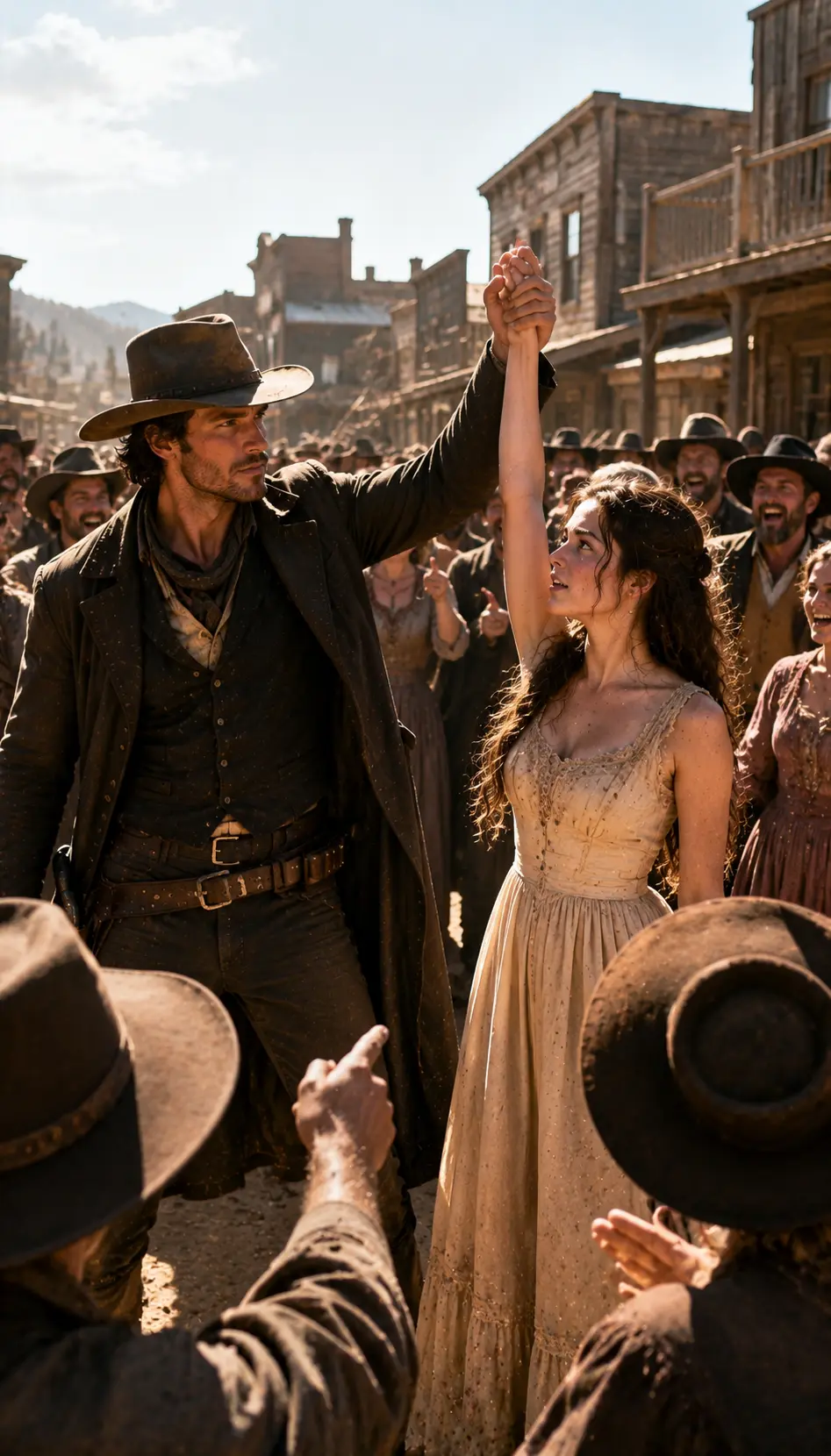
Cashion raised her hand high enough for every soul in the square to see. His grip was not possessive. It was steady. A public answer to a public humiliation.
“This woman is under my protection,” he said, loud and clear. “And if she chooses it, I will call her my bride before I let any of you treat her like dirt again. You want to run your mouths now, you do it to me.”
The silence was thunderous.
No one laughed.
No one stepped forward.
No one wanted to test whether Cashion Layton meant what he said.
The crowd began to peel away in pieces. A man coughed. A woman muttered something about supper. The clerk retreated into the general store. Within moments, the square emptied as if shame itself had brushed the dust from the street.
Only when they were mostly alone did Cashion lower Clara’s hand.
He released it immediately, giving her back the choice he had borrowed in front of the town.
“You all right?” he asked, and his voice was gentler now.
Clara looked at him as if she could not decide whether he was real.
“You do not even know me.”
Cashion shrugged once.
“I saw a woman being treated like she was less than human. That was enough.”
She stared at him.
The force that had kept her standing seemed to leave her all at once. Her shoulders sagged, and she leaned back against the post behind her. For the first time, he saw how tired she was.
Not tired from one afternoon.
Tired from being brave too long.
“You need a place?” he asked.
Her lips parted, but no sound came.
Then she nodded once.
“I have a spare room at the ranch,” Cashion said. “Ain’t much. But it’s safe.”
Clara swallowed.
“I do not want charity.”
“It ain’t charity. It is shelter until you get your feet under you.”
She studied him carefully, as if searching for the hidden hook.
Most kindness had one.
After a long breath, she nodded again.
They rode out of Dry Creek without another word.
The ride to the Layton place was quiet, filled only by the creak of saddle leather, the clink of harness rings, and the rustle of dry grass brushing the horses’ legs. Clara rode behind him on the gelding with both hands gripping the saddle as if she expected the ground to vanish beneath her. Cashion did not press her for answers. He did not ask who had hurt her, where she had come from, or what truth lay behind the rumors.
The town had already demanded too much of her.
He would not add himself to the list.
His ranch sat in a shallow valley west of the creek, with a windbreak of pines along one ridge, a barn with a sagging roof, a fenced pasture, and a two-room cabin with smoke curling from the chimney. It was not a grand place. It was a working place. Rough timber, hard ground, honest repairs, and a silence that did not judge.
Cashion helped her down from the horse.
She stepped slowly into the yard, looking around as if trying to decide whether the place could be trusted.
Inside, the cabin was warmer than it looked. A stove in the corner. A table with two chairs. A narrow bed in the main room that clearly belonged to him. A smaller room at the back, plain but clean, with a straw-stuffed mattress, a quilt, a basin, and a little window facing the pines.
“You can have this room,” he said.
Clara stood in the doorway and touched the frame with the tips of her fingers like it might vanish.
“Door locks from the inside,” Cashion added. “Nobody will bother you.”
She turned.
“It is warm.”
“I’ll get you stew.”
He started away, but her voice stopped him.
“Why did you say that in town?”
Cashion looked back.
“Say what?”
“That you would call me your bride.”
He paused.
The fire snapped quietly in the stove.
“They were not going to stop until someone gave them a reason.”
“Was it a lie?”
He met her eyes.
“Depends what you do tomorrow.”
The answer unsettled her. Not because it was bold, but because it was not a demand. It left the door open. It put the power where no one had put it in a long time.
With her.
That night, Clara lay awake on the straw mattress and stared at the ceiling while the stove breathed warmth through the cabin. Outside, the wind scraped pine branches against one another. Somewhere in the barn, a horse shifted. In the other room, Cashion moved quietly, then settled near the fire instead of taking the bed.
That, more than anything, made her eyes fill.
A man had brought her into his house, called her protected before a whole town, offered her a room, given her a lock, and asked for nothing.
She had come to Dry Creek hoping for a quiet life. Sew a few dresses. Mend shirts. Keep her head down. Outlive the rumors she carried from Wichita and the grief she had buried there.
She had expected suspicion.
She had expected hard winters.
She had expected hunger before kindness.
She had not expected a man like Cashion Layton.
The next morning, he came in from feeding the horses and stopped at the sight of her already boiling water over the stove. She had rolled up her sleeves. Her hair was braided. His coffee was ready, and a small pan of corn cakes sat warming by the fire.
“You cook too?” he asked.
She gave a faint smile.
“I do a little of everything.”
He pulled off his gloves slowly.
“Good. I could use the help.”
By the end of the week, Clara had mended two of his shirts, swept the barn, patched a torn saddle blanket, repaired the cuff of his winter coat, and helped him fix a broken fence line with wire and a stubbornness that made him stop underestimating the softness of her hands.
They ate together each night by firelight.
At first, the meals were mostly silent.
But silence with Cashion was different from silence in town. It did not accuse her. It did not wait for her to make a mistake. It simply sat beside her and let her breathe.
He never pressed her to speak.
When she did, he listened.
“I was a seamstress in Wichita,” she told him one evening, turning her tin cup between both hands. “After my father died, there was nothing left for me there.”
Cashion nodded.
“I lost mine in the war. Grew up in Arkansas. Worked my way west.”
She looked at him across the table.
“Do you always help strangers like that?”
“No.”
The answer came simple, without decoration.
For reasons she did not fully understand, that made her smile.
The next Sunday, he rode into town with her.
Heads turned as they entered Dry Creek. Whispers rose and fell along the boardwalk. The woman in the blue shawl disappeared into the mercantile the moment she saw them. Men who had laughed a week before suddenly found important business with their boots.
No one called Clara names.
No one touched her.
No one asked where she came from.
Cashion did not stand close enough to cage her. He simply walked beside her, carrying a sack of flour over one shoulder and letting the town understand what it had already been told.
She was not alone.
That changed everything.
Not at once.
Nothing true changes all at once.
But it changed the air around her.
At the ranch, days fell into rhythm. Clara rose early, cooked, sewed, kept accounts on scraps of brown paper, and slowly began to bring order into corners Cashion had long stopped seeing. She hung herbs from the rafters. Mended curtains. Scrubbed soot from the stove. Pinned patterns near the little window of her room. The cabin began to look less like a shelter and more like a place someone might want to return to.
Cashion noticed.
He noticed the way she hummed when she forgot herself. The way she stopped humming when she realized he could hear. The way she touched fabric like it was language. The way her eyes softened at the sight of a well-cut sleeve or a clean seam. The way she studied the shape of women in town, not with judgment, but with imagination, already seeing what cloth might become in her hands.
One afternoon, while riding the fence line, he climbed into the barn loft looking for a coil of rope and found her sketchbook tucked beneath a feed sack.
He should not have opened it.
He knew that.
But the cover had slipped, revealing a drawing of a dress so delicate and precise that his rough world seemed to stop around it. He turned one page. Then another.
Dresses.
Flowers.
Hats.
Children’s coats.
Notes in the margins. Measurements. Fabric ideas. Prices she could not afford. Dreams written small, as if she had trained herself not to take up too much room even on paper.
He put the sketchbook back exactly where he found it.
That evening, when Clara came to bring him water outside the barn, he handed her a folded paper.
“What is this?” she asked.
“Order form for fabrics.”
She blinked.
He nodded toward the barn loft.
“I saw enough to know you should open your own dress shop.”
Color rose in her cheeks.
“You looked in my sketchbook?”
“Accidentally. Then more than accidentally. I am sorry.”
Her fingers tightened around the paper.
“I cannot afford a shop.”
“I can.”
Her eyes lifted sharply.
“I do not want charity.”
“You told me that already.”
“Then why?”
“Because I want to.”
“That is not a reason.”
“It is for me.”
She looked away, but he stepped closer, stopping before he crowded her.
“You are strong. Smart. Better with cloth than most men are with horses. You deserve more than people whispering over your shoulder in somebody else’s store.”
Her voice cracked.
“Nobody ever said that to me before.”
His face softened.
“Well, I am saying it now.”
He lifted one hand slowly, giving her time to move away, and touched her cheek with the backs of his fingers. There was a question in the gesture. Not ownership. Not pressure. Just a quiet asking.
Clara leaned toward him.
So he kissed her.
Soft.
Sure.
As if it had been waiting in the silence between them all along.
They stood there while the sun dipped behind the hills, her hands resting against his chest, his arms careful around her like she was not fragile, but precious. For the first time in years, Clara did not feel like she was passing through someone else’s life.
She felt rooted.
Cashion did not take back what he had said in town.
And slowly, Clara began to believe he had never meant to.
A week later, she stood in the shade of the cottonwood behind the house, sorting blackberries into a pail. Juice stained her fingers. The branches scratched her wrists, but she did not mind. The quiet was good. Birds rustled overhead. Cattle moved low along the ridge. The world felt, if not healed, then at least willing to let her try.
Cashion had ridden out before dawn without saying much. He rarely said more than he needed to, but when he looked at her now, there was something steady in it, like he saw her without trying to turn her into someone easier to understand.
She heard hooves near sundown.
He came around the bend with a rolled canvas tied behind his saddle. Dust covered his coat. Weariness sat deep in his shoulders.
“You have been out all day,” she said, wiping her palms on her apron.
“Had to go into Bozeman.”
Her eyebrows rose.
“That is more than forty miles.”
He untied the canvas and handed it down to her.
“Picked this up from a German fellow who came through. Said he used to build storefronts back east.”
Clara unrolled it carefully.
Inside were hand-drawn plans, sharp lines and careful proportions. A plain structure with large windows, a porch awning, a front counter, shelves for fabric bolts, a fitting corner, and a back room for sewing.
Across the top, in neat script, it read:
Clara Ellison, Dressmaker and Millinery.
Her throat closed.
“I thought maybe,” Cashion said, suddenly looking anywhere but at her face, “you would want a place of your own. Not just a corner in someone else’s store.”
She held the plans against her chest.
“You did this for me?”
“I want to see you build something no one can take away.”
Her fingers shook on the canvas.
“You do not even know if I will stay.”
“I know you have not run.”
She stepped closer.
“I was going to leave after the frost,” she admitted. “Head south, maybe Colorado. Somewhere no one knew my name.”
His jaw tightened, but he only said, “You still could.”
“I do not want to.”
The wind stirred the grass between them.
“I have been thinking about what you said that day in town,” Clara continued.
He waited.
“I know you said it to protect me. But you did not take it back.”
“I did not want to.”
She reached out, her fingers brushing the back of his hand.
“What if I did not want you to?”
His hand closed around hers slowly.
“Then I would ask if you would take that name for real.”
Clara nodded once.
It was all she could manage.
Then she pressed her forehead to his chest.
He wrapped his arms around her, his chin resting gently against her hair.
“I do not need a ring,” she whispered.
“I will carve one anyway,” he said. “Walnut or juniper. Something that lasts.”
That evening, they sat beneath the porch awning with a pot of beans warming over the fire. She leaned against his side, and he rested one arm around her shoulders. The plans for the shop lay on the table inside, weighted down by his coffee cup so the wind would not take them.
“I will need a carpenter,” she said.
“There is one past Three Forks. Old man. Steady hands.”
“Think he will come this far if you ask?”
Cashion looked toward the darkening hills.
“I do not always get what I ask for. But I know how to work for it.”
Clara smiled.
Then went quiet.
“Will they ever stop talking?” she whispered.
Cashion tucked a loose strand of hair behind her ear.
“They will get bored.”
“And if they do not?”
“Let them. They cannot touch what we build.”
The fire popped.
The last light faded from the sky.
She breathed in pine smoke, warm earth, and the quiet presence of the man beside her.
For the first time in years, she believed him.
By early November, the wind off the Rockies turned sharp enough to bite. Clara traced chalk lines across muslin with stiff fingers while Cashion oiled hinges on the front door. The old widow on the south ridge sent a note asking for a winter coat for her grandson, the boy with the twisted leg. Payment offered: two hens and a sack of oats.
Clara read the note twice.
Then pulled down her thickest wool.
“He needs room at the knee,” she said. “If the leg does not bend right, a tight seam will hurt him.”
Cashion watched her.
“You know him?”
“I saw him once by the church steps. He tried to hide the limp.”
“Most folks do.”
She lowered the paper.
“Hide pain?”
“Hide anything that makes them think others will stare.”
That evening, while stew simmered low, Clara sat cross-legged on the floor sorting scraps. Cashion leaned against the wall and watched her fingers move.
“You always this quiet when you work?”
“I used to hum,” she said. “My mother said it helped the stitches stay even.”
“Why did you stop?”
She held a square of faded blue calico in her lap.
“Last time I did, I remembered her voice and could not finish the piece.”
Cashion crossed the room and sat beside her.
“What was she like?”
“Small. Fierce. Had a scar on her cheek from a needle snapping during a storm. Said it taught her to respect the thread.”
Clara looked down.
“She died the same winter my father did. I was nineteen. I buried them both myself. Winter earth is hard.”
Cashion placed a calloused hand over hers.
“I know.”
She turned her palm beneath his and laced their fingers together.
“Do you ever think about what it would be like if none of it had happened? No war. No loss. No town square. No running.”
“I used to,” he said. “But it does not hold. Makes the quiet now feel earned when I remember what came before.”
She leaned against his shoulder.
The warmth between them was quiet and sure.
Outside, frost clung to the fence rails. The barn creaked in the wind. Inside, the lamp burned steady, and Clara thought that maybe peace was not a place where nothing had ever gone wrong. Maybe peace was a place where wrong things were no longer allowed to rule.
Cashion rose early the next morning and loaded the wagon with lumber from the mill downriver. Clara stood on the stoop with her shawl pulled tight, watching him tie down the last plank beneath canvas.
“You sure you do not want me to come?”
“You have orders to finish.”
She stepped down and pressed a folded note into his coat pocket.
“That is the address of a woman near Gallatin. She embroiders faster than anyone I have met. If she is willing, I would like her help.”
Cashion unfolded the note, studied her careful script, then tucked it away.
“I will find her.”
He returned three days later with snow dusting his hat and smoke rising in long ribbons from the cabin chimney. Clara met him at the gate, cheeks flushed from cold.
“She said yes,” he told her, handing her a small bundle wrapped in oilcloth. “Wants to start next week.”
Clara’s face lit.
“I will ready the back room.”
They stood in the wagon’s shadow, breath clouding between them.
“I missed you,” she said.
He raised one eyebrow.
“You did?”
“I do not like sleeping without the sound of boots by the door.”
Cashion climbed down and kissed her slow and warm despite the cold.
“Then I will not go far again.”
The first beams for the shop went up two days later.
Clara stood in the snow with her hands tucked into her coat sleeves as Cashion and the carpenter lifted the frame into place. She did not speak. Did not direct. She simply watched her future take shape in pine, nail, sweat, and faith.
Not a dream hidden in a sketchbook.
Not a note written in a margin.
A real place.
A place with windows.
A place with her name.
That night, she traced the edge of the carved walnut ring on her finger while Cashion read beside the fire, one hand resting on her knee.
“I did not think life could be like this,” she said.
He looked up.
“What kind of life?”
“Steady. Safe.”
He reached across the space and took her hand.
“It is now.”
They went to bed without lanterns, letting the firelight fade gently against the walls. Snow fell outside without sound, covering the earth in a clean hush.
Inside, warmth held.
December came heavy and white.
The creek nearly froze along its edges. Wagon wheels were muffled by snow. The eaves sagged beneath ice. Clara stitched with fingerless gloves on, her breath misting some mornings before the stove caught. Yet the days had a rhythm that kept despair out.
Work.
Coffee.
Fabric.
Firewood.
Supper.
Plans.
Cashion spent most days hauling pine from the ridge and sawing it into boards with a focus that left little room for talk. Clara watched him through the window while hemming bonnets or tracing bodice patterns. There was a steadiness to his movements, like labor was the language he trusted most.
One evening after supper, she set aside her sewing.
“What did you think would become of this land when you first came here?”
Cashion leaned back, firelight catching the lines around his eyes.
“Did not think much beyond winter. Just knew I wanted a piece of ground that was mine.”
“Why this valley?”
“Water runs straight. Trees block the wind. Ground is kinder here than most.”
She nodded.
“It has been good to me too.”
He watched her a long moment.
“You still thinking of what comes next?”
Clara looked down at her hands.
“I think I want to stay here until my hair goes white and my hands give out.”
Cashion’s voice went quiet.
“Then I will build a bench for you to sit on and watch the fields come green every spring.”
She smiled.
“When I was little, I imagined marrying a man who worked with his hands. Someone who knew the land. I never imagined him building a shop for me.”
He chuckled.
“I never imagined standing in a dress shop watching a woman choose lace trims.”
“You will get used to it.”
“I expect I will.”
The shop had a roof by New Year, though the windows had not yet arrived. Clara set up a table anyway and tested how the morning light crossed the floorboards. She unrolled dark green calico and moved it from one corner to another until the light fell clean.
Cashion leaned against a beam.
“You choose your place like a rancher chooses pasture.”
She smiled without looking up.
“Cloth is just as particular as cattle.”
He stepped closer.
“You ever think about teaching?”
She paused.
“Teaching?”
“There are girls up by the creek who cannot read a seam if their life depended on it. Their mothers send them to the post with sleeves dragging.”
“I am not sure I know how.”
“You already do. Every time you show me where to nail a shelf or how to fold a pattern.”
She considered that.
“Maybe in spring.”
Two weeks later, the windowpanes arrived.
Mrs. Frell, a woman from the edge of town who had once sewn uniforms during the war, came to help. She had quick hands, a quiet mouth, and a face that understood more than it asked. Together, she and Clara hung fabric along the shelves, swept the floor, set the counter, arranged thread, needles, ribbons, lace, buttons, and bolts of cotton, wool, muslin, and calico.
Cashion carved the sign himself.
It read simply:
Ellison & Stitch.
On opening day, Clara wore a dress she had made from leftover plum wool. The sleeves were tidy. The collar edged with hand-tatted lace. Her hair was pinned cleanly, though one auburn strand escaped before noon. Cashion stood beside her in a pressed shirt and clean boots. He did not say much, but the way he looked at her spoke loudly enough.
By noon, three women had come in.
One needed a mourning veil.
Another asked about a wedding dress for spring.
The third walked around the room for several minutes, fingers brushing the fabric bolts before asking in a quiet voice if Clara could mend a christening gown that had belonged to her mother.
By sunset, Clara was still on her feet, cheeks flushed, hands ink-stained from taking notes.
When she finally locked the door, Cashion met her on the step.
“You did well.”
“I did not expect so many.”
“They saw you hold your ground. That matters.”
She rested her head briefly against his shoulder.
“I feel like I have been walking uphill for years. Today felt like the top.”
He took her hand.
“Then rest. You earned it.”
They walked back to the cabin in silence, boots crunching over the frozen path. That night, with the shop dark and the stove warm, neither spoke much of the past or future.
They did not need to.
The middle had become enough.
And it was theirs.
The thaw came slow that year.
March brought more sleet than sun, and the creek behind the cabin ran high and brown with melt. Clara kept to the shop most days, working by lamplight when clouds pressed low. Orders tripled. She took on two apprentices, Eva and Ruth, both quick-fingered, quiet, and hungry to learn something that might someday feed them.
Clara liked that she no longer needed constant talk to feel understood.
Cashion rose before first light to mend the upper pasture fence before the ground softened too much. He said little when he returned in the evenings, but the way he brushed mud from his boots outside the door before stepping in told her everything.
He respected the floors she scrubbed.
He respected the work she did.
He respected the life they were building.
One evening, after a long day of fittings and a stubborn hem that refused to lie flat, Clara found him on the porch sharpening his drawknife by lantern light. She sat beside him, wrapping a shawl around her shoulders.
“You ever think about what this place will look like in five years?”
He tested the blade against his thumb.
“If we are lucky, the roof will still hold and the cows will not eat your garden again.”
She smiled.
“I have been thinking about planting more than herbs this season. Squash. Beans. Maybe tobacco for dye if I can find good seed.”
“Ambitious.”
“I have help now.”
He wiped the blade clean.
“The shop made you taller somehow.”
She looked down at her lap.
“No. It made me steadier.”
They sat until the wind picked up, and she ducked her head against his shoulder.
Inside, the fire had burned low, but she did not tend it.
Instead, she said, “I want to marry you properly.”
Cashion set the knife aside.
“You sure?”
“I have been sure since the second week on this land.”
“You just did not say?”
“You just did not ask.”
He rose and crossed into the cabin. From the shelf above the hearth, he brought down a folded cloth bundle tied with twine. Clara untied it carefully.
Inside was a length of cream muslin, soft as lamb’s wool, and a small carved box. She opened it to find a brooch: pressed wildflower petals set beneath glass, ringed in simple metal.
“I found it in town,” he said. “Figured if you were going to wear anything, it ought to be something from this place.”
She held the brooch in her palm.
“You already gave me the only thing I ever wanted.”
“What is that?”
“A place to stay.”
He smiled a little.
“Then let us call the preacher from the basin. He owes me a favor.”
They married three weeks later in the clearing behind the shop.
The snow had finally melted from the cottonwood roots, and the creek had dropped enough to be heard without being feared. Eva and Ruth laid wild dogwood along the rail fence. Mrs. Frell brought a jar of preserves. Sheriff Dawes came because he claimed he happened to be passing through, though he wore his good coat and had clearly combed his beard.
Clara wore a dress she made from ivory broadcloth, with sleeves quilted by hand through long winter nights. The wildflower brooch rested at her collar. Cashion stood beside her in a clean shirt, her father’s old watch chain tucked into his vest pocket because she had pressed it there before the ceremony and told him it belonged in a life that kept time kindly.
No one spoke during the vows.
Not even the wind.
When the preacher finished, Cashion kissed her with both hands framing her face, as if she were the only thing in the world worth holding.
After the guests left, they walked through the pasture together, their boots leaving soft prints in new grass. She held his hand, and he did not let go once.
That night, with the window cracked open and frogs beginning their spring chorus, Clara turned toward him in the dark.
“I never thought my name would be spoken with kindness again.”
Cashion brushed her hair back.
“It will be every day you live.”
She pressed her forehead to his chest.
There was nothing more to say.
Years passed the way years do: slow in the living, swift in the remembering.
The shop grew. Eva and Ruth learned, married, moved on, and sent younger girls back to Clara when their own hands became too busy. Others came after them. Clara taught when she could, stitched when she needed, and always came home to a porch light left burning.
Cashion built a second barn, planted an orchard, repaired the creek bridge twice, and carved a cradle when the time came.
Their daughter was born on a summer morning just as the sun lifted over the ridge. Her first cry was strong, indignant, and alive. They named her Mercy because Clara said some blessings arrive late but still deserve to be named.
Mercy had Clara’s eyes and Cashion’s stubborn silence. Clara made her first dress from blue calico and stitched a tiny flower into the hem. Cashion held the baby like she was made of glass and refused to put her down for most of a week, until Clara finally laughed and told him the child would learn to walk faster if he allowed her feet to touch the earth someday.
They grew older on that land.
Not quickly.
Not dramatically.
Just honestly.
The house weathered but stayed warm. The shop stood firm through wind and gossip, through births, funerals, weddings, harsh winters, and springs that smelled of wet earth and new grass. The town changed around them. People who once whispered now came to Clara for christening gowns, mourning veils, wedding dresses, coats for children, curtains for new houses, and the kind of careful repairs that made old things last longer than anyone expected.
Some remembered the day in the square.
Most learned not to mention it.
Clara remembered.
Not with shame anymore.
With wonder.
Because the worst day of her life had not ended with ruin.
It had ended with a hand reaching for hers in front of everyone.
It had ended with a ride into a quiet valley.
A room with a lock.
Stew by the fire.
A man who did not demand her story before deciding she deserved shelter.
One Sunday many years later, Clara walked the fence line with Cashion at dusk, their hands linked between them. Mercy ran ahead through the grass, chasing moths in the amber light. The orchard behind the barn had begun to bloom. Smoke rose from the cabin chimney. The shop windows reflected the sinking sun.
Clara looked toward town, barely visible beyond the far ridge.
“Do you think they remember?” she asked.
Cashion followed her gaze.
“Who?”
“The people in the square.”
He was quiet a moment.
“Maybe.”
“And if they do?”
He squeezed her hand.
“Then let them remember how wrong they were.”
She smiled.
The wind moved through the grass, soft as fabric over a cutting table.
Cashion’s thumb brushed the walnut ring he had carved for her years ago, now worn smooth from time and touch.
“You know,” he said, “I meant what I said that day.”
Clara looked up at him.
“That you would call me your bride?”
“That you were under my protection.”
She stopped walking.
He turned to face her.
“But I was wrong about one thing.”
“What?”
“You did not need me to make you strong.”
Her eyes softened.
“No,” she said. “But I needed someone to stand still long enough for me to remember.”
He brought her hand to his lips.
Behind them, Mercy laughed in the fading light.
The valley held them in gold.
Love, Clara had learned, did not always arrive as thunder. Sometimes it arrived with dust on its boots and anger in its eyes because the world had been cruel one time too many. Sometimes it looked like a spare room, a lock on the inside, a fabric order form, a shop raised plank by plank against winter wind. Sometimes it looked like a man who could have ridden past but did not.
And sometimes, after years of being treated like a rumor, a woman finally heard her name spoken as if it belonged to something sacred.
Clara Ellison Layton never ran again.
Cashion never let go.
And the world, for all its hard edges, gave them peace.