The Schoolteacher Was Too Proud To Beg — So She Undid His Belt And Whispered, “Make Me Feel Worthy”
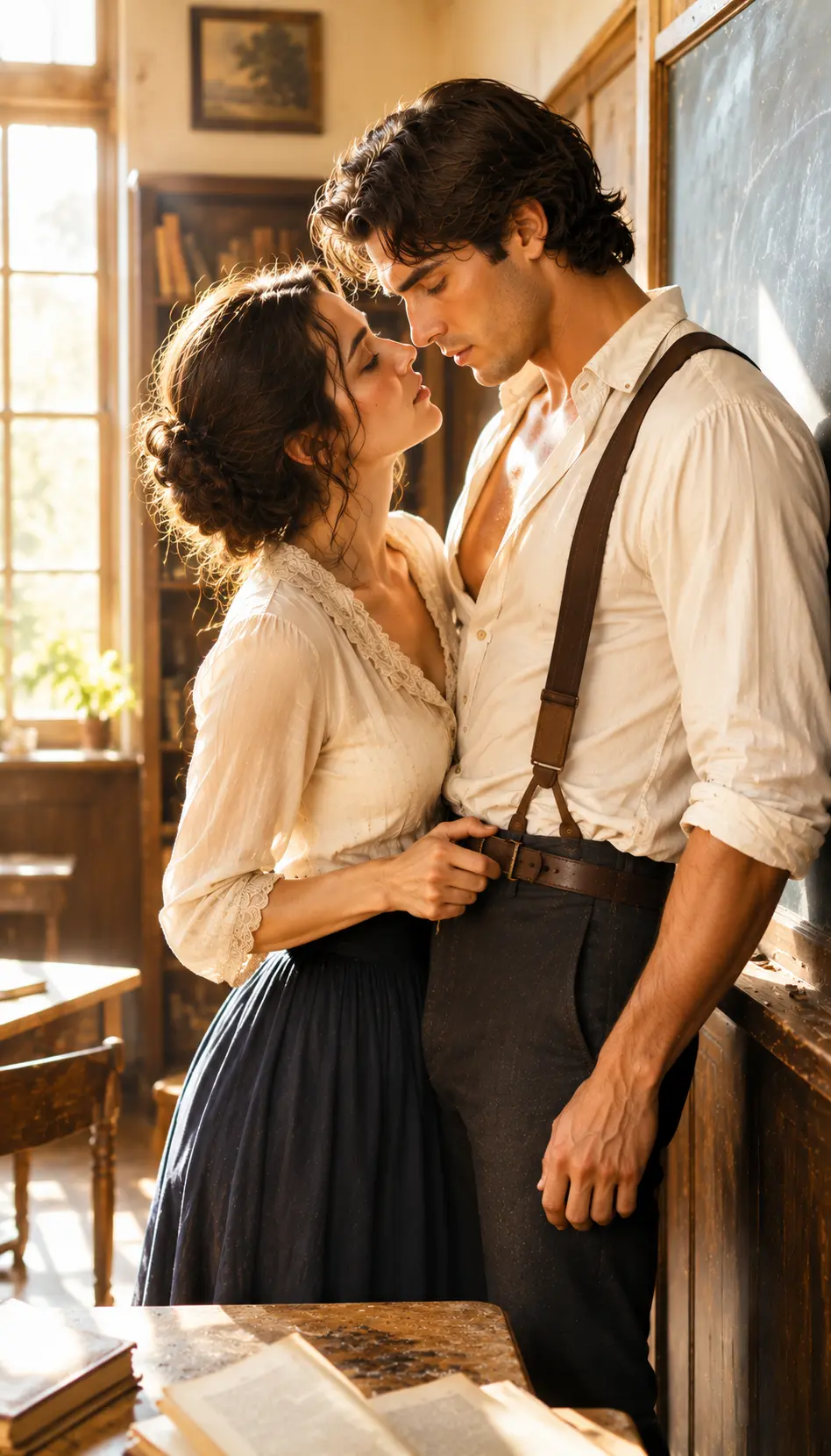
The morning sun burned across the dusty main street of Cedar Falls, turning every storefront, hitching post, and cracked window into a line of hard gold.
Eleanor Whitmore stood on the wooden steps of the one-room schoolhouse with her gloved hand resting on the railing, looking out over the town that had never truly welcomed her and yet had somehow become the place she refused to abandon.
Three years earlier, she had stepped off the stagecoach wearing a black dress, carrying two trunks and a reputation she had not earned. Back east, after burying her husband, people had spoken in soft voices that turned sharp as soon as her back was turned. They said a young widow with debts must have mismanaged the household. They said a woman who survived her husband with dry eyes was either cold or guilty. They said grief should look a certain way, move a certain way, collapse in a certain way, and Eleanor had disappointed them by remaining upright.
So she came west.
Cedar Falls promised distance. It promised work. It promised a place where a woman might start again if she kept her head down, taught children their letters, paid her rent on time, and did not ask too much of anyone.
But the West had its own rules.
And Cedar Falls, with its weathered church, two saloons, a general store, a sheriff’s office, a bank, and more gossip than mercy, had not been as different from the East as Eleanor once hoped.
Here they called her proud.
Too proud to remarry.
Too proud to accept invitations from men who thought a widow should be grateful for any attention.
Too proud to smile at every insult wrapped in concern.
Too stubborn to leave.
The word stubborn amused her most.
People used it when they wanted to shame a woman for having a spine.
That morning, as the bell rang and the children began to arrive, Eleanor smoothed the front of her dark wool dress and stepped inside. The schoolhouse smelled of chalk, dust, ink, sun-warmed wood, and the faint sweetness of the lavender sachet she kept in her desk drawer. Twenty-three children would soon fill the benches: farm boys in patched overalls, merchant daughters in faded calico, the banker’s son with his polished shoes and perfect posture, and several children whose lunch pails were lighter than they pretended.
Eleanor noticed everything.
She noticed when a child came to school hungry.
She noticed when a sleeve had been mended too many times.
She noticed when fear entered a room before the person carrying it spoke.
That was why, before the first lesson had even begun, she noticed the empty desk near the second window.
Thomas Morrison.
Tommy, as the smaller children called him.
He was usually early, sitting with his reader open, pretending not to care while secretly tracing each word with his finger as if the page might disappear if he looked away. He had a crooked smile, a stubborn cowlick, and a hunger for books that reminded Eleanor of herself before life taught her how expensive dreams could be.
His seat remained empty.
Eleanor turned toward the class.
“Good morning,” she said, her voice steady. “Open your readers to page thirty-seven.”
The children obeyed, but a strange tension moved through the room. They whispered when they thought she was writing on the board. They glanced toward Tommy’s empty desk, then toward one another, then back down at their books.
By noon recess, Eleanor could bear it no longer.
She called Mary Sullivan to her desk. Mary was small, freckled, and honest in the way children are before adults teach them that truth has consequences.
“Mary,” Eleanor said gently, “where is Thomas today?”
The girl looked at the floor.
“My pa says Tommy’s pa was found by Coyote Creek yesterday.”
Eleanor’s hand tightened around the piece of chalk she held.
Mary swallowed.
“He said it wasn’t an accident.”
For a moment the room blurred.
Eleanor had seen what violence did to towns. Not always on battlefields, not always in the open. Sometimes it entered through whispers, through locked doors, through men standing outside businesses pretending not to be afraid. She had left one life believing she had outrun the kind of grief that turns a community into a collection of frightened strangers.
But fear had followed her west.
It had only changed clothes.
“Thank you, Mary,” Eleanor said softly. “Go outside with the others.”
The child ran out, relieved to be released from the burden of knowing.
That afternoon, Eleanor dismissed class early.
The children scattered into the sunlight, their laughter brittle, too loud, too forced. Eleanor stayed behind, grading papers by lamplight while dust drifted in slow golden clouds through the air. Across the street, music and laughter spilled from the saloon. She rose and shut the window, choosing heat over the sound of men pretending nothing was wrong.
When she reached for her shawl, she heard voices outside.
She moved closer to the window.
Sheriff Watson stood near the edge of the boardwalk with several townsmen gathered around him. His thumbs were hooked in his belt, his hat low, his face set in the expression he wore whenever he wanted everyone to remember that he carried a badge.
“Can’t keep going like this,” one man muttered. “Morrison makes four this year.”
“You think it’s the Donnelly gang?” another asked.
Watson spat into the dirt.
“Could be. Could be someone else. Either way, we need men ready.”
“What about Hartwell?”
The name moved through the group like a cold draft.
Jed Hartwell.
Eleanor had heard it before. Everyone had.
He lived alone in the foothills beyond town, in a cabin half-hidden by sage and stone. A former Union soldier, people said. A man who had seen too much war and come back with too little soul. Children whispered that he haunted the hills like a ghost. Mothers warned sons not to ride too far toward his land. Men lowered their voices when telling stories about him, perhaps because they feared the stories were true, perhaps because they feared they were not.
Sheriff Watson’s mouth twisted.
“That man won’t help anyone. Hartwell’s got ice for blood. We’re better off without him.”
The men moved on.
Eleanor remained by the window long after they disappeared.
Ice for blood.
She had heard similar words used about herself.
Cold widow.
Proud woman.
Hard-hearted teacher.
People always gave cruel names to those whose pain they did not understand.
The next morning, several mothers gathered outside the schoolhouse before class. Their bonnets were tied tightly under their chins, their faces pinched with worry and judgment.
“Miss Whitmore,” Mrs. Henderson said, stepping forward, “perhaps it would be wise to suspend school until this unpleasantness passes.”
Eleanor stood in the doorway with her books pressed to her chest.
“Education does not stop because life becomes unpleasant,” she replied. “In difficult times, children need structure more than ever.”
The women exchanged glances.
They did not like her answer.
But they moved aside.
That was another thing they disliked about Eleanor Whitmore: she rarely asked permission to do what she believed was right.
By afternoon, Tommy Morrison returned.
He walked into the schoolhouse with shoulders too stiff for a boy his age. His face looked older than it had two days before. Eleanor did not call attention to him. She did not soften her voice in a way that would invite every child to stare. She simply placed a fresh piece of chalk on his desk and continued the lesson.
Sometimes silence was the only kindness that did not humiliate.
Days passed in a tense rhythm.
Lessons continued. Church bells rang. Wagons rolled through town. Men stood in doorways speaking in low voices. The saloon grew louder at night, as if noise might frighten fear away. Sheriff Watson began wearing importance like a second coat, heavier each day.
Then Eleanor met Jed Hartwell.
It happened at Garrison’s General Store on a morning thick with heat. She had gone to buy chalk, lamp oil, and a tin of tea she could not quite afford but had decided she needed. The bell above the door rang while she was counting coins on the counter.
The room changed.
Not loudly. Not dramatically.
But every body inside seemed to remember somewhere else it needed to be.
Garrison stopped wrapping her parcel. Mrs. Dunn, who had been examining ribbon, dropped it. A ranch hand near the flour barrels suddenly became fascinated by the floor.
Eleanor turned.
A tall man stood in the doorway, dust clinging to his coat, one hand resting near his belt but not on it. He had broad shoulders, dark stubble, and a face weathered by sun, wind, and some kind of sorrow that had long ago stopped asking for sympathy. His eyes were blue-gray and cold at first glance, but not empty. Never empty.
Jed Hartwell.
He moved slowly, scanning the room without seeming to look at anyone for long. That was what unsettled people most, Eleanor realized. Not that he appeared wild, but that he appeared aware.
“Coffee,” he told Garrison in a low voice. “Ammunition. Tobacco.”
His voice was rough, unused to unnecessary speech.
One by one, the others drifted out.
Eleanor stayed.
Not because she was brave in the foolish way people sometimes praised after danger had passed. She stayed because she refused to be chased from a store by the arrival of a man she did not know.
When she turned from the counter with her parcel, Hartwell stood in her path.
“Excuse me,” she said evenly.
He stepped aside, but only just enough.
As she passed, she caught the scent of leather, smoke, sage, and rain that had not yet fallen.
“You’re the schoolmarm,” he said.
She stopped.
“Miss Whitmore,” she corrected.
Something almost like amusement touched his mouth.
“Heard you’re teaching Morrison’s boy to read.”
“Among others.”
“Waste of time.”
Her spine straightened.
“Education is never a waste.”
“Boy needs to learn how to protect himself. The way things are going.”
“Reading is part of protection, Mr. Hartwell. A child who can read cannot be fooled as easily by men who rely on ignorance.”
His eyes sharpened.
“I’ve seen educated men act worse than beasts.”
“And I have seen people called beasts show more mercy than respectable men,” she replied before she could stop herself.
For the first time, Jed Hartwell looked at her fully.
Not past her. Not through her.
At her.
The store seemed to hold its breath.
Then he gathered his supplies, tipped his head once, and left.
The bell rang above the door.
Eleanor stood still long after it stopped moving.
She had expected rudeness. She had expected arrogance. She had not expected intelligence. She had not expected pain so carefully hidden that most people mistook it for cruelty.
Outside, thunder rolled somewhere beyond the hills.
Eleanor Whitmore did not know it yet, but her carefully ordered life, every rule, every wall, every polite distance she had built around herself, had just been touched by the one man in Cedar Falls everyone else was afraid to understand.
The scream came two weeks later.
It tore through the afternoon lesson like glass breaking in a church.
Eleanor dropped her chalk and ran to the window. A crowd had gathered on Main Street, circling someone on the ground. Several children rushed to the windows.
“Stay in your seats,” she ordered. “Martha Sullivan, you are in charge. Anyone who leaves this room will answer to me.”
Then she was down the steps and across the street before anyone could stop her.
At the center of the crowd lay Samuel Brennan, one of her older students, seventeen and long-limbed, with a face that had gone pale beneath the dust. His shirt was torn near the ribs and dark with injury. His breathing came shallow and fast.
“What happened?” Eleanor demanded, dropping to her knees.
“Found him near the water tower,” Jake Morrison said, his voice shaking. “Some drifters jumped him. Took the horses.”
Eleanor pressed her handkerchief against Samuel’s side. It was not enough. She knew immediately it was not enough.
“Fetch Dr. Holbrook.”
“He’s out at Hendrick’s ranch,” someone said. “Won’t be back till morning.”
Eleanor looked up.
“Then get Hartwell.”
The name struck the crowd like a gunshot.
Sheriff Watson stepped forward.
“Now, Miss Whitmore—”
“He was a battlefield medic,” she snapped. “He knows wounds. Unless you prefer to stand here discussing pride while a boy dies in the dirt.”
Watson’s jaw tightened.
No one moved.
Eleanor stared at the faces around her. Men who boasted in saloons. Men who spoke of defending the town. Men who wore courage loudly until courage required action.
“Fine,” she said, rising. “I’ll go myself.”
“Miss Whitmore, you can’t ride out there alone,” Mrs. Henderson gasped.
“Then someone may come with me.”
No one met her eyes.
Eleanor’s mouth hardened.
“Of course.”
Within minutes she was in the saddle, skirts gathered, hair coming loose beneath her hat, riding toward the foothills as the sun beat down and dust rose behind her.
The road to Hartwell’s cabin wound through rough country, dry creek beds, sagebrush, rock, and stretches of silence where even the birds seemed cautious. By the time she reached the foothills, sweat had soaked through the back of her dress and her hands ached from the reins.
The cabin appeared around a bend: rough logs, stone chimney, a lean-to for wood, and a porch shadowed by the afternoon sun.
A rifle barrel glinted from the window.
“That’s far enough,” a voice called.
Eleanor raised both hands.
“It’s Eleanor Whitmore. I need your help.”
A pause.
Then the door opened.
Jed Hartwell stepped out with the rifle still in his hand.
“You’re a long way from town, Miss Whitmore.”
“Samuel Brennan is injured. Badly. The doctor is gone. They said you served as a medic.”
His eyes narrowed.
“They say a lot of things.”
“Then prove the useful part true.”
Something flickered across his face.
She took one step closer.
“If you intend to refuse, say it now. I will ride back and do what I can with boiled water and prayer, but I would prefer not to watch a seventeen-year-old boy die because grown men are afraid of your reputation.”
For a long second, he did not move.
Then he lowered the rifle.
“Wait here.”
He disappeared into the cabin and returned with a worn leather satchel.
“Let’s go.”
They rode hard back to town.
He did not speak. She did not ask him to.
When they arrived, the crowd parted as if Hartwell carried a storm around him. Even Sheriff Watson stepped back.
Jed knelt beside Samuel. His hands changed the moment they touched the work. They were no longer the hands of a feared hermit. They were careful, precise, practiced.
“Clean water,” he said. “Whiskey. Bandages. Hold him still.”
Eleanor obeyed, bracing Samuel’s shoulders while Jed cleaned and bound the wound. The boy cried out once, then sagged in exhaustion. Eleanor kept her voice low near his ear.
“Stay with us, Samuel. Breathe. That’s it. Breathe.”
Jed worked without panic.
When he finally tied the bandage and sat back, his face was grim but steady.
“He’ll live if the wound stays clean and fever doesn’t take him.”
Eleanor exhaled shakily.
“Thank you.”
He met her eyes.
“Don’t thank me yet.”
Their gaze held longer than it should have.
Then Sheriff Watson cleared his throat.
Jed stood slowly.
“The boy pulled through,” he said, loud enough for the crowd to hear. “But if this town keeps pretending fear is a strategy, there will be more graves.”
Watson scowled.
“You giving orders now?”
“No,” Jed replied. “Just telling the truth.”
Then he turned toward his horse.
“Mr. Hartwell,” Eleanor called softly.
He paused.
“Thank you,” she said again.
He looked back, and for one brief moment the hardness in his face loosened.
“Boy needed help. That’s all.”
Then he rode away into the falling dusk.
That night, Eleanor sat alone at her desk long after the lamp burned low. Her hands still smelled faintly of soap, iron, and fear. Her mind would not release the image of Jed Hartwell kneeling in the dust, saving a boy while half the town watched helplessly.
Two days later, Samuel was sitting up, weak but alive.
When his mother came to thank Eleanor, Eleanor simply said, “Thank him.”
And that afternoon, she did something that shocked even herself.
She packed a basket with bread, preserves, and a worn copy of Leaves of Grass, then rode toward the foothills.
Jed was splitting wood when she arrived. He wore no coat despite the heat, and his forearms were marked with old scars. At the sound of her horse, he reached for his shirt.
“Miss Whitmore.”
“I brought something.”
“I told you I don’t need thanks.”
“You told me the town owes you nothing,” she said, dismounting. “I am not the town.”
She placed the basket on the porch.
“This is called gratitude. You may practice accepting it.”
He looked at her for a long moment.
“You always this stubborn?”
“Only when I’m right.”
His mouth twitched.
She held out the book.
“I also brought this.”
He stared at it suspiciously.
“You said educated men can behave worse than beasts. I thought you might like to read Mr. Whitman’s opinion on the complexity of mankind.”
“You assuming I can read?”
“I am assuming a man who writes medical notes in perfect spelling has hidden depths.”
For the first time, something like amusement entered his eyes.
“You’re not what I expected.”
“Neither are you.”
She turned to leave before her heart did something foolish on her face.
“Good day, Mr. Hartwell.”
She rode halfway back to town before she realized she was smiling.
Days became weeks.
Samuel recovered. Tommy Morrison began reading louder in class. The town remained tense, its fear growing with every rumor of the Donnelly gang, every stranger passing through, every horse gone missing, every whisper of trouble beyond the creek.
And Eleanor found her thoughts straying more often than she wanted to the cabin in the foothills.
To the man who rejected praise but saved lives.
To the eyes that looked cold until one stood close enough to see the storm inside them.
So when she needed help again, she rode back.
The air that evening smelled of dust and coming rain. Jed was standing in the doorway when she arrived, as if he had known she would come.
“What is it this time, Miss Whitmore?”
“The children are afraid,” she said. “Their parents are afraid. Everyone is pretending the fear will pass if they look away long enough. I want you to teach them how to protect themselves.”
His expression hardened.
“No.”
“You haven’t heard all of it.”
“I heard enough.”
“They need to feel capable.”
“They need to feel safe,” he said flatly. “And there is no such thing.”
“Then teach them how to survive.”
He turned away.
“You don’t know what you’re asking.”
“Yes, I do,” Eleanor said quietly. “I am asking you to care.”
His shoulders went rigid.
For a heartbeat, she thought he might shout.
Instead, he stepped inside and closed the door, leaving her in the dust.
She waited.
He did not return.
By the time Eleanor reached Cedar Falls, the first drops of rain were falling. When the storm broke, it washed dust from her face and hid the tears she refused to acknowledge.
Eleanor Whitmore had spent years building walls around her heart.
Jed Hartwell had cracked them with nothing more than silence.
She did not yet know if she hated him for it or if she was finally learning how to live again.
The next turning point came at night.
Eleanor had rented a small room above the milliner’s shop. It was narrow, clean, and lonely, with a stove in one corner, a bed against the wall, a washstand, and one window facing the alley. She had just finished marking spelling papers when she heard footsteps on the stairs.
Slow.
Heavy.
Not the steps of Mrs. Bell, who owned the shop below.
Eleanor stood and reached for the iron poker beside the stove.
The handle turned.
The door opened.
Sheriff Watson stood in the doorway with rain on his hat and whiskey on his breath.
“Evening, Miss Whitmore.”
Eleanor’s fingers tightened around the poker.
“Leave.”
He smiled in a way that made her skin go cold.
“Now, no need to be unfriendly. Town’s been patient with you.”
“You are not welcome here.”
He stepped inside anyway.
“You want to keep your position, you might learn how things work in Cedar Falls.”
Eleanor raised the poker.
“Take one more step and you will regret it.”
His smile thinned.
The next moment happened fast. Too fast for fear to make a plan.
He reached.
She swung.
The poker struck his arm. Watson cursed and stumbled back. Eleanor did not wait. She ran past him, down the stairs, out into the rain-dark street. He shouted after her, but she kept running.
She ran beyond the last storefront.
Beyond the church.
Beyond the edge of town.
The mud sucked at her shoes until she lost one, then the other. Her stockings tore. Her breath came ragged. The foothills rose black against the sky.
Only one place felt even remotely safe.
Hartwell’s cabin.
She reached it soaked, barefoot, shaking, and slammed her fist against the door.
It opened with a rifle in hand.
Jed’s face was hard for half a second.
Then he saw her.
“Eleanor.”
Her name in his voice almost broke her.
“Watson,” she gasped. “He tried to force his way in. I got away.”
Without another word, Jed pulled her inside and barred the door. He checked the windows, then turned back to her.
“Did he hurt you?”
“No. I ran.”
“Good.”
His voice was low and controlled, but there was a dangerous stillness in his eyes.
He brought a basin, clean cloth, and water warmed on the stove. Then he knelt and washed the mud and grit from her feet with a care so gentle it made her throat ache.
“You ran here barefoot,” he said.
“I had shoes. The road kept them.”
He did not smile.
Not then.
He bandaged her feet, gave her coffee, and placed a blanket around her shoulders.
“You can’t go back tonight,” he said. “You’ll take the bed.”
“I cannot put you out of your own bed.”
“You’re not.”
He reached for his rifle and moved toward the door.
“I’ll keep watch.”
“Jed.”
He stopped.
It was the first time she had said his given name.
Something passed between them, quiet and enormous.
“You do not have to sit in the rain for me,” she said.
“Yes,” he replied. “I do.”
That night, Eleanor lay in his bed, exhausted beyond thought. Through the crack in the door, she could see him on the porch, a dark shape in the rain, broad shoulders still, rifle across his knees, guarding her like a fortress.
For the first time in years, she slept without fear.
When she woke, sunlight streamed through the window.
Jed was sitting at the table reading the book she had given him.
“Whitman,” he said without looking up. “He writes about containing multitudes.”
Eleanor sat slowly, the blanket sliding from her shoulders.
“And what does that mean to you?”
He looked up.
Something soft moved behind the storm in his eyes.
“Maybe it means a man can be broken and still be good. Both sinner and savior. Depends which side wins each day.”
Eleanor’s lips parted, but no answer came.
He poured her coffee.
For a while they sat in silence, and for once silence did not feel like absence. It felt whole.
“I cannot go back,” she said finally. “Not to that room. Not with Watson still wearing a badge.”
“No,” Jed agreed. “Men like him don’t stop because a woman says no. They stop when consequences find them.”
“What am I supposed to do? One woman against a town full of men too frightened to speak?”
Jed studied her.
“You have more steel than any of them.”
“Steel does not pay rent.”
“No,” he said. “But it can cut through rot.”
She stared at him.
“What are you saying?”
He stood.
“I’m saying I’ve watched Cedar Falls rot from fear long enough.”
That afternoon, they rode into town together.
The whole street went silent.
Watson stood outside the sheriff’s office with his wounded arm held stiffly at his side. His face darkened when he saw them.
Jed dismounted slowly.
“Morning, Sheriff,” he called. “Heard you paid Miss Whitmore a visit last night.”
Watson tried to sneer.
“Just a friendly call.”
“There was nothing friendly about it.”
Eleanor remained on the boardwalk, chin high, every eye in town shifting between her and the sheriff.
Jed did not draw a weapon. He did not need to.
He simply stood close enough for Watson to understand that the town’s silence no longer protected him.
“You will resign,” Jed said. “You will leave Cedar Falls. Today.”
Watson’s hand twitched.
Behind the saloon window, men watched. Behind curtains, women watched. Outside the schoolhouse, older students watched.
And then something remarkable happened.
Mrs. Henderson stepped forward.
“I heard him threaten Miss Whitmore last month outside the store,” she said, voice trembling but clear.
Garrison came out of the general store.
“He’s taken more from folks than he had a right to.”
Jake Morrison removed his hat.
“My pa went to him twice before he died. Watson did nothing.”
Another voice followed.
Then another.
Fear, once cracked, began to split open.
Watson looked around and saw not a town behind him, but a town finally seeing him.
By sunset, he was gone.
No grand battle. No heroic bloodshed. Just a coward riding out beneath the weight of truths people had finally dared to speak.
When Jed turned back, Eleanor stood on the boardwalk with her heart pounding so hard she felt it in her throat.
“You did not have to do that,” she said.
“Yes,” he replied. “I did.”
“People will talk.”
“They’ve been talking since the day you stepped off that stagecoach.”
Despite everything, she laughed softly.
“You are impossible.”
“Maybe.”
His eyes held hers.
“But you’re safe.”
And for the first time in a long time, Eleanor believed the word.
Life did not become simple after that.
Stories rarely become simple when truth enters them.
Eleanor lost her official position at the school after the town council claimed scandal had made her presence “difficult.” Everyone knew the real reason: she had made too many men uncomfortable and too many women brave.
But parents kept sending children to her anyway.
At first, three came to the back room of the church with readers under their coats. Then seven. Then fourteen. Eventually even the council stopped pretending not to notice. Eleanor taught wherever she could: in the church hall, under the shade behind the store, later in a rebuilt schoolhouse funded not by the men who once controlled the town, but by families who had seen what her courage cost.
Jed did not become beloved overnight.
People are slow to release the monsters they have invented.
But after Watson left, after Samuel lived, after Jed helped organize night watches and taught older boys and girls how to stay calm under pressure, after he rode out twice to warn ranches of danger and once carried a sick child through a storm to Dr. Holbrook, the whispers changed.
Not all at once.
But they changed.
The hermit became Hartwell.
Then Mr. Hartwell.
Then, to a few children brave enough to test him, Jed.
He still lived in the foothills, but Eleanor visited more often.
Sometimes she brought books. Sometimes bread. Sometimes nothing but herself.
They sat on his porch while the sky turned violet and the desert wind moved through sage. He told her fragments of the war, never too much at once. She told him about her husband, about debt, about the cruelty of people who believed grief should make a woman obedient.
Jed listened as if every word mattered.
That was what undid her most.
Not his strength.
Not his reputation.
His listening.
One evening, she found him reading aloud from Whitman, stumbling over a line, annoyed at himself.
“Again,” she said.
He gave her a dark look.
“Teacher’s habit.”
“Student’s pride.”
He stared at the page, then read the line again.
Better.
She smiled.
His face softened.
“You look different when you smile,” he said.
“So do you.”
“I wasn’t smiling.”
“You almost were.”
“That is a dangerous accusation.”
She laughed.
The sound settled around them like lamplight.
Months passed.
Cedar Falls changed because Eleanor refused to leave and Jed refused to remain a ghost.
When spring floods came, the creek rose fast and mean, swallowing low roads and trapping two families near the south bend. Eleanor organized food, blankets, rope, wagons, lanterns. Jed rode into the rising water with three other men and came back with a child wrapped in his coat and an old woman clinging to him like he was the last solid thing in the world.
After that, even those who feared him struggled to dislike him.
The town had needed a villain for years.
It turned out it had needed a man willing to return from exile even more.
One evening after the floods, Eleanor stood outside the small house that had once been Jed’s cabin and was slowly becoming something larger. A second room had been added. A proper table stood inside. Her books occupied one shelf. His medical satchel hung near the door. There were two mugs by the stove instead of one.
The sunset bled orange and rose across the desert.
Jed came up behind her and stopped close enough that she could feel his warmth without being trapped by it. He had always been careful that way. Every touch offered, never taken.
“Remember the first time we met?” he asked.
“At Garrison’s store?”
“You told me education separates us from animals.”
“You told me animals had more mercy than most men.”
He gave a low chuckle.
“Maybe we were both right.”
She leaned back slightly, and his arms came around her waist.
For a while they watched the light fade.
“I used to think pride kept me safe,” Eleanor said.
Jed lowered his head near her hair.
“Did it?”
“No. It kept me lonely. But loneliness felt less frightening than needing someone who might fail me.”
His arms tightened, barely.
“You do not have to be proud with me.”
She turned to face him.
“And you do not have to be beyond saving with me.”
His jaw shifted.
“I used to think peace was for men who came back cleaner than I did.”
“You came back alive.”
“That was not always the same thing.”
She touched his face, her thumb grazing the line beside his mouth.
“What changed?”
He looked at her with all the guardedness gone from his eyes.
“You came to my cabin and demanded I care.”
A laugh trembled out of her.
“I did, didn’t I?”
“You did.”
“And did it work?”
He took her hand and pressed it to his chest.
“I had been caring all along. I just hated myself for it.”
Her throat tightened.
“Jed.”
He smiled faintly.
“You brought me books, Eleanor. Bread. Trouble. A town I didn’t want. A reason to stop hiding. You gave me back something I thought was gone.”
“What?”
“Worth.”
Her eyes filled.
He brushed one tear from her cheek with a tenderness that would have shocked anyone who still believed the old stories about him.
“You once told your students that worth is not given by other people,” he said. “You said it is chosen. Practiced. Lived.”
“I was trying to sound wise.”
“You succeeded.”
She rose on her toes and kissed him, slow and certain.
Outside, the desert wind carried the scent of sage and rain. Inside, lamplight flickered across the room they were building together, a room filled with books, scars, coffee, quiet laughter, and the kind of love that did not ask permission from anyone who had once judged them.
Years later, people in Cedar Falls would tell the story differently depending on who was speaking.
Some would say the proud widow teacher saved the town by refusing to bow.
Some would say the haunted soldier came down from the hills because one woman was brave enough to knock on his door.
Some would say Sheriff Watson’s fall began the day Eleanor Whitmore raised an iron poker and chose survival over silence.
Some would say it began earlier, the day Jed Hartwell knelt in the street and saved a wounded boy while cowards watched.
But Eleanor knew the truth was quieter.
It began in a store, with two wounded people insulting each other honestly.
It continued on a ride through dust.
In a boy’s shallow breath.
In a basket of bread left on a porch.
In a book passed from one lonely soul to another.
In a woman running barefoot through the dark and finding a door that opened.
In a man who thought he had ice for blood discovering that what he had was grief, frozen only because no one had ever stayed long enough to warm it.
Cedar Falls did not become perfect.
No town does.
There were still arguments, debts, storms, foolish men, frightened women, hungry children, hard winters, and mornings when the dust returned as if nothing had changed.
But something had changed.
The children learned to read.
The town learned to speak.
Jed learned to stay.
Eleanor learned that strength did not require loneliness.
And every time she stood before her students, chalk in hand, she no longer felt like a woman defending herself against the world.
She felt like a woman who had chosen her worth.
Not because a town finally approved of her.
Not because a man loved her.
Not because danger disappeared.
But because she had walked through judgment, fear, grief, and shame and had come out still able to teach, still able to love, still able to stand in the doorway of a schoolhouse with the morning sun on her face and say, in a voice calm enough to guide the frightened and strong enough to challenge the cruel:
“Open your readers. We are not finished learning yet.”