Lone Rancher Bought Her From Her Parents — But He’d Secretly Loved Her for 7 Years
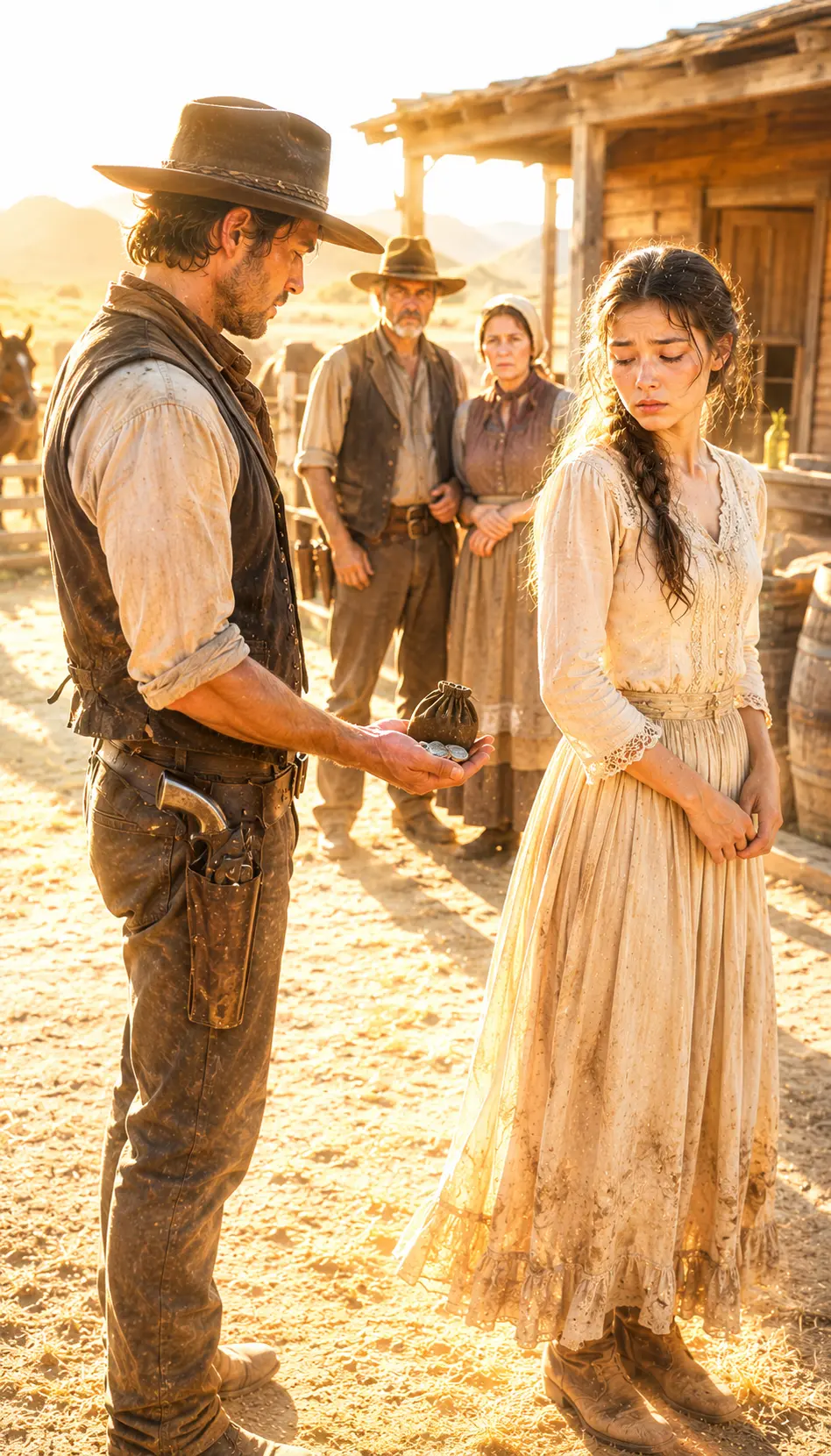
“Your daughter for your debt. Sign here.”
The paper landed on the desk like a sentence no one in that room had the courage to call by its real name.
Evelyn Mercer stood in the doorway of her father’s study, still holding the stair rail behind her as if the wood could keep the floor from vanishing beneath her feet. She was twenty-two years old. Old enough to understand money, shame, hunger, and the quiet way a desperate man could ruin a house one card game at a time. Old enough to know her father had been gambling again. Old enough to know the silence that morning was not peace.
But she was not old enough to believe that a father could look at a piece of paper, see his daughter written between its lines, and reach for a pen without hesitation.
Joseph Mercer’s hand trembled.
Not enough to stop him.
Across from him sat the stranger.
Caleb Grayson did not look like a monster. That was the worst part. Monsters were supposed to announce themselves with a cruel smile, a loud voice, a hand that reached too fast. This man was quiet. Broad-shouldered. Dark-haired. Expensive boots polished with road dust still clinging to the edges. His gray eyes stayed on the document for a moment before lifting to meet hers, and there was something in them Evelyn hated immediately.
Not hunger.
Not victory.
Measurement.
As if he had already seen the whole room, everyone in it, and every lie hiding under every polite word.
Evelyn lifted her chin.
She had learned young that if she could not stop people from hurting her, she could at least deny them the pleasure of watching her fold.
Her stepmother, Margaret, stood near the wall with her arms crossed, face smooth as a frozen pond. Margaret had never shouted when she could wound more deeply with calm. She looked almost relieved, as if this meeting were no uglier than arranging the sale of old furniture.
“Come in, Evelyn,” her father said.
His voice was hoarse.
She did not move.
“What is this?”
No one answered quickly enough.
That told her everything.
Caleb Grayson rose from his chair. He was taller than she expected, but he did not come closer. He kept distance between them, careful and deliberate, as if approaching a frightened horse.
“Your father owes me money,” he said.
Evelyn almost laughed.
“My father owes everyone money.”
“Twelve thousand dollars,” Caleb replied. “Plus interest.”
The room went silent.
Twelve thousand.
It was not a number. It was a collapse. It was the farm, the house, the furniture, her father’s name, and every scrap of dignity left in the Mercer family, all laid out on a gambling table and lost.
Evelyn looked at Joseph.
He could not meet her eyes.
“There is an arrangement,” Margaret said, impatient now. “Mr. Grayson has agreed to settle the debt.”
Evelyn’s gaze dropped to the document.
Then to her father’s hand.
Then back to Caleb.
“And what exactly is being arranged?”
Her father’s mouth opened. Nothing came out.
So Caleb answered.
“You.”
The word did not make sense at first. Her mind refused it. It tried to rearrange it into something less impossible. Employment. Escort. Protection. A misunderstanding.
But Margaret’s expression did not change.
Her father looked like a man already begging forgiveness for something he had not stopped himself from doing.
Evelyn’s blood turned cold.
“You’re buying me.”
Caleb’s jaw tightened.
“No.”
“What would you call it?”
“A way out.”
“For whom?”
“For you.”
That was when she laughed, sharp and humorless.
“Do not insult me with kindness after putting a price on my head.”
Her father flinched as if she had struck him.
“Evelyn, please.”
She turned on him.
“Please what? Smile? Pack politely? Thank the man who negotiated for me like cattle?”
Margaret clicked her tongue.
“Don’t be dramatic.”
Evelyn stared at her stepmother.
For years, Margaret had made a religion out of shrinking her. Smaller portions at dinner. Smaller room. Smaller voice. Smaller dreams. Evelyn had spent half her life trying not to take up space in a house that had belonged to her mother first.
But this?
This was not shrinking.
This was erasing.
Caleb spoke again, quietly.
“Your father had another offer.”
Evelyn looked at him.
“What offer?”
Margaret’s lips pressed thin.
Joseph whispered, “Evelyn…”
“What offer?”
Caleb’s expression did not soften, but something in it darkened.
“Harold Beckman.”
The name fell into the room like a snake.
Evelyn stopped breathing.
Harold Beckman was sixty-three, wealthy, widowed twice, and the kind of man women avoided without needing to explain why. He smiled too long. Stood too close. Had a reputation people lowered their voices to discuss because naming evil too clearly made cowards uncomfortable.
“He wanted marriage,” Margaret said coldly. “It would have settled everything.”
Evelyn turned slowly toward her father.
“You were going to give me to Beckman.”
Joseph covered his face with one shaking hand.
“I was trying to keep you alive.”
“By handing me to him?”
“He was coming tomorrow,” Joseph said, voice breaking. “With papers, with a preacher if necessary. I could not stop him. Caleb arrived first.”
Evelyn looked at Caleb again.
The stranger who had seemed like the villain in the doorway now stood in the center of a nightmare with another shadow behind him.
“Why?” she asked him.
Caleb did not pretend not to understand.
“Because Beckman destroys women who have no one standing between him and them.”
“And you decided to stand between us?”
“Yes.”
“Out of charity?”
“No.”
The honesty in that single word unsettled her.
“Then why?”
Something moved across his face. Grief, maybe. Old grief, the kind that does not announce itself but lives in the bones.
“My wife tried to help a woman escape Beckman’s house three years ago,” he said. “They ran her carriage off the road. Sarah died before I could get to her.”
The room changed.
Even Margaret looked away.
Evelyn stared at him, but the anger in her had nowhere simple to land now.
Caleb took a folded receipt from the desk and held it out.
“I paid the debt before you entered this room. It is cleared whether you come with me or not. You are not part of the transaction.”
Her fingers refused to move.
“What?”
“Your father owes me nothing now.”
“Then what is that paper?”
“Proof that the debt is settled. Nothing more.”
Margaret’s face sharpened.
Joseph looked ruined.
Caleb laid the receipt on the desk and reached for his hat.
“I brought a horse for you. I leave in one hour. You may stay here. You may wait for Beckman. You may wait for the next man your father owes. Or you may ride out with me and decide what you want after you are beyond this house.”
“You expect me to trust you?”
“No.” His gray eyes held hers. “I expect you to survive long enough to decide whether I am worth trusting.”
Then he walked out.
Evelyn stood among the broken pieces of her life and realized the most frightening thing about Caleb Grayson was not that he might be lying.
It was that he might be telling the truth.
She packed in less than an hour.
There was not much to take. Two dresses. A worn shawl her mother had made before illness took the softness from her hands. A comb. A small tin of buttons. A book she had read so many times the spine had surrendered, a story about a girl who ran west and found freedom under a sky wide enough to forgive her.
Freedom.
Evelyn almost laughed when she placed it in her carpet bag.
Freedom had always been something that happened to other people. Men with horses. Women with money. Girls in novels whose authors loved them enough to write open roads instead of locked doors.
A soft knock came behind her.
“Go away, Margaret.”
“It’s me.”
Violet.
Evelyn closed her eyes.
Her stepsister stood in the hallway, dressed in blue muslin with lace at the cuffs, blonde hair pinned perfectly, eyes red from crying. Violet had always been the favored one. Not cruel in the way Margaret was cruel. Worse, sometimes. Silent. Lovely. Protected.
“What do you want?” Evelyn asked.
Violet swallowed.
“I didn’t know about Beckman until this morning.”
“You knew enough to stay away.”
“I know.”
The answer startled Evelyn more than a denial would have.
Violet stepped closer.
“Please go with Caleb Grayson.”
Evelyn laughed bitterly.
“Suddenly concerned?”
“I have always been concerned,” Violet said, and for once her voice had heat in it. “I just did not know how to be brave without losing the only safety I had.”
That landed too close to truth.
Evelyn looked away.
Violet’s eyes filled again.
“Mother treated you terribly. Papa ignored it. I ignored it. I told myself that if I said nothing, at least one of us would be safe. I was wrong.”
Evelyn’s throat tightened despite herself.
“You think Grayson is safety?”
“I think he is not Beckman,” Violet said. “And right now that may be enough.”
Outside, thunder rolled.
When Evelyn stepped onto the porch, Caleb was waiting at the end of the path, exactly where he said he would be. He had not come knocking. Had not ordered. Had not rushed. A sorrel mare stood beside his black gelding, saddled and ready, patient in the thickening air.
Her father appeared behind her.
“Eevee.”
The childhood name almost broke her.
Almost.
“I am sorry,” Joseph whispered.
She did not turn around.
“For losing the money? Or for discovering your daughter still had a price?”
His breath hitched.
“I loved your mother.”
“I know.”
“I failed her.”
“Yes.”
“And I failed you.”
Evelyn closed her eyes.
It would have been easier if she hated him completely. But love does not always die when respect does. Sometimes it remains, sick and thin, making grief out of anger.
“Goodbye, Papa.”
She walked down the steps.
Caleb dismounted when she approached. He took her carpet bag and tied it securely to the mare’s saddle. His hands were careful. Impersonal. He helped her mount without touching more than necessary.
“You can still change your mind,” he said.
“And go where?”
“Anywhere.”
The word sounded impossible.
Caleb looked toward the darkening western sky.
“It will take time to believe it. Being free.”
Evelyn looked back once.
The house sagged under the coming storm. Peeling paint. Crooked shutters. The window where her mother used to stand. Years of trying to be quiet enough, useful enough, grateful enough to be loved.
Then she faced forward.
The first rain struck her cheek.
She followed Caleb Grayson into the storm.
They did not outrun it.
The sky opened before sunset, turning the road to slick mud and the world to gray water. Caleb led them to a rocky outcrop where the horses could stand shielded from the worst of the wind. Evelyn slid from the saddle with legs so sore she nearly stumbled.
Caleb noticed.
“You hurt?”
“I am fine.”
“You are a poor liar.”
“I am fine enough.”
That almost made him smile.
Almost.
He unpacked bedrolls, hardtack, dried meat, and a small tin of coffee grounds wrapped in cloth. He worked efficiently, as if the storm were simply another task to manage. Evelyn watched him through the rain, still waiting for the moment when the mask slipped.
A man did not pay twelve thousand dollars for nothing.
Even decent men wanted something.
Especially decent men.
When they sat under the rocks with rain hammering above them, she finally asked, “What do you want from me?”
Caleb looked out across the wet prairie.
“Nothing tonight except that you sleep.”
“That is not an answer.”
“It is the only answer I can give without sounding like a liar.”
“You already sound like a liar.”
He accepted that with a small nod.
“Fair.”
Evelyn pulled her mother’s shawl tighter.
“What happens when we reach your ranch?”
“You get a room with a working lock. You get the key. You eat three meals a day. You rest. Then you decide what you want.”
“And if I want to leave?”
“I give you money and a horse.”
“And if I want to stay?”
“Then you stay.”
“As what?”
“As Evelyn Mercer,” he said. “Until you decide to be something else.”
The rain filled the silence between them.
She wanted to distrust him. She did distrust him. But his answers were so infuriatingly simple that they gave her no easy argument. He did not defend himself too much. Did not demand gratitude. Did not pretend this was normal.
He simply sat in the rain beside her and kept watch while she slept.
At dawn, he was still awake.
They rode to Guthrie Station and ate at a small hotel restaurant that smelled like bacon, biscuits, coffee, and salvation. Caleb ordered enough food for four. Evelyn ate like a woman trying not to show she had been hungry for years.
He did not comment.
That was another dangerous kindness.
Halfway through breakfast, she asked, “Why haven’t you remarried?”
Caleb’s fork paused.
“That is bold.”
“You paid my father’s debt and carried me halfway across Oklahoma Territory. I think I have earned bold.”
For a moment, he looked younger. Tired, but younger.
“I loved my wife,” he said. “When she died, I did not see the point in replacing her.”
“Three years is a long time.”
“Time does not heal everything. Sometimes it only teaches the wound how to sit quietly.”
Evelyn looked down at her plate.
That sounded like something she understood.
By the second evening, they reached Grayson Ranch.
It sat in a valley cut through endless prairie, with a creek shining like silver under the sunset and long grass moving in slow waves beyond the fences. The house was large but not grand, solid but plain, built by hands that valued shelter more than display. Smoke rose from the chimney. Lantern light glowed in the windows.
“Home,” Caleb said.
The word struck Evelyn strangely.
She had lived in houses all her life.
She had never entered one that felt like it wanted people to return.
A woman stepped onto the porch as they rode in. Older, sharp-eyed, with weathered brown hands and a face that suggested she had survived too much to be impressed by anyone.
“About time,” she called. “I was starting to think you got lost on land you own.”
Caleb dismounted.
“Storm slowed us down, Mrs. Chen.”
Mrs. Chen looked Evelyn over in one swift, thorough glance. Worn dress. Exhaustion. Guarded posture. The careful distance Caleb kept.
“I have the East Room ready,” she said. “Fresh linens. Lock on the door like he asked.”
Evelyn turned sharply toward Caleb.
He did not look smug. Only tired.
Mrs. Chen jerked her head toward the house.
“You hungry, girl?”
Evelyn’s stomach answered before she could.
Mrs. Chen snorted.
“Good. I made stew.”
The East Room had a real bed, a dresser, a small washstand, and a window overlooking the valley. It was not fancy, but it was clean. On the bedside table, in the shadow of the lamp, lay a book.
Evelyn froze.
She knew that cover.
She crossed the room and picked it up with shaking hands.
The story about the girl who ran west and found freedom.
Her story. Her secret wish. Her impossible little escape.
Inside the cover were initials written in faded pencil.
E.M.
Market Day, June 1869.
Seven years ago.
She remembered then.
Not clearly at first. A hot summer market. Her father arguing with a merchant. Evelyn lingering at a book stall she could not afford. A young man beside her asking whether the story was any good. She had spoken too freely because he was a stranger and strangers were safe when you believed you would never see them again.
She had told him the ending mattered. That the girl should not be rewarded with marriage if the whole story was about freedom. That love was only beautiful if it did not become a prettier cage.
She had forgotten his face.
He had kept the book.
At dinner, she confronted him.
Mrs. Chen placed stew before them, studied both faces, and wisely disappeared into the pantry.
“The book,” Evelyn said.
Caleb’s spoon stilled.
“You mentioned it once.”
“Seven years ago.”
“Yes.”
“At a market.”
“Yes.”
“Why do you remember that?”
He looked into his bowl for a long moment.
“Because you spoke about freedom like it was not an idea, but a hunger.”
The room seemed to become too warm.
He continued.
“Your father came over while we were talking. He was drunk. He said cruel things. Called you a burden. Humiliated you in front of everyone.”
Evelyn’s face went cold.
The memory returned all at once.
Her father’s voice. The laughter nearby. The way she had stared at the book stall and pretended each word did not cut.
“You watched?”
“Yes.”
“And did nothing?”
“I was twenty-four,” Caleb said quietly. “Not brave enough yet. Not wise enough. I told myself it was not my business. I have regretted that for seven years.”
Evelyn wanted to hate him for saying it.
Instead, she hated that she believed him.
“When I heard your father owed Beckman,” he said, “I knew exactly who was about to be handed over. Not some nameless woman in trouble. You.”
“That sounds like obsession.”
“It might.” He did not flinch. “Or guilt. Or unfinished decency. I do not know what name to give it. I only know I could not ignore it twice.”
She stared at him.
“Do you have a key to my room?”
He reached into his pocket, placed a brass key on the table, and slid it toward her.
“The only one.”
“You are sure?”
“I had Mrs. Chen watch the lock installed herself.”
Evelyn closed her hand around the key.
The metal was warm from his pocket.
“If you are lying to me,” she said, voice low, “I will burn this entire ranch down on my way out.”
For the first time, Caleb Grayson smiled fully.
“Fair enough.”
The days that followed did not heal her.
Healing was not so simple.
But they confused her.
Caleb did exactly what he said he would. He gave her space. Offered food. Offered choices. Never entered a room without knocking. Never asked for gratitude. Never touched her without warning. He showed her the ranch when she wanted to see it and left her alone when she did not.
Mrs. Chen fed her like she had made a private war against all the years Evelyn had gone hungry. She taught her how to knead bread, preserve beans, mend work shirts, read the weather in the smell of creek mud, and tell when a man was being a fool long before he admitted it.
“Caleb is a fool often,” Mrs. Chen said one morning, rolling dough. “But not usually a cruel one.”
“You trust him?”
“He married my daughter.”
Evelyn stopped.
Mrs. Chen did not look up.
“Sarah. She was mine. He loved her well. Lost himself when she died. I told him if he burned this house down, I would haunt him before Sarah got the chance.”
“I am sorry.”
Mrs. Chen’s hands slowed.
“So am I. Every day. But grief is not an excuse to become useless. He kept building. That counts.”
Evelyn thought about that for a long time.
Caleb began teaching her the ranch in small pieces. How to read ledgers. How to inspect a horse’s hoof. How to count cattle without losing track. How to spot a weak fence line from fifty yards away. He never said she needed to learn. He asked if she wanted to.
She almost always said yes.
Slowly, the ranch stopped feeling like a place where she had been placed.
It became a place she could move through.
Then Violet arrived.
She came in a hired wagon, dressed too well for the dusty road, face pale beneath her hat. Evelyn saw her from the laundry line and felt every old instinct rise.
“What do you want?”
Violet’s smile trembled.
“To talk.”
“No.”
“Please.”
Caleb stepped onto the porch, his gaze moving from Violet to Evelyn.
“Your call,” he said.
Those two words mattered.
More than he knew.
Evelyn allowed five minutes in the kitchen.
Violet did not waste them.
“The agreement is flawed,” she said, unfolding papers with shaking hands. “Papa found a lawyer. There may not have been enough witnesses. He thinks the debt transfer can be challenged.”
Evelyn stared at her.
“And then what?”
“You would come home until things are legally settled.”
Home.
The word was so absurd Evelyn almost laughed.
“You mean until he finds another buyer.”
Violet’s eyes filled.
“He is desperate.”
“He is always desperate. That does not make me currency.”
Violet pressed her lips together.
“I know.”
Evelyn looked at her carefully.
Something was different this time. Violet did not look polished. She looked frightened. Exhausted. Human.
“What are you not saying?”
Violet’s composure cracked.
“Papa gambled again. Worse than before. There is another man involved now, a lawyer named Whitmore. He wants to use the agreement to pressure Caleb for money. If Caleb refuses, he may try to force you back under Papa’s authority.”
Evelyn went cold.
Violet grabbed her hand.
“I am not here to bring you back. I am here to warn you.”
For a moment, all the years between them stood in the kitchen: resentment, silence, jealousy, survival. Then Evelyn saw the truth. Violet had been raised in the same house. She had simply been given a softer room in the same prison.
“Thank you,” Evelyn said.
Violet nodded, tears slipping down her cheeks.
“For what it is worth,” she whispered, “you look different here.”
“How?”
“Like you are finally allowed to take up space.”
After Violet left, Evelyn told Caleb everything.
His face hardened with every word.
“We need a lawyer,” he said.
“I am coming with you.”
“I was not going to ask you to stay behind.”
She blinked.
He glanced at her, that almost smile returning.
“I am learning.”
Their lawyer in Guthrie, Mr. Morrison, listened without interrupting. Then he gave them the truth: Whitmore’s case was weak but dangerous. Territorial law was messy. Evelyn was legally of age, but men with money had a way of making women’s choices look like confusion when those choices inconvenienced them.
“There is one clean solution,” Morrison said.
Caleb’s shoulders went tense.
“What?”
“Marriage.”
The office went still.
Evelyn felt her stomach drop.
Morrison continued carefully. “If Miss Mercer marries, her father’s authority becomes irrelevant. Whitmore’s case loses most of its force.”
“No,” Caleb said immediately.
Evelyn turned toward him.
He looked furious.
Not at her.
At the suggestion.
“No,” he repeated. “She has spent her life being pushed from one man’s control toward another. I will not let the law call that freedom because I put a ring on it.”
Morrison lifted both hands.
“I am only giving options.”
Caleb stood.
“Find another one.”
Outside, Evelyn sat on a bench in the cooling evening. Caleb joined her after a few minutes.
“Would you do it?” she asked.
“Marry you?”
“Yes.”
His answer came without hesitation.
“In a heartbeat.”
Her breath caught.
“But not like this,” he said. “Not because a lawyer cornered us. Not because fear made the decision. If I ever ask you to marry me, Evelyn, it will be when you are free enough to say no without losing anything.”
She stared at the street.
No man had ever valued her no before.
No man had ever protected her choice more fiercely than his desire.
That was the moment Evelyn began to understand that Caleb Grayson was dangerous to her for reasons that had nothing to do with fear.
He made freedom feel possible.
They built their case another way.
Caleb put her on the ranch payroll, officially. Not as charity. As wages for work she was already doing. Mrs. Chen testified in writing that Evelyn managed household accounts. Jack, the foreman, wrote that she helped track supplies, tended horses, and had become part of daily operations. Violet agreed to testify. Caleb gathered receipts. Morrison prepared arguments.
Then Beckman struck.
At first it was cattle.
A cut fence. Twenty head driven toward the property line. Caleb and the men rode hard and got most of them back, but he returned bruised, ribs aching, jaw set like stone.
“This is my fault,” Evelyn said.
Caleb turned on her sharply.
“No.”
“He is doing this because I am here.”
“He is doing this because he is a coward who cannot stand losing control.”
Days later, the barn burned.
Not all of it. Enough.
The fire came before dawn, orange and roaring against the blue-black sky. While Caleb and the men fought to save the horses, three men tried to enter the house.
Mrs. Chen placed a rifle in Evelyn’s hands.
“Can you use it?”
“My father taught me.”
“Good. Aim at the door and do not apologize.”
The first man touched the handle.
Evelyn fired through the lower panel.
He shouted and stumbled back. His companions dragged him away into the trees.
Her hands shook afterward.
But she did not drop the rifle.
By sunrise, the horses were safe, the barn half-ruined, and a note was nailed to a tree.
The girl or the ranch.
You do not get both.
Caleb read it once, tore it in half, and let the pieces fall into the mud.
“He thinks he is offering me a choice,” he said.
Evelyn’s voice was small.
“Isn’t he?”
Caleb looked at her then.
Really looked.
“No. Because I am not giving up either.”
That night, when fear should have driven her away, Evelyn realized the truth.
She did not want to leave.
Not because she had nowhere else to go.
Because this place had become hers in ways no paper had yet named.
The second attack came bolder.
Another fire. More men. More chaos.
This time Evelyn did not hide. She stood beside the front steps with a rifle and saw one of Beckman’s men trying to light the main house.
She fired low.
He fell, clutching his leg, the torch dropping harmlessly into the dirt.
“Move,” she said, rifle steady, “and I aim higher.”
He stared at her like she was the most frightening thing on the ranch.
Maybe, in that moment, she was.
By noon, the marshal had a confession. Beckman was arrested before sundown.
When Caleb returned with the news, Evelyn thought relief would come.
Instead, she began to tremble.
“I shot someone,” she whispered.
Caleb took her hands.
“You protected your home.”
The words entered her slowly.
Your home.
She looked around the kitchen. The table where Mrs. Chen taught her accounts. The shelves she had dusted. The stove where stew simmered. The door she had chosen not to run through.
“My home,” she said.
Caleb’s hands tightened gently around hers.
“Yes.”
The court hearing came two weeks later.
The courthouse in Guthrie was packed. People came because people always came when a woman’s dignity was put on trial and called law. Joseph Mercer sat near the front looking smaller than Evelyn remembered. Margaret beside him looked carved from ice. Whitmore stood polished and confident, the kind of man who believed language existed to disguise cruelty.
Judge Hammond presided.
A woman.
Stern-faced, silver-haired, with eyes that missed nothing.
That gave Evelyn the first breath she had taken all morning.
Whitmore painted her as naive. Easily influenced. A poor girl manipulated by a wealthy rancher into an improper arrangement. He spoke of protection while trying to make a cage sound respectable.
Morrison answered with facts.
Joseph’s gambling. Beckman’s threat. Caleb’s debt payment. The locked room. The only key. Evelyn’s wages. Her work. Her choice to remain.
Then came the witnesses.
Joseph claimed regret.
Margaret claimed concern.
A doctor spoke about women’s fragile judgment until Evelyn wanted to laugh in his face.
Then Mrs. Chen took the stand.
She did not smile.
“Evelyn Mercer is no fool,” she said. “She works hard, eats badly unless watched, reads faster than most men think, and does not trust easily because life taught her not to. If she says she chooses that ranch, she chooses it.”
Jack testified that she had helped defend the house. Miguel said she had stood firm while men twice her size ran. Violet, trembling but clear, told the court what the Mercer household had really been.
“My mother was cruel to her,” Violet said. “My stepfather ignored her unless he needed something. Beckman would have destroyed her. Mr. Grayson did not prey on my sister. He saved her life.”
Whitmore objected.
Judge Hammond overruled him.
Then Evelyn took the stand.
Her knees nearly failed as she sat, but Caleb was there in the first row, gray eyes steady, not rescuing her, not speaking for her.
Just believing she could speak for herself.
Morrison began gently.
“Miss Mercer, why did you leave with Mr. Grayson?”
Evelyn breathed in.
“Because staying meant being handed to Harold Beckman, and I would rather take my chances with a stranger than guarantee my own destruction.”
The room murmured.
She continued.
“Mr. Grayson gave me a room with a lock. He gave me the only key. He told me I could leave whenever I wished. He kept every promise he made.”
Whitmore rose for cross-examination with a smile that belonged in a room without honest air.
“Miss Mercer, you say you are free. Yet you live in Mr. Grayson’s house.”
“I live at Grayson Ranch,” she replied. “Mrs. Chen lives there. The ranch hands live there. Houses often contain more than one person.”
A few people coughed to hide laughter.
Whitmore’s smile thinned.
“You spend considerable time alone with Mr. Grayson.”
“He is teaching me ranch management. That requires conversation.”
“Or influence.”
“Teaching is not control, Mr. Whitmore. You should learn the difference.”
This time Judge Hammond did not hide her faint smile.
Whitmore tried harder.
“If this court orders you to return to your father until the debt matter is resolved, will you comply?”
The room went silent.
Evelyn looked at her father.
Then at Margaret.
Then at Caleb.
And finally back at the judge.
“No.”
A gasp moved through the courtroom.
Whitmore’s eyes flashed.
“You would defy a lawful order?”
“I would refuse to be property.”
Her voice grew steadier.
“I am twenty-two years old. I have been working, earning wages, learning a trade, and making my own choices. If this court decides I must be returned to a man who gambled me away like a poker chip, then I will leave this territory before I let it happen.”
Judge Hammond leaned forward.
“You understand what you are saying, Miss Mercer?”
“I do, Your Honor. I understand that obedience is easier to praise when someone else pays the price for it. I am done paying.”
No one moved.
Morrison stood again.
“One final question. Why do you want to remain at Grayson Ranch?”
Evelyn could have answered safely.
Employment.
Housing.
Independence.
Instead, she told the truth.
“Because it is the first place I have ever felt like a person instead of a burden. Because Caleb Grayson protects without owning. Because I have built something there that belongs to me. And because I love him.”
The last words left her before fear could stop them.
The courtroom erupted.
Judge Hammond slammed her gavel.
Caleb stared at Evelyn as if the whole world had gone silent except for her voice.
The ruling came the next morning.
Judge Hammond dismissed Whitmore’s case.
Evelyn Mercer was of age. Sound of mind. Living independently by choice. Caleb Grayson had acted protectively, not predatory. Joseph Mercer had no legal claim to drag his daughter back into the wreckage he had made.
Then the judge looked directly at Joseph.
“You should be ashamed.”
He lowered his head.
“And you, Mr. Whitmore,” she continued, “should be grateful I do not hold you in contempt for disguising extortion as concern.”
By the time the gavel fell, Evelyn was shaking so badly Caleb had to steady her.
“We won,” she whispered.
“We did.”
“I am free.”
“Yes.”
The word did not feel like a novel now.
It felt like breath.
Outside the courthouse, people surrounded them. Mrs. Chen hugged her so fiercely Evelyn could barely breathe. Violet cried openly and did not apologize for it. Jack clapped Caleb on the back hard enough to make him wince.
Caleb pulled Evelyn into a quieter corner.
“What do you choose now?” he asked softly.
The answer rose in her with no hesitation.
“You.”
His eyes changed.
She smiled through tears.
“I choose you. I choose the ranch. I choose the life we are building. Not because I have to. Because I can.”
He kissed her then, in front of half the town, and for once Evelyn did not care who watched.
That evening, back at the ranch, Caleb took her to the porch after supper. The valley lay gold under the setting sun, the creek catching light like a ribbon. He handed her a folded document.
“What is this?”
“Open it.”
Her hands trembled when she did.
A deed.
Half the ranch.
In her name.
She stared at the paper until the words blurred.
“Caleb…”
“I had Morrison draw it up weeks ago. I waited until after the ruling so you would know it was not leverage. Not pressure. Not a bargain.”
“You cannot give me half your ranch.”
“Our ranch,” he corrected.
She looked at him.
He stood very still, as if giving her space even now, even with his own heart on the table.
“I want you to have something no one can take from you,” he said. “Not your father. Not a court. Not me. If one day you choose to leave, that half remains yours.”
Evelyn laughed once, but it broke into a sob.
“You are impossible.”
“Likely.”
“You barely know me.”
“I know you threatened to burn down my ranch if I lied. I know you stood in court and told a judge you would choose survival over obedience. I know you defended this house like it was yours before any paper said so. I know you are brave and difficult and stubborn enough to make me grateful every morning I get to see you across the table.”
She looked down at the deed.
Then back at him.
“One condition.”
“Name it.”
“Marry me.”
Caleb blinked.
For the first time since she had met him, he looked completely unprepared.
“What?”
“You heard me.”
His voice roughened.
“Evelyn, you are free now. You do not have to—”
“I know,” she interrupted. “That is the point.”
She stepped closer.
“Morrison suggested marriage as protection. You refused because you would not let me confuse fear with choice. Well, I am not afraid right now. Not of you. Not of this. I am free, Caleb Grayson. And I am choosing.”
His eyes shone in the porch light.
She took his hands.
“So I am asking you. Will you marry me? Not to save me. Not to protect me from a law. Not to settle a debt. Because I love you, because this ranch is home, and because I want to build a life where love does not make me smaller.”
For one long second, he simply stared at her.
Then he laughed.
Not mockingly. Joyfully. Like a man hearing a locked door open from the inside.
“Yes,” he said.
Then again, softer.
“Yes to all of it.”
The wedding happened three weeks later in the ranch parlor.
Mrs. Chen cried through the ceremony and threatened anyone who mentioned it. Jack gave Evelyn away because her father was still in jail and, even if he had not been, she would not have asked him. Violet stood beside her in a simple dress, no longer polished to perfection, but somehow more beautiful for looking real.
The vows were traditional.
But Evelyn heard them differently.
Not as surrender.
As promise.
When Caleb said “I do,” he looked at her like he understood exactly what those words cost and exactly what they gave.
When Evelyn said them back, she meant every syllable.
Later, Violet pulled her aside.
“You look happy.”
“I am,” Evelyn said. “It is terrifying.”
“Good terrifying?”
“Ask me in a year.”
Violet smiled.
“I am leaving for the east. I think I might study. Or work. Or simply learn who I am when I am not managing everyone else’s disasters.”
Evelyn hugged her.
“You will write.”
“You will answer?”
“Yes.”
It was not forgiveness for everything.
But it was a beginning.
And beginnings mattered.
Months passed.
Then a year.
Evelyn learned the ranch the way some women learned hymns. Account books. Water rights. Cattle sales. Winter feed. Men who tried to cheat her because she was a woman learned quickly that Caleb was not the dangerous negotiator in the family. Mrs. Chen taught her preservation, medicine, household command, and the art of making ranch hands confess injuries they were trying to hide.
Caleb taught her patience.
Not by preaching it.
By living it.
On bad days, when Evelyn woke expecting the world to change its mind and take everything back, he did not tell her not to fear. He sat beside her. Made coffee. Let silence do its work.
“You do not have to be perfect,” he told her once.
“What if I am not enough?”
“You already are.”
“You cannot know that.”
“I do,” he said. “Because I am not asking you to become someone else.”
That was how she healed.
Not all at once.
Not cleanly.
But steadily.
One ordinary morning, six months after the wedding, Evelyn realized she had stopped checking whether her bedroom door was locked.
The thought made her cry into the bread dough.
Mrs. Chen saw and said nothing.
She only placed a warm hand over Evelyn’s flour-covered fingers.
Years later, when people asked Evelyn Grayson how she came to own half of one of the most successful ranches in Oklahoma Territory, she told them the public version.
She had been used to settle a debt.
A rancher had intervened.
A court had ruled in her favor.
She had married him afterward by choice.
That was true.
But not the whole truth.
The whole truth lived in smaller places.
In a book kept for seven years because a stranger once spoke about freedom like hunger.
In a brass key placed on a kitchen table.
In a woman named Mrs. Chen who fed her until she remembered she had a body worth keeping alive.
In a stepsister brave enough to tell the truth too late, but not too late to matter.
In a burned barn, a courtroom, a deed, a porch under starlight.
And in Caleb Grayson, who had not saved her the way men in stories saved women.
He had opened a door.
He had stood back.
He had let her decide whether to walk through.
That made all the difference.
Because Evelyn did not find freedom by being taken west.
She found it by refusing to be moved again without her consent.
She found it by standing in a courtroom and saying no.
She found it by choosing love only after she knew she could survive without it.
That was the honest ending.
Not the one where a girl is rescued and grateful.
The one where a woman saves herself, accepts help without surrendering her soul, and learns that partnership is not the opposite of freedom when both people stand equal.
Evelyn Mercer began that story as a debt.
Evelyn Grayson ended it as a woman with land beneath her boots, love beside her at the table, and a future no one else would ever sign away again.
And every morning, when the Oklahoma sun rose over the valley and lit the creek gold, she woke beside the man who had waited seven years for one ten-minute conversation to become real.
Not because he owned her.
Because she had chosen to stay.
Free.
Loved.
And finally, completely home.
You Might Also Enjoy
El duque eligió a su hermana en el altar… hasta que una carta reveló la verdad tras sus lágrimas.

El duque puso a prueba a todas las debutantes con su hermano marcado; solo ella le tomó la mano.