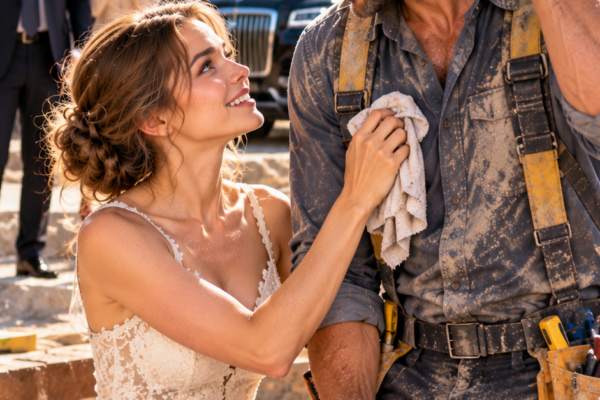
Please Don’t Come Inside! Chinese Widow Begged The Lone Rancher
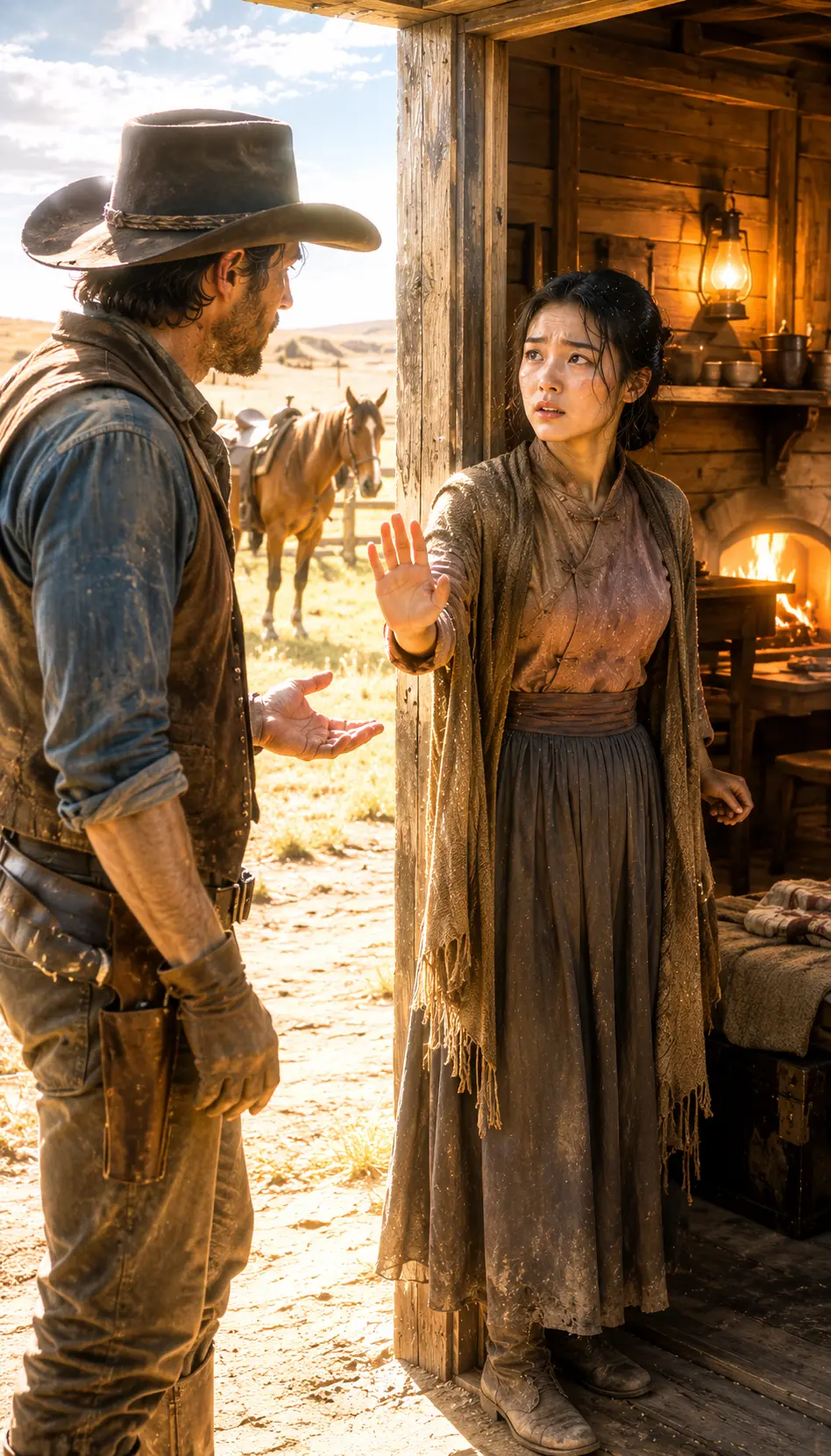
“Please don’t come inside.”
That was the first thing Milin Chen said to the man dying on her porch.
Not “Who are you?”
Not “Are you hurt?”
Not even “Help is coming.”
Just those four words, spoken through a locked cabin door while a blizzard clawed at the walls and her six-year-old daughter burned with fever beside the fire.
Please don’t come inside.
Because Milin knew what the world did to women who opened their doors too easily.
She knew what men could become when the night was long, when the roads were empty, when no witness stood close enough to matter. She knew what it meant to be a Chinese widow in the Colorado wilderness, living alone on land that men with money believed should never have belonged to her in the first place.
And she knew, better than most, that mercy could get a woman killed.
The storm had been raging for three days when death came to her door.
At first, she heard only the wind. It had been screaming around the cabin since before dawn, throwing snow against the shutters, filling every crack in the old pine walls with a cold whistle that sounded almost human. Then came the horse.
Not the clean, steady rhythm of a rider passing by with purpose.
This was broken.
Stumbling.
Hooves dragging through knee-deep snow. A frightened animal snorting hard through the whiteout, its breathing ragged and wet. Milin stood very still beside the hearth, one hand pressed to the table, listening.
Leanne stirred in the small bed near the fireplace.
“Mama?”
Milin turned instantly.
Her daughter’s face was flushed bright with fever, her dark hair damp against her forehead, her lips parted with the effort of breathing. For two days, Milin had tried everything she knew. Willow bark. Ginger. Ginseng. Warm compresses. Steam with bitter herbs brought from her homeland and guarded like treasure through years of hunger, grief, and suspicion.
Nothing had worked enough.
The fever kept rising.
And the nearest doctor was in Crimson Falls, twenty miles away through mountain passes now buried under snow.
“Sleep, little sparrow,” Milin whispered, smoothing the blanket over Leanne’s thin shoulders. “I am here.”
Then came the sound that froze the blood in her veins.
A heavy thud.
A body hitting the ground just beyond her porch.
Milin moved before she thought. She took the rifle from above the mantel and crossed to the window, keeping low, breathing carefully so the glass would not fog. The frost on the pane blurred the world outside into flashes of white and shadow, but she saw enough.
A man lay in the snow.
Large.
Broad-shouldered.
Dark-coated.
Dangerous-looking even on the ground.
His horse had collapsed nearby, its legs folded beneath it, steam rising from its body in the freezing air. The man struggled once, then stilled, one gloved hand pressed to his side.
Milin’s fingers tightened around the rifle.
She had lived alone for three years since Wei died in the mine collapse, and in those three years she had learned lessons no proper school would ever teach. She had learned which riders to avoid. Which smiles meant insult before kindness. Which men called her “Mrs. Chen” in public but “that Chinese woman” after they believed she had turned away.
She had learned that pity and suspicion often wore the same face.
A weak knock came at the door.
Once.
Then again.
“Please,” a voice called through the storm, rough with cold and exhaustion. “I know you’re in there. I just need shelter until the storm passes.”
Milin raised the rifle toward the door.
“Go away,” she called. Her voice did not shake. “There is nothing for you here.”
A pause.
Then a groan, low and strained.
“My horse is down. I’m hurt. I won’t make it through the night.”
Behind her, Leanne coughed.
The sound was small, but it cut Milin deeper than any plea from the stranger outside. She turned toward her daughter, saw the fever-bright spots on her cheeks, the way her little chest rose too fast under the blanket.
The man outside groaned again.
Milin pressed her forehead for one second against the cold wood of the door.
Wei would have opened it.
That thought came so clearly that it hurt.
Her late husband had been foolishly kind, dangerously kind, the sort of man who believed a person was never only the worst thing they had done. Milin used to scold him for it. He used to laugh and tell her the world was hard enough without good people adding more stones to the road.
But Wei was gone.
And Milin was the one left to keep Leanne alive.
She moved back to the window.
The stranger had forced himself to his feet. Snow clung to his coat and hat. He swayed badly, one hand gripping the porch post, the other pressed to his ribs. Blood stained the snow beneath him, a dark bloom spreading through white.
“Please don’t come inside,” Milin said, loud enough for him to hear. “I have a sick child and a loaded gun. Whatever you are running from, whatever you have done, keep moving.”
The stranger lifted his head.
For one breathless moment, his eyes met hers through the frost-covered glass.
Even at that distance, Milin saw something she did not expect.
Not only desperation.
Not cruelty.
Not the hard hunger of a man who had come to take.
There was recognition.
Pain, yes. Exhaustion. But also recognition, as if he had not arrived at her cabin by accident at all.
“I’m not here to hurt you,” he said, his voice carrying strangely through the wind. “Name’s Wade Morrison. And I know who you are.”
Milin’s stomach turned cold.
He took another breath.
“Milin Chen.”
Her own name on his lips felt like ice down her spine.
Nobody came to her cabin by accident.
Not in a blizzard.
Not across twenty miles of mountain and forest.
Not speaking her name like he had carried it there on purpose.
“How do you know my name?” she demanded, rifle still aimed.
“Your husband.” Wade’s voice weakened. “Wei Chen. He saved my life once.”
The cabin seemed to tilt.
Milin did not lower the rifle, but her breathing changed.
Wei.
Three years dead.
Three years buried beneath copper dust and broken timber, taken in the collapse that killed twelve men and left Milin with one child, one cabin, and a town full of people waiting for her to fail.
“Wei never mentioned anyone named Morrison,” she said.
Wade gave a bitter laugh that broke into a cough.
“He knew me by a different name then. Before I became what I am now.”
Milin did not like that answer.
It sounded too much like a confession and not enough like comfort.
“What do you want?”
“I was heading toward Denver when the storm hit. I heard about your girl in Crimson Falls. Heard she was sick.” His knees buckled slightly, and he caught the porch rail. “There’s medicine in my saddlebag. Real medicine. Fever drops. Chest powder. Tonics. Things from a doctor in Denver.”
Milin’s heart slammed once against her ribs.
Medicine.
Real medicine.
Not herbs she was stretching too thin. Not old remedies she knew by memory but feared were no longer enough. Not prayers whispered in two languages over a child who was growing weaker by the hour.
“Why would you bring medicine to me?” she asked.
“Because Wei once told me if I ever wanted to find a different path, his wife in the mountains was the kind of woman who could work miracles.” Wade’s voice was fading now. “And because if I die out here, Mrs. Chen, your daughter may die too.”
The words hit like a hand across the face.
Leanne coughed again.
This time she woke fully.
“Mama?” she whispered. “Who’s outside?”
Milin turned and saw her daughter trying to sit up, small face pale except for those fever spots, eyes too bright, too aware.
“Just a traveler,” Milin said softly. “Lie down.”
Leanne looked toward the door with the strange, unsettling perception children sometimes possess.
“He’s hurt bad, isn’t he?”
Milin closed her eyes for half a second.
Every instinct told her not to open that door.
Every lesson learned in grief, prejudice, widowhood, and wilderness told her to protect the child and let the world outside die where it fell.
But Leanne was already dying slowly beside the fire.
And this stranger had medicine.
So Milin turned back to the door, lifted the rifle again, and called, “If you so much as look at my daughter wrong, I will put a bullet through your heart without hesitation.”
A pause.
Then Wade Morrison answered simply, “Understood.”
Milin unbarred the door.
The wind burst in first, wild and white, flinging snow across the floorboards. Wade stood hunched on the porch, one hand pressed hard beneath his coat. Up close, he looked even more dangerous than he had through the window. Tall, broad, weathered, with a face carved by hard years and harder choices. His gun belt marked him as the sort of man polite mothers warned their daughters about.
But when his gray eyes shifted past Milin to the little girl by the fire, something in them softened.
Not pity.
Concern.
“She’s burning up,” he said quietly.
“Three days,” Milin replied. “I’ve tried everything I know.”
“The medicine is in the right saddlebag,” Wade said, nodding toward the fallen horse. “Blue bottle. White powder.”
Milin hesitated only one second more.
Then she leaned the rifle by the door and stepped into the snow.
The cold struck her like a wall.
Together, they fought their way to the horse. Wade leaned heavily against her, and through his coat she felt the heat of his own fever, the tremor in his muscles, the awful weakness of a man trying to remain standing by will alone. The horse was gone, stiffening under the storm, but the saddlebags remained intact.
Milin’s fingers, numb with cold, found the bottles.
Blue glass.
White paper packet.
A smaller vial wrapped in cloth.
“These?” she asked.
Wade nodded, his face tightening with pain.
“Two drops of the blue in warm water every four hours. White powder for the chest. Small amount. Don’t overdo it.”
“Where did you get these?”
“Denver doctor.” He swallowed hard. “Bought them before heading this way.”
“Heading this way,” Milin repeated, not missing the words.
But there was no time to argue.
She helped him back inside, half-carrying him through the doorway and lowering him into the chair nearest the fire. He tried to protest, but she ignored him. Her daughter came first.
Milin warmed water, measured the drops exactly as Wade instructed, and lifted Leanne’s head with one hand.
“This will taste bitter,” she warned.
Leanne blinked slowly.
“Is that the hurt man?”
“Yes.”
“He looks sad.”
Milin glanced back.
Wade had slumped in the chair, one hand gripping the armrest, his face turned toward the fire. Blood darkened the side of his coat. Snow melted from his shoulders, dripping onto the floor.
“He brought medicine for you,” Milin said.
Leanne swallowed the drops with a small grimace.
“Then he can stay,” she murmured.
Only after Leanne was settled did Milin turn back to Wade.
His coat was soaked through with blood.
When she helped remove it, she found the wound below his ribs. A bullet wound, ugly and deep but not hopeless if cleaned quickly. Milin’s face changed. Fear and suspicion did not vanish, but they moved aside for competence. She became practical. Focused. The woman Wei had once called miracle-handed when she scolded him for exaggerating.
“This needs to be cleaned and stitched,” she said.
“You don’t have to.”
“Yes, I do. You brought medicine for Leanne. I will not let you bleed to death in my chair.”
She gathered what she had: boiled water, clean cloth, needle, thread, a bottle of whiskey Wei had left behind, salve, bandages. Wade watched her silently.
“The bullet is still in there,” she said after examining the wound.
“I figured.”
“This will hurt.”
A shadow of a smile crossed his mouth.
“Most things worth doing do.”
Milin did not smile back.
She worked.
Wade did not cry out. Not once. His jaw clenched, his hand gripped the chair, but he stayed silent as she cleaned the wound and removed the bullet. She had seen strong men become children under pain. Wade became stone. That worried her more than noise would have. Some men learned silence from pride. Others learned it because life had punished every sound out of them.
“You said Wei saved your life,” she said quietly, more to keep him conscious than because she wanted conversation.
“Five years ago.”
“Where?”
“Near a mining camp south of Leadville. I was younger. Angrier.” His voice was tight. “Got myself into a dispute with three men over a claim.”
“And Wei stepped in?”
“He did. Said I had no right to die stupid when there might be someone somewhere waiting for me.”
Milin’s hands stilled for a second.
That sounded like Wei.
“He talked about you,” Wade continued. “Like you were the most precious thing in the world. Said you knew roots and herbs, could read weather in the bones of trees, could calm a child with one touch. Said you were braver than any man he knew.”
Milin looked down at the wound because if she looked at Wade then, she might break.
“Wei saw good even where there was little to find.”
“Then he was a better man than I deserved.”
Milin resumed stitching.
“That makes me wonder what he saw in you.”
Wade’s mouth tightened.
“Someone worth saving, I suppose. Or someone he hoped could become worth it.”
“I have heard stories about a man called the Hawk,” Milin said. “They do not call him that because he is gentle.”
Wade’s smile was bitter.
“Stories grow in saloons.”
“Are they lies?”
“No.” He looked at the fire. “Not all.”
Milin tied the final stitch.
“Why are you really here, Wade Morrison?”
The silence that followed was long enough for the fire to crackle three times.
Then he answered in a voice so low she almost missed it.
“Because I’m tired of running. And because Wei said if I ever wanted to find a different path, I should find you.”
Milin sat back, exhausted.
“And you think I can give you that path?”
“No.” Wade closed his eyes. “I think you can tell me if I still have the right to look for one.”
Outside, the storm howled.
Inside, Milin looked at the dangerous man bleeding by her fire, then at the medicine bottles that might save her daughter’s life, and realized the world had put two impossible choices in her cabin at the same time.
Sometimes salvation came wrapped in danger.
Sometimes danger arrived carrying exactly what you needed to survive.
Milin woke before dawn to the sound of Leanne breathing.
For the first time in days, it was deep.
Even.
Not the thin, frantic breathing of fever. Not the little cough that had been slicing Milin’s heart open all night. Real sleep. Healing sleep.
She rose from her chair, stiff and cold, and crossed to her daughter. Her palm pressed against Leanne’s forehead.
Cool.
Milin closed her eyes.
For one moment, she did not move.
She let gratitude pass through her in silence.
“How is she?” Wade’s voice came from near the fire.
Milin turned.
He sat exactly where she had left him, pale and hollow-eyed, clearly not fully asleep. The blanket had slipped from one shoulder. Pain still tightened his face, but his attention was on Leanne.
“Better,” Milin said. “The fever broke.”
“Good.”
“Those medicines saved her life.”
“I’m glad.”
“You should sleep properly. You lost blood.”
A ghost of a smile touched his lips.
“Not used to people worrying about my health, Mrs. Chen.”
“Milin,” she corrected. “And I’m not worried. I am practical. Dead men are inconvenient in small cabins.”
For the first time, Wade almost laughed.
“Practical,” he murmured. “I can respect that.”
By morning, the wind had died, but the snow had risen nearly to the window ledge. They were trapped. Wade said he could make his way to the barn when the path cleared. Milin said no.
“You will stay here until you can stand without leaning on furniture,” she told him. “I will not have a man’s death on my conscience after I spent half the night keeping him alive.”
Wade studied her.
“Wei was right about you.”
Milin poured coffee into two tin cups.
“Wei was right about many things. He was also wrong about some.”
“About me?”
She handed him the cup.
“That remains to be seen.”
He accepted that without offense.
Later that morning, when Leanne woke hungry, something shifted in the cabin.
It began simply.
A child sitting up, asking for broth.
A mother crying silently while pretending not to.
A wounded man softening his voice so he would not frighten a little girl.
Leanne stared at Wade with enormous eyes.
“You’re still here.”
“Storm’s not done with me yet.”
“Are you still hurt?”
“A little.”
“Mama is good at fixing things,” Leanne said with complete confidence. “She fixed my doll when the arm came off.”
Wade looked at Milin, and there was something almost reverent in his expression.
“I believe it.”
Over breakfast, Leanne chattered more than she had in days. She asked Wade if he had children. His face shifted, just slightly.
“No.”
“Why not?”
“I never thought I was the sort of man who should be a father.”
“Why?”
Milin almost stopped her, but Wade answered.
“Because fathers are supposed to protect children. And I spent most of my life being the kind of man other fathers protected their children from.”
Leanne considered this with a seriousness far too large for six years old.
“But you protected me,” she said. “You brought medicine.”
Wade looked down at his coffee.
“I suppose I did.”
“Mama says sometimes we do good things before we understand why. We just do them because they feel right.”
Milin turned away before Wade could see her face.
The next days moved strangely.
The storm kept them sealed inside the white world beyond the cabin. Wade’s wound slowly steadied. Leanne recovered color. Milin returned to her routine, though now there was another person breathing inside the small home, another cup on the table, another presence near the fire.
Wade proved useful even injured.
He split kindling one-handed when Milin scolded him for lifting too much. He repaired the loose chair by the hearth. He told Leanne stories about mountain trails, desert stars, and horses clever enough to untie knots. He never spoke of his violent life unless Milin asked, and when she did, he told enough truth to make her believe the rest was worse.
“I killed a man,” he said one night while Leanne slept. “Not in a fair fight. Not in anger. Because I was paid to.”
Milin felt cold despite the fire.
“You were a hired gun.”
“I was a coward wearing a brave man’s coat.”
“Why tell me this?”
“Because you deserve to know what kind of man you sheltered.”
Milin sat across from him, hands folded around her cup.
“People change.”
“Do they? Or do they just get better at hiding what they are?”
“That depends,” she said, “on whether they want to change or only want to escape consequences.”
His eyes lifted to hers.
“And which do you think I want?”
Milin did not answer quickly.
If she had learned anything in life, it was that judgment made too fast often served pride more than truth. She thought of the man bleeding on her porch. The medicine in his bags. His gentle voice with Leanne. The way he positioned himself near the door even while wounded, watching the windows, expecting danger to follow him.
“I think,” she said finally, “if you only wanted to escape, you would have kept running. You came here asking for a new path. That is not the same thing.”
Wade looked into the fire.
For a long time, he said nothing.
When the storm finally broke on the fourth day, the world outside was white and bright enough to hurt the eyes.
Milin stood on the porch with Wade beside her, both wrapped against the cold. Leanne sat inside near the window, under strict orders not to move from her quilt pile.
“The trail will be impassable another day or two,” Wade said.
“Long enough for you to decide what you will do.”
He glanced at her.
“And you?”
Milin’s gaze moved over the land.
Her land.
The land Wei had worked for. The land Aldridge Harrison wanted. The land men in Crimson Falls said she could not manage because she was Chinese, because she was widowed, because she was alone, because men with money always found reasons why a woman’s home should belong to them instead.
“When people find out you were here, there will be trouble,” she said.
Wade’s face hardened.
“Because of my past.”
“Because of Harrison. He has been waiting for any excuse to call me unfit and take Leanne. He wants this land. He has wanted it since Wei died.”
“Aldridge Harrison,” Wade said, his voice turning dark.
“You know him?”
“Men like him know men like I used to be.”
Milin looked at him.
“Harrison does not think a Chinese woman should own land. He thinks I should sell, move into town, let Leanne be raised somewhere more proper.”
“Proper,” Wade repeated, disgusted.
Before Milin could answer, the sound of horses cut across the frozen morning.
Three riders emerged from the trees.
Dr. Finch came first, kind-faced and worried. Behind him rode Sheriff Broady, young and ambitious, sitting too straight in the saddle. The third man wore a fine coat despite the storm, silver hair combed beneath his hat, mouth set in a line of practiced authority.
Aldridge Harrison.
Milin’s spine stiffened.
Wade’s hand moved toward where his gun belt hung inside.
“I should go,” he said quietly.
“Where?”
He looked at the snow.
There was nowhere.
“Inside,” Milin said. “Sit by the fire. Let me speak.”
The riders reached the cabin.
“Mrs. Chen,” Dr. Finch called, visibly relieved. “Thank heavens. We feared the worst.”
“We are fine, doctor.”
“Are you?” Harrison asked, dismounting with elegant disapproval. “A woman alone in a storm with a sick child hardly seems fine. This arrangement has always been unsuitable.”
“This is our home.”
“For now,” Harrison said softly.
Milin understood the threat.
Sheriff Broady’s eyes moved over the tracks in the snow.
“Looks like you had company.”
“A traveler needed shelter,” Milin replied.
“What sort of traveler?”
“The sort who was injured.”
Dr. Finch stepped forward.
“May I examine him?”
Inside the cabin, Wade sat in the chair by the fire, blanket pulled high, eyes closed. Leanne watched silently from her bed.
Dr. Finch approached and drew back the blanket slightly.
“Good Lord. This man has been shot.”
“A hunting accident,” Milin said.
Sheriff Broady frowned.
“Who is he?”
“Wayne Miller,” Milin lied.
Harrison studied Wade’s face with sharp interest.
“Wayne Miller,” he repeated. “How curious. A stranger travels through a deadly storm, wounded by accident, and finds shelter with the most notorious widow in three counties.”
Dr. Finch looked uncomfortable.
“Mr. Harrison—”
“No, doctor. I find this very interesting.” Harrison moved closer. “Sheriff, does he look familiar to you? That scar near the brow. The build.”
Wade opened his eyes.
Harrison smiled coldly.
“Well. Wade Morrison. The Hawk.”
The name landed in the cabin like a weapon drawn.
Sheriff Broady reached for his gun.
Dr. Finch went pale.
Leanne pressed herself against Milin’s side.
“There is a five-hundred-dollar bounty on his head,” Harrison said with satisfaction. “Sheriff, arrest this man immediately.”
“You cannot take him,” Milin heard herself say.
Every eye turned to her.
“He is injured,” she continued, voice steady. “He is under my care. As the only person within twenty miles capable of treating that wound, I will determine when he can be moved.”
Harrison’s eyes narrowed.
“Are you refusing lawful authority?”
“I am refusing to let you kill a man in my home.”
“Milin,” Wade said quietly. “Don’t. I’m not worth this.”
She looked at him.
“You brought medicine to save my daughter. That is what matters.”
Harrison sneered.
“How touching. Sheriff, arrest them both. Mrs. Chen can answer for harboring a fugitive along with her other failures.”
For one terrifying second, Milin saw what would happen.
Her arrest.
Leanne taken.
Harrison smiling as he finally gained control of the land Wei had died trying to protect.
Then Wade moved.
Slowly.
Painfully.
But suddenly the wounded man in the chair was no longer just a patient. He was the Hawk. Dangerous, still, even pale and stitched together. His hand rested near the gun belt Milin had not noticed he could reach.
“There’s one problem with your plan, Harrison,” he said calmly.
Harrison stiffened.
“You’re threatening the woman who saved my life. I take that personally.”
“Nobody needs to die in this cabin,” Wade continued, his eyes shifting to the sheriff. “Especially not with a child in the room.”
Sheriff Broady looked at Leanne.
His jaw tightened.
“I don’t want trouble, Morrison. But you are wanted.”
“Enough,” Milin said, stepping between them. Her voice rang harder than she expected. “This is my home. My child is terrified. I will not have violence here.”
Harrison snapped, “Sheriff, arrest them or I will find someone who will.”
“You will find someone who will what, exactly?”
The new voice came from the open doorway.
Everyone turned.
A tall man stood against the snowlight, lean, composed, wearing the badge of a U.S. Deputy Marshal.
Dr. Finch breathed out.
“Marshal Grant.”
Grant stepped inside, brushing snow from his coat.
“Harrison. Interesting way to conduct official business.”
“Marshal,” Harrison began, his tone changing instantly. “We have discovered Mrs. Chen harboring a dangerous fugitive.”
Grant looked at Wade.
“Mr. Morrison. You certainly get around.”
“Marshal.”
“Sheriff,” Grant said, “lower your weapon. I’ll handle this.”
Broady obeyed slowly.
Harrison’s face darkened.
“Handle it? He is wanted.”
“Not exactly.” Grant pulled a folded document from his coat. “Presidential pardon. Conditional, but valid. Signed three days ago. Mr. Morrison has been cooperating with federal authorities by providing information about certain criminal organizations.”
Milin felt her knees weaken.
Wade avoided her eyes.
“That is impossible,” Harrison said.
“It was classified,” Grant replied mildly. “You didn’t need to know.”
“He is a killer.”
“The man he killed was running a counterfeiting ring,” Grant said. “The government found his cooperation useful.”
Harrison recovered quickly.
“Even if this is legitimate, it does not excuse Mrs. Chen. She believed him a criminal and harbored him.”
Grant turned to Milin.
“Mrs. Chen, did you know Mr. Morrison was wanted by federal law enforcement?”
“No,” Milin said honestly. “I knew he had a violent past. I knew he was injured. I knew he brought medicine for my child.”
“Then she is guilty of charity,” Grant said. “Which, last I checked, is not a crime in Colorado.”
Harrison’s mouth tightened.
“As for questions of Mrs. Chen’s fitness as a mother,” Grant continued, “those are civil matters. You may pursue them through appropriate channels, not by inventing an arrest in a sickroom.”
The men left one by one.
Harrison last.
He paused at the door and looked back at Milin with a smile that promised this was not finished.
Then he rode away.
Marshal Grant remained a moment longer.
“The pardon is conditional,” he told Wade. “Stay out of trouble.”
“I’m trying.”
Grant glanced around the cabin. Leanne by the bed. Milin near the fire. Wade pale but upright.
“You may want to think carefully about appearances,” he said. “A widow of Mrs. Chen’s standing living alone with a notorious gunslinger, pardoned or not, will give Harrison more to use.”
Milin understood too well.
Grant tipped his hat and left.
The storm outside had ended.
But the storm around their lives had only begun.
Three weeks later, Wade was still there.
At first, he had stayed because he was healing.
Then because the trail was bad.
Then because a hinge needed repair.
Then because Leanne had asked him to show her how to make a snow fort.
Milin watched from the porch as he knelt in the snow beside her daughter, carefully shaping walls with hands that had once been paid for violence. Leanne laughed freely now, her fever gone, her cheeks pink from cold and happiness.
Wade smiled at her in a way that transformed his face.
Not handsome exactly.
Something better.
Human.
Dr. Finch arrived at sunset with worry carved into every line of his face.
“I am afraid I have news.”
Milin’s hands tightened around the porch rail.
“Harrison has filed a petition with the territorial governor,” the doctor said gently. “He claims your association with Mr. Morrison endangers Leanne’s moral welfare. There will be a custody hearing in Denver in two weeks.”
Milin felt the world drop.
Denver.
In winter.
Three days by road if the weather held, which it likely would not.
“And if I cannot appear?”
Dr. Finch’s silence answered.
“He wins by default,” Wade said from behind her, his voice low.
Dr. Finch nodded sadly.
“What exactly is he claiming?” Wade asked.
“Improper supervision. Moral corruption. Unsuitable household. He is using Mr. Morrison’s presence as evidence.”
Wade turned away.
“I should leave tonight.”
“No,” Milin said.
“If I disappear, Harrison loses the argument.”
“If you disappear, he will simply invent another one.”
“I am the danger.”
Milin faced him fully.
“You are not running away because a rich man wants me afraid.”
Dr. Finch cleared his throat.
“There may be another solution.”
Both of them turned to him.
He looked miserable.
“Marriage.”
The word seemed to steal the air from the porch.
Milin stared at him.
“I beg your pardon?”
“Harrison’s petition rests largely on the impropriety of the arrangement. A marriage would eliminate the objection. Legally, at least.”
Milin looked at Wade.
He was very still.
“This is absurd,” she said.
“Perhaps,” Dr. Finch replied. “But law often cares more about appearances than truth.”
Milin’s throat tightened.
Marriage.
Wei’s ring.
Wei’s name.
Wei’s memory.
Wade seemed to read the grief moving through her face.
“I won’t ask this of you for convenience,” he said quietly.
“You will not ask it at all,” she said, but her voice lacked force.
He stepped closer, still careful not to crowd her.
“Milin, I have watched you fight for your daughter, your home, your dignity. You are the strongest woman I have ever known. I know what I was. I know danger follows me. But these weeks here, with you and Leanne, have been the closest thing to peace I have ever had.”
Milin could not look away.
“What about Leanne?”
“A life with two people who love her and would die to protect her,” Wade said without hesitation.
Her breath caught.
“You love her?”
“Yes.”
“And me?”
He did not flinch.
“I have been in love with you since the day you stood between me and Harrison’s threats.”
Milin shook her head once, overwhelmed.
“You hardly know me.”
“I know enough. I know how you hold your fear until your child is safe. I know how you use truth like a blade and kindness like medicine. I know you still speak to Wei when you think no one hears. I know you do not need saving. You need someone willing to stand beside you when men like Harrison come to take what is yours.”
Before Milin could answer, Leanne ran toward them from the snow, face bright.
“Mama! Mr. Wade! Look what I found!”
She held out her small hand.
In her palm lay a simple gold band.
Milin’s heart stopped.
Wei’s ring.
Lost years ago near the old tree stump where he used to sit in the evenings, turning the band around his finger while watching Leanne play. Milin had searched for it after his death until her hands bled from digging through frozen ground.
Now it lay in their daughter’s hand, cold and shining.
“Was it Papa’s?” Leanne asked.
Milin could not speak.
Wade stood silent beside her.
“Maybe Papa left it there for when you needed it,” Leanne said with the plain faith of childhood.
Milin closed her fingers around the ring.
Wei had loved her.
Wei had protected her while he lived.
But love was not a grave.
It was not meant to lock the living inside memory forever.
She looked at Wade Morrison, the dangerous man who had arrived in blood and snow, carrying medicine in his saddlebags and regret in his bones. A man who had not pretended to be innocent. A man who had told the truth when lies would have been easier. A man Leanne trusted with the effortless clarity of a child who felt safe.
“Leanne,” Milin said carefully. “How would you feel if Mr. Wade became part of our family? If he stayed with us always?”
Leanne’s eyes widened.
“Really? He could be my papa?”
Milin’s throat tightened.
“He would not replace your Papa Wei.”
“I know,” Leanne said quickly. “Nobody can. But he tells good stories. And he makes you smile, Mama.”
Over her daughter’s head, Milin met Wade’s eyes.
He looked more afraid now than he had with Harrison in the cabin.
“So,” he said softly, “what do you say, Milin Chen?”
She looked at Wei’s ring.
Then at Leanne.
Then at the man who had brought danger to her door and somehow left hope by her fire.
“Yes,” she whispered.
Wade blinked, as if he had not allowed himself to believe it.
Milin lifted her chin.
“Yes, Wade Morrison. I will marry you.”
Dr. Finch broke into a grin so wide it seemed to warm the whole porch.
“Well,” he said, clearing his throat, “I believe this calls for a celebration.”
Leanne danced in the snow.
Wade reached for Milin slowly, giving her time to refuse.
She did not.
When his arms closed around her, careful of his healing wound, Milin felt something she had not felt in years.
Not safety exactly.
Something stronger.
A choice.
Harrison would come with petitions.
The world would come with whispers.
Some doors would still close.
Some eyes would still judge.
But Milin Chen had survived widowhood, winter, prejudice, hunger, fever, and fear. Wade Morrison had crawled out of a life built on violence and chosen, against every instinct, to seek redemption instead of another road to run down.
Together, they were not clean.
They were not simple.
They were not what polite society would call proper.
But they were honest.
And they were stronger than any storm.
So let Harrison bring his hearing.
Let him stand in a courtroom and explain why a mother who saved lives should lose her child. Let him explain why a widow could not own land, why a Chinese woman could not build a home, why a pardoned man could never become worthy of love.
Let him try.
Because when the next storm came, Milin would not be standing alone behind a locked door with a rifle in her hands and terror in her chest.
Wade would be beside her.
Leanne would be between them, laughing, alive, loved by two parents who understood that family was not always born from blood.
Sometimes family arrived half-frozen on a porch.
Sometimes it carried medicine through a blizzard.
Sometimes it looked like danger at first.
And sometimes, when the whole world told a woman to close the door, salvation began the moment she opened it.
You Might Also Enjoy
El duque eligió a su hermana en el altar… hasta que una carta reveló la verdad tras sus lágrimas.

El duque puso a prueba a todas las debutantes con su hermano marcado; solo ella le tomó la mano.